![Indonesia Export Center [IEC]](https://indonesiaexportcenter.com/wp-content/uploads/2023/07/logo-no-background.svg)
![Indonesia Export Center [IEC]](https://indonesiaexportcenter.com/wp-content/uploads/2023/07/svgviewer-output.svg)
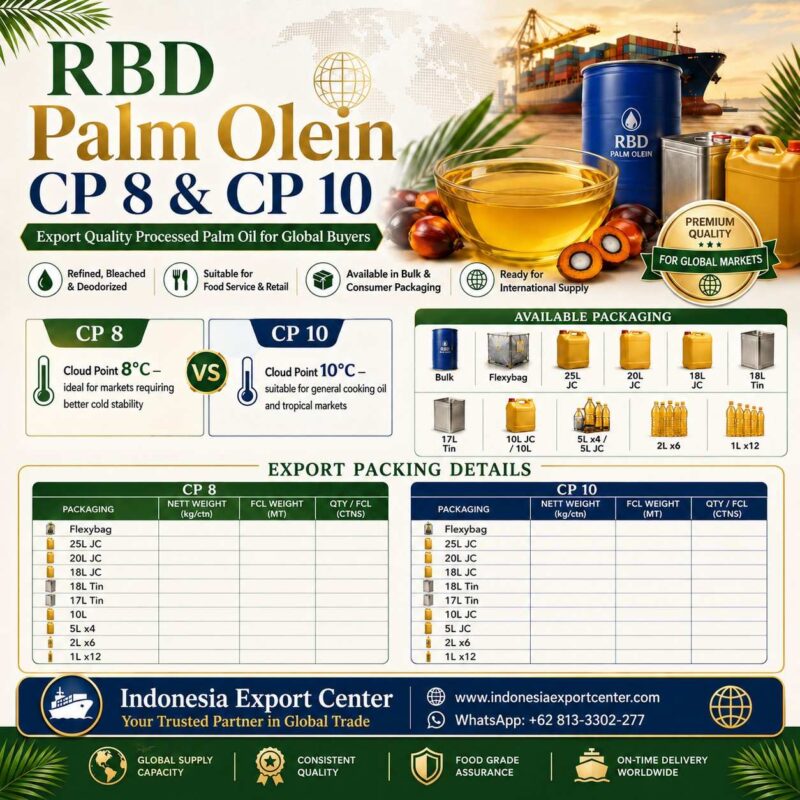
RBD Palm Olein Packaging, MOQ, and Shipment Planning for International Buyers
International buyers purchasing RBD Palm Olein must consider more than product price and specification. Packaging format, minimum order quantity, container capacity, private-label requirements, shipping terms, temperature conditions, and destination-port facilities can all affect the final landed cost.
RBD Palm Olein is the liquid fraction obtained through the fractionation of palm oil. It is widely traded for use as cooking oil, frying oil, food-processing material, and an ingredient in food manufacturing. The Codex Standard for Named Vegetable Oils recognizes palm olein as a distinct palm oil fraction intended for human consumption.
Whether buyers are sourcing from an RBD Palm Olein Supplier from Indonesia, an RBD Palm Olein CP8 Supplier, or an RBD Palm Olein CP10 Supplier, the most suitable packaging and shipment method depends on their distribution system, order volume, destination climate, and unloading capabilities.
1. Why Packaging Selection Matters
Packaging affects several commercial and operational factors:
- Product protection during transportation
- Total packaging cost
- Container loading efficiency
- Handling and warehousing requirements
- Private-label production lead time
- Import-market labeling compliance
- Product discharge requirements
- Cost per metric ton
A package that is economical for a supermarket distributor may not be suitable for an industrial food processor. Similarly, a flexitank may offer competitive bulk transport costs but will not suit buyers who need ready-to-distribute retail cooking oil.
International buyers should therefore select the packaging format before requesting a final quotation.
2. Common RBD Palm Olein Packaging Options
A. Consumer-Size Bottles and Jerrycans
RBD Palm Olein may be packed in bottles or jerrycans for retail and food-service distribution. Common market formats can include:
- 1-liter bottles
- 2-liter bottles
- 3-liter jerrycans
- 5-liter jerrycans
- Other customized sizes
These packages are suitable for importers that distribute edible oil through supermarkets, wholesalers, traditional markets, restaurants, hotels, or institutional buyers.
Main advantages
- Ready for retail distribution
- Convenient for household and food-service customers
- Suitable for private-label branding
- Easier inventory distribution than bulk oil
Important considerations
Retail packaging usually requires more preparation than bulk packaging. The buyer must confirm bottle design, cap type, carton configuration, label language, nutritional information, barcode, batch coding, production date, expiration date, and destination-country requirements.
For private-label orders, artwork approval must normally be completed before packaging materials are printed or produced. Buyers should include sufficient time for design review, packaging-material procurement, production, and quality inspection.
B. Metal Tins
Metal tins are commonly requested in markets where cooking oil is distributed through wholesale, food-service, and household channels. Depending on market practice and supplier capability, buyers may request formats such as:
- 10-liter tins
- 15-liter tins
- 16-liter tins
- 17-liter tins
- 18-liter tins
- 20-liter tins
Tins provide good physical protection and offer a large printable surface for branding in English, Arabic, French, or another destination-market language.
Metal tins are suitable for:
- Private-label edible oil brands
- Distributors in the Middle East and Africa
- Restaurants and catering companies
- Wholesale cooking oil markets
- Institutional food-service buyers
However, tins add packaging weight and occupy more container space than flexitank shipments. Buyers should request a detailed loading plan showing the number of tins per carton, cartons per pallet where applicable, total net weight, packaging weight, and estimated container gross weight.
C. Plastic Drums
Food-grade plastic drums may be suitable for medium-volume industrial customers that cannot receive a full flexitank.
Drums can offer:
- Easier handling in factories
- Partial unloading according to production requirements
- Lower individual unit size than an IBC or flexitank
- Better suitability for customers without bulk storage tanks
The supplier and buyer should confirm drum material, closure system, net weight, palletization, food-contact suitability, and whether the oil can be discharged efficiently under destination temperatures.
D. Steel Drums
Coated steel drums may also be used for edible oils when the inner surface and all product-contact materials are suitable for food.
The Codex Code of Practice for the Storage and Transport of Edible Fats and Oils states that materials contacting oils should be inert and suitable for food use. For bulk systems, stainless steel is preferred, while mild steel may be used with an appropriate inert internal coating. Copper and copper alloys should be excluded from systems that contact edible oils because they can accelerate oxidation.
Before placing an order, buyers should obtain written confirmation that the drum and internal coating are approved for edible-oil contact.
E. Intermediate Bulk Containers
An intermediate bulk container, commonly known as an IBC, can provide a middle option between drums and flexitanks.
IBCs may be appropriate for:
- Medium-sized food manufacturers
- Buyers requiring controlled batch usage
- Customers without flexitank discharge equipment
- Warehouses that handle oil by forklift
- Buyers who need multiple smaller bulk units
However, IBC shipments generally have more packaging cost per metric ton and lower container utilization than flexitanks.
Buyers should also verify whether reusable IBCs are new, properly cleaned, dedicated to food products, or supplied with a food-grade liner.
F. Flexitanks
A flexitank is a large flexible bladder installed inside a standard freight container. It is generally used for compatible, non-dangerous liquid cargoes.
The Container Owners Association states that flexitanks are normally installed in 20-foot general-purpose containers. It identifies a usual capacity of approximately 24,000 liters and a recommended maximum cargo mass of 24,000 kilograms, subject to the equipment, route, carrier, and applicable regulations.
Flexitank advantages
- Competitive packaging cost per metric ton
- High liquid volume in one container
- No individual retail packages
- Suitable for industrial processing
- Efficient for buyers with storage tanks
- Lower packaging waste than many small packages
Flexitank requirements
The buyer should have:
- A suitable oil storage tank
- A safe unloading area
- Compatible hoses, valves, and pumps
- Trained unloading personnel
- A plan for managing crystallization in cold weather
- A procedure for flexitank disposal or recycling
The flexitank manufacturer and operator should follow recognized quality and operating practices. The Container Owners Association maintains a Flexitank Quality List for manufacturers and operators that have achieved its quality-conformance requirements. Flexitank transportation is also subject to carrier approval and the IMO/ILO/UNECE Code of Practice for Packing of Cargo Transport Units.
G. ISO Tank Containers
ISO tank containers can be used for bulk edible oil shipments when reusable tank equipment, controlled handling, and a structured cleaning system are required.
For fully refined and deodorized oils intended for direct human consumption, Codex states that road tankers, rail tankers, and ISO tank containers are normally constructed from stainless steel or mild steel coated with a suitable epoxy resin.
ISO tanks may be appropriate for:
- Regular industrial supply
- Customers needing reusable transport equipment
- Routes with established tank-container operations
- Buyers requiring more controlled handling than a single-use flexitank
The tank operator should provide cleaning records, previous-cargo information, tank condition reports, and confirmation that the equipment is suitable for edible oil.
H. Bulk Vessel Shipment
Bulk vessel shipment is generally intended for large refiners, government procurement programs, major distributors, and high-volume industrial buyers.
Codex notes that individual ship tanks may range from approximately 200 to 2,500 metric tons. It also describes bulk and parcel tankers commonly operating in substantially larger overall vessel capacities.
Bulk vessel shipments require:
- Suitable shore tanks at loading and destination
- Dedicated or properly segregated pipelines
- Tank inspection
- Previous-cargo verification
- Independent survey and sampling
- Heating and temperature-control arrangements
- Coordinated loading and discharge schedules
For edible oils, contamination control is particularly important. Codex recommends adequate cleaning, inspection, dry tanks, segregated systems, and evaluation of previous cargoes.
3. How MOQ Is Determined
There is no single international MOQ that applies to all RBD Palm Olein suppliers. MOQ is a commercial requirement determined by factors such as:
- Packaging format
- Production-line setup
- Printed packaging requirements
- Number of product sizes
- CP8 or CP10 grade availability
- Refinery production schedule
- Container capacity
- Destination-country labeling
- Private-label artwork
- Supplier inventory
- Shipping method
Packaged products
For bottles, jerrycans, and tins, suppliers may determine MOQ by:
- Number of pieces
- Number of cartons
- One production batch
- One SKU
- One 20-foot container
- Multiple containers for customized packaging
A private-label order may have a higher MOQ because the supplier must purchase or manufacture printed tins, labels, cartons, caps, and other branded materials.
Buyers seeking a smaller trial shipment should ask whether the supplier can offer:
- An existing manufacturer brand
- Neutral packaging
- Standard containers with sticker labels
- Shared production scheduling
- A mixed-size container
- A standard tin design with customized artwork
Mixed-container loading may not always be available because different pack sizes can complicate production scheduling, palletization, weight distribution, and loading calculations.
Flexitank and ISO tank shipments
Flexitank and ISO tank orders are normally planned by complete transport units. However, the final permitted quantity must not be assumed solely from the nominal tank volume.
The loading quantity must be checked against:
- Container maximum gross weight
- Container tare weight
- Flexitank system limitations
- Road weight regulations
- Port regulations
- Shipping-line restrictions
- Product density at the agreed temperature
Container specifications can vary by manufacturer and individual equipment. Shipping lines therefore advise shippers to verify the actual container specification and permitted payload rather than relying only on a general container-capacity estimate.
Bulk vessel shipments
Bulk vessel MOQ is normally much higher because the shipment must be commercially compatible with terminal operations, ship-tank allocation, freight economics, and shore-tank capacity.
A buyer requesting bulk vessel delivery should specify:
- Total required volume
- Monthly or annual contract quantity
- Minimum parcel size
- Maximum acceptable vessel size
- Destination draft restrictions
- Shore-tank capacity
- Pumping and discharge rates
- Heating capability
4. CP8 and CP10 Packaging Considerations
Both RBD Palm Olein CP8 and CP10 may be supplied in retail or bulk packaging, depending on refinery capability.
The main packaging decision is not based only on whether the product is CP8 or CP10. Buyers should also consider:
- Destination temperature
- Warehouse conditions
- Length of voyage
- Final application
- Storage-tank design
- Availability of heating facilities
- Required product clarity
- Distribution format
CP8 is generally selected where the buyer requires a lower agreed cloud-point grade than CP10. However, packaged or bulk oil can still show crystallization when exposed to sufficiently low temperatures.
The appearance of crystals during cold storage does not automatically mean that the oil is contaminated or permanently damaged. Nevertheless, heating must be controlled to avoid localized overheating and unnecessary quality deterioration.
5. Temperature Planning for Bulk Palm Olein
Temperature planning is especially important for flexitank, ISO tank, and bulk vessel shipments.
Codex guidance lists the following temperature ranges for palm olein transported in bulk:
| Operation | Recommended temperature |
|---|---|
| Storage and bulk shipment | 25–30°C |
| Loading and discharge | 32–35°C |
These values are intended to limit excessive crystallization while avoiding unnecessarily high temperatures that may accelerate product deterioration.
Codex also recommends that oils requiring heating be heated gradually. For bulk handling, it advises avoiding a temperature increase of more than 5°C over a 24-hour period to reduce the risk of localized overheating.
The appropriate procedure must still be confirmed with the refinery, flexitank operator, tank owner, shipping line, and receiving terminal.
Before shipment, buyers should ask:
- Will the oil be loaded at the correct transfer temperature?
- Is the flexitank equipped with an appropriate heating pad where required?
- Can the destination facility provide hot water or another approved heating method?
- Are the discharge hoses and pipelines suitable for palm olein?
- How long will reheating take in the expected destination climate?
- Who is responsible for heating and discharge costs?
- What happens if unloading is delayed?
Packaged oil in a standard dry container does not normally have active temperature control. Buyers shipping tins, bottles, or jerrycans to cold destinations should therefore plan appropriate storage and product-conditioning procedures after arrival.
6. Calculating the Correct Shipment Quantity
International buyers should calculate RBD Palm Olein purchases in net kilograms or metric tons, not only in liters.
A complete loading calculation should include:
Total gross container weight = product net weight + primary packaging + cartons + pallets + securing materials + container tare weight
The shipment must remain within:
- The actual container maximum gross weight
- Shipping-line cargo restrictions
- Port limits
- Truck and axle-weight regulations
- Destination-country inland transport limits
For example, a buyer ordering 17-liter tins should not simply divide the container volume by 17 liters. The loading plan must account for the physical dimensions and weight of the tins, cartons, pallets, dunnage, and securing materials.
The final quotation should clearly state:
- Number of units per carton
- Number of cartons per container
- Net liters per container
- Net kilograms per container
- Total gross weight
- Palletized or floor-loaded arrangement
- Estimated container utilization
7. Palletized Versus Floor-Loaded Cargo
Palletized loading
Palletized loading offers:
- Faster forklift handling
- Better warehouse efficiency
- Easier cargo counting
- Lower manual handling
- Improved organization at destination
However, pallets reduce the amount of oil that can fit into a container and add weight.
When solid-wood pallets or dunnage are used in international trade, buyers should verify applicable ISPM 15 requirements. The International Plant Protection Convention explains that ISPM 15 covers wood packaging materials such as pallets, crates, drums, and dunnage used in international transportation.
Floor-loaded cargo
Floor loading can increase container utilization, but it may require more manual labor during unloading. Buyers should confirm whether the destination warehouse has enough workers, equipment, and time to unload safely.
The loading method should be agreed before the supplier issues a final commercial offer.
8. Private-Label Shipment Planning
Private-label cooking oil requires additional coordination because the product must comply with the buyer’s brand and destination-market requirements.
The buyer should provide:
- Brand name
- Logo files
- Packaging design
- Required languages
- Product description
- Nutrition panel
- Country-of-origin statement
- Importer or distributor information
- Barcode
- Net-content declaration
- Manufacturing and expiry format
- Storage instructions
- Required certification logos
Artwork should not be printed until it has been reviewed by the importer or its regulatory consultant. The supplier should also confirm whether the artwork dimensions match the tin, bottle, jerrycan, label, and carton specifications.
Private-label planning should include separate lead times for:
- Artwork preparation
- Regulatory review
- Printing-cylinder or plate preparation
- Packaging-material production
- Oil filling and packing
- Laboratory testing
- Final inspection
- Container booking
- Export documentation
9. FOB, CFR, or CIF Shipment Terms
Buyers should state the required Incoterm and named port when requesting a quotation.
FOB
Under an FOB quotation, the seller is generally responsible for delivering the cargo on board the vessel at the agreed port of shipment. The buyer arranges the main ocean freight and normally manages cargo insurance according to its requirements.
A complete request should state:
FOB [Named Indonesian Port], Incoterms® 2020
CFR
Under CFR, the seller arranges and pays the ocean freight to the named destination port. However, the transfer of risk should not be confused with the seller’s payment of freight.
A request should state:
CFR [Named Destination Port], Incoterms® 2020
CIF
Under CIF, the seller arranges ocean freight and the insurance required under the rule. ICC explains that CIF is reserved for maritime trade and that its default insurance level under Incoterms® 2020 remains based on Institute Cargo Clauses (C), unless the parties agree to broader coverage.
Buyers requiring broader insurance should specify the required coverage in the purchase contract instead of assuming that all-risk insurance is automatically included.
A request should state:
CIF [Named Destination Port], Incoterms® 2020, with the agreed insurance coverage
Incoterms define the allocation of tasks, costs, and risks, but they do not replace a complete sales contract. Product specification, quality tolerances, payment terms, inspection procedures, claims, shipment period, and required documents should be stated separately.
10. Documents to Confirm Before Shipment
The exact documents depend on the destination country, contract, and customs requirements. A typical RBD Palm Olein shipment may involve:
- Commercial invoice
- Packing list
- Bill of lading
- Certificate of origin
- Certificate of analysis
- Product specification sheet
- Health or sanitary certificate where required
- Halal certificate where required
- Insurance certificate for CIF shipments
- Fumigation or ISPM 15-related documentation where applicable
- Weight certificate
- Inspection certificate
- Private-label artwork approval
- Manufacturing and expiry information
For bulk shipments, buyers may also request:
- Tank inspection report
- Tank cleanliness certificate
- Previous-cargo declaration
- Loading temperature records
- Sealed loading samples
- Independent survey report
- Heating log
Codex recommends inspection records for tanks and pipelines, properly marked and sealed loading samples where required by contract, and access to previous-cargo records for ship tanks.
11. A Practical Shipment Planning Timeline
A practical shipment plan should begin before the buyer submits an official purchase order.
Stage 1: Product confirmation
Confirm:
- RBD Palm Olein CP8 or CP10
- Required specification
- Quantity
- Intended application
- Destination country and port
Stage 2: Packaging confirmation
Confirm:
- Bottle, jerrycan, tin, drum, IBC, flexitank, ISO tank, or bulk vessel
- Pack size
- Private label or supplier brand
- Palletized or floor-loaded cargo
Stage 3: Commercial quotation
Request:
- FOB, CFR, or CIF price
- MOQ
- Container loading quantity
- Packaging cost
- Private-label cost
- Production lead time
- Offer validity
Stage 4: Compliance and artwork
Verify:
- Import regulations
- Product registration
- Label language
- Nutrition panel
- Certification requirements
- Artwork approval
Stage 5: Contract and payment
Agree on:
- Product specification
- Quantity tolerance
- Shipment period
- Payment terms
- Inspection
- Claims procedure
- Required documents
Stage 6: Production and booking
Coordinate:
- Packaging-material production
- Oil availability
- Filling schedule
- Vessel booking
- Container release
- Documentation deadlines
Stage 7: Loading and inspection
Verify:
- Product grade
- Packaging condition
- Quantity
- Container cleanliness
- Seal number
- Loading temperature for bulk cargo
- Sampling and laboratory results
12. Information Buyers Should Include in an RFQ
To receive an accurate quotation from an Indonesian RBD Palm Olein supplier, buyers should provide complete information.
Sample RFQ format
Product: RBD Palm Olein
Grade: CP8 or CP10
Quantity: ___ metric tons or ___ containers per month
Packaging: ___ liter tin, jerrycan, drum, IBC, flexitank, ISO tank, or bulk vessel
Brand: Supplier brand or private label
Label language: English, Arabic, French, or other
Destination port: ___
Price required: FOB, CFR, or CIF
Payment terms: ___
Required shelf life: ___
Required shipment date: ___
Required certificates: COA, COO, Halal, Health Certificate, ISO, HACCP, or others
Special requirements: Palletization, inspection, insurance, artwork, or destination registration
Incomplete RFQs often result in inaccurate indicative prices because packaging, freight, branding, and container loading can materially change the final cost.
13. How Buyers Can Reduce Shipment Risk
International buyers can reduce operational and commercial risks by following several practical steps:
- Approve the specification before discussing the final price.
- Obtain a written packaging specification.
- Request a container loading plan.
- Confirm whether the quantity is stated in liters or kilograms.
- Verify the actual container payload.
- Confirm private-label artwork before printing.
- Check destination labeling regulations.
- Agree on inspection and sampling procedures.
- Confirm heating and unloading requirements for bulk cargo.
- Use a written sales contract with complete shipment terms.
- Verify the supplier, refinery, exporter, and bank account.
- Avoid relying only on photographs or informal messaging.
Choosing the Right Packaging and MOQ
The best RBD Palm Olein packaging depends on how the product will be sold or used.
- Retail distributors generally require bottles, jerrycans, or tins.
- Restaurants and food-service wholesalers may prefer large jerrycans or tins.
- Medium-sized manufacturers may select drums or IBCs.
- Industrial buyers often prefer flexitanks or ISO tanks.
- Large refiners and national distributors may consider bulk vessel shipments.
MOQ should be evaluated together with packaging cost, container utilization, private-label requirements, and monthly demand. The cheapest packaging per metric ton is not always the best commercial option if the buyer does not have suitable unloading, storage, repacking, or distribution facilities.
Conclusion
Successful RBD Palm Olein procurement requires coordinated planning between the buyer, refinery, packaging supplier, exporter, freight forwarder, shipping line, inspector, and destination warehouse.
Before confirming an order, international buyers should define:
- CP8 or CP10 grade
- Required specification
- Packaging format
- Private-label requirements
- MOQ and shipment frequency
- Container loading quantity
- Destination port
- Incoterm
- Required certificates
- Storage and unloading capability
Buyers seeking an RBD Palm Olein Supplier from Indonesia should request a quotation based on complete technical and commercial information. Separate sourcing pages for an RBD Palm Olein CP8 Supplier and an RBD Palm Olein CP10 Supplier can then guide buyers toward the grade most appropriate for their climate, distribution channel, and application.
Read also
https://indonesiaexportcenter.com/product/rbd-palm-olein-cp-8-cp-10-from-indonesia/
https://indonesiaexportcenter.com/rbd-palm-olein-cp10-supplier-indonesia/
Reference Basis
- Codex Standard for Named Vegetable Oils, CXS 210-1999.
- Codex Code of Practice for the Storage and Transport of Edible Fats and Oils in Bulk, CXC 36-1987, revised through 2024.
- Container Owners Association guidance and Code of Practice information for flexitanks.
- IMO/ILO/UNECE Code of Practice for Packing of Cargo Transport Units.
- ICC Incoterms® 2020 guidance.
- International Plant Protection Convention guidance concerning ISPM 15 wood packaging.
