![Indonesia Export Center [IEC]](https://indonesiaexportcenter.com/wp-content/uploads/2023/07/logo-no-background.svg)
![Indonesia Export Center [IEC]](https://indonesiaexportcenter.com/wp-content/uploads/2023/07/svgviewer-output.svg)
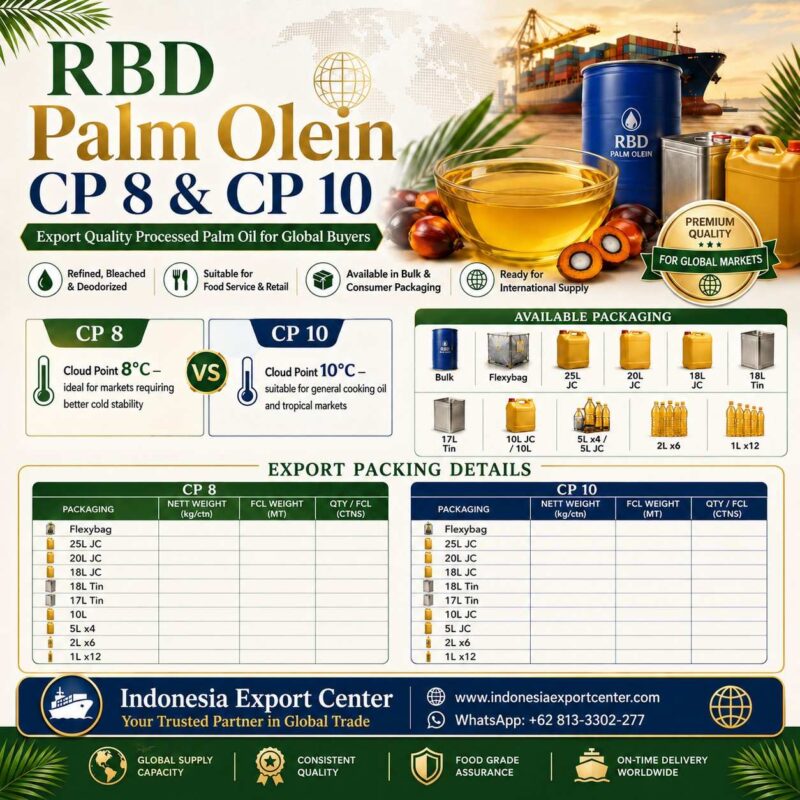
Importing RBD palm olein from Indonesia can be an efficient way for food distributors, cooking oil brands, wholesalers, and industrial users to secure a reliable supply of refined edible oil. However, a successful transaction requires more than simply requesting the lowest price.
International buyers must select the correct palm olein grade, agree on measurable specifications, verify the supplier, choose suitable packaging, understand the applicable Incoterm, and confirm the documents required by the destination country.
This practical guide explains the main steps international buyers should follow when purchasing RBD Palm Olein CP8 or CP10 from Indonesia.
What Is RBD Palm Olein?
RBD palm olein is the liquid fraction obtained after palm oil has been refined, bleached, deodorized, and fractionated. The Codex Alimentarius Standard for Named Vegetable Oils defines palm olein as the liquid fraction derived from the fractionation of palm oil.
The abbreviation RBD means:
- Refined: impurities, gums, and unwanted components are removed.
- Bleached: pigments and trace contaminants are reduced using an adsorbent material.
- Deodorized: volatile compounds responsible for undesirable odors and flavors are removed.
- Olein: the more liquid fraction separated from the more solid palm stearin fraction.
RBD palm olein is widely purchased as a cooking oil and as an ingredient for food processing, frying operations, restaurants, catering companies, and private-label edible oil brands.
Buyers searching for a dependable RBD Palm Olein Supplier from Indonesia should nevertheless specify the required grade and quality limits instead of relying only on the general product name.
Understanding RBD Palm Olein CP8 and CP10
CP8 and CP10 are commercial grade descriptions based primarily on the product’s cloud point. The cloud point is the temperature at which the oil begins to appear cloudy as crystals start forming during cooling.
In common commercial specifications:
- RBD Palm Olein CP8 has a maximum cloud point of approximately 8°C.
- RBD Palm Olein CP10 has a maximum cloud point of approximately 10°C.
An Indonesian government-supported export marketplace describes CP8 as fractionated RBD palm olein with a cloud point of 8°C. Commercial CP10 specifications generally state a maximum cloud point of 10°C.
CP8 generally offers better cold stability than CP10. It may therefore be preferable when the oil will be stored, transported, or displayed under relatively cool conditions. CP10 can be suitable for tropical and consistently warm markets where occasional cloudiness at lower temperatures is less of a concern.
However, buyers should not assume that “CP8” or “CP10” alone defines the complete product quality. Each purchase contract should state the required limits for cloud point, free fatty acids, moisture and impurities, iodine value, color, odor, and other applicable parameters.
A qualified RBD Palm Olein CP8 Supplier or RBD Palm Olein CP10 Supplier should be able to provide a technical data sheet and a recent Certificate of Analysis before the order is finalized.
Step 1: Confirm the Import Requirements in Your Country
Before requesting a quotation, buyers should confirm whether palm olein can be imported freely into the destination country and what permits, registrations, duties, food safety rules, and labeling requirements apply.
Requirements may differ according to:
- Destination country
- Product classification
- Retail or industrial use
- Consumer or bulk packaging
- Nutritional labeling rules
- Language requirements
- Halal certification requirements
- Import quota or licensing system
- Preferential trade agreement
- Intended food application
The Harmonized System provides an internationally used six-digit classification structure, while individual countries may add further tariff digits. Indonesia applies the ASEAN Harmonised Tariff Nomenclature through its official customs tariff system. Buyers and sellers should therefore confirm the final HS classification with their respective customs brokers rather than selecting a code only from a general online description.
The buyer should also check whether the destination authority requires product registration, an import permit, a health certificate, laboratory analysis, Arabic or local-language labeling, a specified remaining shelf life, or pre-shipment conformity inspection.
Step 2: Prepare a Complete Request for Quotation
A vague inquiry such as “Please send your best price for palm oil” is unlikely to produce an accurate quotation. Freight, packaging, product grade, inspection, and documentation can significantly affect the final cost.
A professional request for quotation should include:
- Product name: RBD Palm Olein CP8 or CP10
- Required quantity in metric tons or number of containers
- Packaging type and unit size
- Buyer’s brand or supplier’s standard brand
- Destination country and port
- Required Incoterm
- Payment preference
- Required certificates and export documents
- Inspection requirement
- Target delivery schedule
- Labeling language and artwork requirements
- Any destination-specific quality or regulatory requirements
For private-label orders, buyers should provide the artwork, brand name, container size, label dimensions, barcode requirements, carton design, production language, and mandatory regulatory statements as early as possible.
A quotation cannot be considered complete unless it identifies the product specification, quantity, packing, loading port, destination port, Incoterm, validity period, lead time, and payment conditions.
Step 3: Verify the Indonesian Supplier
Supplier verification is one of the most important stages of the transaction. International buyers may encounter refineries, packing companies, exporters, trading companies, sourcing agents, and brokers. These parties perform different functions and may not own the refinery or inventory they offer.
Before issuing a purchase commitment, buyers should verify:
- The company’s legal name and registration
- Registered business address
- Authorized representative
- Corporate bank account
- Export capability or appointed exporter
- Relationship with the refinery or packing facility
- Production or allocation capacity
- Previous export experience
- Product certifications
- Recent Certificate of Analysis
- Packaging capability
- Loading port and warehouse location
- References from previous transactions where available
Buyers should be cautious when the seller refuses to provide basic corporate information, requests payment to an unrelated personal account, guarantees unrealistic prices, or claims unlimited supply without supporting evidence.
A reliable supplier should also explain whether it acts as the producer, packer, exporter of record, trading company, or authorized marketing representative. This transparency helps the buyer understand who will be responsible for production, documentation, payment, and shipment.
Step 4: Agree on the Product Specification
The sales contract should contain measurable product specifications. A verbal statement that the oil is “high quality” or “export quality” is not sufficient for an international commodity transaction.
Common RBD palm olein parameters include:
- Cloud point
- Free fatty acids as palmitic acid
- Moisture and impurities
- Iodine value
- Slip melting point
- Lovibond color
- Peroxide value
- Appearance
- Odor and taste
- Relative density
- Fatty acid composition, when required
- Contaminants and residues required by the destination market
Codex CXS 210-1999 provides internationally recognized identity and quality guidance for named vegetable oils. Nevertheless, Codex standards do not replace the specific limits agreed between buyer and seller or mandatory rules imposed by the importing country.
The contract should state whether the specification applies at the time of production, loading, shipment, or arrival. This distinction is important because storage conditions, transit time, handling, and temperature can affect certain quality indicators.
Buyers should request a pre-shipment Certificate of Analysis for the actual production batch instead of relying only on a generic product data sheet.
Step 5: Choose the Appropriate Packaging
RBD palm olein can be supplied in several packaging formats. The most suitable option depends on order volume, destination infrastructure, customer segment, import duty structure, and local distribution system.
Jerrycans and PET Bottles
Jerrycans and bottles are suitable for retail, wholesale, food-service, and private-label markets. Common sizes vary by country and customer preference.
Buyers should confirm:
- Container material
- Net volume or net weight
- Cap and tamper-evident seal
- Label material
- Carton configuration
- Palletization
- Container loading quantity
- Leak test procedure
- Food-contact compliance
Metal Tins
Metal tins are commonly requested in markets where cooking oil is distributed in larger household or food-service units. Buyers should carefully confirm the nominal volume, net oil weight, tin thickness, handle design, closure system, lithographic printing, and carton or shrink-wrap arrangement.
Drums and Intermediate Bulk Containers
Drums and IBCs may be appropriate for industrial users, restaurants, food processors, and repacking facilities. The buyer should verify that every contact surface is suitable for edible oil.
Flexitanks
Flexitanks allow large volumes of liquid product to be transported inside a standard freight container. They can reduce packaging cost per ton, but they require experienced loading, container inspection, proper installation, suitable transport routes, and reliable discharge facilities.
The IMO/ILO/UNECE CTU Code provides international guidance on packing and handling cargo transport units. Flexitank loading should follow the flexitank manufacturer’s instructions, the container operator’s conditions, and the carrier’s acceptance rules.
ISO Tanks and Bulk Vessels
ISO tanks and parcel or bulk vessels may be considered for larger industrial shipments. Such shipments require appropriate tanks, heating arrangements where necessary, terminal access, survey procedures, and strict contamination controls.
The Codex Code of Practice for the Storage and Transport of Edible Fats and Oils in Bulk emphasizes suitable food-contact surfaces, cleanliness, previous cargo controls, and protection against contamination and deterioration.
Step 6: Select the Correct Incoterm
FOB, CFR, and CIF are frequently used in international palm oil transactions, but buyers must understand the allocation of cost and risk.
FOB — Free on Board
Under FOB, the seller delivers the goods on board the nominated vessel at the named port of shipment. The buyer normally arranges and pays for the main ocean freight and insurance.
CFR — Cost and Freight
Under CFR, the seller contracts and pays for freight to the named destination port. However, risk transfers to the buyer when the goods are loaded on board the vessel at the port of shipment, not when they arrive at the destination.
CIF — Cost, Insurance and Freight
Under CIF, the seller pays the ocean freight and arranges the contractually required cargo insurance to the named destination port. Risk still transfers at the port of shipment. ICC Incoterms 2020 states that CIF is a maritime rule commonly used in commodity trading and carries a default insurance level based on Institute Cargo Clauses (C), unless the parties agree to broader coverage.
For containerized cargo, including some flexitank shipments, buyers and sellers should discuss whether FCA is operationally more appropriate than FOB. The final Incoterm should always include the named port or place and the version used, for example:
CIF Jeddah Islamic Port, Saudi Arabia — Incoterms 2020
Freight quotations can change quickly. Therefore, a CFR or CIF offer should state its validity period and whether it is subject to carrier space, equipment availability, fuel surcharges, war-risk charges, or other exceptional costs.
Step 7: Negotiate a Clear Sales Contract
Once the buyer accepts the commercial basis, both parties should sign a detailed sales contract or sales and purchase agreement.
The contract should cover:
- Full legal names of buyer and seller
- Product grade and specifications
- Quantity and contractual tolerance
- Unit price and total value
- Currency
- Packaging
- Incoterm and named port
- Loading period
- Production lead time
- Inspection method
- Sampling and laboratory method
- Payment terms
- Required documents
- Insurance responsibility
- Quality and quantity claims
- Force majeure
- Governing law
- Dispute resolution
- Bank charges
- Conditions for private-label approval
Commercial documents such as a Letter of Intent, quotation, Full Corporate Offer, purchase order, or Irrevocable Corporate Purchase Order may be used at different stages. Their names are less important than ensuring that the final binding contract contains complete and consistent terms.
Step 8: Use Secure Payment Terms
Payment terms depend on the supplier’s policy, transaction value, buyer’s creditworthiness, country risk, and production requirements.
Common structures may include:
- Irrevocable letter of credit at sight
- Advance payment followed by balance before loading
- Deposit followed by balance against agreed shipping documents
- Documentary collection for established relationships
Buyers should independently verify the beneficiary’s bank account and confirm that it belongs to the contracted company. Any request to redirect payment to a different company or bank account should be supported by formal documentation and independently verified.
The buyer should also examine whether the payment trigger is linked to production, inspection, loading, issuance of the bill of lading, or presentation of agreed documents.
Step 9: Arrange Pre-Shipment Inspection
Independent inspection can reduce disputes, especially for first transactions, large orders, or private-label shipments.
Depending on the contract, an inspection company may verify:
- Product quality
- Sampling
- Quantity or weight
- Packaging condition
- Label accuracy
- Container cleanliness
- Flexitank installation
- Seal numbers
- Loading process
- Container count
- Photographic evidence
The contract should identify who appoints and pays the inspector, where inspection takes place, which laboratory method applies, and whether the inspection result is final at the loading port.
Retention samples should be sealed, labeled, and kept by the relevant parties for an agreed period in case a quality claim arises.
Step 10: Confirm the Export and Shipping Documents
The exact document package depends on the destination country, payment method, Incoterm, packaging, and buyer requirements.
A typical shipment may include:
- Commercial invoice
- Packing list
- Bill of lading
- Certificate of Analysis
- Certificate of Origin
- Health or sanitary certificate when required
- Halal certificate when required
- Insurance certificate under CIF
- Weight or quantity certificate
- Inspection certificate
- Fumigation or packaging declaration where applicable
- Product specification sheet
- Other destination-specific documents
In Indonesia, the Pemberitahuan Ekspor Barang, or PEB, is the customs declaration used to notify the export of goods. Indonesian Customs explains that the PEB is prepared using supporting documents such as the commercial invoice, packing list, and other documents required for the export transaction.
The Indonesian Certificate of Origin, known as Surat Keterangan Asal or SKA, certifies that the exported goods originate from Indonesia. It may be required under a preferential trade agreement or by the importing country. Indonesia operates an electronic Certificate of Origin system known as e-SKA.
Buyers should send their complete documentary instructions before production and shipment. Requesting additional certificates after the vessel has departed can cause delays, amendment charges, or customs problems.
Step 11: Monitor Production and Shipment
After the contract and payment conditions are completed, the buyer should request regular production and logistics updates.
Important milestones include:
- Artwork approval
- Packaging material production
- Oil allocation
- Packing schedule
- Inspection date
- Container release
- Loading date
- Customs clearance
- Vessel departure
- Bill of lading draft
- Final document issuance
- Estimated arrival date
The buyer should review the draft bill of lading, invoice, packing list, Certificate of Origin, and other documents before originals are issued. Company names, addresses, product descriptions, quantities, ports, container numbers, and payment references must be consistent.
Minor documentary differences can cause bank discrepancies, customs delays, or rejection of preferential tariff claims.
Step 12: Inspect the Cargo at Destination
Upon arrival, the importer should check the cargo before completing distribution or discharge.
For packaged cargo, inspect:
- Container seal
- Carton condition
- Leakage
- Rust or deformation
- Label accuracy
- Production and expiry information
- Unit count
- Product appearance
For flexitank or bulk cargo, inspect:
- Seal numbers
- Flexitank or tank condition
- Discharge arrangements
- Product temperature
- Quantity
- Representative samples
- Evidence of contamination or leakage
Any suspected loss or quality issue should be documented immediately with photographs, survey reports, samples, port records, and written notice to the seller, carrier, insurer, or inspection company within the contractual claim period.
Common Mistakes to Avoid
Choosing a Supplier Only by Price
A quotation that is significantly below the market may involve an incorrect grade, incomplete freight cost, unverified allocation, inadequate packaging, or fraud.
Ordering Without a Signed Specification
Terms such as “CP8,” “CP10,” or “standard export quality” should always be supported by measurable contractual limits.
Ignoring Destination Regulations
The exporter cannot determine every import requirement without information from the buyer. The importer should confirm local permits, labels, product registration, and certificate requirements before shipment.
Confusing Freight Responsibility With Risk Transfer
Under CFR and CIF, the seller pays the main freight, but the risk normally transfers when the goods are loaded on board at the port of shipment.
Approving Labels Too Late
Private-label artwork should be approved before packaging materials are printed. Late changes can delay production and create additional costs.
Failing to Verify the Exporter and Bank Account
The company named in the contract, invoice, bank account, and shipping documents should be checked for consistency.
Practical Import Checklist
Before placing an order, confirm that you have:
- Selected CP8 or CP10
- Agreed on the complete technical specification
- Confirmed the quantity and packaging
- Verified the supplier’s legal identity
- Checked the refinery or packing relationship
- Confirmed destination import requirements
- Selected the appropriate Incoterm
- Agreed on payment security
- Approved private-label artwork
- Identified all required documents
- Arranged inspection when necessary
- Signed a complete sales contract
- Reviewed the shipping document drafts
- Established a sampling and claims procedure
Conclusion
Importing RBD palm olein from Indonesia requires coordinated planning between the buyer, supplier, refinery, packing facility, exporter, freight forwarder, inspection company, customs broker, and shipping carrier.
The most important first step is to define the requirement clearly. Buyers should specify whether they need CP8 or CP10, the quantity, packaging, destination port, Incoterm, private-label requirements, documents, payment method, and delivery schedule.
Working with an experienced RBD Palm Olein Supplier from Indonesia can help buyers coordinate technical specifications, packaging, refinery confirmation, export documentation, and shipment planning.
Buyers serving cooler markets or requiring greater cold stability may consider working with a specialized RBD Palm Olein CP8 Supplier. Buyers distributing cooking oil in warm tropical markets may find an experienced RBD Palm Olein CP10 Supplier more suitable for their commercial requirements.
The final selection should always be based on the destination climate, product application, regulatory requirements, landed cost, and a clearly written purchase contract.
Read also
https://indonesiaexportcenter.com/product/rbd-palm-olein-cp-8-cp-10-from-indonesia/
https://indonesiaexportcenter.com/rbd-palm-olein-cp10-supplier-indonesia/
Reference Basis
This article was prepared using internationally recognized and official sources, including:
- Codex Alimentarius Standard for Named Vegetable Oils, CXS 210-1999.
- Codex Code of Practice for the Storage and Transport of Edible Fats and Oils in Bulk, CXC 36-1987.
- International Chamber of Commerce Incoterms 2020 guidance.
- Indonesian Directorate General of Customs and Excise export procedures.
- Indonesian Ministry of Trade electronic Certificate of Origin information.
- Roundtable on Sustainable Palm Oil supply-chain guidance.
