![Indonesia Export Center [IEC]](https://indonesiaexportcenter.com/wp-content/uploads/2023/07/logo-no-background.svg)
![Indonesia Export Center [IEC]](https://indonesiaexportcenter.com/wp-content/uploads/2023/07/svgviewer-output.svg)
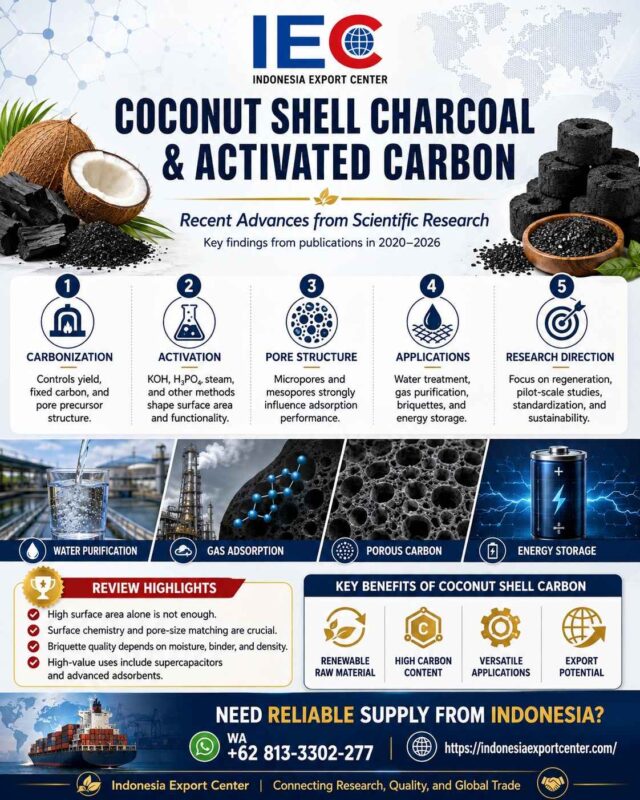
Recent Advances in Coconut Shell Charcoal and Activated Carbon: Effects of Carbonization, Activation, Pore Structure, Adsorption Performance, Briquette Quality, and High-Value Applications
Abstract
Coconut shells are a dense lignocellulosic residue that can be converted into charcoal, activated carbon, and advanced porous carbon materials. This review critically synthesizes peer-reviewed studies published during the last decade, with emphasis on the 2020–2026 period, to clarify how carbonization conditions, activation strategy, pore development, surface chemistry, and product formulation govern performance. A structured narrative search was performed using publisher platforms, DOI-indexed records, and multidisciplinary scholarly search services. The working database contained 53 primary studies published from 2017 to 2 August 2026, of which 47 were published in 2020–2026, together with four key review or life-cycle studies. Thirty-two high-relevance publications were selected for detailed synthesis.
The evidence shows that carbonization controls yield, fixed-carbon development, volatile release, and the precursor pore network, while physical and chemical activation impose different trade-offs between microporosity, mesoporosity, surface functionality, process simplicity, washing demand, and environmental burden. High surface area alone is not a sufficient predictor of adsorption because pore-size matching, surface charge, heteroatom functionality, solution chemistry, humidity, and competitive species frequently dominate under realistic conditions. Recent work extends coconut-shell carbon from conventional dye and metal adsorption to treatment of pharmaceuticals, PFAS alternatives, microplastics, indoor volatile organic compounds, biogas, and refrigerants.
For briquettes, binder selection, moisture, density, mechanical strength, ash, and drying control determine commercial quality; electrical-resistivity monitoring offers a promising route to rapid process control. High-value applications include supercapacitors, capacitive deionization, adsorption cooling, green toner colorants, catalytic composites, and greenhouse-gas separation. Future research should prioritize standardized reporting, continuous-flow and pilot-scale validation, regeneration, techno-economic analysis, life-cycle assessment, and direct comparison with commercial benchmarks.
Keywords— coconut shell charcoal; activated carbon; carbonization; chemical activation; physical activation; pore structure; adsorption; charcoal briquette; supercapacitor; sustainability.
1. Introduction
The global coconut-processing sector generates substantial quantities of shells that are frequently burned inefficiently, discarded, or converted into low-value fuel. In contrast to many agricultural residues, coconut shell has a compact structure, relatively high lignin content, low friability after carbonization, and a natural tendency to form hard carbon with a well-developed microporous framework. These characteristics explain its long-standing use as a precursor for granular activated carbon, household and industrial charcoal, barbecue and shisha briquettes, and more recently electrochemical and catalytic carbon materials. Recent reviews describe a transition from simple waste valorization toward deliberate engineering of pore size, surface chemistry, morphology, and environmental performance [1], [2].
The properties of coconut-shell-derived carbon are not intrinsic constants. They emerge from a sequence of coupled operations beginning with feedstock cleaning and drying, followed by carbonization, activation, washing, drying, milling or shaping, and application-specific modification. Carbonization temperature, heating rate, residence time, oxygen exclusion, particle size, and reactor configuration determine charcoal yield, volatile-matter removal, fixed-carbon content, ash concentration, tar formation, and the stability of the initial pore network. A modified pyrolysis reactor equipped with a tar scrubber, for example, improved charcoal quality while reducing smoke-related pollution, illustrating that reactor design can affect both product performance and process emissions [3].
Activation then enlarges or creates accessible porosity and modifies surface functionality. Physical activation with steam, carbon dioxide, air, or combinations of these agents is comparatively clean and avoids residual activating salts, but it usually requires high temperature and careful burn-off control. Chemical activation with potassium hydroxide, phosphoric acid, zinc chloride, sodium hydroxide, or sulfuric acid can generate high surface area at lower or moderate temperatures, although chemical recovery, corrosion, washing-water demand, and waste treatment may offset these benefits. Direct comparison of chemical agents has shown that the identity and ratio of the activator substantially affect surface area, pore-size distribution, yield, and water-treatment performance [4].
The scientific literature is broad but fragmented. Many studies optimize one material for one contaminant under batch conditions, while others focus on electrochemical performance, briquette formulation, gas separation, or life-cycle impacts. Metrics are often reported using different bases and experimental conditions, making simple ranking potentially misleading. For example, adsorption capacity depends not only on Brunauer–Emmett–Teller surface area but also on accessible ultramicropores, mesopore transport, surface charge, functional groups, adsorbate size, pH, ionic strength, humidity, and co-contaminants. Likewise, supercapacitor capacitance depends on electrode density, electrolyte, mass loading, cell configuration, and voltage window, whereas briquette quality depends on binder, compaction, moisture, ash, density, durability, and combustion protocol.
This review therefore aims to synthesize recent advances across the complete value chain. It addresses six questions:
- How does carbonization govern charcoal yield and precursor quality?
- How do activation and functionalization control pore architecture and surface chemistry?
- Which material features dominate adsorption in water and gas treatment?
- How do briquette formulation and drying determine fuel quality?
- Which high-value applications are emerging?
- What sustainability and scale-up gaps must be resolved?
The review emphasizes publications from 2020–2026 while using selected 2017–2019 studies to establish technological continuity.
2. Literature Search Method
A structured narrative literature search was conducted for publications available up to 2 August 2026. Bibliographic records were identified through multidisciplinary scholarly search services, DOI and Crossref records, PubMed where applicable, and publisher platforms including ScienceDirect, Springer Nature, Wiley, MDPI, the Royal Society of Chemistry, Taylor & Francis, ACS Publications, and individual journal sites.
Search combinations included:
- “coconut shell charcoal”;
- “coconut shell activated carbon”;
- “carbonization” and “pyrolysis”;
- “physical activation” and “chemical activation”;
- “KOH” and “H3PO4”;
- “pore structure”;
- “adsorption”;
- “briquette quality”;
- “fixed bed”;
- “supercapacitor”;
- “capacitive deionization”;
- “gas separation”; and
- “life cycle assessment.”
Reference lists of relevant reviews and recent primary studies were also screened.
The inclusion criteria were:
- Peer-reviewed journal articles in English.
- Publication from 2017 to 2 August 2026, with the principal synthesis concentrated on 2020–2026.
- Coconut shell charcoal, biochar, activated carbon, or a clearly identifiable coconut-shell-derived carbon component.
- Quantitative or mechanistic information on carbonization, activation, pore structure, adsorption, briquette quality, electrochemical behavior, gas separation, catalysis, or sustainability.
- A verifiable DOI or stable publisher record.
Conference abstracts, non-peer-reviewed promotional material, duplicate records, studies without separable coconut-shell results, and records whose bibliographic identity could not be verified were excluded. Publisher corrections were checked when identified, and the current corrected record was used.
The working spreadsheet contained 53 primary research articles and four key review or life-cycle papers. Forty-seven primary studies were published during 2020–2026 and six during 2017–2019. Articles were coded by year, research theme, carbonization or preparation method, activation or modification method, target application, principal result, novelty, DOI, access status, and relevance. Thirty-two sources were retained for detailed narrative synthesis because they represented major methodological developments, realistic application conditions, comparative activation studies, industrially relevant briquette research, or high-value applications.
Because the included studies used heterogeneous feedstocks, particle sizes, reactors, activation ratios, analytical methods, adsorbates, concentrations, electrolytes, and performance metrics, a formal meta-analysis was not appropriate. Results were therefore synthesized qualitatively and comparatively. Reported numerical values are presented only when they clarify a major trend and should not be interpreted as directly interchangeable unless test conditions are equivalent. This review is consequently a structured narrative review rather than a PRISMA-compliant systematic review.
3. Discussion
3.1 Carbonization and Charcoal Formation
Carbonization converts the organic matrix of coconut shell into a carbon-rich solid through dehydration, depolymerization, devolatilization, aromatization, and structural rearrangement. Hemicellulose and cellulose decompose at lower temperatures, whereas lignin decomposes over a wider range and contributes to char formation. Raising the final temperature generally decreases solid yield and volatile matter while increasing fixed carbon, aromaticity, electrical conductivity, and resistance to biological degradation. However, excessive temperature or residence time can collapse fragile structures, enlarge ash concentration on a mass basis, consume carbon, and reduce economic yield.
The 2020 reactor study by Sari et al. demonstrated the practical importance of equipment design [3]. Their modified pyrolysis system incorporated gas handling and a tar scrubber to reduce smoke while producing charcoal with high carbon content. This result is important because conventional small-scale kilns often optimize neither heat transfer nor vapor removal. Slow and uneven heating produces heterogeneous charcoal, while uncontrolled oxygen ingress causes localized combustion and yield loss. Capturing or combusting pyrolysis vapors can also reduce visible emissions and recover energy, but the total environmental advantage depends on system boundaries, fuel source, condensate treatment, and whether co-products are productively used.
For activated-carbon production, the carbonized precursor must balance mechanical strength and reactivity. A highly ordered char may resist activation, whereas a more disordered char can react rapidly but may lose yield and strength. Mineral matter can catalyze gasification or block pores, so feedstock washing and ash control are important when the final product is intended for drinking-water treatment, food processing, or electrochemical devices. Reporting only the final activation temperature without the carbonization history is insufficient because two carbons activated under nominally identical conditions may inherit different pore nuclei, functional groups, and burn-off behavior.
Future carbonization studies should report dry-basis mass yield, proximate and ultimate analysis, heating rate, residence time at the final temperature, reactor atmosphere, particle size, energy input, condensable and non-condensable products, and replicate variability. Such data are necessary to distinguish genuine process improvements from performance gains obtained at the cost of severe carbon loss.
3.2 Activation and Pore-Structure Engineering
Activation is the decisive step for converting charcoal into an adsorbent or functional porous carbon. Physical activation selectively gasifies reactive carbon using steam, carbon dioxide, air, or mixed oxidants. It tends to preserve a relatively clean surface and can be integrated with heat recovery, but its high temperature and long residence time increase energy demand.
Chemical activation impregnates the precursor with dehydrating, crosslinking, oxidizing, or intercalating agents before heat treatment. KOH often generates extensive microporosity through redox reactions, intercalation, and carbon etching. H3PO4 promotes dehydration and crosslinking while introducing phosphorus- and oxygen-containing groups. ZnCl2 dehydrates and develops pores but raises toxicity and chemical-recovery concerns.
A direct comparison by Sujiono et al. showed that NaOH, H3PO4, and ZnCl2 created materially different structures under otherwise comparable preparation conditions [4]. NaOH activation produced the highest reported surface area in that study, but the broader literature demonstrates that no single agent is universally optimal. The appropriate activation route depends on target pore width, adsorbate size, desired surface chemistry, product form, regeneration method, allowable ash or residual ions, and environmental constraints.
Recent pore-analysis research has moved beyond reporting a single BET value. Kwiatkowski and Hu examined coconut-shell-derived carbons prepared under different conditions and showed that activation temperature and precursor-to-KOH ratio strongly controlled micro- and mesopore development [5]. Conditions near 700 °C and relatively high KOH ratios favored extensive micropore formation in their system. Their use of density-functional theory and clustering highlights why pore-size distribution should be analyzed at the scale relevant to the target molecule rather than summarized by total surface area alone.
Lowden et al. compared physical and chemical preparation routes and linked physicochemical properties with dye removal [6]. The study reinforces an important principle: pore volume and surface chemistry act together. Micropores provide high adsorption potential, mesopores accelerate diffusion toward internal sites, and surface oxygen or phosphorus groups alter acidity, hydrophilicity, and electrostatic interaction. A carbon with somewhat lower total area may outperform a higher-area sample when its pores are more accessible or its surface chemistry better matches the adsorbate.
Post-activation modification provides additional control. Atmospheric-pressure dielectric-barrier-discharge plasma can change surface functionality without prolonged wet-chemical treatment [7]. Phosphoric-acid activation in air has also been explored as a route that may reduce dependence on an inert atmosphere, although oxidation and yield must be carefully controlled [8]. Other studies use chitosan, graphene oxide, metal oxides, conductive polymers, or metal–organic frameworks to introduce selective binding, catalytic activity, or electrical conductivity.
The central limitation of aggressive chemical activation is that outstanding laboratory porosity may conceal substantial upstream and downstream burdens. Acid or alkali manufacture, corrosion-resistant equipment, repeated washing, wastewater neutralization, dissolved salts, and drying energy can dominate environmental impacts. Saleem et al. showed that activation chemistry, water source, and fuel choice materially change the life-cycle profile and the amount of carbon required per unit pollutant removed [9]. Future optimization should therefore maximize useful performance per kilogram of precursor, activating chemical, process water, and energy—not BET area alone.
3.3 Adsorption Performance in Water and Gas Treatment
Water treatment remains the largest application group. Coconut-shell activated carbon has been evaluated for synthetic dyes, heavy metals and metalloids, pharmaceuticals, pesticides, persistent fluorinated compounds, disinfection by-products, and particulate contaminants. The apparent adsorption capacity depends on the interaction between adsorbent structure and solution chemistry. For ionic pollutants, pH controls both adsorbate speciation and surface charge. For aromatic organics, pore filling, hydrophobic interaction, π–π interaction, hydrogen bonding, and electrostatic attraction may operate simultaneously.
Recent dye studies illustrate the range of performance but also the danger of direct numerical comparison. Saleem et al. reported high Langmuir capacities for base-activated coconut-shell carbon, whereas acid-activated materials behaved differently because activation altered pore structure and surface chemistry [12]. Yu et al. optimized phosphoric-acid treatment for Rhodamine B and used characterization before and after adsorption to clarify the roles of pore filling and phosphorus- and oxygen-containing groups [13]. These results demonstrate that activation should be designed around molecular size and charge rather than selected solely to maximize surface area.
Pharmaceutical adsorption has expanded from conventional batch removal toward process optimization and mechanistic analysis. Daouda et al. optimized phosphoric-acid-activated carbon for diclofenac and amoxicillin using response surface methodology and related preparation variables to pore properties and adsorption behavior [14]. DasSharma et al. reported strong enrofloxacin removal by chemically activated green-coconut-shell carbon and included reuse assessment, providing more application-relevant evidence than a single adsorption cycle [15].
Nonetheless, pharmaceutical studies should increasingly evaluate mixtures, natural organic matter, ionic strength, transformation products, and regeneration because single-solute tests typically overestimate field performance.
The target-contaminant portfolio has recently broadened to fluorinated and particulate pollutants. Wu et al. reported a triphasic, multimechanistic adsorption process for F-53B, a persistent PFOS alternative, with surface adsorption, pore diffusion, and equilibrium stages [16]. Chitosan-modified coconut-shell activated carbon achieved high Cr(VI) removal under strongly acidic conditions and retained performance over multiple cycles [17]. A 2026 study comparing H3PO4, KOH, and ZnCl2 activation for arsenic showed that KOH-derived carbon provided the strongest removal of both As(III) and As(V) in the tested system [18].
Evidence from real industrial matrices is particularly valuable. Suleiman et al. applied KOH-modified carbon to multi-metal removal from tannery effluent and reported high removal after process optimization, including repeated use [19]. Such studies reveal competition, dissolved organic matter, salinity, and pH effects that are absent in idealized solutions.
Fixed-bed operation is the next essential step because breakthrough behavior—not equilibrium capacity—determines service life. Han et al. evaluated a coconut-shell-biochar fixed bed for simultaneous removal of microplastics and perfluorooctanoic acid from groundwater, moving the evidence base closer to continuous remediation [20]. Wang et al. further expanded microplastic capture by growing MIL-100(Fe) in situ on coconut-shell activated carbon, creating a hierarchical composite with additional accessible binding sites [21].
For gas treatment, ultramicropores and humidity are especially important. Water vapor can occupy high-energy sites, block pore entrances, alter surface polarity, and lower selectivity. Staudt et al. quantified the effect of gas moisture on CH4/CO2 equilibrium capacity and selectivity using coconut-shell granular activated carbon [22]. The study provides a reminder that dry-gas data may not predict biogas-purification performance.
Sheng et al. examined low-concentration trichloroethylene and tetrachloroethylene in indoor air by integrating experiments, molecular simulation, and breakthrough modeling [23]. Adsorption was stronger for PCE, while elevated relative humidity reduced capacity through competitive adsorption.
Across adsorption studies, four methodological priorities emerge:
- Researchers should report full pore-size distributions, surface chemistry, pH at point of zero charge, ash, particle size, and density.
- Tests should include realistic concentration ranges, competing solutes, humidity, and natural matrices.
- Fixed-bed or flow-through data should accompany batch equilibrium results.
- Regeneration must be evaluated by mass balance, retained capacity, energy demand, secondary emissions, and disposal of concentrated contaminants.
Without these elements, a high laboratory capacity does not establish practical superiority.
3.4 Briquette Quality and Drying Control
Coconut-shell charcoal briquettes are commercially important for barbecue, household fuel, metallurgical heating, and shisha applications. Their quality depends on charcoal properties and shaping conditions. Important parameters include:
- particle-size distribution;
- binder type and dosage;
- water addition;
- mixing uniformity;
- compaction pressure;
- extrusion temperature;
- density;
- dimensional stability;
- drop resistance;
- compressive strength;
- moisture;
- volatile matter;
- ash;
- fixed carbon;
- calorific value;
- ignition behavior;
- burning duration;
- odor;
- smoke; and
- carbon-monoxide emissions.
Binder selection is a central trade-off. Sufficient binder improves green strength, handling, and resistance to fracture, but excessive binder can increase moisture, volatile matter, smoke, ash, and ignition time while diluting fixed carbon.
Anis et al. compared tapioca, cassava, and modified cassava binders in screw-extruded coconut-shell charcoal briquettes [10]. Binder type significantly affected density, compressive properties, proximate composition, and combustion behavior. The study is industrially relevant because screw extrusion produces continuous, dense briquettes but also introduces shear, temperature, and die-pressure effects that are not reproduced by simple laboratory pressing.
Moisture is another critical variable. Inadequately dried briquettes have lower net heating value, poor ignition, microbial or odor risk during storage, and higher shipping mass. Overdrying wastes fuel and can induce cracking or binder degradation. Conventional oven testing is reliable but too slow for real-time process decisions.
Prasetyadi et al. developed an electrical-resistivity approach using plate electrodes and electrolyte to determine drying completion [11]. In their formulation, briquettes below approximately 5% moisture were associated with resistivity above 10 kΩ·m, and the indirect method showed low variation. This represents an important shift from end-product inspection toward process analytical technology.
However, an electrical threshold cannot be transferred automatically between factories. Resistivity is affected by charcoal conductivity, ash ions, binder chemistry, density, temperature, geometry, and electrode contact. Each product family therefore requires calibration against a reference moisture method and periodic verification.
Future work should combine electrical sensing with infrared temperature, mass-loss modeling, airflow and humidity measurement, and machine-learning control. Commercial studies should also evaluate container storage, moisture reabsorption, packaging permeability, spontaneous heating, breakage during transport, and compliance with destination standards.
3.5 High-Value Energy and Functional-Material Applications
The most significant recent development is the movement from commodity adsorbents and fuels toward high-value functional carbon. Coconut-shell carbon is attractive for electrochemical devices because it can provide high micropore volume, low impurity content, mechanical stability, and a renewable carbon source.
Device performance nevertheless requires more than surface area. Pores must be accessible to electrolyte ions, the electrode must possess adequate electrical conductivity and packing density, and the binder/current-collector architecture must minimize resistance.
Lee et al. demonstrated coconut-shell-derived activated carbon in high-performance solid-state supercapacitors, showing the feasibility of a complete device rather than only a three-electrode screening test [24]. Sasono et al. introduced dispersed nanofiber structures to improve electron pathways and ion access [25]. More recently, Sun et al. combined KOH activation with electrooxidation, obtaining a highly porous carbon with enriched oxygen functionality and strong specific capacitance [26].
These studies illustrate complementary design strategies:
- pore creation;
- conductive-network engineering; and
- controlled pseudocapacitive functionality.
Capacitive deionization is another promising electrochemical route. Huynh et al. incorporated carbon nanotubes into coconut-shell activated carbon to improve conductivity and ion transport in deionization electrodes [27]. The environmental advantage of such devices, however, depends on the carbon activation route, nanotube loading, electrode manufacture, electricity mix, salt-removal capacity, lifetime, and end-of-life management.
A life-cycle assessment of coconut-shell activated-carbon supercapacitor electrodes showed that precursor renewability does not automatically guarantee a low-impact device; activation chemicals and energy can dominate [28].
Gas separation and thermal systems further broaden the application space. Sosa et al. evaluated differently activated coconut-shell carbons for separation of refrigerants and greenhouse gases, showing that activation route alters selectivity among molecules with similar sizes and polarizabilities [29].
Coconut-shell activated carbon has also been investigated as the adsorbent in CO2-based advanced adsorption-cooling systems, where equilibrium capacity, isosteric heat, mass transfer, and cyclic stability jointly determine cooling performance [32].
Other work demonstrates applications outside conventional environmental engineering. Wijewardhana et al. produced activated carbon black from coconut shell as a renewable alternative to fossil-derived toner colorants [30]. Gu et al. modified coconut-shell biochar with TiO2 to create a multifunctional material for heavy-metal removal in water or soil and tetracycline degradation [31].
These composites add selectivity or catalytic activity but also increase synthesis complexity, cost, and end-of-life uncertainty. Metal leaching, nanoparticle release, reproducibility, and recovery must be assessed before large-scale deployment.
For high-value products, performance should be benchmarked against commercial activated carbon, carbon black, graphene, metal–organic frameworks, or battery-grade carbons under identical test conditions. Future papers should report volumetric as well as gravimetric performance, electrode mass loading, full-cell metrics, cycle life, self-discharge, impurity profile, batch variability, and scale-up yield. These requirements are essential because an exceptionally high value measured on a thin laboratory electrode may not translate to a dense commercial device.
3.6 Sustainability, Scale-Up, and Techno-Economic Considerations
Coconut shell is renewable and frequently treated as waste, but the environmental profile of the final carbon is determined by the complete process. Important contributors include:
- shell collection and transport;
- drying fuel;
- carbonization efficiency;
- activation temperature;
- production of KOH or acids;
- water use;
- neutralization;
- wastewater treatment;
- product drying;
- yield loss;
- regeneration; and
- end-of-life disposal.
Studies that define the functional unit as one kilogram of activated carbon may reach a different conclusion from studies based on one kilogram of pollutant removed, one mole of gas separated, or one unit of energy stored.
The acid-activation life-cycle and adsorption analysis by Saleem et al. showed that activation agent, water, and fuel choice can change both environmental burden and the amount of carbon required for treatment [9]. Similarly, the supercapacitor-electrode assessment by Glogic et al. demonstrated that high-temperature processing and chemical activation can dominate impacts despite the biogenic precursor [28].
These findings support a performance-normalized approach: the preferred product is not necessarily the carbon with the highest surface area, but the one delivering the required service with the lowest combined consumption of biomass, chemicals, water, energy, and replacement material.
Scale-up also introduces quality-control challenges. Coconut variety, growing conditions, shell age, storage, residual fiber, mineral contamination, and moisture can change process behavior. Industrial producers need:
- incoming-feedstock specifications;
- statistically controlled carbonization;
- activation-bath monitoring;
- washing end points;
- particle-size control;
- hardness and abrasion tests;
- iodine or molasses number where relevant; and
- application-specific breakthrough testing.
For export briquettes, packaging, container ventilation, moisture protection, mechanical durability, and transport-safety documentation are equally important.
Techno-economic analysis should include realistic yields, chemical recovery, labor, equipment materials, wastewater treatment, energy integration, carbon credits where applicable, and revenue from gas or liquid co-products. Comparisons should use the same production scale and product specification. A laboratory route requiring very high KOH ratios or multiple washing cycles may be scientifically valuable but commercially unattractive unless activating chemicals and water are efficiently recovered.
3.7 Research Gaps and Future Directions
First, standardized reporting is urgently needed. Carbonization and activation studies should provide feedstock composition, moisture, particle size, heating profile, residence time, atmosphere, impregnation ratio, chemical purity, washing procedure, dry-basis yield, burn-off, ash, pore-size distribution, surface chemistry, and replicate uncertainty.
Adsorption studies should report solution composition, pH, ionic strength, temperature, particle size, dosage, blank controls, equilibrium verification, model-selection criteria, and error analysis.
Second, the field must move from idealized batch systems toward continuous and multicomponent conditions. Fixed-bed breakthrough, humidity-dependent gas adsorption, realistic influent variability, fouling, pressure drop, and regeneration are the decisive engineering parameters. Pilot-scale operation should be sustained long enough to expose aging, attrition, microbial growth, pore blockage, and seasonal changes.
Third, regeneration and circularity require greater attention. Thermal regeneration can destroy adsorbates but consumes energy and may reduce mass or surface functionality. Chemical regeneration generates secondary liquid waste. Electrochemical or microwave approaches may be faster but require equipment and electricity. Studies should quantify carbon loss, retained capacity, contaminant fate, emissions, and the number of economically useful cycles.
Fourth, briquette research needs internationally comparable quality and safety protocols. Future studies should include:
- calorific value;
- fixed carbon;
- ash composition;
- ignition time;
- burning duration;
- compressive and drop strength;
- abrasion;
- odor;
- visible smoke;
- carbon monoxide and other emissions;
- reabsorption of moisture;
- spontaneous-heating potential; and
- long-distance transport simulation.
Sensor-based drying control should be calibrated across binders, densities, and industrial dryers.
Fifth, advanced-material studies need stronger commercial benchmarking. Full-cell electrochemical data, volumetric performance, high mass loading, calendar life, manufacturing yield, impurity limits, and batch reproducibility are more informative than a single high gravimetric value. Composite materials should be assessed for metal or nanoparticle leaching, recovery, recyclability, and cost.
Finally, life-cycle and techno-economic analyses should be embedded early in material development. Environmental assessment can identify whether a pore-development route merely transfers burden from waste disposal to chemical production, water consumption, or wastewater treatment. Integrating performance, cost, and environmental impact will help distinguish scientifically interesting materials from scalable low-carbon technologies.
4. Conclusion
Coconut shell is a versatile precursor for charcoal, activated carbon, and advanced functional carbon. The literature from 2017–2026, particularly the rapid expansion after 2020, shows that product performance is created through the interaction of carbonization history, activation chemistry, pore-size distribution, surface functionality, shaping, and operating conditions.
Carbonization establishes yield, fixed carbon, strength, and the initial pore network. Physical activation offers a cleaner surface and simpler chemical management, whereas chemical activation can produce extensive porosity and tailored functionality but may impose substantial chemical, water, and waste burdens.
For adsorption, surface area is necessary but not sufficient. Pore-size matching, transport pores, surface charge, functional groups, pH, competitive species, humidity, and regeneration determine practical performance. The strongest recent evidence comes from studies using real effluent, fixed beds, low-concentration indoor air, humid gas, or multiple reuse cycles.
Briquette quality likewise requires integrated control of binder, moisture, density, strength, ash, and combustion. Electrical-resistivity sensing is a promising tool for rapid drying control when properly calibrated.
High-value applications—including supercapacitors, capacitive deionization, adsorption cooling, refrigerant and greenhouse-gas separation, catalytic composites, and renewable toner carbon black—demonstrate that coconut shell can support products far beyond conventional fuel.
The next stage of research should prioritize standardized methods, pilot-scale validation, continuous operation, regeneration, full-cell or full-system metrics, techno-economic analysis, and life-cycle assessment. These steps are essential for converting excellent laboratory performance into reliable, safe, and environmentally credible industrial products.
5. References
[1] M. G. Koutchouo et al., “From coconut shell to functional carbon: A review of thermochemical production, activation, and sustainability assessment of biochar,” Journal of Environmental Chemical Engineering, vol. 14, no. 3, Art. no. 122706, 2026, doi: 10.1016/j.jece.2026.122706. [2] A. Ajien, J. Idris, N. Md Sofwan, R. Husen, and H. Seli, “Coconut shell and husk biochar: A review of production and activation technology, economic, financial aspect and application,” Waste Management & Research, vol. 41, no. 1, pp. 37–51, 2023, doi: 10.1177/0734242X221127167. [3] R. M. Sari, S. Gea, B. Wirjosentono, S. Hendrana, and Y. A. Hutapea, “Improving Quality and Yield Production of Coconut Shell Charcoal Through a Modified Pyrolysis Reactor with Tar Scrubber to Reduce Smoke Pollution,” Polish Journal of Environmental Studies, vol. 29, no. 2, pp. 1815–1824, 2020, doi: 10.15244/pjoes/110582. [4] E. H. Sujiono et al., “Fabrication and characterization of coconut shell activated carbon using variation chemical activation for wastewater treatment application,” Results in Chemistry, vol. 4, Art. no. 100291, 2022, doi: 10.1016/j.rechem.2022.100291. [5] M. Kwiatkowski and X. Hu, “Porous structure analysis of coconut shell–derived activated carbons prepared under different conditions,” Scientific Reports, vol. 16, Art. no. 10220, 2026, doi: 10.1038/s41598-026-39432-4. [6] V. M. C. M. Lowden, M. F. Alexandre-Franco, J. M. Garrido-Zoido, E. M. Cuerda-Correa, and V. Gómez-Serrano, “Coconut Shell-Derived Activated Carbons: Preparation, Physicochemical Properties, and Dye Removal from Water,” Molecules, vol. 31, no. 2, Art. no. 263, 2026, doi: 10.3390/molecules31020263. [7] A. A. Khan, Y. S. Ling, and Z. Z. Chowdhury, “Improvement of adsorption properties of coconut shell activated carbon using atmospheric pressure dielectric barrier discharge plasma jet,” The European Physical Journal Plus, vol. 139, Art. no. 673, 2024, doi: 10.1140/epjp/s13360-024-05496-2. [8] D. Higai, Z. Huang, and E. W. Qian, “Preparation and surface characteristics of phosphoric acid-activated carbon from coconut shell in air,” Environmental Progress & Sustainable Energy, vol. 40, no. 2, Art. no. e13509, 2021, doi: 10.1002/ep.13509. [9] J. Saleem, Z. K. B. Moghal, F. Tahir, T. Al-Ansari, and G. McKay, “Environmental Impacts and Adsorption Isotherms of Coconut Shell Activated Carbon: Effect of Acid Activation, Water, and Fuel,” C—Journal of Carbon Research, vol. 11, no. 1, Art. no. 22, 2025, doi: 10.3390/c11010022. [10] S. Anis et al., “Effect of Adhesive Type on the Quality of Coconut Shell Charcoal Briquettes Prepared by the Screw Extruder Machine,” Journal of Renewable Materials, vol. 12, no. 2, pp. 381–396, 2024, doi: 10.32604/jrm.2023.047128. [11] A. Prasetyadi, B. W. Harini, and R. Sambada, “Rapid coconut shell charcoal briquette drying completion determinant using plate electrodes with electrolyte,” Journal of Engineering and Applied Science, vol. 73, Art. no. 116, 2026, doi: 10.1186/s44147-026-00976-x. [12] J. Saleem, Z. K. B. Moghal, S. Pradhan, and G. McKay, “High-performance activated carbon from coconut shells for dye removal: study of isotherm and thermodynamics,” RSC Advances, vol. 14, no. 46, pp. 33797–33808, 2024, doi: 10.1039/D4RA06287F. [13] J. Yu et al., “Coconut Shell Carbon Preparation for Rhodamine B Adsorption and Mechanism Study,” Molecules, vol. 29, no. 17, Art. no. 4262, 2024, doi: 10.3390/molecules29174262. [14] M. M. A. Daouda et al., “Optimal removal of diclofenac and amoxicillin by activated carbon prepared from coconut shell through response surface methodology,” South African Journal of Chemical Engineering, vol. 38, pp. 78–89, 2021, doi: 10.1016/j.sajce.2021.08.004. [15] D. DasSharma et al., “A mechanistic insight into enrofloxacin sorptive affinity of chemically activated carbon engineered from green coconut shell,” Journal of Environmental Chemical Engineering, vol. 8, no. 5, Art. no. 104140, 2020, doi: 10.1016/j.jece.2020.104140. [16] Y. Wu et al., “Coconut shell activated carbon engineered for triphasic adsorption and multimechanistic removal of emerging contaminant F-53B,” Scientific Reports, vol. 15, Art. no. 26141, 2025, doi: 10.1038/s41598-025-11051-5. [17] D. Lei, W. She, X. Chen, L. You, Y. Zheng, and B.-S. Kim, “Chitosan-Modified Coconut Shell Activated Carbon for Efficient Hexavalent Chromium Removal from Aqueous Solution,” Polymers, vol. 18, no. 10, Art. no. 1237, 2026, doi: 10.3390/polym18101237. [18] R. P. Singh et al., “Activation strategy–driven performance of coconut shell–based activated carbon for arsenic decontamination,” Journal of Environmental Science and Health, Part A, vol. 61, no. 6, pp. 431–444, 2026, doi: 10.1080/10934529.2026.2655127. [19] H. A. Suleiman, M. M. Hanafiah, R. Nawaz, S. Uba, and S. N. Harun, “Heavy metals removal from industrial effluent using Cocos nucifera shell waste-derived activated carbon,” Scientific Reports, vol. 16, Art. no. 3435, 2026, doi: 10.1038/s41598-025-33358-z. [20] X. Han et al., “Coconut-shell biochar fixed-bed for groundwater remediation: Co-removal of microplastics and perfluorooctanoic acid,” Journal of Environmental Chemical Engineering, vol. 13, no. 6, Art. no. 119244, 2025, doi: 10.1016/j.jece.2025.119244. [21] Q. Wang, G. Wang, S. Ma, Z. Wang, L. Luo, and Y. Chen, “In Situ Growth of MIL-100(Fe) on Coconut Shell Activated Carbon for High-Efficiently Removal of Microplastics from Water,” Polymers, vol. 18, no. 6, Art. no. 772, 2026, doi: 10.3390/polym18060772. [22] J. Staudt et al., “Evaluation of the CH4/CO2 separation by adsorption on coconut shell activated carbon: Impact of the gas moisture on equilibrium selectivity and adsorption capacity,” Heliyon, vol. 10, no. 9, Art. no. e30368, 2024, doi: 10.1016/j.heliyon.2024.e30368. [23] Y. Sheng, Q. Dong, and S. Zhang, “From Lab to Real-World: Unraveling Coconut Shell Activated Carbon’s Efficiency for Low-Concentration TCE/PCE in Indoor Air,” Sustainability, vol. 18, no. 2, Art. no. 570, 2026, doi: 10.3390/su18020570. [24] K.-C. Lee et al., “Coconut Shell-Derived Activated Carbon for High-Performance Solid-State Supercapacitors,” Energies, vol. 14, no. 15, Art. no. 4546, 2021, doi: 10.3390/en14154546. [25] S. R. A. Sasono, M. F. Rois, W. Widiyastuti, T. Nurtono, and H. Setyawan, “Nanofiber-enrich dispersed activated carbon derived from coconut shell for supercapacitor material,” Results in Engineering, vol. 18, Art. no. 101070, 2023, doi: 10.1016/j.rineng.2023.101070. [26] H. Sun, Z. Ying, X. Chen, X. Zheng, B. Dou, and G. Cui, “Synergistic enhancement of coconut shell biochar for energy storage via KOH activation and electrooxidation,” Renewable Energy, vol. 263, Art. no. 125549, 2026, doi: 10.1016/j.renene.2026.125549. [27] L. T. N. Huynh et al., “Coconut shell-derived activated carbon and carbon nanotubes composite: a promising candidate for capacitive deionization electrode,” Synthetic Metals, vol. 265, Art. no. 116415, 2020, doi: 10.1016/j.synthmet.2020.116415. [28] E. Glogic et al., “Life Cycle Assessment of Supercapacitor Electrodes Based on Activated Carbon from Coconut Shells,” ACS Sustainable Chemistry & Engineering, vol. 10, no. 46, pp. 15025–15034, 2022, doi: 10.1021/acssuschemeng.2c03239. [29] J. E. Sosa et al., “Coconut shell derived activated carbon for effective separation of greenhouse gases,” International Journal of Refrigeration, vol. 176, pp. 66–78, 2025, doi: 10.1016/j.ijrefrig.2025.04.022. [30] G. D. M. H. Wijewardhana, T. B. N. S. Madugalla, M. M. M. G. P. G. Mantilaka, W. P. S. L. Wijesinghe, and W. S. S. Gunathilake, “Exploring coconut shell-derived activated carbon black as a green alternative for toner colourants,” RSC Advances, vol. 16, no. 7, pp. 6507–6520, 2026, doi: 10.1039/D5RA08767H. [31] X. Gu et al., “A multifunctional coconut shell biochar modified by titanium dioxide for heavy metal removal in water/soil and tetracycline degradation,” Journal of Cleaner Production, vol. 482, Art. no. 144192, 2024, doi: 10.1016/j.jclepro.2024.144192. [32] Gautam, A. Chaudhary, A. Singh, P. K. Singh, and S. Sahoo, “Experimental Investigation and Thermodynamic Analysis of Coconut-Shell-Derived Activated Carbon for CO2-Based Advanced Adsorption Cooling Systems,” Industrial & Engineering Chemistry Research, vol. 63, no. 5, pp. 2395–2415, 2024, doi: 10.1021/acs.iecr.3c03789.:::
