![Indonesia Export Center [IEC]](https://indonesiaexportcenter.com/wp-content/uploads/2023/07/logo-no-background.svg)
![Indonesia Export Center [IEC]](https://indonesiaexportcenter.com/wp-content/uploads/2023/07/svgviewer-output.svg)
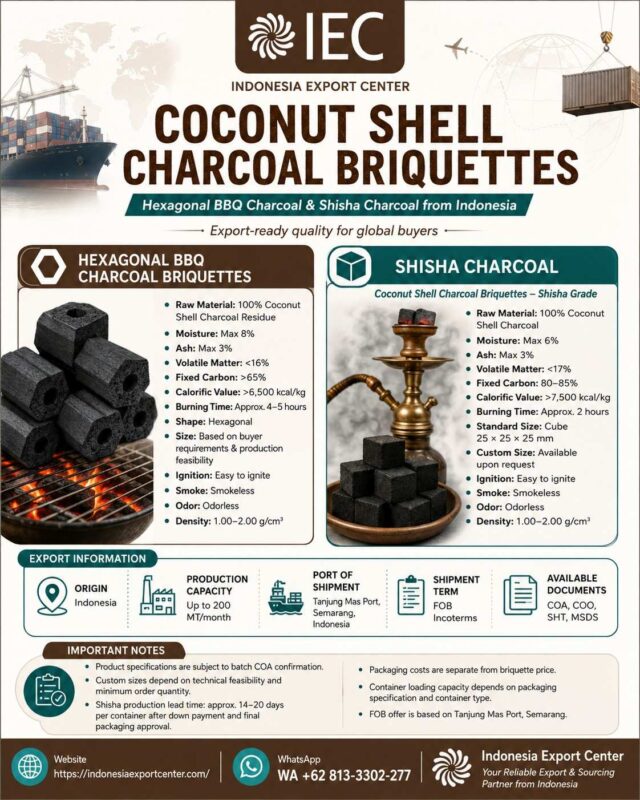
Coconut Charcoal Briquette Specifications Explained: Ash, Moisture, Fixed Carbon, Volatile Matter and Burning Time
International buyers rarely evaluate coconut charcoal briquettes by appearance alone. Two briquettes may have the same cube, finger, hexagonal, or pillow shape but perform very differently when ignited.
The difference is usually found in the product specification.
Ash content, moisture, fixed carbon, volatile matter, calorific value, ignition behaviour, and burning time collectively determine whether a coconut charcoal briquette is suitable for shisha, hookah, barbecue, restaurant, food-service, or retail distribution.
However, buyers should not interpret these parameters separately. A briquette with high fixed carbon may provide stable heat, but excessive density can make ignition slower. Low moisture is generally desirable, but burning time also depends on briquette dimensions, airflow, binder composition, particle size, and compression pressure.
This guide explains the five specifications most frequently discussed in international coconut charcoal transactions: ash, moisture, fixed carbon, volatile matter, and burning time.
Quick Overview of Coconut Charcoal Briquette Specifications
| Parameter | What It Measures | Why It Matters to Buyers |
|---|---|---|
| Ash content | Non-combustible residue remaining after combustion | Influences cleanliness, heat transfer, residue volume, and user experience |
| Moisture content | Water contained in the briquette | Affects ignition, storage stability, usable energy, and product weight |
| Fixed carbon | Solid combustible fraction remaining after moisture, ash, and volatile matter are accounted for | Associated with sustained heat and charcoal combustion |
| Volatile matter | Compounds released when the sample is heated under controlled conditions | Influences ignition, flame development, smoke, aroma, and combustion behaviour |
| Burning time | Duration for which the briquette remains usefully burning under specified conditions | Important for shisha sessions, BBQ cooking, restaurants, and retail claims |
These values should always be interpreted together with the test method, reporting basis, briquette size, binder composition, and intended application.
Why the Laboratory Test Method Matters
A specification number is useful only when the buyer knows how it was obtained.
ASTM D1762 covers the determination of moisture, volatile matter, and ash in charcoal and is applicable to both charcoal lumps and briquettes. Current ISO methods for solid biofuels include ISO 18134-1:2022 for moisture, ISO 18122:2022 for ash, and ISO 18123:2023 for volatile matter.
Buyers should therefore avoid accepting a Certificate of Analysis that lists percentages without stating:
- The test method used
- Whether the result is reported as received or on a dry basis
- The date and identity of the tested production batch
- The laboratory that performed the analysis
- The sampling procedure
- Whether fixed carbon was measured or calculated
As-Received Basis Versus Dry Basis
The reporting basis can create an apparent difference between two laboratory reports even when the briquettes are similar.
An as-received basis includes moisture in the total sample mass. A dry basis excludes moisture before the remaining components are expressed as percentages. ISO 18134-1:2022 specifies that total moisture of solid biofuels as received is reported relative to the total mass of the test sample.
Consequently, an ash or fixed-carbon result reported on a dry basis should not be compared directly with an as-received result without conversion.
1. What Is Ash Content in Coconut Charcoal Briquettes?
Ash is the non-combustible mineral residue left after the combustible portion of the briquette has burned under specified test conditions.
It may originate from:
- Natural mineral matter in the coconut shell
- Soil, sand, or dust contamination
- Mineral content in the binder
- Contaminated charcoal powder
- Processing equipment or factory-floor contamination
- Deliberately added mineral ingredients
ISO 18122:2022 provides a current international method for determining ash content in solid biofuels. ASTM D1762 is also commonly referenced for charcoal analysis.
Why Buyers Prefer Low Ash
Lower ash generally means less residue after use. This is especially important for shisha charcoal because excessive residue may fall from the charcoal, obstruct airflow, cover the charcoal surface, or require more frequent ash handling.
For BBQ applications, ash can also interfere with air circulation and heat transfer if it accumulates around the fuel.
A 2023 study of coconut-shell charcoal briquettes found that increasing the proportion of cassava-peel adhesive increased ash content in the tested formulations. The researchers reported ash values between 1.50% and 2.86%, with the lowest result occurring in the formulation containing the highest proportion of coconut-shell charcoal. The same study noted that higher ash can reduce calorific value and combustion rate.
Does White Ash Always Mean High Quality?
Not necessarily.
Ash colour can be influenced by mineral composition, combustion temperature, oxygen availability, and additives. A visually attractive light-grey or white ash does not automatically prove that the product has low ash content, high fixed carbon, or safe ingredients.
For commercial purchasing, a laboratory result is more reliable than an ash-colour claim.
2. What Is Moisture Content?
Moisture content represents the amount of water present in the finished briquette.
ISO 18134-1:2022 describes a reference oven-drying method for determining moisture in solid biofuels. The standard applies to solid biofuels and reports total moisture on a wet or as-received basis.
Why Excessive Moisture Is Undesirable
Before a wet briquette can produce useful heat, part of its energy must first evaporate the water contained in the product. Excessive moisture can therefore contribute to:
- Slower ignition
- Unstable early combustion
- Lower effective heat output
- More steam or visible emissions during lighting
- Increased risk of cracking during heating
- Additional shipping weight that does not contribute useful fuel
- Moisture migration inside plastic or carton packaging
- Product deterioration during long storage
Coconut charcoal briquettes are hygroscopic, meaning they can absorb moisture from humid air. Packaging and warehouse conditions therefore remain important even after the briquettes have completed the factory drying process.
The 2023 coconut-shell briquette study reported moisture values from 5.51% to 7.85% across different binder formulations. Greater binder addition was associated with higher moisture in that experiment.
A 2026 study examining rapid determination of coconut charcoal briquette drying completion noted that industrial burning tests can take at least 120 minutes, while normal production drying may continue for more than 48 hours. The research illustrates why drying control is both a quality issue and a production-cost issue.
Moisture Can Change After Testing
A laboratory result represents the sample at the time of analysis. Moisture may increase later if finished briquettes are:
- Stored in an open or humid warehouse
- Packed before adequately cooling
- Exposed during container loading
- Packed in unsuitable inner plastic
- Shipped in a container affected by condensation
- Stored for a long period after the Certificate of Analysis is issued
Buyers should therefore request a representative pre-shipment sample or inspection when moisture is a critical contractual requirement.
3. What Is Fixed Carbon?
Fixed carbon is the solid combustible fraction remaining after moisture, volatile matter, and ash are accounted for in proximate analysis.
It is not identical to the total elemental carbon reported in an ultimate analysis.
In many laboratory reports, fixed carbon is calculated by difference:
Fixed Carbon (%) = 100 − Moisture − Volatile Matter − Ash
The calculation must use values reported on a consistent basis. The 2024 coconut-shell bio-briquette study by Yirijor and Bere used this calculation for percentage fixed carbon.
Why Fixed Carbon Matters
Fixed carbon represents the part of the briquette that continues to oxidise after much of the volatile fraction has been released. A higher fixed-carbon value is therefore generally associated with:
- A stronger charcoal character
- Sustained glowing combustion
- More stable heat
- Potentially longer useful performance
- Lower relative proportions of moisture, ash, and volatile matter
However, fixed carbon should not be used as the only indicator of quality.
A dense briquette with high fixed carbon may still ignite slowly. A product can also show an apparently favourable fixed-carbon result while having poor mechanical strength, inconsistent dimensions, unacceptable odour, sparks, cracks, or packaging damage.
Fixed Carbon Is Influenced by Production
The final value can be affected by:
- Carbonisation temperature
- Carbonisation duration
- Oxygen control during carbonisation
- Quality of the coconut-shell charcoal
- Binder type and binder percentage
- Particle size
- Contamination
- Drying conditions
The 2024 study on coconut-shell charcoal briquettes found that binder type, binder concentration, and particle size produced substantial differences in moisture, volatile matter, ash, fixed carbon, heating value, ignition, and burning behaviour. Its highest fixed-carbon result was obtained from a particular fine-particle and corn-binder formulation, demonstrating that production variables can materially change the finished fuel.
4. What Is Volatile Matter?
Volatile matter is the portion released as gases and vapours when a prepared sample is heated under controlled conditions without the normal amount of oxygen required for complete combustion.
ISO 18123:2023 specifies the requirements and method for determining volatile matter in solid biofuels.
Volatile matter is not simply “smoke.” It is a laboratory-defined fraction that may include combustible gases and vapours released during heating.
How Volatile Matter Affects Performance
A certain amount of volatile matter can help a briquette ignite. However, an excessively high volatile fraction may be associated with:
- More visible flame during initial combustion
- Faster mass loss
- Stronger odour
- Smoke during lighting
- Less stable heat
- Lower calculated fixed carbon
Very low volatile matter may contribute to clean glowing combustion but can make the briquette more difficult to ignite. This creates a practical balance between easy ignition and stable, low-smoke performance.
The appropriate result depends on whether the product is intended for shisha, BBQ, restaurant cooking, or another application.
Why Binder Selection Matters
Uncarbonised starch-based binders contribute differently to volatile matter than carbonised coconut shell.
Binder quantity must therefore be controlled carefully. Too little binder may cause breakage, dust, and poor handling strength. Too much binder may alter moisture, ash, volatile matter, calorific value, density, ignition, and burning behaviour.
Recent studies confirm that binder type and concentration can significantly alter both the mechanical and combustion characteristics of coconut-shell charcoal briquettes.
5. What Does Burning Time Mean?
Burning time is the duration for which a briquette continues to burn or deliver useful heat under a defined test condition.
Unlike ash, moisture, and volatile matter, burning time is not a simple proximate-analysis value. It is a performance measurement.
A claim such as “120-minute burning time” is incomplete unless the supplier also explains:
- Briquette dimensions
- Weight per piece
- Number of pieces tested
- Ignition method
- Starting point of the timer
- Stove, burner, or heat-management device
- Airflow
- Ambient conditions
- Whether the briquette was moved or turned
- Test endpoint
- Whether the test measured total burning, useful heat, or time until complete ash formation
Total Burning Time Versus Useful Heating Time
These terms should not be treated as identical.
Total burning time may continue until virtually all combustible material has disappeared.
Useful heating time describes the period during which the briquette maintains heat suitable for its intended application.
For shisha buyers, useful stable heat may be more important than the final weak glowing stage. For BBQ buyers, heat intensity, cooking duration, ignition time, and fuel consumption may be more relevant than the longest possible burn.
The 2024 coconut-shell study separately evaluated ignition time, burning time, and boiling time. This distinction is important because a briquette may burn for a long period without transferring heat efficiently enough for the intended use.
How the Five Parameters Interact
The best coconut charcoal briquette is not necessarily the one with the highest or lowest individual number.
The parameters interact:
- Higher moisture reduces the proportion of immediately usable dry fuel.
- Higher ash leaves more non-combustible residue and may obstruct airflow.
- Higher volatile matter can support ignition but may increase flame or emissions during lighting.
- Higher fixed carbon generally supports sustained glowing heat.
- Higher density may extend burning but can slow ignition.
- More binder may improve strength but can affect moisture, ash, volatiles, and heating value.
- Smaller particles may improve compaction, although excessive compaction can restrict oxygen movement.
- Briquette dimensions strongly influence surface area, mass, ignition, heat release, and burning time.
Laboratory analysis should therefore be combined with a practical burning test and physical-quality inspection.
Shisha and BBQ Briquettes Should Not Use Identical Specifications
Shisha charcoal and BBQ charcoal have different performance priorities.
Shisha or Hookah Charcoal
Shisha buyers commonly focus on:
- Low ash
- Controlled moisture
- High and consistent fixed carbon
- Controlled volatile matter
- Long, stable heating
- Minimal smoke after complete ignition
- Neutral odour
- Minimal sparking
- Uniform cube or other requested shape
- Resistance to cracking
- Consistent piece weight
- Stable performance in a heat-management device
BBQ Charcoal Briquettes
BBQ buyers may give greater attention to:
- Ignition time
- Cooking heat
- Duration of usable heat
- Mechanical strength
- Shape and airflow
- Ash generation
- Smoke and odour
- Food-contact suitability
- Packaging and storage durability
EN 1860-2:2023 specifically covers requirements and test methods for barbecue charcoal and barbecue charcoal briquettes used in barbecue appliances. Because its scope is barbecue fuel, it should not automatically be treated as a complete specification for shisha charcoal.
Recommended Coconut Charcoal Briquette Purchasing Specification
Before ordering, buyers should issue a written specification containing at least the following information:
| Specification Item | Buyer Requirement |
|---|---|
| Product application | Shisha, hookah, BBQ, restaurant, retail, or private label |
| Raw material | Coconut-shell charcoal |
| Briquette shape | Cube, flat cube, finger, hexagonal, pillow, or custom |
| Dimensions and tolerance | Stated in millimetres |
| Piece weight and tolerance | Stated in grams |
| Moisture | Maximum percentage and reporting basis |
| Ash | Maximum percentage and reporting basis |
| Fixed carbon | Minimum percentage and reporting basis |
| Volatile matter | Maximum or agreed range |
| Calorific value | Minimum value and unit |
| Ignition time | Defined test procedure |
| Burning time | Minimum time under an agreed protocol |
| Smoke | Acceptance criteria during and after ignition |
| Odour | Neutral or agreed requirement |
| Sparks | Acceptance limit |
| Cracks and breakage | Maximum defective percentage |
| Packaging | Inner box, master carton, plastic liner, and private label |
| Test method | ISO, ASTM, or another mutually agreed method |
| Inspection | Pre-shipment inspection or third-party laboratory testing |
This approach is more reliable than purchasing based only on claims such as “premium,” “long burning,” “low ash,” or “export quality.”
Questions Buyers Should Ask a Coconut Charcoal Briquette Supplier
Before confirming an international order, ask the supplier:
- Is the Certificate of Analysis based on the current production batch?
- Which laboratory and test methods were used?
- Are the results reported as received or on a dry basis?
- How is burning time tested?
- What are the dimensions and piece-weight tolerances?
- What binder is used and at what approximate percentage?
- Can the supplier provide samples before mass production?
- Can private-label packaging be produced?
- What is the acceptable breakage level after container shipment?
- Which documents are available for export and destination-country clearance?
The final specification should become part of the quotation, purchase contract, or sales agreement.
Source Coconut Charcoal Briquettes from Indonesia
Indonesia is an important sourcing location for coconut-based products and processed coconut charcoal. International buyers can source coconut charcoal briquettes for shisha, hookah, BBQ, restaurants, wholesale distribution, retail packaging, and private-label programmes.
Indonesia Export Center supports international buyers as an Indonesian coconut charcoal briquette supplier and export sourcing partner. Our team assists with supplier coordination, specification matching, sample requests, packaging discussions, quotation preparation, and export-oriented shipment support.
Available sourcing discussions may include:
- Shisha-grade coconut charcoal briquettes
- Hexagonal BBQ charcoal briquettes
- Cube and custom-size briquettes
- Bulk and container orders
- Standard or private-label cartons
- FOB, CFR, or CIF shipment
- Certificate of Analysis and supporting documents
- Buyer-specific specifications
To request a quotation, buyers should provide:
- Required product type
- Intended application
- Target ash, moisture, fixed carbon, and volatile matter
- Required size and shape
- Quantity or monthly demand
- Packaging preference
- Destination port
- Preferred shipment term
Indonesia Export Center
Website: indonesiaexportcenter.com
WhatsApp: +62 813-3302-277
Email: info@indonesiaexportcenter.com
Contact Indonesia Export Center to discuss coconut charcoal briquette specifications, samples, packaging, container capacity, and export shipment requirements from Indonesia.
Frequently Asked Questions
What is the most important coconut charcoal briquette specification?
No single parameter determines overall quality. Ash, moisture, fixed carbon, volatile matter, density, strength, ignition, burning time, smoke, odour, and size consistency should be evaluated together.
Is higher fixed carbon always better?
Higher fixed carbon is generally favourable for sustained charcoal combustion, but it does not guarantee easy ignition, adequate mechanical strength, low ash, neutral odour, or a specific burning time.
Why should ash content be low?
Low ash reduces the quantity of non-combustible residue and can help maintain airflow and cleaner handling. It is particularly important for shisha and premium retail applications.
Does low moisture make charcoal burn longer?
Low moisture prevents energy from being wasted evaporating water, but burning duration also depends on fixed carbon, density, dimensions, airflow, binder, particle size, and the test device.
Can burning time be verified from a Certificate of Analysis?
Burning time normally requires a separate performance test. The test conditions must be documented because briquette size, airflow, ignition method, and endpoint can significantly change the result.
Are BBQ and shisha charcoal specifications the same?
No. BBQ specifications focus on cooking performance and applicable market standards, while shisha buyers commonly require stricter control of ash, odour, smoke, sparks, cube dimensions, and heat stability.
References
- International Organization for Standardization, ISO 18134-1:2022—Solid Biofuels: Determination of Moisture Content, Part 1: Reference Method.
- International Organization for Standardization, ISO 18122:2022—Solid Biofuels: Determination of Ash Content.
- International Organization for Standardization, ISO 18123:2023—Solid Biofuels: Determination of Volatile Matter.
- ASTM International, ASTM D1762—Standard Test Method for Chemical Analysis of Wood Charcoal.
- J. Yirijor and A. A. T. Bere, “Production and Characterization of Coconut Shell Charcoal-Based Bio-Briquettes as an Alternative Energy Source for Rural Communities,” Heliyon, vol. 10, 2024, e35717.
- B. Rudiyanto et al., “Utilization of Cassava Peel Waste as an Adhesive in the Manufacture of Coconut Shell Charcoal Briquettes,” International Journal of Renewable Energy Development, vol. 12, no. 2, pp. 270–276, 2023.
- A. Prasetyadi et al., “Rapid Coconut Shell Charcoal Briquette Drying Completion Determinant Using Plate Electrodes with Electrolyte,” Journal of Engineering and Applied Science, 2026.
- European Committee for Standardization, EN 1860-2:2023—Barbecue Charcoal and Barbecue Charcoal Briquettes: Requirements and Test Methods.
