![Indonesia Export Center [IEC]](https://indonesiaexportcenter.com/wp-content/uploads/2023/07/logo-no-background.svg)
![Indonesia Export Center [IEC]](https://indonesiaexportcenter.com/wp-content/uploads/2023/07/svgviewer-output.svg)
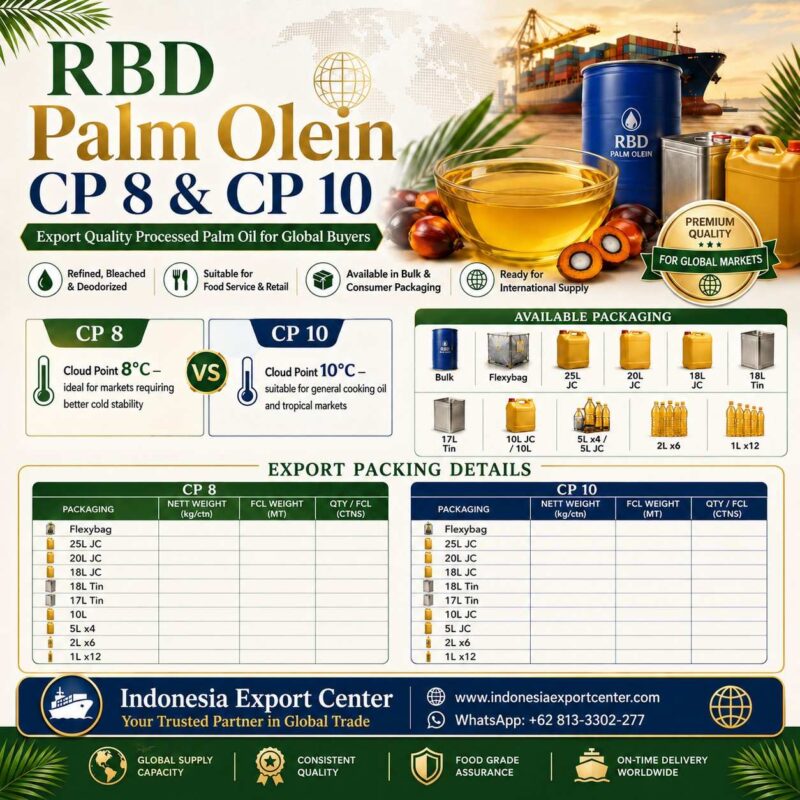
RBD Palm Olein CP8 vs CP10: Which Grade Should Buyers Choose?
International buyers comparing RBD Palm Olein CP8 vs CP10 often assume that CP8 is automatically superior because it has a lower cloud point. In practice, however, the best grade depends on the destination climate, storage conditions, packaging, customer expectations, regulatory requirements, and target price.
Both CP8 and CP10 are refined palm olein grades commonly used for household cooking oil, commercial frying, food processing, and private-label edible oil products. Their most important difference is their behavior at lower temperatures.
RBD Palm Olein CP8 has a maximum cloud point of approximately 8°C, while CP10 has a maximum cloud point of approximately 10°C under the applicable testing conditions. CP8 therefore offers better clarity in moderately cooler environments, whereas CP10 is generally suitable for warm and tropical markets.
This guide explains the technical and commercial differences between the two grades so buyers can select the right product before requesting a quotation from an RBD Palm Olein supplier from Indonesia.
What Is RBD Palm Olein?
RBD stands for:
- Refined
- Bleached
- Deodorized
Palm olein is the liquid fraction obtained when palm oil is fractionated into a liquid component, called olein, and a higher-melting solid component, called stearin. The Codex Alimentarius defines palm olein as the liquid fraction derived from the fractionation of palm oil.
During refining, undesirable free fatty acids, pigments, odors, flavors, moisture, and other impurities are reduced. The resulting RBD palm olein is a light-colored, neutral-tasting edible oil suitable for consumer and industrial food applications.
It is important to distinguish normal palm olein from palm superolein. Codex defines palm superolein as a specially fractionated liquid palm oil with an iodine value of 60 or higher. Therefore, CP8 should not automatically be described as “superolein” unless its actual iodine value and production specification meet that definition.
What Does CP8 or CP10 Mean?
The letters “CP” refer to cloud point.
Cloud point is the temperature at which visible crystals begin to form in the oil during controlled cooling, causing the oil to appear cloudy. It is not exactly the same as a freezing point, and cloudiness does not necessarily mean that the oil is spoiled.
Typical commercial limits are:
- CP8: Cloud point of 8°C maximum
- CP10: Cloud point of 10°C maximum
A lower cloud point generally indicates that the oil can maintain better clarity at lower temperatures. Research on palm oil fractionation has also shown that more unsaturated olein fractions usually have higher iodine values and lower cloud points.
However, storage duration, temperature fluctuations, fatty-acid composition, diglyceride content, and crystallization history can also influence clarity. Research published by the Malaysian Palm Oil Board found that palm olein samples with different iodine values behaved differently during extended storage at low temperatures.
Typical RBD Palm Olein CP8 vs CP10 Specifications
The following figures represent commonly used commercial specifications. The final sales contract, product data sheet, and certificate of analysis should always take priority.
| Parameter | RBD Palm Olein CP8 | RBD Palm Olein CP10 |
|---|---|---|
| Cloud Point | 8°C max | 10°C max |
| Iodine Value, Wijs | 57 min, commonly higher | 56 min |
| Free Fatty Acid as Palmitic | 0.10% max | 0.10% max |
| Moisture and Impurities | 0.10% max | 0.10% max |
| Slip Melting Point | 24°C max | 24°C max |
| Colour, Lovibond | Commonly 3 Red max | Commonly 3 Red max |
| Peroxide Value at Shipment | Frequently 1.0 meq/kg max | Frequently 1.0 meq/kg max |
Commercial specification sheets reviewed for CP8 and CP10 list maximum cloud points of 8°C and 10°C respectively, with CP8 having a minimum iodine value of 57 and CP10 a minimum iodine value of 56. Both sheets specify maximum FFA and moisture-and-impurities levels of 0.1%.
A laboratory comparison of CP8 and CP10 palm olein samples also reported iodine values of approximately 58.17–58.26 for the CP8 samples and 56.26–56.48 for the CP10 samples. All tested samples remained within the referenced limits for FFA, moisture and impurities, colour, and melting point.
Specifications can vary slightly among refineries, origins, national standards, and buyer contracts. The Malaysian Palm Oil Board notes that palm superolein does not have one universal international specification and that individual markets may apply their own standards.
The Main Differences Between CP8 and CP10
1. Low-Temperature Clarity
The most practical difference is how the oil performs when exposed to lower temperatures.
CP8 is less likely than CP10 to become cloudy when storage or transportation temperatures approach 8–10°C. This can be important for retail products sold in transparent PET bottles because consumers may interpret visible crystals as poor quality, even when the crystallization is a natural physical characteristic of palm olein.
CP10 is normally adequate when the product will be shipped, stored, and sold in consistently warm conditions.
Neither grade should be assumed to remain clear under refrigerated or near-freezing conditions. Buyers requiring clarity at temperatures well below 8°C may need to discuss CP6, double-fractionated olein, superolein, or a specific cold-stability requirement with the refinery.
2. Iodine Value
Iodine value measures the relative degree of unsaturation in an oil. A higher iodine value generally corresponds to a more unsaturated liquid fraction and is commonly associated with a lower cloud point.
CP8 normally has a slightly higher iodine value than CP10. This helps explain its improved clarity at moderately lower temperatures. MPOB and fractionation research both describe the relationship between higher iodine value and lower cloud point in palm olein fractions.
However, buyers should not choose a grade solely by comparing iodine values. Iodine value is only one quality parameter. FFA, moisture, peroxide value, colour, contaminants, freshness, storage conditions, and production consistency are also important.
3. Fractionation Requirement
Achieving a lower cloud point requires careful control of crystallization temperature, cooling profile, agitation, and separation of the liquid and solid fractions.
Research on dry fractionation found that crystallization temperature significantly affects iodine value, cloud point, slip melting point, and solid-fat content. Producing olein with stronger cold stability requires an appropriate cooling profile and effective filtration.
As a commercial inference, CP8 may be quoted at a premium over CP10 because its lower-cloud-point specification can require tighter fractionation control and may affect production yield. The actual difference is not fixed and should be confirmed through current quotations.
4. Market Availability
CP10 is widely offered for general household cooking and food-processing applications. Indonesia’s official Inaexport marketplace, for example, lists Indonesian RBD Palm Olein CP10 with a minimum iodine value of 56, maximum FFA of 0.1%, maximum moisture and impurities of 0.1%, and multiple packing formats.
CP8 is also available from Indonesian refineries and exporters, but buyers should confirm current production schedules, minimum order quantity, packing capacity, private-label availability, and lead time before issuing an ICPO or purchase order.
When Should Buyers Choose RBD Palm Olein CP10?
CP10 is usually the practical choice when:
The Destination Has a Warm Climate
CP10 is generally suitable for tropical and consistently warm markets where temperatures are unlikely to remain below 10°C during storage and distribution.
Potential markets may include parts of Southeast Asia, South Asia, the Middle East, and Africa. Nevertheless, buyers should assess actual seasonal conditions rather than selecting a grade based only on the country’s general climate.
The Product Is Used for General Cooking and Frying
CP10 can be used for:
- Household cooking oil
- Deep frying
- Stir-frying
- Restaurant and catering operations
- Snack and food production
- Bakery and food-service applications
- Bulk industrial edible-oil requirements
Commercial product sheets describe CP10 as suitable for cooking, stir-frying, deep-frying, consumer use, and industrial use.
The Buyer Prioritizes Competitive Landed Cost
When both grades are technically acceptable, buyers can request quotations for CP8 and CP10 and compare:
- FOB price
- Ocean freight
- Packaging cost
- Private-label cost
- Import duty
- Destination charges
- Total landed cost per litre or metric ton
Choosing CP10 can avoid paying for a lower cloud point that the destination market does not actually require.
When Should Buyers Choose RBD Palm Olein CP8?
CP8 may be the better option when:
The Supply Chain Experiences Cooler Temperatures
CP8 provides an additional margin of cold clarity compared with CP10. It may be preferable where containers, warehouses, trucks, retail stores, or distribution centres experience temperatures between approximately 8°C and 10°C.
Buyers should examine the lowest expected temperature throughout the complete supply chain, not only the average temperature at the final destination.
Retail Appearance Is Important
Cloudiness is more visible in clear PET bottles than in metal tins, opaque jerrycans, drums, flexitanks, or bulk tanks.
For premium retail oil sold in transparent bottles, CP8 may reduce consumer complaints related to temporary cloudiness during cooler weather.
The Importer’s Product Standard Requires CP8
Some distributors, supermarket chains, government tenders, and private-label owners specify a maximum cloud point of 8°C.
In such cases, CP10 should not be offered as an equivalent unless the buyer formally approves the substitution.
The Brand Is Positioned as a Higher Cold-Clarity Grade
CP8 may support a differentiated retail or food-service product where improved low-temperature appearance is commercially valuable.
However, marketing claims should remain accurate. CP8 should not automatically be called superolein unless the agreed iodine value meets the applicable superolein definition.
Is CP8 Always Better Than CP10?
No. CP8 has better low-temperature clarity, but that does not mean it is the correct grade for every buyer.
A buyer operating in a hot market may receive no practical benefit from paying for an 8°C cloud-point limit. Conversely, an importer serving a cooler market may face customer complaints if CP10 becomes cloudy during winter distribution.
The more accurate question is:
Which grade meets the lowest expected storage temperature, customer specification, intended application, and target landed cost?
CP8 and CP10 should therefore be treated as different commercial solutions rather than simply “high quality” and “low quality” products.
Does Cloudy Palm Olein Mean the Oil Is Defective?
Not necessarily.
Palm olein contains triglycerides with different melting and crystallization characteristics. When the oil is exposed to lower temperatures, some higher-melting components can form visible crystals.
Scientific studies show that palm olein clarity depends on temperature, iodine value, fatty-acid composition, diglyceride content, and fractionation history. At sufficiently low temperatures, even highly fractionated olein can crystallize.
Nevertheless, unexpected cloudiness should be investigated, especially when it occurs above the contractual cloud-point limit. Buyers should review:
- Certificate of Analysis
- Retained loading sample
- Storage-temperature records
- Container and tank cleanliness
- Possibility of contamination or blending
- Laboratory cloud-point retesting
- Sampling method and test procedure
What Buyers Should Include in an RFQ
An international buyer should provide complete information when requesting an offer from an Indonesian supplier.
A professional RFQ should include:
Product Information
- RBD Palm Olein CP8 or CP10
- Required specification
- Intended application
- Fortification requirements, where applicable
- Antioxidant requirements
- Required shelf life
Quantity and Contract Period
- Trial-order quantity
- Number and type of containers
- Monthly requirement
- Contract duration
- Delivery schedule
Packaging
Possible packaging options include:
- PET bottles
- Pouches
- Jerrycans
- Metal tins
- Steel or plastic drums
- IBC totes
- Flexitanks
- Bulk vessel shipment
Indonesian CP10 products are commercially offered in formats including flexibags, jerrycans, bottles, and pouches, while international product sheets also show drums, IBCs, and retail packs.
Trade Information
- Destination country
- Port of discharge
- FOB, CFR, or CIF quotation
- Preferred loading port
- Payment terms
- Required shipment date
- Inspection requirements
Documentation
Buyers may request:
- Product specification sheet
- Certificate of Analysis
- Certificate of Origin
- Health Certificate
- Halal Certificate
- Packing list
- Commercial invoice
- Bill of Lading
- Food-safety certification
- Sustainability certification, where required
Document availability must be confirmed for the selected refinery, exporter, packing facility, destination country, and shipment.
Buyer Decision Checklist
Use the following questions before selecting CP8 or CP10:
- What is the lowest expected temperature during shipping, warehousing, and retail distribution?
- Is the oil packed in clear bottles where cloudiness will be visible?
- Does the importer or retailer specify a maximum cloud point?
- Is the product intended for a tropical, temperate, or seasonally cold market?
- What iodine value is required?
- Are FFA, moisture, peroxide value, colour, and melting point included in the contract?
- Has the supplier provided a recent specification sheet and sample COA?
- Is the quoted product manufactured by a verified refinery or packed by an approved facility?
- What is the landed-cost difference between CP8 and CP10?
- Will an independent surveyor inspect quantity and quality before shipment?
Final Recommendation: CP8 or CP10?
Choose RBD Palm Olein CP10 when the destination and distribution chain remain consistently warm, the oil is intended for general cooking or industrial frying, and the buyer wants an economical standard grade.
Choose RBD Palm Olein CP8 when better low-temperature clarity is necessary, the product will be sold in transparent retail packaging, the supply chain experiences cooler temperatures, or the buyer’s specification explicitly requires a maximum cloud point of 8°C.
The safest procurement strategy is to request quotations for both grades and compare their specifications, packing options, minimum order quantities, lead times, and total landed costs.
For sourcing support, buyers can review our:
- RBD Palm Olein Supplier from Indonesia
- RBD Palm Olein CP8 Supplier
- RBD Palm Olein CP10 Supplier
Indonesia Export Center can assist international buyers in communicating their requirements to Indonesian suppliers, reviewing indicative specifications, coordinating quotations, and discussing suitable packing and shipment options.
Frequently Asked Questions
What is the main difference between CP8 and CP10 palm olein?
The main difference is the maximum cloud point. CP8 has a maximum cloud point of approximately 8°C, while CP10 has a maximum of approximately 10°C. CP8 therefore provides better clarity at moderately lower temperatures.
Does CP8 have a higher iodine value than CP10?
Typical CP8 specifications require an iodine value of at least 57, while CP10 commonly requires at least 56. Actual production results can be higher, so buyers should verify the shipment COA.
Can CP10 be used for deep frying?
Yes. CP10 is commercially specified for cooking, stir-frying, deep-frying, and consumer or industrial food applications.
Is CP8 considered palm superolein?
Not automatically. Codex defines palm superolein as a specially fractionated palm oil liquid fraction with an iodine value of 60 or higher. A CP8 product with an iodine value below 60 should not automatically be marketed as superolein.
Which grade is better for Saudi Arabia, Africa, or other warm markets?
CP10 may be sufficient for many warm-market applications, but buyers should consider winter temperatures, inland transportation, air-conditioned storage, product packaging, and retailer specifications before deciding.
Which grade should be used in cold climates?
CP8 performs better than CP10 at moderately low temperatures, but it is not intended to guarantee clarity under refrigeration or near-freezing conditions. For colder applications, buyers should discuss CP6, superolein, or a contractual cold-stability test.
What documents should be checked before buying?
At minimum, review the product specification, recent COA, Certificate of Origin, Halal Certificate where required, food-safety documents, packing details, shelf life, loading-port information, and sales-contract quality clauses.
Reference Basis
This article was prepared using the Codex Standard for Named Vegetable Oils, Malaysian Palm Oil Board technical information, palm-oil fractionation research, commercial CP8 and CP10 specification sheets, an Indonesian RBD palm olein quality study, and product information published through Indonesia’s Inaexport platform.
