![Indonesia Export Center [IEC]](https://indonesiaexportcenter.com/wp-content/uploads/2023/07/logo-no-background.svg)
![Indonesia Export Center [IEC]](https://indonesiaexportcenter.com/wp-content/uploads/2023/07/svgviewer-output.svg)
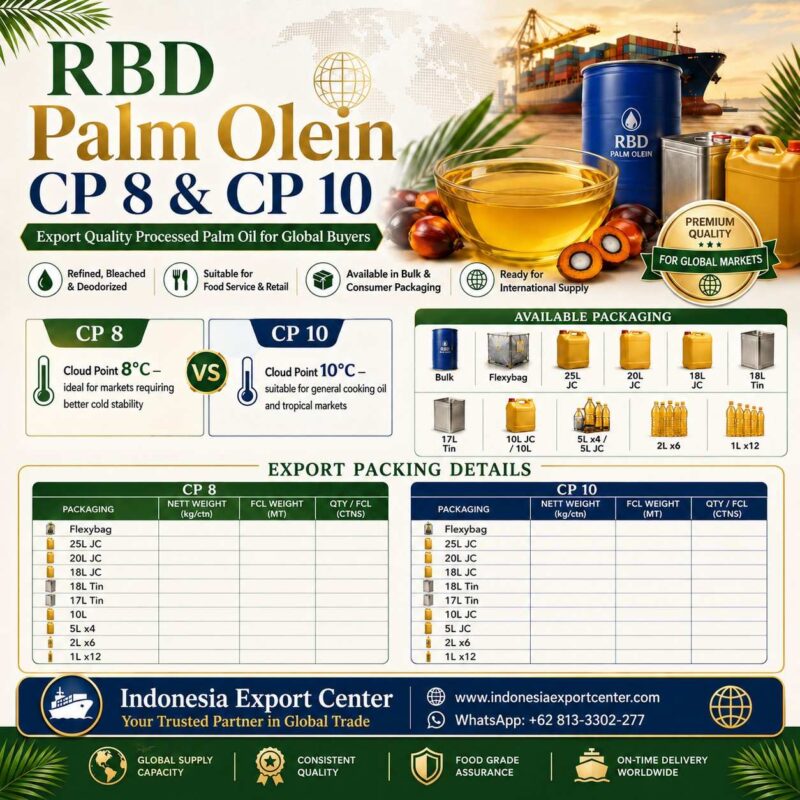
International buyers often ask a supplier a simple question:
“What is your best CIF price for RBD Palm Olein?”
However, a supplier cannot calculate an accurate quotation without knowing the product grade, packaging, destination port, shipment quantity, labeling requirements, payment terms, and delivery schedule.
Two buyers purchasing the same quantity of RBD Palm Olein may receive significantly different quotations because one buyer requests bulk flexitank shipment while another requires private-label tins packed in cartons. Their freight routes, packaging costs, documentation requirements, and insurance arrangements may also be different.
Understanding the differences between FOB, CFR, and CIF will help buyers compare offers correctly and avoid unexpected logistics costs.
Incoterms® are internationally recognized trade rules issued by the International Chamber of Commerce. They clarify how transportation responsibilities, costs, risks, customs procedures, and insurance obligations are divided between sellers and buyers. FOB, CFR, and CIF belong to the Incoterms® rules intended for sea and inland waterway transportation.
Why Accurate Quotation Details Matter
An export quotation is not simply the factory price of the oil.
A complete RBD Palm Olein quotation may include:
- Product cost
- Refining and processing costs
- Consumer or industrial packaging
- Private-label printing
- Cartons, pallets, and protective materials
- Inland transportation to the loading port
- Export customs clearance
- Port handling and loading
- Ocean freight
- Cargo insurance
- Inspection and laboratory analysis
- Export certificates and documentation
- Banking and payment-related costs
The final amount depends on which costs are included under the selected Incoterm.
Therefore, buyers should not compare a supplier’s FOB price directly with another supplier’s CIF price. The buyer must first identify which services and charges are included in each offer.
What Is FOB for RBD Palm Olein?
FOB means Free on Board.
Under FOB, the seller is generally responsible for preparing the goods, transporting them to the agreed Indonesian port, completing export formalities, and loading the cargo onto the vessel nominated by the buyer.
The buyer arranges and pays for the main ocean transportation from the loading port to the destination.
The correct quotation format should identify the loading port and the Incoterms edition, for example:
USD 1,XXX per MT FOB [Named Indonesian Loading Port], Incoterms® 2020
Risk normally transfers from the seller to the buyer when the goods have been loaded on board the vessel at the named port of shipment. Under FOB, the buyer is responsible for nominating the carrier, arranging the transportation contract, paying the main freight, and handling import procedures at the destination.
Seller’s Typical Responsibilities Under FOB
The seller generally handles:
- Product preparation
- Export-standard packaging
- Inland transport to the port
- Export customs formalities
- Origin port handling
- Loading the goods on board
- Export documentation required by the contract
Buyer’s Typical Responsibilities Under FOB
The buyer generally handles:
- Vessel or carrier nomination
- Ocean freight
- Marine cargo insurance
- Destination port charges
- Import customs clearance
- Import duties and taxes
- Inland delivery in the destination country
When Should Buyers Request FOB?
FOB may be suitable when the buyer:
- Has an established freight forwarder
- Can negotiate competitive shipping rates
- Wants control over the carrier and shipment schedule
- Has an annual freight contract
- Wants to arrange cargo insurance independently
- Regularly imports edible oils
FOB may also make it easier to compare the product and origin-handling costs offered by different Indonesian suppliers.
However, buyers should confirm whether the shipment structure is suitable for FOB. ICC guidance notes that where containerized goods are delivered to a terminal before being loaded on board, FCA may sometimes be more technically appropriate than FOB.
What Is CFR for RBD Palm Olein?
CFR means Cost and Freight.
Under CFR, the seller arranges and pays for ocean freight from the loading port to the named destination port.
A quotation should therefore be written clearly, for example:
USD 1,XXX per MT CFR Jeddah Islamic Port, Saudi Arabia, Incoterms® 2020
Under CFR, the seller pays the cost of transporting the cargo to the destination port. However, the risk of loss or damage normally transfers to the buyer when the goods are loaded on board the vessel at the port of shipment—not when the cargo arrives at the destination.
This difference between cost responsibility and risk transfer is frequently misunderstood.
ICC guidance explains that the CFR seller arranges transportation and pays freight to the destination port, while the buyer bears the cargo risk after the goods have been delivered on board at the loading port. The buyer is also advised to arrange cargo insurance because the seller has no obligation to purchase insurance under CFR.
Seller’s Typical Responsibilities Under CFR
The seller generally handles:
- Product preparation
- Packaging and labeling
- Inland transport to the loading port
- Export clearance
- Origin port charges
- Loading on board
- Ocean freight to the named destination port
- Agreed shipping documents
Buyer’s Typical Responsibilities Under CFR
The buyer generally handles:
- Marine cargo insurance
- Destination port handling not included in freight
- Import customs clearance
- Import duties and taxes
- Customs inspection charges
- Inland transportation after arrival
- Demurrage or storage caused by delayed cargo clearance
When Should Buyers Request CFR?
CFR may be suitable when:
- The supplier can obtain a better freight rate
- The buyer wants the seller to arrange shipping
- The buyer already has a global cargo insurance policy
- The buyer wants more insurance coverage than the standard CIF arrangement
- The buyer understands destination clearance procedures
CFR may initially appear cheaper than CIF because the seller does not include cargo insurance. However, buyers should add the cost of their own marine insurance before comparing the total landed cost.
What Is CIF for RBD Palm Olein?
CIF means Cost, Insurance and Freight.
Under CIF, the seller arranges and pays for:
- The goods;
- Ocean freight to the named destination port; and
- Marine cargo insurance in accordance with the agreed contract.
An accurate CIF quotation should include the exact destination port:
USD 1,XXX per MT CIF Mogadishu Port, Somalia, Incoterms® 2020
CIF is widely requested by international buyers because the supplier coordinates the main transportation and insurance arrangements.
However, CIF does not mean that the seller carries the cargo risk until arrival. Similar to CFR, the risk generally transfers when the goods are loaded on board at the origin port, although the seller pays for freight and insurance to the named destination port.
Seller’s Typical Responsibilities Under CIF
The seller generally handles:
- Product preparation
- Packaging
- Export clearance
- Origin handling
- Loading
- Ocean freight
- Minimum required cargo insurance
- Commercial invoice
- Packing list
- Bill of lading
- Insurance certificate or policy
- Other contractually agreed documents
Buyer’s Typical Responsibilities Under CIF
The buyer generally handles:
- Import customs clearance
- Import license requirements
- Duties and taxes
- Destination port charges not included in the freight contract
- Inland delivery after port arrival
- Additional insurance where required
- Cargo release and clearance procedures
Important: Check the Insurance Coverage
Under Incoterms® 2020, CIF normally requires the seller to arrange insurance based on the default minimum coverage associated with Institute Cargo Clauses (C), unless the parties agree to broader coverage.
Buyers who need more comprehensive protection should request:
- Institute Cargo Clauses (A), or equivalent all-risks coverage
- Coverage for 110% of invoice value, where agreed
- War risk coverage
- Strike risk coverage
- Coverage from the warehouse or port of origin
- Coverage until the agreed destination
- Insurance issued by an internationally acceptable insurer
ICC confirms that Institute Cargo Clauses (C) remains the default insurance level for CIF under Incoterms® 2020, while the parties may agree to a higher level of protection.
FOB vs CFR vs CIF: Quick Comparison
| Quotation Term | Ocean Freight Arranged By | Freight Paid By | Insurance Arranged By | Risk Normally Transfers |
|---|---|---|---|---|
| FOB | Buyer | Buyer | Buyer | When cargo is loaded on board at the origin port |
| CFR | Seller | Seller | Buyer | When cargo is loaded on board at the origin port |
| CIF | Seller | Seller | Seller | When cargo is loaded on board at the origin port |
The most important point is that CFR and CIF do not transfer risk at the destination port. The seller may pay the transportation cost to the destination, but the risk transfer point remains at the port of shipment.
Which Incoterm Should an RBD Palm Olein Buyer Choose?
There is no single Incoterm that is suitable for every transaction.
Choose FOB When You Want Shipping Control
FOB may be preferable when the buyer has:
- Competitive freight contracts
- A trusted shipping agent
- Experience arranging edible-oil shipments
- Strong cargo insurance coverage
- A preferred carrier or shipping line
Choose CFR When You Want the Supplier to Arrange Freight
CFR may be suitable when:
- The supplier has access to competitive freight rates
- The buyer wants to arrange insurance independently
- The buyer has an open marine insurance policy
- The buyer wants control over the insurance terms
Choose CIF When You Want Freight and Insurance Included
CIF may be suitable when:
- The buyer is importing for the first time
- The buyer does not have an insurance partner
- The supplier has better access to freight and insurance services
- The buyer wants one quotation covering product, freight, and minimum insurance
Nevertheless, the buyer must still calculate import duties, destination charges, customs clearance, and domestic transportation before determining the final landed cost.
Information Required for an Accurate RBD Palm Olein Quotation
A serious buyer should provide a complete Request for Quotation, commonly called an RFQ.
1. Specify the Exact Product Grade
Do not request only:
“RBD Palm Olein.”
Instead, specify:
- RBD Palm Olein CP8
- RBD Palm Olein CP10
- Another required grade
- Required maximum cloud point
- Applicable product standard
- Destination-country food regulations
Palm olein is recognized by Codex as the liquid fraction obtained from palm oil fractionation. Codex also provides quality and identity criteria for edible vegetable oils, including parameters related to composition, slip point, contaminants, labeling, and analysis.
Commercial CP8 and CP10 orders should nevertheless include a detailed specification sheet and not depend only on the grade name.
Buyers should state the required limits for:
- Cloud point
- Free fatty acid
- Moisture and impurities
- Iodine value
- Slip melting point
- Color
- Peroxide value
- Odor and taste
- Heavy metals, where required
For grade-specific information, buyers may review our pages for an [RBD Palm Olein CP8 Supplier] and [RBD Palm Olein CP10 Supplier].
2. State the Required Quantity
The buyer should provide:
- Trial-order quantity
- Number and type of containers
- Approximate metric tons per shipment
- Monthly requirement
- Contract period
- Shipment frequency
For example:
Trial order: 2 × 20-foot containers
Regular requirement: 10 containers per month for 12 months
A quotation for one trial container may differ from a quotation for a long-term monthly contract because production scheduling, packaging procurement, freight allocation, and raw-material planning are different.
3. Specify the Packaging
Packaging has a major impact on the price.
Common RBD Palm Olein packaging may include:
- Flexitank
- Food-grade drum
- IBC
- Jerrycan
- PET bottle
- Tin
- Bag-in-box
- Bulk vessel shipment
For retail or food-service packaging, the buyer should state:
- Net volume or net weight per unit
- Number of units per carton
- Packaging material
- Bottle, jerrycan, or tin dimensions
- Cap and handle specifications
- Carton quality
- Pallet requirements
- Shrink wrapping
- Barcode requirements
- Language requirements
- Target shelf life
A request for “17-liter tins” is still incomplete unless the buyer confirms whether the supplier will use the supplier’s brand, a neutral design, or the buyer’s private label.
4. Explain the Private-Label Requirements
For private-label cooking oil, provide:
- Brand name
- Logo
- Label artwork
- English or local-language text
- Arabic, French, or other required translations
- Nutritional information
- Manufacturing details
- Country-of-origin statement
- Batch-number format
- Production and expiry-date format
- Barcode
- Carton artwork
- Packaging approval process
The buyer should also confirm who is responsible for checking compliance with the destination country’s labeling regulations.
Artwork changes, printing plates, cylinders, packaging samples, and low-volume custom production may create additional costs.
5. State the Exact Incoterm and Port
Avoid incomplete requests such as:
“Please quote CIF Africa.”
Africa contains many countries and destination ports, each with different freight rates, routes, transshipment requirements, and port charges.
A better request is:
Please quote CIF Mombasa Port, Kenya, Incoterms® 2020.
For FOB quotations, identify the acceptable loading port or ask the supplier to confirm its regular port of loading.
For CFR or CIF, provide:
- Destination country
- Exact destination port
- Preferred terminal, where applicable
- Whether transshipment is acceptable
- Required arrival period
FOB, CFR, and CIF should always be followed by the named port and the agreed Incoterms edition.
6. Provide the Required Shipment Schedule
State:
- Earliest shipment date
- Latest acceptable shipment date
- Required arrival period
- Whether partial shipment is allowed
- Whether transshipment is allowed
- Expected monthly shipment schedule
- Required lead time after payment or Letter of Credit
The supplier may need to coordinate refining, packaging production, container availability, vessel space, inspection, and documentation.
7. Request a Detailed Price Breakdown
Where commercially possible, ask the supplier to separate:
- Product price
- Packaging cost
- Private-label cost
- Inspection cost
- Documentation cost
- Ocean freight
- Insurance
- Additional surcharges
A breakdown makes it easier to compare FOB, CFR, and CIF offers.
It also allows the buyer to determine whether arranging freight or insurance independently would be more economical.
8. Confirm What the Freight Includes
For CFR and CIF offers, ask:
- Is the freight rate based on a direct or transshipment service?
- Which shipping line is expected?
- Is the freight prepaid?
- Are origin terminal charges included?
- Are destination terminal charges included or excluded?
- Are fuel and security surcharges included?
- Is container detention free time specified?
- Is a heating pad required for flexitank shipments?
- Is flexitank installation included?
- Is the quotation subject to freight reconfirmation?
Ocean freight can change because of vessel capacity, fuel costs, port congestion, route disruptions, seasonal demand, and security conditions. UN Trade and Development has highlighted how shipping disruptions and demand changes can increase freight-rate volatility and affect international food prices.
Therefore, an RBD Palm Olein CFR or CIF offer should have a clear quotation-validity period.
9. State the Required Documents
The buyer should identify all required documents before the seller calculates the final price.
Documents may include:
- Commercial invoice
- Packing list
- Bill of lading
- Certificate of origin
- Certificate of analysis
- Health certificate
- Halal certificate
- Free Sale Certificate
- Phytosanitary certificate, if specifically required
- Fumigation certificate for wooden packaging
- Insurance certificate
- Weight certificate
- Quality certificate
- Inspection certificate
- Manufacturer’s declaration
- Certificate required by the destination-country authority
Not every document is automatically included in a standard offer. Third-party inspection, legalization, embassy certification, laboratory testing, and special government certificates may involve additional fees.
10. Explain the Inspection Requirement
Specify whether the buyer requires:
- Seller’s internal Certificate of Analysis
- Independent pre-shipment inspection
- Container loading supervision
- Quantity and weight verification
- Packaging inspection
- Sampling and laboratory analysis
- Seal verification
- Photo and video documentation
Where independent inspection is required, state the inspection company or confirm that the inspection agency must be mutually agreed.
11. State the Payment Terms
Incoterms do not replace the need for complete commercial payment conditions.
The RFQ should state the proposed payment method, such as:
- Telegraphic Transfer
- Advance payment and balance before shipment
- Advance payment and balance against shipping documents
- Irrevocable Letter of Credit at sight
- Confirmed Letter of Credit
- Documentary collection, where accepted
Also provide:
- Payment currency
- Bank requirements
- Document presentation conditions
- Whether partial shipment is permitted
- Whether third-party payment is involved
Payment risk, financing cost, bank charges, and document requirements may affect the supplier’s final quotation.
12. Request a Quotation Validity Period
The quotation should clearly state:
Offer valid until [date and time], subject to product and freight reconfirmation.
RBD Palm Olein prices and ocean freight rates can change. Buyers should therefore respond within the stated validity period or request an updated quotation before issuing a purchase order.
Sample RFQ for RBD Palm Olein
Subject: Request for Quotation – RBD Palm Olein CP10, CIF Jeddah
Dear Sales Team,
We are interested in purchasing RBD Palm Olein from Indonesia. Please provide your best quotation based on the following requirements:
Product: RBD Palm Olein CP10
Origin: Indonesia
Cloud Point: 10°C maximum
Quantity: 2 × 20-foot containers for the trial order
Regular Requirement: Approximately 10 containers per month
Packaging: 17-liter rectangular tins
Branding: Private label
Label Languages: English and Arabic
Destination: Jeddah Islamic Port, Saudi Arabia
Price Required: FOB Indonesian loading port and CIF Jeddah
Incoterms: Incoterms® 2020
Shipment: Earliest available shipment
Payment Terms: Please provide your accepted payment options
Inspection: Third-party pre-shipment inspection, if available
Please include the following:
- Product specification sheet
- Certificate of Analysis
- Halal certificate
- Food-safety certificates
- Packaging details
- Container loading quantity
- Production lead time
- Quotation validity
- Country of origin and loading port
- Available export documents
Please also confirm whether freight, insurance, labeling, printing, inspection, and documentation costs are included in your quotation.
Best regards,[Buyer’s Name][Company Name][Country][Email][WhatsApp]
Common Quotation Mistakes Buyers Should Avoid
Requesting “CIF Price” Without Naming the Port
Always provide the exact destination port. Freight to two ports in the same country may be different.
Comparing FOB and CIF Prices Directly
Add freight and insurance to the FOB offer before comparing it with CIF.
Assuming CIF Includes Import Duties
CIF does not normally include import duties, taxes, destination customs clearance, or final delivery to the buyer’s warehouse.
Assuming CIF Means the Seller Bears Risk Until Arrival
Under CIF, the seller pays freight and insurance to the named destination port, but risk normally transfers when the goods are loaded on board at the origin port.
Not Specifying CP8 or CP10
Different grades may have different production availability, specifications, applications, and prices.
Ignoring Packaging Details
A quotation for flexitank cargo cannot be compared with a quotation for private-label tins or jerrycans.
Not Asking About Destination Charges
Buyers should confirm destination terminal handling, delivery-order fees, storage, demurrage, customs inspection, and inland transport separately.
Requesting a Long Price Validity
Commodity and freight prices may change rapidly. Suppliers may only be able to hold an offer for a limited period.
How to Compare RBD Palm Olein Offers
Use a comparison sheet containing:
| Comparison Item | Supplier A | Supplier B | Supplier C |
|---|---|---|---|
| Product grade | |||
| Technical specification | |||
| Quantity | |||
| Packaging | |||
| Net weight per container | |||
| FOB price | |||
| Ocean freight | |||
| Insurance | |||
| CFR or CIF price | |||
| Inspection cost | |||
| Documentation cost | |||
| Shipment lead time | |||
| Payment terms | |||
| Quotation validity | |||
| Loading port | |||
| Destination charges |
The lowest price is not always the best offer.
Buyers should also evaluate:
- Supplier identity
- Refinery or manufacturer verification
- Product consistency
- Certification validity
- Export experience
- Production capacity
- Packaging quality
- Payment security
- Documentation capability
- Shipment reliability
For broader supplier-evaluation information, visit our [RBD Palm Olein Supplier from Indonesia] page.
Frequently Asked Questions
Is FOB always cheaper than CIF?
The FOB amount is normally lower because ocean freight and insurance are not included. However, the buyer’s final landed cost may be higher if the buyer cannot obtain competitive freight or insurance rates.
Does CFR include insurance?
No. Under CFR, the seller pays the freight to the named destination port, but the buyer generally arranges cargo insurance.
Does CIF include destination customs clearance?
No. CIF generally does not include import customs clearance, duties, taxes, or delivery from the destination port to the buyer’s warehouse.
Who bears the risk during a CIF shipment?
The buyer normally bears the cargo risk after the goods are loaded on board at the loading port. The seller arranges insurance for the buyer’s transit risk.
Should buyers request both FOB and CIF prices?
Yes. Requesting both prices can help the buyer compare the supplier’s freight rate with the buyer’s own forwarder quotation.
Why does a CIF quotation have a short validity?
The product price, vessel availability, insurance premium, and ocean freight may change. Suppliers may therefore need to reconfirm the price before accepting an order.
What information is most important for the supplier?
At minimum, provide:
- Product grade
- Quantity
- Packaging
- Destination port
- Incoterm
- Shipment schedule
- Payment terms
- Required certificates
Can CP8 and CP10 have the same price?
Prices may sometimes be close, but availability, production requirements, destination, packaging, quantity, and market conditions can create differences. Buyers should request separate confirmed offers for each grade.
Conclusion
An accurate RBD Palm Olein quotation begins with an accurate buyer requirement.
A request that only asks for the “best CIF price” is unlikely to produce a reliable offer. International buyers should clearly state the product grade, technical specifications, quantity, packaging, destination port, Incoterm, private-label requirements, inspection, documents, shipment schedule, and payment terms.
FOB may give experienced buyers greater control over freight. CFR allows the seller to arrange transportation while the buyer manages insurance. CIF includes seller-arranged freight and minimum insurance, but it does not eliminate the buyer’s responsibilities for import clearance, destination charges, and inland delivery.
By submitting a complete RFQ and comparing offers on the same commercial basis, buyers can reduce misunderstandings, calculate a more realistic landed cost, and build a more transparent relationship with an Indonesian RBD Palm Olein supplier.
Read also
https://indonesiaexportcenter.com/product/rbd-palm-olein-cp-8-cp-10-from-indonesia/
https://indonesiaexportcenter.com/rbd-palm-olein-cp10-supplier-indonesia/
Recommended Internal Links
Use the following anchor texts naturally within the website:
- RBD Palm Olein Supplier from Indonesia
Recommended for sections discussing Indonesian suppliers, export capability, documentation, and supplier verification. - RBD Palm Olein CP8 Supplier
Recommended for sections discussing product grades, lower-cloud-point requirements, specifications, and buyer applications. - RBD Palm Olein CP10 Supplier
Recommended for sections discussing standard cooking-oil requirements, tropical markets, packaging, and container orders.
References
- International Chamber of Commerce, Incoterms® Rules and Incoterms® 2020.
- ICC Academy, Incoterms® 2020: FAS or FOB?
- ICC Academy, Incoterms® 2020: CFR or CIF?
- International Trade Administration, Know Your Incoterms.
- FAO/WHO Codex Alimentarius, Standard for Named Vegetable Oils.
- UN Trade and Development, information on freight-rate volatility and its impact on international trade.
