

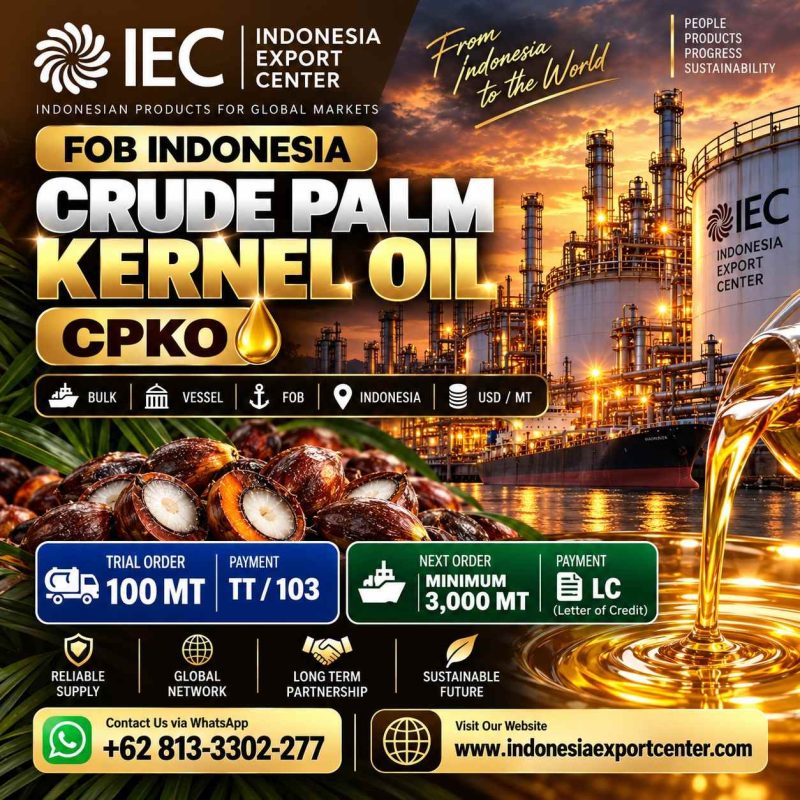
Source Crude Palm Kernel Oil for Your Soap Manufacturing Business
Indonesia Export Center (IEC) facilitates Indonesian Crude Palm Kernel Oil sourcing for industrial soap manufacturers, detergent producers, soap noodle factories, vegetable oil processors, and oleochemical ingredient companies.
Palm kernel oil is an important lauric oil feedstock associated with various soap and cleaning product manufacturing applications.
Its characteristic fatty acid composition makes palm kernel oil-derived ingredients relevant to formulations requiring suitable cleansing, lathering, and other performance characteristics.
However, crude palm kernel oil is an upstream industrial raw material. Its suitability for soap manufacturing depends on the actual quality, processing requirements, formulation design, and finished product standards.
IEC welcomes technical and commercial inquiries from soap manufacturers evaluating Indonesian CPKO for refining, industrial processing, or recurring feedstock procurement.
Why Palm Kernel Oil Is Used in Soap Manufacturing
Soap properties are influenced by the fatty acid composition of the oils and fats used during manufacturing.
Palm kernel oil contains a relatively high proportion of lauric acid compared with conventional palm oil.
Lauric oil-derived soap components may contribute to lather formation, cleansing characteristics, and selected physical properties.
Actual soap performance depends on the complete formulation, processing conditions, other ingredients, and intended application.
Crude palm kernel oil should not be treated as a universally ready-to-use soap ingredient.
Indonesian CPKO Specifications for Soap Manufacturers
| Parameter | Indicative Reference |
|---|---|
| Product | Crude Palm Kernel Oil |
| Origin | Indonesia |
| Product Grade | Crude Industrial Feedstock |
| Oil Category | Lauric Oil |
| FFA as Lauric Acid | Maximum 5.0% |
| Moisture and Impurities | Maximum 0.5% |
| Iodine Value | Approximately 16–19 |
| Lauric Acid | Approximately 45–52% |
| Supply Format | Bulk, Subject to Confirmation |
| Reference Trade Term | FOB Indonesia |
| Reference HS Code | 1513.21 |
| Pricing | Upon Request |
Actual supplier specifications and batch COAs must be confirmed before commercial purchasing.
The Role of Lauric Acid in Soap Products
Lauric acid is one of the principal fatty acids associated with palm kernel oil.
In appropriately manufactured soap formulations, lauric fatty acid-derived components may contribute to cleansing and lathering characteristics.
However, the appropriate proportion depends on the intended soap product.
A household cleaning soap may require different formulation characteristics from a personal cleansing bar.
Manufacturers should establish their desired performance profile through formulation development and product testing.
CPKO for Industrial Laundry Soap
Laundry soap manufacturers may evaluate palm kernel oil-derived materials as part of their oil and fatty acid feedstock combinations.
Important commercial considerations include cleansing performance, material availability, processing efficiency, finished product consistency, and total manufacturing cost.
The crude oil may require purification or other preparation according to the selected manufacturing process.
CPKO for Household Cleaning Soap
Palm kernel oil-derived soap components may be used in selected household cleaning formulations.
Manufacturers should evaluate the compatibility of the feedstock with other oils, fatty acids, and formulation ingredients.
Finished product safety and performance requirements must be established separately.
CPKO for Soap Noodle Manufacturing
Soap noodles are intermediate materials used in various downstream soap production processes.
Palm kernel oil-derived feedstock may be evaluated for soap noodle manufacturing where compatible with the required composition and production technology.
Soap noodle manufacturers should establish quality requirements relating to fatty acid composition, color, odor, moisture, impurities, and finished intermediate performance.
Crude CPKO is not equivalent to finished soap noodles.
CPKO for Personal Cleansing Products
Processed palm kernel oil derivatives may be relevant to selected personal cleansing formulations.
Personal care manufacturers generally require appropriate ingredient quality, safety assessment, and regulatory compliance.
Crude industrial CPKO should not automatically be considered suitable for direct cosmetic or personal care use.
Additional refining and ingredient qualification may be necessary.
CPKO for Detergent-Related Manufacturing
Palm kernel oil may serve as an upstream feedstock for oleochemical intermediates used in detergent and surfactant manufacturing.
The crude oil generally requires appropriate processing before becoming a functional detergent ingredient.
Soap and synthetic detergent manufacturing may involve different chemical technologies and raw material requirements.
Buyers should identify the actual manufacturing route when requesting quotations.
Crude Palm Kernel Oil Versus Refined Palm Kernel Oil for Soap Production
| Evaluation Area | Crude Palm Kernel Oil | RBD Palm Kernel Oil |
|---|---|---|
| Processing Stage | Unrefined | Refined |
| FFA | Typically Higher | Typically Lower |
| Color and Odor | More Variable | Generally Reduced Through Refining |
| Impurities | May Require Additional Removal | Generally Reduced |
| Additional Preparation | Application Dependent | Application Dependent |
| Suitable Buyers | Facilities Equipped for Crude Feedstock | Buyers Requiring Refined Oil |
Soap manufacturers should evaluate which grade best matches their processing equipment, product requirements, and commercial objectives.
Understanding FFA for Soap Feedstock
Free fatty acids may influence manufacturing requirements and formulation calculations.
The indicative CPKO FFA limit is 5.0%, expressed as lauric acid.
Actual FFA content should be established using an agreed analytical method.
Manufacturers should account for the actual oil characteristics rather than assume a standard formulation will perform identically with every batch.
The appropriate acceptance limit depends on the manufacturing process.
Moisture and Impurity Considerations
The reference combined moisture and impurity limit is 0.5%.
Moisture and impurities may affect storage stability, material handling, processing consistency, and finished product appearance.
Soap manufacturers requiring stricter quality limits should communicate their requirements before commercial quotation.
Additional cleaning, filtration, or refining may be necessary.
Color and Odor Requirements
Crude palm kernel oil may exhibit natural variation in appearance and odor.
Manufacturers producing light-colored, fragranced, or appearance-sensitive soap products may require additional refining or more stringent material specifications.
Buyers should establish acceptable color and odor characteristics through representative sample evaluation.
No specific color value or odor standard has been established for the reference product.
Saponification Value and Fatty Acid Profile
Soap manufacturers may request additional analytical information beyond FFA and moisture.
Saponification value is particularly relevant to evaluating oil characteristics for soap production.
Fatty acid composition may also help manufacturers assess expected formulation performance.
These parameters should be obtained from actual supplier documentation or laboratory testing.
No unverified saponification value is presented as a guaranteed specification.
Technical Qualification Before Commercial Purchasing
Soap manufacturers evaluating a new CPKO supplier may follow a structured qualification process.
- Define the intended soap product.
- Establish required feedstock specifications.
- Review supplier COA information.
- Obtain representative samples where feasible.
- Conduct laboratory evaluation.
- Perform controlled manufacturing trials.
- Evaluate finished product characteristics.
- Establish commercial acceptance criteria.
- Approve the supplier and purchasing grade.
- Monitor recurring shipment quality.
This process helps identify whether the material is suitable for the actual manufacturing operation.
Comparing Soap Feedstock Costs
The lowest crude oil price may not produce the lowest finished soap manufacturing cost.
Manufacturers should evaluate raw material price, freight, refining expenses, material preparation, process adjustments, manufacturing losses, product rejection rates, and finished product performance.
A supplier offering consistent quality may provide commercial advantages where reduced process variation is valuable.
Actual economic comparisons should be based on verified production data.
Bulk CPKO Procurement for Soap Factories
IEC welcomes purchasing inquiries from soap factories requiring commercial trial quantities, bulk shipments, and recurring monthly supply.
Buyers should identify their average oil consumption, preferred shipment schedule, available storage capacity, and technical acceptance criteria.
Actual MOQ, production capacity, shipment format, and loading location must be confirmed with the selected supplier.
Quality Inspection and Batch Consistency
Recurring soap manufacturing may require consistent feedstock quality.
The parties should establish batch identification, sampling procedures, agreed analytical methods, inspection frequency, and claims procedures.
A representative COA may support preliminary evaluation but does not guarantee the quality of future shipments.
Independent inspection may be discussed according to the commercial contract.
Soap Feedstock RFQ Requirements
| RFQ Parameter | Buyer Information |
|---|---|
| Intended Product | Laundry Soap, Soap Noodles, Cleaning Soap or Other |
| Required Grade | Crude or Refined |
| Required Quantity | Metric Tons |
| FFA Limit | As Lauric Acid |
| Moisture and Impurities | Maximum Accepted Level |
| Color Requirement | Buyer Specification |
| Odor Requirement | Buyer Specification |
| Saponification Value | Required Range if Applicable |
| Fatty Acid Profile | Required Composition |
| Shipment Period | Preferred Date |
| Trade Term | FOB or Other Requested Arrangement |
| Destination | Country and Port |
Frequently Asked Questions
Can CPKO be used in soap manufacturing?
It may be evaluated as an industrial feedstock, subject to appropriate preparation and process qualification.
Is crude palm kernel oil ready for direct personal care use?
No such suitability is established by the reference crude product specification.
Why is lauric acid important in soap manufacturing?
Lauric acid-derived soap components may contribute to cleansing and lathering characteristics.
Can I request lower FFA CPKO?
Alternative quality requirements may be submitted for supplier evaluation.
Can I purchase RBD palm kernel oil instead?
Refined grade inquiries should be submitted separately.
Can I request CPKO samples?
Sample arrangements may be discussed according to supplier capabilities.
Can IEC facilitate recurring soap feedstock procurement?
Yes. Recurring inquiries are welcome, subject to verified supply arrangements.
Related Soap Feedstock Resources
- Crude Palm Kernel Oil Supplier Indonesia
- CPKO for Oleochemical Manufacturing
- Bulk Crude Palm Kernel Oil Indonesia
- CPKO Specifications and COA
- CPKO vs RBD Palm Kernel Oil
Request Palm Kernel Oil Feedstock for Soap Manufacturing
Indonesia Export Center welcomes industrial soap producers, soap noodle manufacturers, detergent ingredient companies, and vegetable oil processors.
Submit your intended manufacturing application, technical requirements, purchasing quantity, and shipment schedule.
Indonesia Export Center (IEC)
Crude Palm Kernel Oil | Industrial Soap Feedstock | Indonesian Commodity Sourcing
Website: https://indonesiaexportcenter.com/
WhatsApp: +62 813-3302-277
Contact IEC today to discuss suitable palm kernel oil feedstock for your soap manufacturing business.
All product suitability, specifications, supply arrangements, and commercial conditions require verification.
