

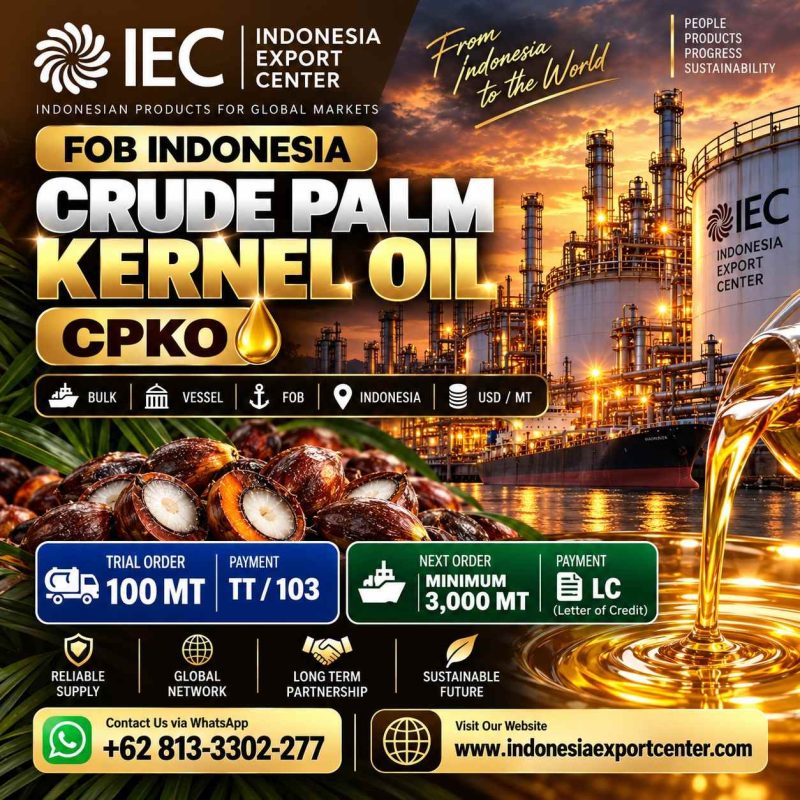
Source Crude Palm Kernel Oil for Oleochemical Production
Indonesia Export Center (IEC) facilitates Indonesian Crude Palm Kernel Oil sourcing for oleochemical manufacturers, fatty acid producers, fatty alcohol plants, surfactant intermediate manufacturers, and international industrial procurement companies.
Crude Palm Kernel Oil is an important vegetable oil feedstock within the lauric oil category.
Its characteristic fatty acid composition makes it relevant to various downstream oleochemical manufacturing processes.
Oleochemical producers require raw materials that are compatible with their processing technology, product specifications, production efficiency targets, and commercial requirements.
IEC welcomes technical RFQs from manufacturers evaluating Indonesian CPKO for industrial processing, commercial trial purchases, and recurring bulk procurement.
What Are Oleochemicals?
Oleochemicals are chemical products derived from natural oils and fats.
Vegetable oils, including palm kernel oil, may be processed through various industrial technologies to produce chemical intermediates and downstream derivatives.
Oleochemical products may be used in cleaning products, personal care formulations, industrial lubricants, specialty chemicals, emulsifiers, surfactants, and other manufacturing applications.
The suitability of a particular oil depends on its fatty acid composition, quality characteristics, processing requirements, and intended downstream products.
Why Crude Palm Kernel Oil Is Relevant to Oleochemical Manufacturers
CPKO contains a characteristic proportion of medium-chain fatty acids, particularly lauric acid.
This fatty acid profile distinguishes palm kernel oil from crude palm oil and other vegetable oils.
Potential advantages for oleochemical manufacturers include access to lauric feedstock, renewable agricultural origin, multiple downstream processing opportunities, and bulk industrial procurement options.
Actual manufacturing suitability depends on the selected technology, process design, and material qualification.
CPKO Technical Specifications for Oleochemical Buyers
| Parameter | Indicative Reference |
|---|---|
| Product | Crude Palm Kernel Oil |
| Origin | Indonesia |
| Product Grade | Crude / Unrefined |
| Feedstock Category | Lauric Oil |
| FFA as Lauric Acid | Maximum 5.0% |
| Moisture and Impurities | Maximum 0.5% |
| Iodine Value | Approximately 16–19 |
| Lauric Acid | Approximately 45–52% of Fatty Acids |
| Shipment Format | Bulk, Subject to Confirmation |
| Reference Trade Term | FOB Indonesia |
| Reference HS Code | 1513.21 |
The values are indicative references only.
Oleochemical manufacturers should request supplier-specific COAs and additional analytical information according to their process requirements.
Fatty Acid Composition and Industrial Relevance
Palm kernel oil contains a mixture of fatty acids.
Potentially relevant fatty acids include caprylic acid, capric acid, lauric acid, myristic acid, palmitic acid, stearic acid, oleic acid, and linoleic acid.
The relative proportions influence the characteristics of downstream chemical products.
Lauric acid is a particularly important component of palm kernel oil.
The reference lauric acid proportion is approximately 45–52% of total fatty acids.
Specific values for other fatty acids should be obtained from actual analytical reports rather than assumed.
CPKO for Fatty Acid Manufacturing
Oleochemical plants may process suitable palm kernel oil feedstock into fatty acid streams.
Industrial processing may involve oil preparation, hydrolysis, separation, purification, and fractionation according to the selected technology.
Manufacturers should evaluate the fatty acid distribution, FFA content, moisture, impurities, and additional contaminants that may influence processing efficiency.
The appropriate feedstock specification depends on the intended fatty acid products.
CPKO for Fatty Alcohol Production
Palm kernel oil-derived intermediates may be used in selected fatty alcohol manufacturing routes.
Fatty alcohols are important industrial intermediates for various surfactant and specialty chemical applications.
Crude CPKO generally requires appropriate upstream preparation and processing before conversion into downstream fatty alcohol products.
Manufacturers should establish their required feedstock characteristics and process-specific impurity limits.
CPKO for Surfactant Manufacturing
Processed palm kernel oil derivatives may serve as upstream materials for surfactant manufacturing.
Surfactants are used in household cleaning products, industrial cleaners, personal care formulations, and various specialty applications.
The final surfactant characteristics depend on chemical structure, processing technology, and formulation requirements.
Crude palm kernel oil is not itself a finished surfactant.
CPKO for Glycerol-Related Production Streams
Certain oleochemical processing routes may generate glycerol-containing streams alongside fatty acid products.
The actual recovery and quality of these streams depend on the selected process and purification arrangements.
Manufacturers should evaluate overall process economics using verified material balances rather than assumed coproduct yields.
CPKO for Specialty Oleochemical Derivatives
Palm kernel oil-derived fatty acids and other intermediates may be processed into selected specialty chemicals.
Potential downstream categories include esters, emulsifiers, specialty surfactants, industrial additives, and other formulated chemical ingredients.
The suitability of CPKO depends on the required intermediate specifications and processing technology.
No universal compatibility with every oleochemical manufacturing process is claimed.
Crude Palm Kernel Oil Versus Refined Feedstock
Oleochemical manufacturers may evaluate either crude or refined palm kernel oil according to their processing capabilities.
| Evaluation Area | CPKO | RBD Palm Kernel Oil |
|---|---|---|
| Processing Stage | Crude | Refined, Bleached and Deodorized |
| FFA | Typically Higher | Typically Reduced Through Refining |
| Naturally Occurring Impurities | May Be Present | Generally Reduced |
| Additional Preparation | Often Required | Depends on Process |
| Main Procurement Focus | Feedstock Economics and Processing Capability | Refined Quality and Compatibility |
Crude oil may be commercially appropriate for facilities equipped to handle its characteristics.
Refined oil may be preferable where stricter quality requirements apply.
The decision should be based on total manufacturing economics.
Technical Feedstock Qualification
Before approving a new CPKO supplier, oleochemical manufacturers should establish a technical qualification process.
Potential evaluation stages include supplier identification, technical specification review, COA assessment, representative sample testing, process compatibility evaluation, commercial trial production, and recurring supplier approval.
Additional testing may include fatty acid profile, saponification value, peroxide value, unsaponifiable matter, trace metals, and other process-specific parameters.
The availability of these test results must be confirmed with the selected supplier.
Understanding FFA in Oleochemical Processing
FFA may influence different manufacturing routes in different ways.
For conventional oil refining, elevated FFA may increase refining requirements.
For certain fatty acid production processes, free fatty acids may remain relevant components of the feedstock.
Therefore, FFA should not automatically be interpreted as a direct percentage of material loss.
Oleochemical buyers should establish acceptance limits according to their process technology and economic model.
Moisture, Impurities and Process Efficiency
Moisture and impurities may influence storage, transfer operations, separation performance, catalyst compatibility, or other manufacturing conditions.
The reference combined moisture and impurity limit is 0.5%.
Manufacturers requiring separate limits or stricter impurity controls should identify these requirements before quotation.
The actual analytical methods and acceptance criteria should be documented.
Oleochemical Procurement and Manufacturing Economics
The most competitive CPKO purchase is not necessarily the lowest-priced offer.
Procurement teams should evaluate product value, freight, feedstock preparation, refining requirements, processing efficiency, product recovery, coproduct value, and waste management costs.
A meaningful comparison should use plant-specific manufacturing data.
Representative laboratory and production trials may help establish whether a new feedstock is commercially suitable.
Bulk CPKO Supply for Oleochemical Plants
Industrial oleochemical facilities may consume substantial quantities of vegetable oil feedstock.
IEC welcomes inquiries identifying trial quantities, monthly consumption, annual demand, preferred shipment format, and purchasing schedules.
Bulk liquid cargo arrangements depend on supplier capabilities, loading infrastructure, carrier availability, and receiving facilities.
No specific production capacity or shipment volume is guaranteed without verification.
Quality Consistency and Recurring Procurement
Recurring oleochemical manufacturing requires consistent raw material characteristics.
Buyers should establish agreed specification ranges, lot identification procedures, inspection frequency, documentation requirements, and corrective action procedures.
A long-term purchasing arrangement may also address supply schedules, price reviews, quantity tolerances, and inventory planning.
Supplier commitments must be supported by written agreements.
Sustainability and Responsible Sourcing Considerations
Palm-based oleochemical buyers may require documentation related to agricultural origin, traceability, responsible sourcing, and environmental performance.
Potential requirements may include supply chain declarations, certification evidence, traceability information, or other customer-specific documentation.
No particular sustainability certification, including RSPO certification, is established by the reference CPKO product profile.
Buyers should identify their required certification model and evidence before supplier selection.
Technical RFQ for Oleochemical Manufacturers
Please provide:
- Required CPKO quantity in metric tons.
- Intended downstream chemical product.
- Manufacturing process requirements.
- Maximum FFA as lauric acid.
- Moisture and impurity limits.
- Required iodine value.
- Required fatty acid composition.
- Additional contaminant limits.
- Required analytical methods.
- Sample and trial requirements.
- Shipment schedule.
- Preferred trade terms.
- Sustainability documentation requirements.
- Destination port.
Frequently Asked Questions
Is CPKO suitable for oleochemical manufacturing?
It is a relevant lauric oil feedstock for selected oleochemical processes, subject to technical qualification.
Can CPKO be used for fatty acid production?
Yes. Suitable CPKO may be evaluated for industrial fatty acid manufacturing.
Can CPKO be converted into fatty alcohols?
Palm kernel oil-derived intermediates may be used in appropriate fatty alcohol production routes.
Is crude oil suitable for direct surfactant formulation?
Generally, additional chemical processing is required.
Can I request a complete fatty acid profile?
Yes. Detailed analytical requirements may be submitted for supplier evaluation.
Is the reference CPKO RSPO certified?
No specific certification has been verified.
Can IEC support recurring industrial purchases?
Recurring procurement inquiries are welcome, subject to verified supplier capacity.
Related Oleochemical Feedstock Resources
- Crude Palm Kernel Oil Supplier Indonesia
- Bulk Crude Palm Kernel Oil Indonesia
- CPKO Specifications and COA
- CPKO vs CPO Differences
- CPKO vs RBD Palm Kernel Oil
Send Your Technical CPKO RFQ
Indonesia Export Center welcomes oleochemical manufacturers seeking Indonesian lauric oil feedstock for industrial processing.
Submit your technical specifications, process requirements, purchasing quantity, and shipment schedule.
Indonesia Export Center (IEC)
Crude Palm Kernel Oil | Lauric Oleochemical Feedstock | Global Industrial Sourcing
Website: https://indonesiaexportcenter.com/
WhatsApp: +62 813-3302-277
Contact IEC today to discuss Indonesian CPKO sourcing for your oleochemical manufacturing facility.
All technical specifications, supply availability, certifications, and commercial conditions require verification.
