

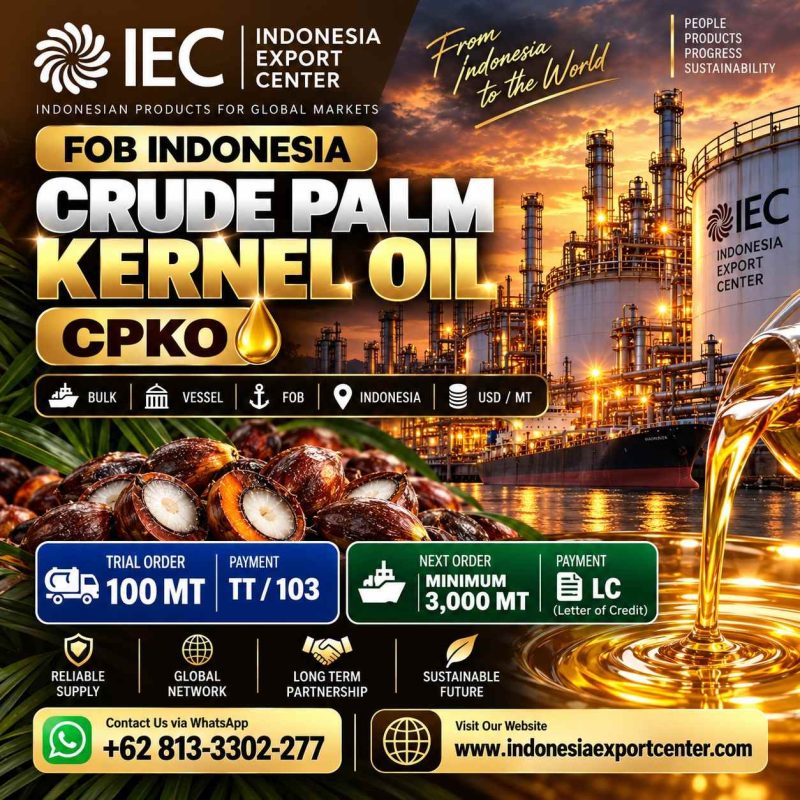
A Practical Guide to Indonesian CPKO Procurement for International Buyers
Importing Crude Palm Kernel Oil from Indonesia requires careful coordination of supplier verification, technical specifications, commercial negotiations, transportation arrangements, export documentation, and destination customs requirements.
Indonesia Export Center (IEC) facilitates Indonesian CPKO sourcing discussions for international importers, commodity traders, oil refineries, oleochemical manufacturers, and industrial soap producers.
Whether your company is importing CPKO for the first time or evaluating additional Indonesian supply partners, a structured procurement process may help reduce technical and commercial uncertainty.
This guide explains the main stages of international CPKO purchasing, from initial supplier identification to cargo receiving and quality evaluation.
Step 1: Identify the Correct Palm Kernel Oil Grade
Before contacting suppliers, buyers should determine whether they require crude palm kernel oil, refined palm kernel oil, palm kernel olein, palm kernel stearin, or another palm-based commodity.
CPKO is an unrefined lauric vegetable oil derived from oil palm kernels.
It is distinct from crude palm oil and refined palm kernel oil.
Purchasing the wrong grade may result in additional processing expenses or incompatibility with the intended manufacturing process.
Step 2: Establish Your Technical Specifications
A complete purchasing specification should identify measurable product acceptance criteria.
| Parameter | Indicative CPKO Reference |
|---|---|
| Product | Crude Palm Kernel Oil |
| Origin | Indonesia |
| FFA as Lauric Acid | Maximum 5.0% |
| Moisture and Impurities | Maximum 0.5% |
| Iodine Value | Approximately 16–19 |
| Lauric Acid | Approximately 45–52% |
| Reference HS Code | 1513.21 |
| Reference Trade Term | FOB Indonesia |
These reference values must be adapted to the buyer’s actual industrial requirements.
Additional parameters may include fatty acid composition, color, saponification value, peroxide value, unsaponifiable matter, and specific contaminant limits.
Step 3: Determine Your Required Purchasing Quantity
Buyers should identify their initial purchasing quantity and estimated recurring consumption.
Commercial quantities are generally expressed in metric tons.
A procurement plan should consider manufacturing demand, inventory levels, storage capacity, shipment frequency, and supplier lead times.
For illustration, a facility consuming 20 MT per operating day over 25 operating days would require approximately 500 MT per month.
Actual purchasing quantities should account for existing inventory and contingency requirements.
Step 4: Verify Potential Indonesian Suppliers
Supplier verification is an important part of international commodity purchasing.
Buyers should evaluate the legal identity of the contracting company, relevant business registration, authorized representatives, production or sourcing arrangements, export capabilities, commercial documentation, and beneficiary bank account information.
Where appropriate, additional verification may include facility visits, independent company checks, commercial references, and review of relevant licenses.
IEC facilitates supplier matching but does not guarantee the legitimacy or performance of an unverified commercial party.
Buyers should complete appropriate due diligence before entering contracts or transferring funds.
Step 5: Submit a Complete Request for Quotation
A complete RFQ allows suppliers to evaluate the buyer’s actual requirements.
The RFQ should include product name, technical specifications, required quantity, purchasing frequency, intended application, shipment period, preferred trade terms, destination port, proposed payment terms, and documentation requirements.
Incomplete inquiries may result in preliminary offers that require further clarification.
Step 6: Review Supplier Technical Documentation
Buyers may request a product specification sheet, representative COA, technical data, fatty acid profile, and other relevant documentation.
The documents should be reviewed by the buyer’s procurement and quality assurance teams.
A representative COA may support preliminary supplier evaluation but should not be treated as a verified certificate for a future shipment.
Step 7: Arrange Samples and Technical Qualification
Representative samples may be requested for laboratory testing or manufacturing trials.
Sample availability, quantity, packaging, shipping costs, and import requirements should be confirmed.
The buyer should establish how the approved sample relates to future commercial acceptance criteria.
Sample approval alone does not replace contractual batch specifications.
Step 8: Select the Appropriate International Trade Term
IEC’s reference CPKO sourcing arrangement is FOB Indonesia.
Under FOB Incoterms 2020, the seller delivers the goods on board the nominated vessel at the agreed loading port.
The buyer generally arranges main ocean freight.
Alternative arrangements may include CFR, CIF, FCA, or other appropriate terms where commercially available.
| Trade Term | Main Transportation Responsibility | Key Consideration |
|---|---|---|
| FOB | Generally Buyer | Named Loading Port |
| CFR | Seller Arranges Main Ocean Freight | Risk Transfers at Origin Vessel Delivery |
| CIF | Seller Arranges Freight and Required Insurance | Risk Transfers at Origin Vessel Delivery |
| FCA | According to Agreed Carrier Delivery Arrangement | Suitable for Certain Containerized Shipments |
The parties should identify the applicable Incoterms edition and exact named location.
Step 9: Confirm the Shipment Format
CPKO transportation may require specialized liquid cargo handling arrangements.
Potential formats include suitable bulk liquid cargo vessels, tank containers, or other approved transportation configurations.
The appropriate method depends on shipment quantity, product handling characteristics, supplier facilities, carrier acceptance, and destination infrastructure.
Buyers should verify that their receiving facility can safely handle the selected cargo format.
Step 10: Negotiate the Commercial Contract
A written contract should identify the responsible buyer and seller, product description, agreed specifications, quantity, price, currency, trade term, loading location, shipment period, and payment arrangement.
Additional provisions may address inspection, quantity tolerances, documentation, title transfer, nonconforming cargo, delays, claims, dispute resolution, and applicable law.
Incoterms alone do not replace a comprehensive commercial contract.
Step 11: Establish Secure Payment Arrangements
Payment terms should be negotiated between the contracting parties.
Potential arrangements may include documentary letters of credit, bank transfers, or other mutually accepted commercial instruments.
Before transferring funds, buyers should verify the supplier’s legal identity and beneficiary bank details.
Unexpected changes to payment instructions should be independently confirmed through established communication channels.
Financial and legal professionals may assist with transaction risk evaluation.
Step 12: Arrange Pre-Shipment Inspection
The buyer and seller may agree on independent quality and quantity inspection.
Inspection may include representative sampling, laboratory analysis, cargo quantity verification, and review of relevant loading conditions.
The parties should establish inspection responsibility, analytical methods, acceptance criteria, and costs.
Inspection does not automatically guarantee future cargo condition after transportation.
Step 13: Verify Indonesian Export Requirements
Indonesian export requirements may depend on commodity classification, applicable regulations, exporting company status, and the commercial shipment.
The exporter of record should verify the relevant export customs procedures, required approvals, and applicable export-related charges.
Regulations may change over time.
Buyers should not rely solely on historical export documentation or outdated regulatory references.
Step 14: Verify Destination Import Requirements
Importers should establish the applicable requirements in their destination country before confirming shipment.
Potential considerations include:
- Importer registration.
- Correct customs classification.
- Import permits where applicable.
- Customs declarations.
- Import duties and taxes.
- Industrial product regulations.
- Food-related requirements if relevant.
- Sustainability or traceability obligations where applicable.
- Required certificates and declarations.
The reference HS code for crude palm kernel oil is 1513.21.
National tariff extensions and applicable treatment must be verified with qualified customs professionals.
Step 15: Prepare Export and Shipping Documents
Potential CPKO shipment documents include:
| Document | Purpose |
|---|---|
| Commercial Invoice | Transaction Information |
| Bill of Lading | Maritime Transportation |
| Cargo Quantity Statement | Shipment Quantity |
| Certificate of Analysis | Agreed Quality Results |
| Certificate of Origin | Origin Evidence Where Applicable |
| Export Customs Documentation | Indonesian Export Formalities |
| Weight Certificate | Quantity Verification Where Agreed |
| Inspection Report | Agreed Inspection Findings |
| Insurance Certificate | Where Required by Commercial Terms |
| Safety Data Sheet | Relevant Material Handling Information |
The final document package depends on the commercial contract and destination requirements.
Step 16: Coordinate Loading and International Transportation
The contracting parties should confirm the loading facility, vessel or equipment nomination, cargo readiness, loading schedule, inspection arrangements, and required shipping documents.
Potential delays should be addressed according to the agreed commercial terms.
No specific loading port or transit time should be assumed before logistics confirmation.
Step 17: Arrange Customs Clearance and Cargo Receiving
The importer should coordinate destination customs clearance, port handling, applicable inspections, cargo release, and transportation to the receiving facility.
Bulk liquid cargo may require suitable receiving tanks, transfer equipment, and qualified facility operators.
The receiving facility should establish appropriate material handling and storage procedures.
Step 18: Conduct Incoming Quality Evaluation
Upon receiving the cargo, the buyer may conduct agreed quality and quantity checks.
The results should be compared with the contract and applicable inspection provisions.
Any discrepancies should be documented according to the agreed claims procedure.
Buyers should preserve relevant inspection records and samples where appropriate.
Common Mistakes When Importing CPKO
International buyers should avoid selecting suppliers solely on the basis of an unusually low price, purchasing without defined specifications, assuming all CPKO grades are identical, overlooking the FFA reporting basis, accepting unverified documentation, or transferring funds before completing due diligence.
Other common commercial risks include failing to confirm loading locations, underestimating destination expenses, misunderstanding Incoterms, and assuming historical regulations remain applicable.
A structured procurement process can help reduce these risks.
Complete CPKO Import RFQ Template
Product: Crude Palm Kernel Oil
Origin: Indonesia
Intended Application: [Insert Application]
Required Quantity: [Insert MT]
Monthly Consumption: [Insert MT]
Maximum FFA as Lauric Acid: [Insert Limit]
Maximum Moisture and Impurities: [Insert Limit]
Iodine Value: [Insert Requirement]
Additional Quality Requirements: [Insert Details]
Preferred Trade Term: [Insert Incoterm]
Preferred Shipment Period: [Insert Date]
Destination Port: [Insert Port]
Payment Proposal: [Insert Terms]
Inspection Requirements: [Insert Details]
Required Documents: [Insert Details]
Company Name and Country: [Insert Information]
Frequently Asked Questions
Can first-time importers purchase CPKO from Indonesia?
Yes. Commercial feasibility depends on supplier arrangements and applicable import requirements.
What is the minimum order quantity?
MOQ requires supplier and shipment confirmation.
Is an import permit always required?
Requirements depend on the destination country and applicable commodity regulations.
Can I request a supplier COA before purchasing?
Yes. Supplier-specific documentation may be requested.
Can IEC arrange FOB sourcing discussions?
Yes. FOB Indonesia is the reference commercial arrangement.
How long does shipping take?
Actual transit times depend on the loading location, destination, carrier, and shipping schedule.
Can IEC guarantee supplier performance?
No. Supplier verification and contractual risk management remain necessary.
Related CPKO Import Resources
- Crude Palm Kernel Oil Supplier Indonesia
- Bulk Crude Palm Kernel Oil Indonesia
- CPKO FOB Indonesia
- Crude Palm Kernel Oil Price per MT
- CPKO Specifications and COA
Start Your Indonesian CPKO Import Inquiry
Indonesia Export Center welcomes international businesses seeking Indonesian crude palm kernel oil for industrial manufacturing and commercial procurement.
Submit your technical specifications, purchasing quantity, destination requirements, and shipment schedule to begin supplier evaluation.
Indonesia Export Center (IEC)
Indonesian Crude Palm Kernel Oil | International Import Facilitation | Industrial B2B Sourcing
Website: https://indonesiaexportcenter.com/
WhatsApp: +62 813-3302-277
Contact IEC today to begin your Indonesian CPKO sourcing inquiry.
All import eligibility, supplier capabilities, product specifications, and commercial conditions require independent verification and written agreement.
