

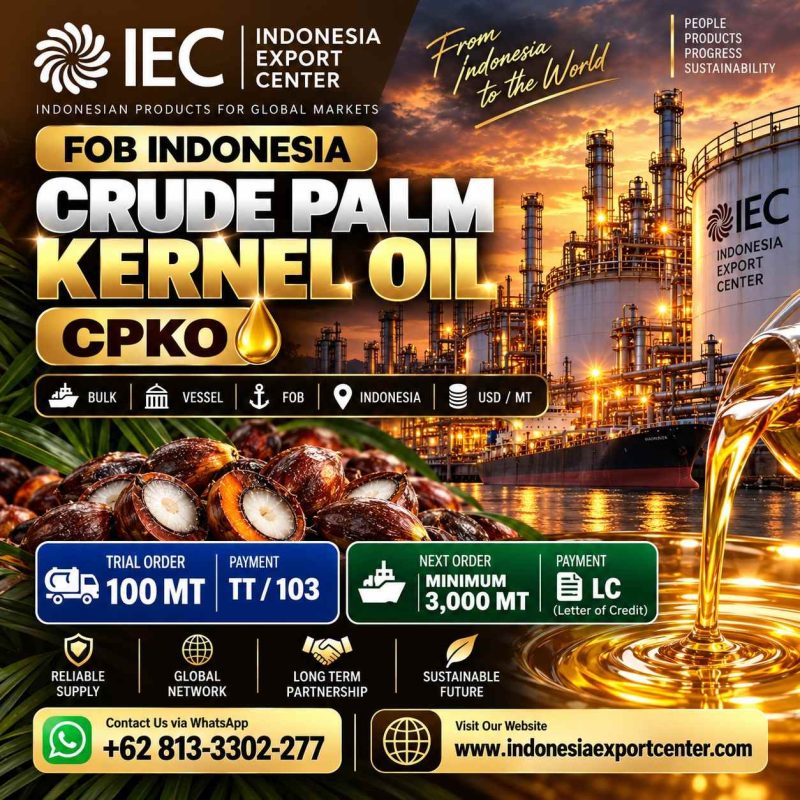
Understand the Difference Between Crude Palm Kernel Oil and Crude Palm Oil
Crude Palm Kernel Oil (CPKO) and Crude Palm Oil (CPO) are two important vegetable oil commodities derived from oil palm fruits.
Although both originate from the same agricultural crop, they are extracted from different parts of the fruit and possess distinct fatty acid compositions, physical characteristics, industrial applications, and commercial specifications.
International buyers should clearly distinguish CPKO from CPO before requesting quotations or approving industrial raw material purchases.
Indonesia Export Center (IEC) facilitates Indonesian palm-based commodity sourcing discussions for international importers, oleochemical manufacturers, oil refineries, soap producers, and industrial procurement companies.
This guide explains the principal differences between CPKO and CPO to help buyers select the appropriate feedstock.
What Is Crude Palm Kernel Oil?
Crude Palm Kernel Oil is an unrefined vegetable oil extracted from oil palm kernels.
The kernel is located inside the hard shell of the oil palm fruit.
CPKO belongs to the lauric oil category because of its characteristic fatty acid composition, including a relatively high proportion of lauric acid.
It is particularly relevant to selected oleochemical processes, fatty acid manufacturing, soap feedstock preparation, and palm kernel oil refining.
What Is Crude Palm Oil?
Crude Palm Oil is extracted from the fleshy mesocarp surrounding the palm fruit’s inner kernel.
CPO generally contains substantial proportions of palmitic acid and oleic acid.
It is an important upstream feedstock for palm oil refining, fractionation, selected oleochemical applications, and other downstream industrial supply chains.
Crude palm oil is not equivalent to refined palm oil or palm olein.
CPKO vs CPO: Main Differences
| Comparison | CPKO | CPO |
|---|---|---|
| Full Name | Crude Palm Kernel Oil | Crude Palm Oil |
| Raw Material | Palm Kernel | Palm Fruit Mesocarp |
| Oil Category | Lauric Oil | Non-Lauric Palm Oil |
| Characteristic Fatty Acids | Lauric and Other Fatty Acids | Palmitic and Oleic Acids |
| Typical Crude Appearance | May Vary from Yellowish to Brownish | Often Orange to Reddish |
| Iodine Value | Generally Lower | Generally Higher |
| Main Downstream Applications | Lauric Oleochemicals and Kernel Oil Refining | Palm Oil Refining and Fractionation |
| Reference HS Heading/Subheading | 1513.21 | 1511.10 |
| Commercial Price | Independently Determined | Independently Determined |
The actual characteristics depend on supplier, production batch, and processing conditions.
Different Extraction Sources
The oil palm fruit contains a fleshy outer portion and an inner kernel protected by a shell.
Crude palm oil originates from the fleshy mesocarp.
Crude palm kernel oil originates from the inner kernel.
The extraction processes and resulting oil compositions are different.
This distinction is fundamental to industrial procurement because the two oils are not automatically interchangeable.
Fatty Acid Composition Differences
CPKO contains a characteristic proportion of lauric acid and other saturated fatty acids.
The reference lauric acid content is approximately 45–52% of total fatty acids.
CPO generally contains substantial proportions of palmitic and oleic acids rather than a similarly high lauric acid concentration.
These differences influence melting behavior, chemical processing characteristics, and downstream product suitability.
Actual fatty acid profiles should be obtained from supplier-specific analytical documentation.
CPKO vs CPO Iodine Value
Iodine value provides information about the degree of unsaturation in an oil.
The indicative CPKO iodine value is approximately 16–19.
CPO generally has a higher iodine value because of its different fatty acid composition.
Buyers should not apply the CPKO iodine value range to CPO.
A separate CPO specification must be established.
CPKO vs CPO Free Fatty Acid Reporting
FFA is an important quality parameter for both crude oils.
However, the reporting basis may differ.
CPKO FFA may be expressed as lauric acid, while CPO FFA is commonly expressed as palmitic acid.
A numerical FFA percentage should not be compared without confirming the fatty acid basis and analytical method.
For example, 5% FFA expressed as lauric acid is not analytically identical to 5% expressed as palmitic acid.
Buyers should request clearly identified reporting methods.
Indicative CPKO Product Specifications
| Parameter | Reference CPKO Specification |
|---|---|
| Product | Crude Palm Kernel Oil |
| Origin | Indonesia |
| FFA as Lauric Acid | Maximum 5.0% |
| Moisture and Impurities | Maximum 0.5% |
| Iodine Value | Approximately 16–19 |
| Lauric Acid | Approximately 45–52% |
| Reference Trade Term | FOB Indonesia |
| Reference HS Code | 1513.21 |
These values apply only to the indicative CPKO product profile.
They do not establish CPO specifications.
CPKO Applications in Oleochemical Manufacturing
CPKO is particularly relevant to selected industrial processes requiring lauric oil feedstock.
Potential downstream applications include fatty acid manufacturing, fatty alcohol production, surfactant intermediates, soap feedstock processing, and specialty chemical derivatives.
The appropriate manufacturing route depends on the desired chemical products and process technology.
CPO Applications in Industrial Manufacturing
CPO may be processed into refined palm oil and palm oil fractions.
It may also serve as a feedstock for selected oleochemical manufacturing and other industrial applications.
Potential downstream products include refined palm oil, palm olein, palm stearin, and other processed derivatives.
Actual suitability depends on the intended application and required quality.
CPKO vs CPO for Soap Manufacturing
Both palm kernel oil-derived and palm oil-derived materials may be used in selected soap manufacturing processes.
However, their different fatty acid profiles contribute different formulation characteristics.
Palm kernel oil-derived components may be evaluated for cleansing and lathering properties.
Palm oil-derived components may contribute other structural and physical characteristics according to the formulation.
Manufacturers may use combinations of oils and fatty acids to achieve desired product performance.
Crude oils may require additional preparation or refining.
CPKO vs CPO for Oil Refineries
Oil refineries should select feedstock according to their intended refined product.
CPKO may be refined into RBD Palm Kernel Oil and processed into selected kernel oil fractions.
CPO may be refined into RBD Palm Oil and processed into palm olein and palm stearin.
These product families should be clearly distinguished during procurement.
Palm kernel olein is not equivalent to conventional palm olein.
Palm kernel stearin is not equivalent to conventional palm stearin.
Can CPKO Replace CPO?
Not automatically.
The oils have different fatty acid profiles, physical properties, and processing characteristics.
A manufacturing process designed for CPO may not achieve the same results using CPKO.
Similarly, a process requiring lauric feedstock may not obtain equivalent performance from conventional palm oil.
Any substitution should be evaluated through technical assessment and controlled manufacturing trials.
CPKO vs CPO Price Differences
CPKO and CPO are commercially distinct commodities.
Their prices may be influenced by different supply and demand conditions, raw material availability, downstream industrial demand, technical specifications, and logistics expenses.
Neither commodity is guaranteed to remain more expensive than the other.
International buyers should request separate, dated quotations for each product.
Comparing Bulk Procurement Requirements
Both CPKO and CPO may be purchased in industrial bulk quantities.
However, the required storage, handling, transportation, and receiving conditions should be evaluated separately.
The physical behavior of the oils may differ according to composition and temperature.
Buyers should confirm suitable cargo equipment and supplier handling recommendations.
CPKO vs CPO Customs Classification
The reference HS subheading for crude palm kernel oil is 1513.21.
The general HS subheading for crude palm oil is 1511.10.
National tariff extensions, export-related charges, import duties, and applicable regulations may differ.
Buyers should verify the correct classification according to the actual commodity and destination country.
Sustainability and Traceability Considerations
Both oils originate from oil palm agricultural supply chains.
International buyers may require documentation concerning agricultural origin, supply chain traceability, sustainability certification, or destination-specific environmental obligations.
The availability of such documentation must be verified with the selected supplier.
No automatic sustainability certification or regulatory compliance is claimed.
Which Product Should Your Business Purchase?
| Industrial Requirement | Feedstock to Evaluate |
|---|---|
| Lauric Fatty Acid Manufacturing | CPKO |
| Palm Kernel Oil Refining | CPKO |
| Palm Kernel Olein or Stearin Production | Appropriate Palm Kernel Oil Feedstock |
| Conventional Palm Oil Refining | CPO |
| Palm Olein and Palm Stearin Production | Appropriate Palm Oil Feedstock |
| Soap Manufacturing | CPKO, CPO or Suitable Processed Derivatives |
| Oleochemical Manufacturing | According to Required Fatty Acid Profile |
| Food Ingredient Production | Appropriately Refined and Compliant Grade |
The final purchasing decision should be based on actual technical specifications and manufacturing compatibility.
Frequently Asked Questions
Are CPKO and CPO the same oil?
No. They originate from different parts of the oil palm fruit.
Which oil contains more lauric acid?
CPKO generally contains substantially more lauric acid than CPO.
Which oil is suitable for lauric oleochemical manufacturing?
CPKO is a relevant feedstock for selected lauric oleochemical processes.
Can CPO replace CPKO in soap production?
Substitution requires formulation and manufacturing evaluation.
Do CPKO and CPO have the same HS code?
No. They generally fall under different HS subheadings.
Is CPKO always more expensive?
No. Actual market conditions and supplier quotations determine commercial prices.
Can I request quotations for both products?
Yes. Submit separate specifications and purchasing requirements for each commodity.
Related Palm-Based Commodity Resources
- Crude Palm Kernel Oil Supplier Indonesia
- CPKO for Oleochemical Manufacturing
- CPKO for Soap Manufacturing
- CPKO Specifications and COA
- CPKO vs RBD Palm Kernel Oil
Compare Indonesian CPKO and CPO Sourcing Options
Indonesia Export Center welcomes international buyers evaluating palm kernel oil, crude palm oil, and related industrial commodities.
Provide your required product grade, technical specifications, intended application, purchasing quantity, and preferred commercial terms.
Separate RFQs should be submitted for CPKO and CPO.
Indonesia Export Center (IEC)
Crude Palm Kernel Oil | Crude Palm Oil | Indonesian Industrial Commodity Sourcing
Website: https://indonesiaexportcenter.com/
WhatsApp: +62 813-3302-277
Contact IEC today to discuss the appropriate palm-based feedstock for your industrial manufacturing requirements.
All product availability, specifications, and commercial conditions require supplier confirmation.
