

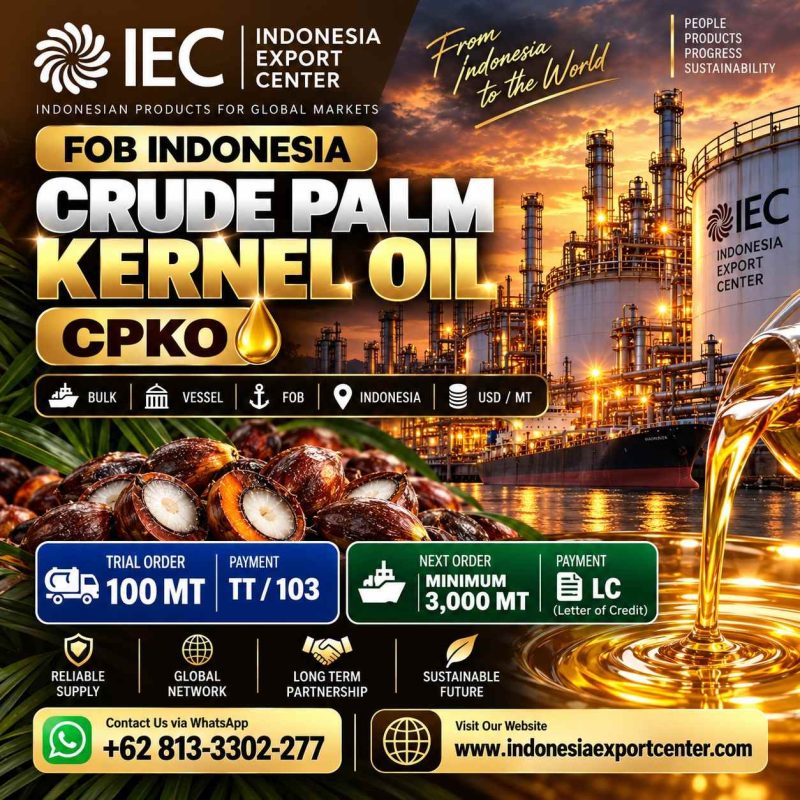
Choose the Appropriate Palm Kernel Oil Grade for Your Industrial Application
Are you deciding whether to purchase Crude Palm Kernel Oil or Refined, Bleached and Deodorized Palm Kernel Oil for your industrial manufacturing requirements?
CPKO and RBD Palm Kernel Oil originate from the same agricultural raw material, but they represent different stages of oil processing.
Their quality characteristics, commercial specifications, manufacturing applications, and purchasing requirements may differ significantly.
Indonesia Export Center (IEC) facilitates Indonesian palm kernel oil sourcing inquiries for international refineries, oleochemical manufacturers, soap producers, specialty ingredient companies, and industrial procurement teams.
This guide explains the differences between crude and refined palm kernel oil to help buyers identify the appropriate product grade.
What Is Crude Palm Kernel Oil?
Crude Palm Kernel Oil, commonly abbreviated as CPKO, is unrefined vegetable oil extracted from oil palm kernels.
The crude oil may contain naturally occurring free fatty acids, moisture, impurities, pigments, odor-producing compounds, and other minor constituents.
CPKO is generally evaluated as an upstream industrial feedstock for oil refining, oleochemical manufacturing, and selected industrial processing applications.
Additional preparation may be necessary depending on the intended use.
What Is RBD Palm Kernel Oil?
RBD Palm Kernel Oil is palm kernel oil that has undergone refining, bleaching, and deodorization.
These processing stages are intended to reduce or remove selected undesirable constituents and improve relevant oil quality characteristics.
Refined palm kernel oil may be suitable for various downstream applications according to its actual grade, technical specifications, and regulatory compliance.
The term RBD alone does not automatically establish food-grade, cosmetic-grade, organic, halal, or other certified status.
What Does RBD Stand For?
Refined
Refining may reduce free fatty acids and other undesirable constituents according to the selected refining technology.
Bleached
Bleaching generally involves treatment intended to reduce selected pigments and other unwanted compounds.
Deodorized
Deodorization generally involves removal of selected volatile compounds associated with odor and other oil characteristics.
The actual manufacturing process depends on the refinery’s technology and required finished product specifications.
CPKO vs RBD Palm Kernel Oil: Main Differences
| Comparison | CPKO | RBD Palm Kernel Oil |
|---|---|---|
| Full Name | Crude Palm Kernel Oil | Refined, Bleached and Deodorized Palm Kernel Oil |
| Raw Material | Palm Kernels | Palm Kernel Oil Feedstock |
| Processing Stage | Crude | Refined |
| FFA | Typically Higher | Typically Reduced |
| Moisture and Impurities | May Be Higher | Generally Reduced |
| Color | More Variable | Generally Lighter |
| Odor | More Variable | Generally Reduced |
| Additional Preparation | Often Required | Depends on Application |
| Typical Buyers | Refineries and Industrial Processors | Ingredient and Industrial Manufacturers |
| Commercial Price | Supplier and Market Dependent | Supplier and Market Dependent |
| Food Suitability | Not Established for Reference Crude Grade | Requires Appropriate Food-Grade Compliance |
Actual technical characteristics must be confirmed separately for each grade.
Indicative Crude Palm Kernel Oil Specifications
| Parameter | Reference CPKO Specification |
|---|---|
| Origin | Indonesia |
| Product Grade | Crude |
| FFA as Lauric Acid | Maximum 5.0% |
| Moisture and Impurities | Maximum 0.5% |
| Iodine Value | Approximately 16–19 |
| Lauric Acid | Approximately 45–52% |
| Reference HS Code | 1513.21 |
| Reference Trade Term | FOB Indonesia |
These values represent indicative crude palm kernel oil specifications.
They should not be applied automatically to refined palm kernel oil.
Technical Specifications for RBD Palm Kernel Oil
Buyers requiring refined palm kernel oil should establish a separate purchasing specification.
Potential quality parameters include:
| Parameter | Required Information |
|---|---|
| FFA | Supplier-Specific Refined Grade Limit |
| Moisture | Agreed Maximum |
| Impurities | Agreed Maximum |
| Iodine Value | Agreed Range |
| Color | Required Measurement Method and Limit |
| Odor | Agreed Acceptance Criteria |
| Peroxide Value | Required Maximum |
| Fatty Acid Composition | Supplier-Specific Profile |
| Melting Characteristics | Application-Specific Requirement |
| Regulatory Grade | Industrial, Food or Other Required Grade |
No specific RBD palm kernel oil values are guaranteed by the reference CPKO data.
Why Refineries Purchase Crude Palm Kernel Oil
Refineries may purchase CPKO as an upstream feedstock for producing refined palm kernel oil.
Facilities equipped to handle crude oil may evaluate the economic relationship between raw material price, refining requirements, oil recovery, operating expenses, and finished product value.
Crude oil purchasing decisions should account for actual quality characteristics and expected refining performance.
A lower crude oil price may not necessarily provide better refining economics.
Why Manufacturers Purchase RBD Palm Kernel Oil
Manufacturers may prefer refined palm kernel oil when their processes require reduced FFA, lower impurities, more controlled appearance, or other refined quality characteristics.
Potential applications include selected soap formulations, specialty oil processing, personal care ingredient supply chains, and appropriately compliant food ingredient manufacturing.
Actual suitability depends on the product grade and intended application.
CPKO vs RBD Palm Kernel Oil for Oleochemical Manufacturing
Oleochemical manufacturers may evaluate crude or refined palm kernel oil depending on their processing technology.
Facilities equipped to prepare crude feedstock may consider CPKO.
Other facilities may require refined material with stricter impurity limits.
The preferred grade should be selected according to process compatibility, catalyst requirements where relevant, material recovery, and overall manufacturing economics.
CPKO vs RBD Palm Kernel Oil for Soap Manufacturing
Soap manufacturers may evaluate crude palm kernel oil if their facilities can appropriately prepare and process the material.
Refined palm kernel oil may be preferable for certain appearance-sensitive or quality-sensitive formulations.
The choice depends on the finished soap characteristics, manufacturing process, and commercial cost structure.
Neither grade should be approved solely on the basis of its product name.
CPKO vs RBD Palm Kernel Oil for Food Applications
The reference CPKO product is intended for industrial feedstock sourcing.
Direct food suitability has not been established.
RBD palm kernel oil may be used in food ingredient manufacturing when it meets applicable food-grade specifications, contaminant limits, production requirements, and destination regulations.
Buyers should request appropriate food-grade documentation and verify regulatory compliance.
The refining designation alone does not guarantee food suitability.
Palm Kernel Oil for Personal Care Applications
Processed palm kernel oil and its derivatives may be used in selected personal care ingredient supply chains.
Manufacturers should establish the required ingredient grade, composition, purity, safety documentation, and regulatory status.
Crude industrial CPKO should not be represented as a ready-to-use cosmetic ingredient.
Palm Kernel Oil Refining and Fractionation
Refined palm kernel oil may undergo further processing to produce fractions with different physical characteristics.
Potential fractions include palm kernel olein and palm kernel stearin.
These products are distinct commercial grades and should be specified separately.
| Product | General Description |
|---|---|
| CPKO | Crude Palm Kernel Oil |
| RBD PKO | Refined Palm Kernel Oil |
| Palm Kernel Olein | Relatively More Liquid Kernel Oil Fraction |
| Palm Kernel Stearin | Relatively Higher-Melting Kernel Oil Fraction |
The exact properties depend on the fractionation process and product specification.
Palm kernel olein and palm kernel stearin should not be confused with conventional palm oil fractions.
Comparing Crude and Refined Oil Manufacturing Economics
Industrial buyers should evaluate the total cost of obtaining material suitable for their production process.
For illustration:
| Hypothetical Parameter | Crude Feedstock | Refined Feedstock |
|---|---|---|
| Landed Purchase Cost per MT | USD 1,000 | USD 1,130 |
| Additional Preparation Cost per Purchased MT | USD 70 | USD 10 |
| Observed Usable Recovery | 94% | 99% |
| Effective Cost per MT of Usable Material | USD 1,138.30 | USD 1,151.52 |
This example demonstrates how processing expenses and usable recovery may influence purchasing decisions.
The figures are hypothetical and do not represent current market prices or guaranteed refining yields.
Actual calculations should include plant-specific expenses, coproduct recovery where relevant, and verified material performance.
CPKO vs RBD Palm Kernel Oil Price
Refined palm kernel oil involves additional processing compared with crude palm kernel oil.
However, actual commercial price differences depend on market conditions, supplier arrangements, quality specifications, production economics, and purchasing quantities.
Buyers should request separate quotations for crude and refined grades.
A quotation for CPKO should not be assumed to apply to RBD Palm Kernel Oil.
Certificate of Analysis Requirements
Both crude and refined palm kernel oil buyers should request appropriate supplier-specific COAs.
The required analytical parameters may differ between grades.
Crude oil buyers may prioritize FFA, moisture, impurities, iodine value, and refining-related parameters.
Refined oil buyers may require stricter limits for FFA, moisture, color, oxidation indicators, and application-specific contaminants.
Actual batch results should be compared with the agreed contractual specification.
Customs Classification Differences
Crude palm kernel oil generally falls under HS subheading 1513.21.
Other palm kernel oil grades may fall under different tariff subdivisions depending on the actual product and processing condition.
Buyers should verify the correct national tariff classification for crude, refined, or fractionated products.
Customs duties, export-related charges, and destination regulations may differ.
Which Palm Kernel Oil Grade Should You Purchase?
| Buyer Requirement | Grade to Evaluate |
|---|---|
| Refining Feedstock | CPKO |
| Crude Lauric Oil Processing | CPKO |
| Manufacturing Requiring Reduced FFA | Suitable RBD PKO |
| Appearance-Sensitive Formulations | Suitable Refined Grade |
| Food Ingredient Manufacturing | Verified Food-Grade Refined Oil |
| Personal Care Ingredients | Appropriately Qualified Processed Grade |
| Specialty Higher-Melting Fraction | Palm Kernel Stearin |
| Specialty More Liquid Fraction | Palm Kernel Olein |
The final decision should be supported by technical evaluation and actual supplier documentation.
Separate RFQ Requirements for CPKO and RBD PKO
Buyers should identify the exact product grade before requesting quotations.
A complete RFQ should include required product name, intended application, quantity, technical specifications, required certification or regulatory grade, shipment schedule, destination port, and preferred commercial terms.
Where both grades are being evaluated, separate RFQs should be submitted.
This helps prevent technical misunderstandings and incorrect commercial comparisons.
Frequently Asked Questions
Is CPKO the same as RBD Palm Kernel Oil?
No. CPKO is crude oil, while RBD Palm Kernel Oil has undergone refining, bleaching, and deodorization.
Which grade has lower FFA?
RBD Palm Kernel Oil generally has lower FFA following appropriate refining.
Is CPKO suitable for direct food use?
Direct food suitability is not established for the reference crude industrial grade.
Is RBD Palm Kernel Oil automatically food grade?
No. Food-grade compliance requires appropriate specifications and documentation.
Which grade is better for oleochemical manufacturing?
The appropriate grade depends on the manufacturer’s processing technology and technical requirements.
Can IEC facilitate quotations for both grades?
Separate sourcing inquiries may be submitted for crude and refined palm kernel oil.
Is palm kernel stearin the same as RBD Palm Kernel Oil?
No. Palm kernel stearin is a distinct fraction of palm kernel oil.
Which grade is cheaper?
Actual commercial prices depend on current market conditions and supplier quotations.
Related Palm Kernel Oil Resources
- Crude Palm Kernel Oil Supplier Indonesia
- Bulk Crude Palm Kernel Oil Indonesia
- Crude Palm Kernel Oil Price per MT
- CPKO Specifications and COA
- CPKO vs CPO Differences
Request the Appropriate Palm Kernel Oil Grade
Indonesia Export Center welcomes international inquiries for crude palm kernel oil and related processed palm kernel oil grades.
Provide your intended application, required product grade, technical specifications, purchasing quantity, destination requirements, and preferred commercial terms.
IEC facilitates sourcing discussions according to the buyer’s actual industrial needs.
Indonesia Export Center (IEC)
Crude Palm Kernel Oil | Refined Palm Kernel Oil | Indonesian Industrial Feedstock Sourcing
Website: https://indonesiaexportcenter.com/
WhatsApp: +62 813-3302-277
Contact IEC today to discuss the appropriate palm kernel oil grade and request your commercial quotation.
All product grades, technical specifications, availability, certifications, and commercial conditions are subject to supplier verification and written agreement.
