![Indonesia Export Center [IEC]](https://indonesiaexportcenter.com/wp-content/uploads/2023/07/logo-no-background.svg)
![Indonesia Export Center [IEC]](https://indonesiaexportcenter.com/wp-content/uploads/2023/07/svgviewer-output.svg)
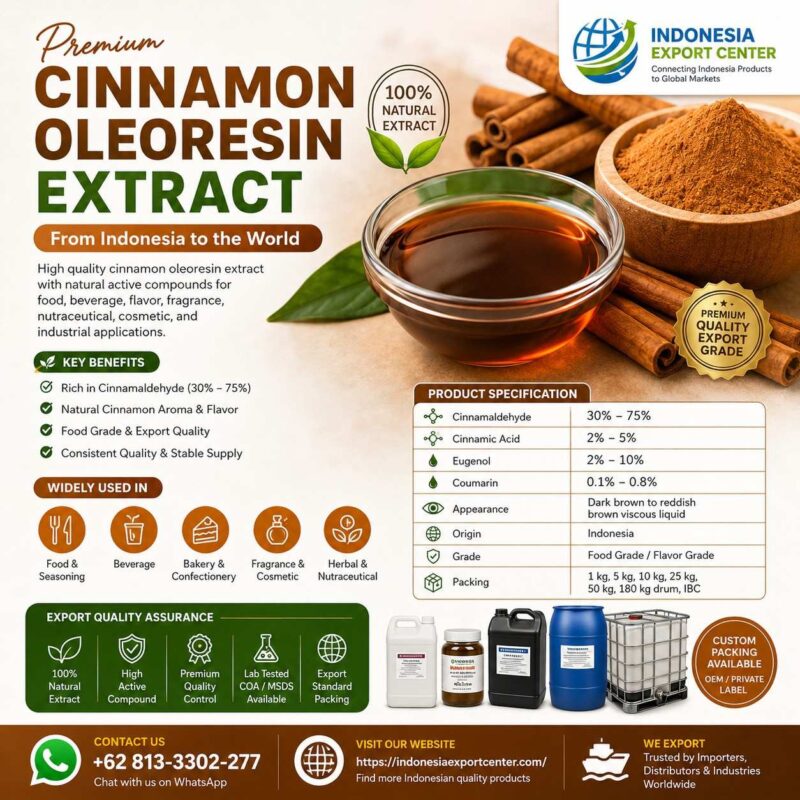
Cinnamon Oleoresin Specifications Explained: Volatile Oil Content, Solubility, and Microbiological Quality
Cinnamon oleoresin is a concentrated spice extract designed to provide the characteristic aroma, flavor, warmth, and lingering profile of cinnamon in a more standardized form than ground bark. Spice oleoresins are generally produced through solvent extraction followed by removal of the extraction solvent, leaving a concentrated mixture of volatile aromatic compounds and non-volatile resinous components.
For international buyers, however, the product name alone is not enough. Two materials sold as “cinnamon oleoresin” may differ substantially in botanical source, volatile oil concentration, carrier system, viscosity, solubility, microbiological status, and intended application.
The United States FDA identifies cinnamon bark oleoresin, cinnamon bark extract, and cinnamon bark oil as flavoring agents or adjuvants and refers them to 21 CFR 182.20. The regulation covers essential oils, solvent-free oleoresins, and natural extractives from recognized cinnamon and cassia sources for their intended use.
Regulatory recognition, nevertheless, does not create one universal commercial specification. The buyer and supplier must still agree on measurable quality parameters for each shipment.
Start with the Correct Product Identity
Before comparing prices or volatile oil percentages, buyers should confirm exactly what material is being offered.
A complete product description should identify:
- The botanical species
- The plant part used, usually bark
- The country or region of origin
- The extraction method
- Whether the oleoresin is solvent-free after processing
- Whether it is supplied neat or standardized with a carrier
- The declared volatile oil concentration
- Its suitability for food, flavor, fragrance, or another application
For Indonesian material, the botanical source may be Indonesian cassia, commonly associated with Padang or Batavia cassia. The eCFR lists Padang or Batavia cassia under Cinnamomum burmanni Blume alongside Chinese, Saigon, and Ceylon cinnamon sources.
Botanical identity matters because cinnamon species and plant parts can have different chemical profiles. Buyers should therefore avoid approving a shipment based only on the general word “cinnamon.”
A useful purchasing description would be:
Food-grade cinnamon bark oleoresin obtained from Indonesian cinnamon, standardized to the agreed volatile oil content, with the carrier and extraction process clearly declared.
1. Volatile Oil Content
What Is Volatile Oil Content?
Volatile oil content represents the steam-distillable aromatic fraction of the oleoresin. This fraction contains many of the compounds responsible for cinnamon’s recognizable aroma and immediate flavor impact.
Oleoresin also contains non-volatile substances extracted from the bark. These components contribute body, warmth, depth, taste persistence, color, and resinous character. Cinnamon oleoresin is therefore not identical to cinnamon essential oil: essential oil mainly represents the volatile fraction, while oleoresin provides both volatile and non-volatile components.
Why Volatile Oil Content Matters
The volatile oil percentage helps buyers estimate:
- Aromatic strength per kilogram
- Likely dosage in the finished product
- Batch-to-batch consistency
- Suitability for concentrated flavor formulations
- Cost in relation to flavor strength
- Whether the product has been standardized or diluted
A higher volatile oil percentage may provide a stronger aromatic top note, but it does not automatically mean that the product is superior for every application. A balanced oleoresin must also deliver the expected cinnamon taste, resinous body, and stability in the buyer’s formulation.
For example, a bakery flavor may require a warm and persistent cinnamon profile, while a beverage flavor may prioritize aroma release and dispersibility. A fragrance formulation may require compatibility with ethanol, dipropylene glycol, triethyl citrate, oils, or another selected base.
How Volatile Oil Is Tested
The American Spice Trade Association lists several relevant analytical methods, including:
- ASTA Method 5.0: Determination of Steam Volatile Oil by Modified Clevenger Method
- ASTA Method 5.1: Determination of Steam Volatile Oil by Lee and Ogg Method
- ASTA Method 5.2: Determination of Steam Volatile Oil by AOAC Method 962.17
- ASTA Method 16.0: Determination of Steam Volatile Oil in Cassia
- ASTA Method 17.0: Determination of Cinnamic Aldehyde in Cassia Oil
The testing method must be written on the Certificate of Analysis. Results obtained using different methods or reporting bases should not be compared without technical review.
Questions Buyers Should Ask
When reviewing volatile oil content, request clarification on:
- Is the result expressed as weight by weight, volume by weight, or another basis?
- Is it measured on an “as-is” basis or dry basis?
- What analytical method was used?
- Is the value a minimum, maximum, or acceptable range?
- Has the oleoresin been standardized with an edible oil or another carrier?
- Is cinnamaldehyde tested separately by gas chromatography?
- Does the supplier provide a chromatographic profile for each batch?
A specification that merely states “volatile oil: 30%” is incomplete unless the tolerance, reporting basis, and test method are also stated.
Volatile Oil Content Is Not the Same as Cinnamaldehyde Content
Cinnamaldehyde is an important contributor to the characteristic cinnamon aroma, but volatile oil content measures a broader fraction. It should not be treated as a direct substitute for a cinnamaldehyde assay.
A buyer requiring a particular sensory profile may therefore request both:
- Total steam-volatile oil content
- Cinnamaldehyde content or a complete GC profile
Scientific studies show that cinnamon oils and extracts contain multiple volatile constituents and that composition can vary according to species, plant part, raw-material quality, and extraction process.
2. Solubility and Dispersibility
What Does “Soluble” Mean?
Solubility is one of the most frequently misunderstood items on a cinnamon oleoresin specification sheet.
A supplier may describe the product as:
- Oil-soluble
- Soluble in fixed oils
- Soluble in alcohol
- Partly soluble in alcohol
- Water-dispersible
- Emulsifiable
- Dispersible in a carrier
These descriptions are not interchangeable.
Cinnamon oleoresin contains lipophilic volatile and resinous compounds. A conventional oleoresin is therefore generally more compatible with oil-based systems than with water. Essential-oil components are predominantly lipophilic, and their behavior in food depends on how they partition between lipid, aqueous, protein, and carbohydrate phases.
Oil Solubility
Oil-soluble cinnamon oleoresin is normally the preferred format for applications such as:
- Fat-based bakery fillings
- Chocolate and confectionery
- Seasoning oils
- Sauces containing an oil phase
- Meat marinades
- Butter and fat-based flavor systems
- Oil-based flavor concentrates
However, “oil-soluble” should still be verified in the buyer’s actual oil. Compatibility in soybean oil does not automatically guarantee identical behavior in palm oil, medium-chain triglycerides, cocoa butter, or another lipid system.
Water Dispersibility
Neat cinnamon oleoresin should not be assumed to dissolve directly in water. For beverages, syrups, dairy drinks, aqueous sauces, or instant products, the buyer may need:
- An emulsified cinnamon oleoresin
- A water-dispersible liquid flavor
- A spray-dried cinnamon oleoresin
- A microencapsulated powder
- A carrier-based flavor preparation
- A customized emulsion using an approved food-grade emulsifier
Oil-in-water emulsions require an oil phase, an aqueous phase, and an appropriate emulsifier or stabilizer. Encapsulation and nanoemulsion technologies are also used to improve dispersion and protect volatile compounds.
Alcohol Solubility for Flavor and Fragrance Applications
For flavor and fragrance buyers, the supplier should state whether the oleoresin is:
- Completely soluble
- Partly soluble
- Dispersible with haze
- Dispersible with sediment
- Insoluble in the selected alcohol concentration
Solubility should be tested using a defined procedure. The specification should state:
- Test medium
- Oleoresin-to-solvent ratio
- Temperature
- Mixing time
- Observation time
- Acceptable haze or sediment
- Whether filtration is permitted
A more useful specification is:
Passes compatibility test at 1:10 in the buyer’s selected carrier at 25°C, with no unacceptable separation after 24 hours.
This is more meaningful than simply stating “soluble in alcohol.”
Solubility Is a Formulation Parameter
Solubility results should always be evaluated in relation to the intended product.
| Application | Recommended Compatibility Test |
|---|---|
| Bakery and confectionery | Edible oil, shortening or fat system |
| Beverage | Finished emulsion or aqueous flavor base |
| Dairy product | Milk-fat and protein-containing formulation |
| Dry seasoning | Salt, maltodextrin or dextrose carrier |
| Liquid flavor | Ethanol, propylene glycol or other approved carrier |
| Fragrance formulation | Actual fragrance solvent or finished base |
Food-grade status confirms that the material is intended and handled as a food ingredient under the applicable requirements. It does not automatically prove that the same material will be technically compatible with every fragrance, cosmetic, candle, soap, or personal-care formulation.
3. Microbiological Quality
Why Microbiological Testing Is Still Necessary
Cinnamon contains compounds associated with antimicrobial activity, but this does not eliminate the need for microbiological testing.
An oleoresin may still be affected by:
- Contaminated raw bark
- Poor equipment hygiene
- Inadequate post-extraction handling
- Contaminated carriers
- Packaging contamination
- Water exposure
- Improper storage
- Cross-contamination during filling
The natural antimicrobial properties of cinnamon must never be used as a substitute for validated hygiene controls and batch testing.
Important Microbiological Parameters
A food-grade cinnamon oleoresin specification commonly includes:
Total Plate Count or Aerobic Plate Count
Aerobic Plate Count provides a general indication of the microbial population and can help assess sanitary quality, processing conditions, handling practices, and shelf-life control. It does not identify individual bacterial species or prove the absence of pathogens.
Yeast and Mold Count
Yeast and mold testing is especially relevant where the raw material, carrier, processing environment, or packaging may have been exposed to moisture. FDA BAM Chapter 18 provides laboratory procedures for yeast and mold examination in foods.
Escherichia coli and Coliforms
Coliforms may be used as general indicators of sanitary conditions, while E. coli can indicate fecal contamination or unsanitary processing. FDA BAM Chapter 4 includes methods for enumerating E. coli and coliform bacteria.
Salmonella
For ready-to-use food ingredients, buyers commonly require Salmonella to be absent in a defined sample quantity, frequently 25 grams. FDA BAM Chapter 5 provides reference procedures for detecting Salmonella in foods.
Cinnamon Can Interfere with Microbiological Recovery
Cinnamon presents an important laboratory challenge because its antimicrobial compounds may inhibit the organisms that the laboratory is trying to detect.
FDA BAM guidance includes special considerations for cinnamon and certain other spices, including dilution beyond inhibitory or toxic levels when examining them for Salmonella. Therefore, a microbiological result is meaningful only when the analytical method is suitable for the cinnamon matrix and can recover injured or low-level organisms.
Buyers should ask whether the laboratory has:
- Validated the method for cinnamon oleoresin
- Used an appropriate dilution or neutralization procedure
- Included positive recovery controls
- Reported the sample quantity tested
- Stated the method detection limit
Example of a Buyer-Defined Microbiological Specification
The following table is an illustrative procurement template, not a universal international regulation. Final limits should reflect the destination market, finished product, customer policy, processing conditions, and intended use.
| Parameter | Illustrative Purchase Requirement |
|---|---|
| Total Plate Count | Maximum 1,000 CFU/g |
| Yeast and Mold | Maximum 100 CFU/g |
| E. coli | Below the agreed detection limit |
| Salmonella | Absent in 25 g |
Commercial cinnamon oleoresin specifications may use limits in this general range, but buyers should treat them as contractual quality targets rather than globally mandatory values.
A stronger specification should state both the limit and method, for example:
Salmonella: Absent in 25 g, tested using FDA BAM Chapter 5 or a validated equivalent method suitable for the cinnamon oleoresin matrix.
How to Read a Cinnamon Oleoresin Certificate of Analysis
A proper batch Certificate of Analysis should include at least:
| Category | Information to Verify |
|---|---|
| Product identity | Product name, botanical species and plant part |
| Batch information | Batch number and production date |
| Appearance | Color, physical form and homogeneity |
| Sensory profile | Characteristic cinnamon aroma and taste |
| Volatile oil | Result, unit, limit and analytical method |
| Marker compounds | Cinnamaldehyde or agreed GC profile |
| Solubility | Medium, test conditions and result |
| Microbiology | APC, yeast and mold, E. coli and Salmonella |
| Residual solvent | Solvent tested, result and limit |
| Contaminants | Heavy metals and mycotoxins when required |
| Shelf life | Expiry or best-before date |
| Storage | Recommended temperature, light and humidity controls |
| Authorization | Name or approval of quality-control personnel |
The COA should report the actual batch result rather than merely repeating the specification limit. For example, “complies” is less informative than “volatile oil: 30.4% by ASTA Method 5.0.”
Other Specifications Buyers Should Not Ignore
Although volatile oil, solubility, and microbiological quality are central parameters, importers should also review:
- Residual extraction solvents
- Heavy metals
- Pesticide residues
- Aflatoxins or other mycotoxins where relevant
- Coumarin when required by the buyer or destination market
- Carrier or diluent declaration
- Allergen statement
- GMO status
- Halal or kosher certification
- Food-safety certification
- Packaging compatibility
- Shelf-life and storage stability
The extraction solvent and any added food-grade carrier should be disclosed. A “30% cinnamon oleoresin” may refer to a standardized preparation rather than 100% undiluted extract.
Recommended Questions for an Indonesian Cinnamon Oleoresin Supplier
Before confirming an international order, buyers should request written answers to the following:
- What is the botanical species and plant part?
- Is the raw cinnamon sourced from Indonesia?
- Is the product neat or standardized with a carrier?
- What is the declared volatile oil range?
- Which ASTA, AOAC, ISO, FDA BAM, or validated internal methods are used?
- Is cinnamaldehyde measured separately?
- Is the oleoresin soluble in edible oil, alcohol, or another carrier?
- Can the supplier test compatibility in the buyer’s formulation?
- What microbiological limits are guaranteed?
- Is Salmonella tested in 25 grams?
- Has the microbiological method been validated for the inhibitory cinnamon matrix?
- Can the supplier provide TDS, SDS, COA, allergen statement, and certification documents?
- Are pre-shipment samples and third-party laboratory tests available?
- What packaging and storage conditions are recommended?
Conclusion
Cinnamon oleoresin should be purchased according to measurable performance and safety criteria rather than product name or price alone.
Volatile oil content indicates the concentration of aromatic compounds, but it must be interpreted together with the analytical method, cinnamaldehyde profile, carrier system, and sensory performance. Solubility must be tested in the buyer’s actual food, flavor, or fragrance base. Microbiological quality must be verified through appropriate methods that account for the naturally inhibitory properties of cinnamon.
For importers seeking a reliable Cinnamon Oleoresin Supplier from Indonesia, the best approach is to agree on the complete technical specification before requesting a final quotation. Buyers developing food, beverage, seasoning, bakery, confectionery, or selected aromatic formulations should also request an application-specific sample of Food-Grade Cinnamon Oleoresin for Flavor & Fragrance before approving commercial production.
Call to Action
Looking for Indonesian cinnamon oleoresin with customized volatile oil content, application-specific solubility, microbiological testing, and export documentation?
Send your required specification, target application, quantity, packaging preference, destination port, and Incoterm to Indonesia Export Center for supplier matching and quotation support.
Main References
- U.S. Electronic Code of Federal Regulations, 21 CFR 182.20: Essential oils, solvent-free oleoresins, and natural extractives.
- FDA Substances Added to Food database: Cinnamon bark oleoresin and related cinnamon extracts.
- American Spice Trade Association, Official Analytical Methods for steam-volatile oil and cassia analysis.
- FDA Bacteriological Analytical Manual, Chapters 3, 4, 5 and 18.
- FSSAI Manual of Methods of Analysis: Microbiological Examination of Food and Water, 2024.
- Review of spice oleoresins, essential oils, formulation behavior, and food applications.
