

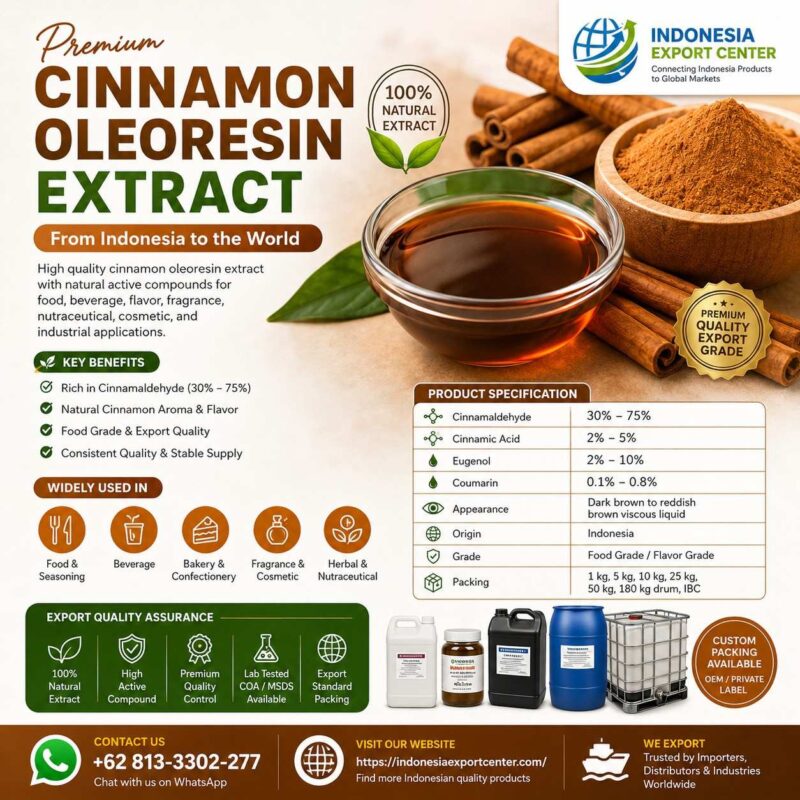
How to Import Cinnamon Oleoresin from Indonesia
Cinnamon oleoresin is a concentrated botanical ingredient used to provide a warm, sweet, spicy, and characteristic cinnamon profile in food flavorings, beverages, bakery products, confectionery, seasonings, fragrances, personal-care products, and other industrial formulations.
Importing cinnamon oleoresin from Indonesia can provide international buyers with access to Indonesian cinnamon raw materials and export-oriented processing partners. However, a successful transaction requires more than requesting a price per kilogram.
Buyers must clearly define the intended application, botanical source, chemical specifications, food-safety requirements, packaging, documentation, and destination-country regulations before confirming an order.
This practical guide explains the main steps international buyers should follow when sourcing cinnamon oleoresin from Indonesia.
1. Define the Intended Application
The first step is to determine exactly how the cinnamon oleoresin will be used.
Typical applications may include:
- Bakery and confectionery flavorings
- Beverage concentrates
- Dairy and dessert formulations
- Sauces and seasoning blends
- Processed food products
- Nutraceutical formulations
- Fragrance compounds
- Personal-care products
- Soap and household fragrance formulations
- Industrial aroma products
This distinction is important because food-grade cinnamon oleoresin and fragrance-use material are not automatically interchangeable.
Food applications must comply with food-safety, contaminant, extraction-solvent, labeling, and permitted-use requirements. Fragrance applications may require compliance with applicable IFRA restrictions and finished-product safety assessments.
The United States Food and Drug Administration lists cinnamon bark oleoresin from Cinnamomum species as a flavoring agent or adjuvant under its food-substance framework. European food flavorings are regulated under Regulation (EC) No 1334/2008, which establishes requirements for the safe use and labeling of flavorings in food.
Before contacting a supplier, specify whether the product is intended for:
- Food flavoring
- Beverage flavoring
- Fragrance compounding
- Cosmetics or personal care
- Nutraceuticals
- Research and product development
- Another industrial application
2. Prepare a Detailed Product Specification
There is no single cinnamon oleoresin specification suitable for every buyer. The specification should be developed according to the final formulation, destination market, and regulatory requirements.
A proper purchasing specification should address the following parameters.
Botanical Identity
Request confirmation of:
- Botanical name
- Cinnamon species
- Country and region of origin
- Plant part used
- Raw-material traceability
- Harvest or production batch information
Different cinnamon species may produce different sensory profiles and naturally occurring constituent levels. Therefore, the botanical identity should appear consistently on the technical data sheet, Certificate of Analysis, commercial documents, and product label.
Extraction Method
Ask the supplier to disclose:
- Extraction process
- Extraction solvent
- Solvent-removal method
- Standardization process
- Added carrier or diluent
- Whether the product is solvent-free after processing
- Residual-solvent test results
The extraction solvent and carrier must be acceptable for the intended food, beverage, fragrance, cosmetic, or industrial application.
Physical and Sensory Characteristics
The agreed specification may include:
- Appearance
- Color
- Odor profile
- Flavor profile
- Viscosity
- Density or specific gravity
- Solubility or dispersibility
- Total solids
- Volatile oil content
- Refractive index, where relevant
Because cinnamon oleoresin can be highly concentrated, sensory evaluation should be conducted at an agreed dilution rather than only by smelling the undiluted product.
Active and Marker Compounds
Depending on the product and buyer requirements, testing may include:
- Cinnamaldehyde content
- Volatile oil profile
- Total aromatic compounds
- Coumarin content
- Chromatographic fingerprint
- Other agreed marker compounds
Coumarin should receive particular attention when the material is intended for food applications. Its relevance depends on the cinnamon species, concentration, dosage, final food category, and destination-market regulations.
Food-Safety Parameters
For food-grade cinnamon oleoresin, buyers should consider requesting:
- Total plate count
- Yeast and mold
- Coliforms
- Escherichia coli
- Salmonella
- Heavy metals
- Pesticide residues
- Residual solvents
- Mycotoxins, where relevant
- Foreign-matter controls
Codex food-hygiene principles emphasize Good Hygiene Practices and HACCP-based preventive controls throughout food production. Codex also recognizes that spices and dried aromatic materials require appropriate hygiene and contamination controls throughout production, processing, and packing.
Additional Declarations
Depending on the customer and destination market, the buyer may also request:
- Allergen statement
- GMO statement
- Vegan or vegetarian statement
- Halal certificate
- Kosher certificate
- Country-of-origin declaration
- Natural-status declaration
- Irradiation statement
- Nanomaterial statement
- Animal-testing statement
- California Proposition 65 statement
- REACH-related information for applicable non-food uses
Not every declaration is mandatory for every shipment. The required documents should be agreed upon before the quotation is finalized.
3. Verify the Indonesian Supplier
A low quotation should not be the main basis for selecting a cinnamon oleoresin supplier.
International buyers should verify whether the supplier is:
- The actual manufacturer
- An authorized distributor
- An export trading company
- A sourcing and coordination partner
- A broker without physical product control
Each business model can work, but the responsibilities must be transparent.
Supplier Information to Request
Ask for:
- Registered company name
- Business address
- Business registration information
- Production-site address
- Export experience
- Product catalog
- Technical data sheet
- Safety Data Sheet
- Sample Certificate of Analysis
- Food-safety certifications
- Production capacity
- Minimum order quantity
- Standard lead time
- Export packaging options
- References from previous international transactions, where available
For food-grade products, preference should be given to suppliers or processors operating under documented GMP, HACCP, ISO 22000, FSSC 22000, or another recognized food-safety management system appropriate to their operations.
Certification alone does not guarantee that every batch meets the buyer’s requirements. The certification scope, issuing body, production address, expiry date, and product coverage should also be verified.
4. Request and Evaluate Samples
Never approve a commercial cinnamon oleoresin order based solely on photographs, product descriptions, or a generic Certificate of Analysis.
A structured sample-approval process is recommended.
Laboratory Sample
Request a representative sample for:
- Sensory evaluation
- Solubility testing
- Stability testing
- Application testing
- Analytical verification
- Comparison with the buyer’s existing standard
Pilot Sample
A pilot quantity may be needed for testing in the actual food, beverage, fragrance, or personal-care formulation.
The buyer should evaluate:
- Flavor or aroma strength
- Heat stability
- Compatibility with other ingredients
- Dispersibility
- Color contribution
- Flavor persistence
- Off-notes
- Performance during storage
- Recommended dosage
Approved Reference Sample
Once approved, both parties should retain a sealed reference sample from the accepted batch or approved product standard.
The purchase contract should state whether future shipments must:
- Match the approved sample
- Meet only the written specification
- Meet both the written specification and approved sample
Using both an approved sample and measurable specifications provides stronger quality control than relying on sensory judgment alone.
5. Confirm Destination-Market Compliance
Import requirements are determined primarily by the destination country and intended use.
The Indonesian exporter can provide supporting documents, but the importer remains responsible for confirming whether the product can legally enter and be used in the destination market.
United States
For food use in the United States, cinnamon bark oleoresin is identified by FDA as a flavoring agent or adjuvant within its food-substance database. However, each imported shipment must still comply with applicable FDA requirements.
Most foreign facilities that manufacture, process, pack, or hold food for the United States must maintain FDA food-facility registration, subject to applicable exemptions. Imported food also requires prior notice to FDA.
The U.S. importer may also have obligations under the Foreign Supplier Verification Programs rule. FSVP generally requires covered importers to conduct risk-based activities to verify that foreign suppliers produce food according to applicable U.S. food-safety requirements.
Before shipment, U.S. buyers should confirm:
- FDA food-facility registration status
- U.S. agent information, where required
- Prior Notice responsibility
- FSVP importer
- Customs-entry information
- Labeling requirements
- Ingredient-status documentation
- Applicable contaminant and residual-solvent limits
European Union
Food flavorings marketed in the European Union must comply with Regulation (EC) No 1334/2008 and other applicable EU legislation concerning food safety, contaminants, pesticide residues, extraction solvents, labeling, and traceability.
The European importer should determine:
- Whether the product qualifies as a flavoring preparation
- Whether its botanical source and extraction process are acceptable
- Whether any restricted naturally occurring constituents are relevant
- Whether the proposed dosage is suitable for the final food category
- Whether the commercial description and labeling are compliant
- Whether additional testing is required
Fragrance and Personal-Care Applications
For fragrance use, buyers should review the current IFRA Standards for relevant constituents such as cinnamic aldehyde and coumarin.
IFRA Standards provide scientifically developed restrictions, prohibitions, and specifications for fragrance ingredients according to product category and exposure route. The permitted concentration can therefore vary between fine fragrance, soap, body lotion, air care, and other finished products.
An IFRA conformity document for a fragrance ingredient or compound does not replace the safety assessment of the final consumer product. The finished-product manufacturer remains responsible for applying the correct IFRA category and usage level.
6. Confirm the HS Code
Extracted oleoresins are generally classified within HS heading 3301, which covers essential oils, resinoids, extracted oleoresins, and related aromatic materials. However, the final national tariff code may depend on the product’s exact composition, processing method, carrier, concentration, and presentation.
A pure or concentrated extracted oleoresin may receive a different classification from:
- A standardized flavor preparation
- An oleoresin diluted in vegetable oil
- A water-dispersible formulation
- A mixture of several flavoring substances
- A retail fragrance preparation
- A finished food ingredient blend
Indonesia uses the BTKI tariff classification system based on the Harmonized System and ASEAN Harmonised Tariff Nomenclature. Indonesian Customs recommends using BTKI and the Indonesia National Single Window as official classification references.
Before issuing the purchase order, the buyer and seller should ask their customs brokers to confirm:
- Export HS code
- Import HS code
- Applicable import duty
- Value-added tax or sales tax
- Preferential tariff eligibility
- Certificate-of-origin requirements
- Import permits or product restrictions
The six-digit HS heading may be internationally harmonized, but national extensions and tariffs can differ.
7. Request a Complete Commercial Quotation
A professional quotation should contain more than the product price.
Ask the supplier to include:
- Product name
- Botanical name
- Product grade
- Concentration or standardization
- Carrier or diluent
- Packaging size
- Net weight and gross weight
- Minimum order quantity
- Price per kilogram
- Total order value
- Incoterm
- Port of loading
- Production lead time
- Quotation validity
- Payment terms
- Shelf life
- Storage requirements
- Documents included
- Sample policy
- Inspection terms
Suitable Incoterm Options
Common options may include:
EXW – Ex Works
The buyer manages pickup, export arrangements, and international transportation from the supplier’s location.
FCA – Free Carrier
The seller delivers the goods to the buyer’s appointed carrier at the agreed location.
FOB – Free on Board
The seller handles the goods until they are loaded on board the vessel at the named Indonesian port.
CFR – Cost and Freight
The seller pays the ocean freight to the destination port, while insurance remains the buyer’s responsibility.
CIF – Cost, Insurance and Freight
The seller arranges ocean freight and minimum insurance coverage to the named destination port.
DAP – Delivered at Place
The seller arranges transportation to an agreed destination, while import clearance and duties generally remain with the buyer.
The selected Incoterm should be followed by a precise named place or port and the applicable Incoterms edition.
8. Agree on Payment Terms
Payment terms should reflect the order value, supplier relationship, production requirements, and commercial risk.
Possible arrangements include:
- Full payment for small samples
- Advance payment for trial orders
- Deposit with balance before shipment
- Deposit with balance against shipping-document copies
- Irrevocable letter of credit for larger transactions
- Documentary collection
- Other mutually agreed bank instruments
Before making payment, verify that:
- The beneficiary name matches the contracting company
- The bank account belongs to the supplier or authorized contracting party
- The proforma invoice contains complete company details
- Product specifications are attached to the agreement
- Refund, replacement, and claim procedures are documented
- No unexplained third-party bank account is used
For a first commercial order, buyers may consider an independent inspection, controlled payment milestone, or limited trial shipment before committing to a long-term contract.
9. Prepare the Export and Import Documents
The exact documents depend on the destination country, product use, transport mode, and contractual agreement.
A typical cinnamon oleoresin shipment may require:
- Commercial invoice
- Packing list
- Bill of lading or air waybill
- Certificate of Analysis
- Technical Data Sheet
- Safety Data Sheet
- Certificate of Origin
- Health certificate, when required
- Halal or Kosher certificate, when requested
- Insurance certificate under applicable terms
- FDA-related information for U.S. food shipments
- Fumigation or treatment certificate when applicable to the packaging
- Inspection certificate when contractually required
For Indonesian exports, the exporter or its appointed customs representative submits the Pemberitahuan Ekspor Barang, commonly known as the PEB. Indonesian Customs may conduct document review or physical inspection based on its risk-management process before loading and departure.
Document consistency is essential. The following details should match across the invoice, packing list, Certificate of Analysis, labels, and transport documents:
- Product name
- Botanical name
- Grade
- Batch number
- Quantity
- Packaging
- Country of origin
- Consignee
- HS code
- Purchase-order number
10. Select Appropriate Packaging
Cinnamon oleoresin is a concentrated aromatic material that may be viscous, strongly scented, and sensitive to unsuitable storage conditions.
Possible bulk packaging includes:
- Food-grade HDPE containers
- Food-grade jerrycans
- Metal drums with suitable internal lining
- Food-grade pails
- Smaller sample bottles
- Other validated containers compatible with the formulation
The packaging specification should state:
- Container material
- Inner lining
- Net weight per container
- Seal type
- Tamper-evident protection
- Batch label
- Pallet configuration
- Maximum stacking
- Storage temperature
- Shelf life
Before approving packaging, confirm that the oleoresin does not react with, soften, permeate, or absorb into the container material.
Each container should normally display:
- Product name
- Botanical identity
- Grade
- Batch or lot number
- Net weight
- Manufacturing date
- Best-before or expiry date
- Storage instructions
- Country of origin
- Manufacturer or supplier details
For food-grade shipments, packaging must be clean, closed, suitable for food contact, and protected against contamination.
11. Plan Transportation and Storage
Cinnamon oleoresin should be protected from excessive heat, direct sunlight, air exposure, moisture, and contamination.
The supplier and buyer should agree on:
- Acceptable storage-temperature range
- Whether temperature-controlled transport is necessary
- Container-stuffing method
- Palletization
- Drum or container securing
- Protection from strong-smelling cargo
- Maximum transit time
- Port and route
- Transshipment risks
Before loading, the shipping container should be checked for:
- Cleanliness
- Dryness
- Odor
- Water leakage
- Structural damage
- Pest evidence
- Suitability for food ingredients
Small shipments may move by air freight or courier, while larger commercial orders may be shipped by sea freight as less-than-container-load or full-container-load cargo.
12. Conduct Pre-Shipment Inspection
A pre-shipment inspection can reduce quality and quantity disputes.
Inspection may cover:
- Product identity
- Batch numbers
- Packaging condition
- Container count
- Net and gross weight
- Label accuracy
- Certificate of Analysis
- Container cleanliness
- Loading photographs
- Seal number
For higher-value orders, the buyer may appoint an independent inspection company or laboratory.
Testing arrangements should clearly define:
- Sampling procedure
- Laboratory
- Test methods
- Acceptance limits
- Retesting procedure
- Responsibility for testing costs
- Procedure for out-of-specification results
13. Inspect the Product Upon Arrival
The importer should inspect the shipment immediately upon arrival.
Check:
- Container seal
- Drum or container condition
- Leakage
- Dents or damage
- Label information
- Batch numbers
- Quantity
- Abnormal odor
- Evidence of overheating
- Evidence of contamination
Samples should be taken according to an agreed sampling method and tested against the contractual specification and approved reference sample.
The sales contract should specify the time allowed for:
- Visible-damage notification
- Quantity claims
- Laboratory testing
- Quality claims
- Replacement or credit negotiations
Photographs, seal records, survey reports, and laboratory results should be retained as supporting evidence.
Common Importing Mistakes to Avoid
Buying Without Confirming the Cinnamon Species
“Cinnamon oleoresin” is not a sufficiently detailed purchasing description. Botanical identity should be confirmed.
Assuming Food Grade and Fragrance Grade Are Identical
Food and fragrance applications may involve different regulatory standards, carriers, purity requirements, declarations, and maximum usage levels.
Relying Only on a Generic Certificate of Analysis
A Certificate of Analysis should relate to the actual shipment batch and the agreed specification.
Ignoring the Carrier or Diluent
The carrier affects concentration, solubility, labeling, dosage, customs classification, and application performance.
Using an Unverified HS Code
The exact tariff code may vary according to formulation and destination country.
Skipping Application Testing
A sample may smell acceptable but perform differently in a beverage, bakery product, fragrance base, soap, or emulsion.
Failing to Define the Claim Procedure
Quality claims become difficult when the contract does not define sampling, test methods, acceptance limits, and claim deadlines.
Cinnamon Oleoresin Import Checklist
Before placing an order, confirm the following:
- Intended food, flavor, fragrance, cosmetic, or industrial application
- Botanical species and plant part
- Country of origin
- Extraction solvent
- Carrier or diluent
- Product concentration
- Cinnamaldehyde or agreed marker level
- Coumarin requirement
- Residual-solvent limits
- Heavy-metal limits
- Microbiological specification
- Pesticide-residue requirements
- Approved sample
- Batch-specific Certificate of Analysis
- Technical Data Sheet
- Safety Data Sheet
- Food-safety certification
- Halal or Kosher requirements
- Packaging material and size
- Minimum order quantity
- Production lead time
- Shelf life
- Storage conditions
- HS code
- Import duty and taxes
- Required import permits
- Incoterm and named port
- Payment terms
- Inspection procedure
- Claim procedure
Working with an Indonesian Cinnamon Oleoresin Sourcing Partner
International buyers may benefit from working with an Indonesian sourcing partner that can coordinate communication among processors, laboratories, packaging providers, freight forwarders, customs representatives, and exporters.
A professional sourcing process should help the buyer with:
- Product-specification matching
- Supplier identification
- Sample coordination
- Commercial quotation
- Document preparation
- Packaging confirmation
- Pre-shipment inspection
- Freight coordination
- Export communication
However, final approval should always be based on the buyer’s own technical, regulatory, and commercial evaluation.
Conclusion
Importing cinnamon oleoresin from Indonesia can be a practical sourcing option for food manufacturers, flavor houses, beverage producers, fragrance companies, cosmetic manufacturers, distributors, and industrial ingredient buyers.
The most important step is to define the product correctly before discussing price.
Buyers should confirm the botanical species, extraction method, carrier, concentration, marker compounds, contaminant limits, regulatory status, packaging, documents, and application performance. Samples and batch-specific Certificates of Analysis should be approved before a commercial shipment is released.
By combining clear specifications, supplier verification, regulatory review, controlled sampling, appropriate packaging, and documented inspection procedures, international buyers can reduce risk and build a more reliable cinnamon oleoresin supply chain from Indonesia.
Request Cinnamon Oleoresin from Indonesia
Looking for an Indonesian cinnamon oleoresin supplier for food flavoring, fragrance, personal-care, or industrial applications?
Indonesia Export Center can assist international buyers with:
- Product requirement matching
- Supplier and processor coordination
- Sample requests
- Food-grade document coordination
- Packaging options
- MOQ and quotation preparation
- Export and shipment planning
Send your required application, specification, quantity, packaging, destination port, and preferred Incoterm to request a quotation.
Related Pages
- Cinnamon Oleoresin Supplier from Indonesia
- Food-Grade Cinnamon Oleoresin for Flavor & Fragrance
Authoritative Reference Framework
This guide was prepared with reference to regulatory and technical information published by:
- Indonesian Directorate General of Customs and Excise — export procedures and BTKI classification
- U.S. Food and Drug Administration — cinnamon bark oleoresin, food imports, Prior Notice, facility registration, and FSVP
- European Union EUR-Lex — Regulation (EC) No 1334/2008 on food flavorings
- Codex Alimentarius Commission — General Principles of Food Hygiene and controls for spices and low-moisture ingredients
- International Fragrance Association — IFRA Standards for fragrance ingredients
- World Customs Organization and national tariff authorities — HS heading 3301 for extracted oleoresins
