![Indonesia Export Center [IEC]](https://indonesiaexportcenter.com/wp-content/uploads/2023/07/logo-no-background.svg)
![Indonesia Export Center [IEC]](https://indonesiaexportcenter.com/wp-content/uploads/2023/07/svgviewer-output.svg)
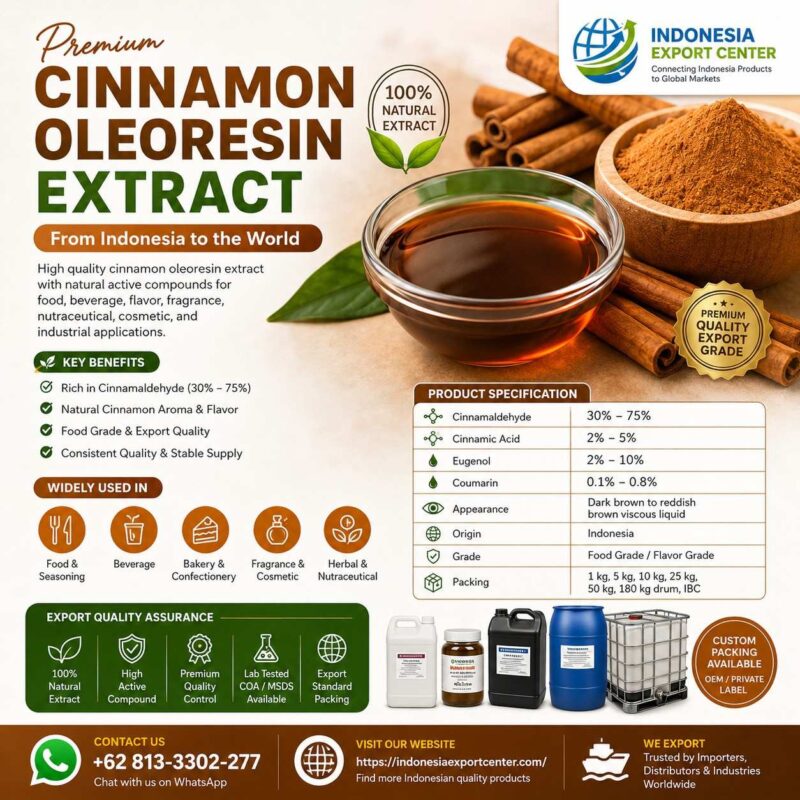
Cinnamon is widely used in bakery products, beverages, confectionery, sauces, seasonings, processed foods, fragrances, and personal-care formulations. However, manufacturers purchasing cinnamon ingredients must decide whether cinnamon powder or cinnamon oleoresin is more suitable for their production process.
Although both ingredients originate from cinnamon bark, they behave very differently during formulation. Cinnamon powder provides the appearance, texture, and broad character of the whole spice, while cinnamon oleoresin delivers a concentrated flavor extract that can be standardized for industrial use.
The right choice depends on the desired flavor intensity, product appearance, processing system, dosage accuracy, regulatory market, and cost per finished unit.
What Is Cinnamon Powder?
Cinnamon powder is produced by cleaning, drying, and grinding cinnamon bark into particles of a specified mesh size. It therefore contains the physical bark material, including its natural fiber, color, volatile compounds, and non-volatile components.
Under the US food-labeling definition, a spice is an aromatic vegetable material in whole, broken, or ground form whose main function is seasoning and from which the volatile oil or other flavoring principles have not been removed.
For Indonesian cinnamon, buyers commonly encounter Cinnamomum burmannii, also known commercially as Indonesian cassia or Korintje cinnamon. ISO 6538 specifically covers Chinese, Indonesian, and Vietnamese cassia types, including whole and ground forms.
Cinnamon powder is commonly used in:
- Bakery mixes and fillings
- Biscuits, cakes, and breakfast cereals
- Spice blends and seasoning powders
- Tea and instant drink mixtures
- Curry and savory formulations
- Products requiring visible cinnamon particles
- Traditional or minimally processed food concepts
The powder does not truly dissolve in water or oil. Instead, the particles disperse temporarily and may settle, float, or remain suspended depending on the particle size and viscosity of the finished product.
What Is Cinnamon Oleoresin?
Cinnamon oleoresin is a concentrated extract produced from cinnamon bark. FAO describes oleoresins as products obtained through solvent extraction of flavor compounds, followed by solvent removal—often under vacuum—to leave a concentrated flavoring material.
Unlike cinnamon essential oil, which mainly represents the volatile fraction of the spice, an oleoresin can contain both volatile aroma compounds and extracted non-volatile flavor components. The American Spice Trade Association explains that oleoresins were developed to provide a broader spice profile than essential oils alone.
Cinnamon oleoresin is generally dark brown, viscous, and strongly aromatic. Depending on the manufacturer and intended application, it may be supplied as:
- A concentrated viscous oleoresin
- An oil-dispersible product
- A water-dispersible or emulsified preparation
- A dry, spray-dried flavor powder
- A standardized oleoresin diluted with food-grade carrier oil
- A custom flavor preparation with a defined flavor strength
Some oleoresins require vegetable oil, food-grade solubilizers, emulsifiers, or dry carriers to improve handling and dispersibility. Therefore, buyers should never assume that every cinnamon oleoresin has the same solubility or concentration.
Key Differences Between Cinnamon Oleoresin and Cinnamon Powder
1. Flavor concentration
Cinnamon powder provides the natural character of ground bark, but much of its mass consists of plant material that does not directly contribute strong aroma.
Cinnamon oleoresin is a flavor concentrate. Consequently, a smaller quantity may produce a stronger cinnamon impact than the same weight of powder. However, there is no universal conversion such as “one kilogram of oleoresin equals a fixed quantity of powder.” The equivalent dosage depends on the oleoresin’s volatile oil content, extraction ratio, carrier concentration, and sensory profile.
Buyers should request a supplier’s recommended starting dosage and perform trials in the actual food matrix.
2. Batch-to-batch consistency
The flavor of cinnamon powder can vary according to species, geographical origin, harvest period, bark age, storage conditions, grinding temperature, and volatile oil loss.
Industrial oleoresins can be blended or standardized to provide more consistent flavor strength. ASTA notes that spice extractives may be customized according to solubility, dispersibility, aroma, flavor, and color, and may be standardized despite seasonal crop variations.
For large food factories producing the same formulation throughout the year, this consistency is one of the strongest reasons to consider oleoresin.
3. Appearance and texture
Cinnamon powder adds a natural brown color, visible particles, and a slightly fibrous or gritty mouthfeel. These characteristics can be desirable in bakery products, traditional spice blends, tea products, and foods marketed with visible spices.
Oleoresin contributes flavor without introducing the same quantity of bark particles. It is therefore more suitable when manufacturers require a smoother appearance or texture.
Nevertheless, cinnamon oleoresin itself may be dark and can influence the color of light-colored products. A laboratory trial should be performed before it is used in white confectionery, dairy analogues, clear beverages, or pale sauces.
4. Solubility and dispersibility
Cinnamon powder is an insoluble particulate ingredient. It may create sediment in beverages and can be difficult to distribute uniformly in low-viscosity liquids.
Conventional cinnamon oleoresin is generally more compatible with oil-based systems than with water. Water-dispersible versions require a suitable emulsifier or carrier system. ASTA describes liquid-soluble oleoresins, emulsions, concentrates, suspensions, and dry-soluble versions designed for different food systems.
Buyers should specify whether the application is:
- Water-based
- Oil-based
- Alcohol-based
- A dry powder blend
- An emulsion
- A high-fat food
- A clear or opaque beverage
The term “water-soluble cinnamon oleoresin” should be verified carefully. In many cases, the product is technically water-dispersible rather than molecularly soluble.
5. Dosing and production control
Powder is relatively easy to weigh using conventional dry-ingredient equipment. However, uniform distribution may become difficult at low dosage levels, especially in large production batches.
Oleoresin allows concentrated dosing but requires more accurate equipment. A small weighing error can noticeably change the final flavor. Highly viscous oleoresin may also require warming, pre-dilution, or mixing with a carrier before addition.
Manufacturers should establish:
- A controlled weighing procedure
- A suitable pre-blending step
- A defined addition temperature
- Adequate mixing time
- A validated dosage range
- Sensory approval standards
Oleoresin should not be poured directly into a large production tank without confirming that it can disperse evenly.
6. Microbiological considerations
Ground spices are agricultural products and can be exposed to microorganisms during cultivation, drying, storage, grinding, and transportation. FDA’s spice risk profile identifies Salmonella as the pathogen most frequently associated with reported illness from contaminated spices and describes microbial contamination as a systemic challenge in the spice supply chain.
A properly manufactured oleoresin will usually have a different microbiological profile from untreated ground bark because it has undergone extraction and additional processing. However, oleoresin should not automatically be described as sterile.
For either ingredient, international buyers should request a Certificate of Analysis covering applicable parameters such as:
- Total plate count
- Yeast and mold
- Coliforms or Enterobacteriaceae
- Escherichia coli
- Salmonella
- Staphylococcus aureus, where required
For cinnamon powder, buyers should also ask whether steam treatment or another validated microbial-reduction process has been applied.
7. Storage and logistics
Cinnamon powder requires greater storage volume for an equivalent flavor contribution and can generate dust during handling. It should be protected from moisture, heat, pests, and strong surrounding odors.
Oleoresin normally uses less warehouse space for equivalent flavor production, but its concentrated nature demands careful packaging. Exposure to oxygen, excessive heat, and light may change its aroma, viscosity, or color.
Food-grade oleoresin is commonly packed in lined containers or suitable food-contact drums. Exact packaging depends on order size and product viscosity.
Shelf life should be based on the supplier’s stability data rather than a general assumption that all extracts last longer than powder.
Which Ingredient Is More Economical?
Comparing price per kilogram can be misleading.
Cinnamon powder is normally less expensive per kilogram, but manufacturers may need a larger dosage. It may also create additional costs from storage volume, microbial treatment, dust management, filtration, sedimentation, or inconsistent flavor strength.
Cinnamon oleoresin may have a higher purchase price per kilogram, but its concentrated nature can reduce:
- Dosage per production batch
- Freight volume
- Warehouse requirements
- Spice particles in processing equipment
- Flavor variation between batches
The correct comparison is therefore cost per unit of finished product, not simply cost per kilogram of ingredient.
A buyer should calculate:
Ingredient cost per batch ÷ number of finished units produced
This calculation should be completed after pilot trials establish the actual dosage required.
Best Applications for Cinnamon Powder
Cinnamon powder is generally the stronger choice when the product requires:
- Visible cinnamon particles
- Traditional whole-spice positioning
- Natural brown coloring from bark
- Dry blending without liquid-dosing equipment
- Texture associated with ground spices
- A broad bark profile rather than concentrated aroma alone
It is particularly suitable for spice mixes, bakery fillings, cookies, cakes, tea blends, oatmeal, cereals, and products where sediment is acceptable.
Best Applications for Cinnamon Oleoresin
Cinnamon oleoresin is generally more suitable when manufacturers need:
- Concentrated flavor delivery
- Improved batch-to-batch consistency
- Low-dosage industrial formulation
- Reduced particulate matter
- Better integration into oils, fats, sauces, or emulsions
- Customized flavor strength
- Reduced storage and transportation volume
Typical applications include confectionery, sauces, processed foods, flavored oils, seasonings, bakery flavor systems, beverage bases, and industrial flavor compounds.
In the United States, FDA’s food-substance database identifies cinnamon bark extract from Cinnamomum species as a flavoring agent or flavoring adjuvant and references its regulatory status under 21 CFR 182.20.
For the European market, flavorings and flavoring preparations must comply with the applicable conditions, labeling provisions, source-material requirements, and naturally occurring substance limits under Regulation (EC) No 1334/2008.
Can Cinnamon Oleoresin Be Used for Fragrance Applications?
Cinnamon extracts can provide a warm, sweet, spicy, and woody character in fragrance formulations. In general, an extract or oleoresin is more practical than cinnamon powder because powder introduces insoluble bark particles.
However, food-grade does not automatically mean fragrance-ready.
Fragrance buyers should evaluate:
- Odor profile and strength
- Color contribution
- Solubility in the fragrance base
- Residual non-volatile material
- Cinnamaldehyde content
- Coumarin and other restricted constituents
- Skin-sensitization considerations
- Intended finished-product category
- Applicable national cosmetic or chemical regulations
IFRA maintains standards restricting or specifying certain fragrance materials, including cinnamic aldehyde. IFRA also explains that natural complex substances must be assessed according to their restricted constituents and the intended consumer-product category.
A raw-material supplier may provide analytical and conformity information, but an IFRA Certificate of Conformity is normally issued for the final fragrance mixture by the fragrance mixture manufacturer, not as a general certification of the raw oleoresin.
Species and Coumarin Must Be Verified
The choice between powder and oleoresin does not remove the need to confirm the botanical species.
Indonesian cinnamon is commonly classified as cassia. Cassia cinnamon generally contains more naturally occurring coumarin than Ceylon cinnamon, although the level can vary considerably among samples. BfR notes that coumarin occurs at relatively high concentrations in cinnamon varieties collectively described as cassia.
Because extraction can change the relative concentration of different compounds, buyers should not estimate coumarin content from the raw bark specification alone. A specific coumarin test may be required when the finished product is destined for markets or food categories with applicable limits.
Can Manufacturers Use Both?
In many formulations, the best solution is not to choose only one.
A combination of cinnamon powder and cinnamon oleoresin can provide:
- Visible spice particles from the powder
- Stronger aroma from the oleoresin
- A more consistent flavor profile
- Lower powder dosage
- Better sensory performance after processing
ASTA confirms that oleoresins may be combined with ground spices to produce customized blends and seasoning products.
This approach can be useful in bakery fillings, meat seasonings, instant beverage powders, sauces, and premium spice blends.
What Should Buyers Request from a Supplier?
Before purchasing cinnamon powder or cinnamon oleoresin, request a complete specification and recent batch Certificate of Analysis.
For cinnamon powder, the specification should include:
- Botanical name
- Country and region of origin
- Mesh size
- Moisture content
- Volatile oil content
- Total ash and acid-insoluble ash
- Microbiological limits
- Heavy metals
- Pesticide residues
- Coumarin, where relevant
- Microbial-reduction treatment
- Packaging and shelf life
For cinnamon oleoresin, buyers should request:
- Botanical name and plant part
- Extraction method
- Extraction solvent
- Residual solvent limits
- Volatile oil or marker-compound content
- Cinnamaldehyde content, where specified
- Coumarin content, where relevant
- Carrier or diluent declaration
- Solubility or dispersibility
- Recommended dosage
- Microbiological specification
- Heavy-metal and pesticide-residue results
- Food-grade and regulatory declarations
- Packaging, storage, and shelf life
A representative sample should be tested in the buyer’s actual formulation before a commercial contract is finalized.
Final Recommendation: Which Should Buyers Choose?
Choose cinnamon powder when the finished product needs visible spice material, traditional texture, natural bark color, or straightforward dry blending.
Choose cinnamon oleoresin when the priority is concentrated flavor, accurate industrial dosing, reduced particles, batch consistency, and efficient storage.
Choose a combination of both when the product needs the authentic visual appeal of ground cinnamon together with the stronger and more consistent aroma of an extract.
The decision should ultimately be based on application trials, target-market regulations, total formulation cost, and an agreed technical specification—not on ingredient price alone.
For manufacturers seeking consistent Indonesian cinnamon extracts, the next step is to consult a reliable Cinnamon Oleoresin Supplier from Indonesia and request a food-grade sample matched to the intended application. Buyers developing flavor compounds, processed foods, or aromatic formulations should also review the technical options available for Food-Grade Cinnamon Oleoresin for Flavor & Fragrance.
References
- Food and Agriculture Organization of the United Nations, Spices and Herbs for Home and Market—production and extraction of spice oleoresins.
- American Spice Trade Association, A Concise Guide to Spices, Herbs, Seeds and Extractives—oleoresin composition, standardization, carriers, and industrial applications.
- US Food and Drug Administration, CPG Sec. 525.750 Spices—Definitions.
- US Food and Drug Administration, Risk Profile on Pathogens and Filth in Spices.
- US FDA Food Substances Database, Cinnamon Bark Extract—Flavoring Agent or Adjuvant.
- International Organization for Standardization, ISO 6538—Chinese, Indonesian, and Vietnamese cassia specification.
- European Union, Regulation (EC) No 1334/2008 on flavorings and food ingredients with flavoring properties, consolidated through December 2024.
- German Federal Institute for Risk Assessment, information on coumarin in cassia and Ceylon cinnamon.
- International Fragrance Association, IFRA Standards and Standards Library.
