

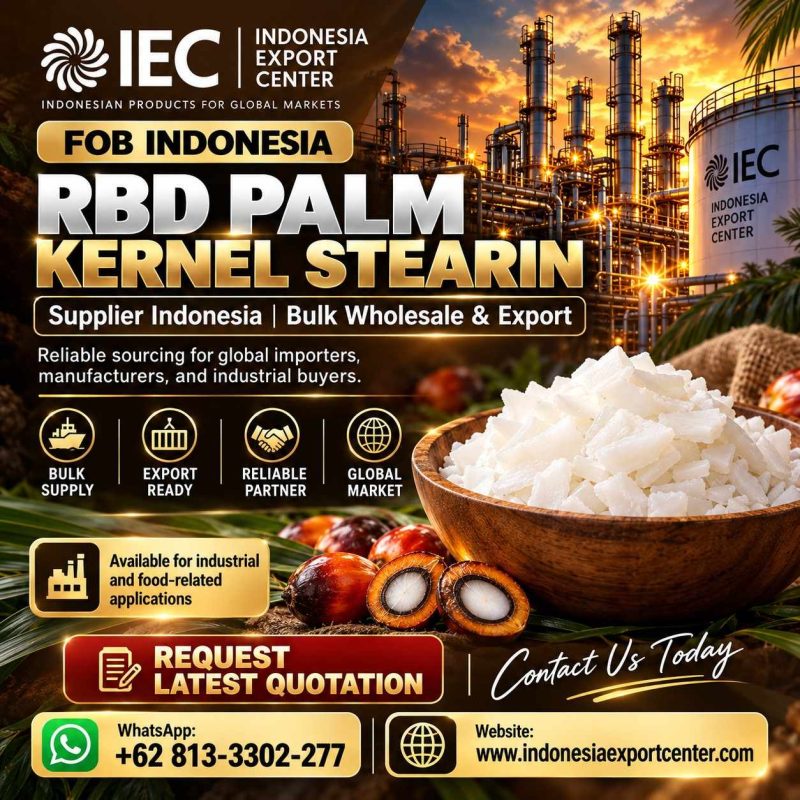
Source RBD Palm Kernel Stearin for Specialty Fat Production
Specialty fat manufacturing involves developing oils and fats with defined functional characteristics for particular industrial applications.
Unlike general-purpose vegetable oils, specialty fats may require carefully controlled melting profiles, crystallization behavior, texture, and consistency.
RBD Palm Kernel Stearin is a higher-melting lauric fat fraction that may be evaluated as a feedstock for selected specialty fat manufacturing processes.
Indonesia Export Center (IEC) supports international processors, ingredient manufacturers, and industrial procurement teams seeking Indonesian supplier options, technical documents, and bulk export quotations.
Our sourcing approach emphasizes raw material qualification and manufacturing suitability.
What Are Specialty Fats?
Specialty fats are developed to meet particular processing or finished-product requirements.
Their characteristics may be adjusted through raw material selection, fractionation, blending, or other appropriate manufacturing processes.
Potential application categories include confectionery fats, bakery ingredient systems, coatings, fillings, and selected industrial fat products.
The required properties depend on the finished application.
A specialty fat intended for a coating may have a different physical profile from one designed for a soft filling.
Understanding Palm Kernel Stearin
Palm kernel stearin is obtained by separating the higher-melting fraction of palm kernel oil.
Palm kernel oil is derived from the kernel of the oil palm fruit.
It contains substantial lauric fatty acids and differs from palm oil extracted from the mesocarp.
Fractionation produces fractions with different physical characteristics.
Palm kernel stearin is generally more solid than palm kernel olein under comparable conditions.
The actual properties of a commercial grade must be verified using supplier documentation.
Why Specialty Fat Manufacturers Evaluate Palm Kernel Stearin
Thermal Characteristics
Palm kernel stearin may provide a useful raw material for developing particular melting profiles.
Solid Fat Behavior
Its solid fat characteristics can be relevant to the design of structured fat systems.
Further Processing
Manufacturers may evaluate palm kernel stearin as an input for additional processing routes.
Blending Applications
The material may be considered in blends with other compatible fats.
Product Development
Specialty fat formulators may use palm kernel stearin as one candidate ingredient during technical research.
None of these potential applications guarantees a particular finished-product performance.
Raw Material vs Finished Specialty Fat
| Category | Palm Kernel Stearin Feedstock | Finished Specialty Fat |
|---|---|---|
| Role | Input material | Functional ingredient |
| Specification | Raw material quality | Application performance |
| Processing | Refined fraction | May undergo further processing |
| Melting Behavior | Grade-dependent | Designed for target use |
| Testing | Chemical and physical analysis | Formulation and functional testing |
| Approval | Feedstock qualification | Finished-product qualification |
Important Quality Parameters
Free Fatty Acid
FFA is relevant to raw material quality.
The acceptable limit should be established in the purchasing specification.
Iodine Value
Iodine value helps characterize the degree of unsaturation.
Slip Melting Point
SMP provides information about melting characteristics.
Solid Fat Content
SFC measurements across different temperatures may help formulators evaluate physical behavior.
Fatty Acid Composition
A detailed fatty acid profile may support feedstock selection and formulation calculations.
Moisture and Impurities
These parameters are important for raw material quality control.
Color
Color may influence the suitability of the material for particular finished products.
Crystallization and Texture
Crystallization behavior is important in many specialty fat systems.
It can influence firmness, plasticity, setting, and other functional properties.
The characteristics of a finished blend depend on the full composition and manufacturing process.
A raw material’s melting point alone does not determine the final texture.
Manufacturers should use appropriate analytical and pilot-production methods.
Blending Compatibility
Not all fats behave predictably when combined.
Differences in fatty acid and triglyceride composition can influence crystallization and melting behavior.
Lauric and non-lauric fat combinations may require particular attention.
Compatibility testing should be completed before commercial substitution or reformulation.
Specialty Fat Manufacturing Evaluation Process
1. Define the Target Product
Identify the intended industrial application and performance requirements.
2. Establish Raw Material Specifications
Determine the required quality and thermal parameters.
3. Request Supplier Documentation
Review the TDS, COA, and relevant analytical information.
4. Conduct Laboratory Screening
Evaluate candidate grades and potential blends.
5. Test Processing Compatibility
Assess performance under the intended manufacturing conditions.
6. Conduct Pilot Production
Confirm that the material performs acceptably at a representative scale.
7. Evaluate Finished-Product Stability
Monitor the characteristics relevant to the application.
8. Approve Commercial Supply
Establish incoming quality controls and purchasing conditions.
Industrial Procurement and Supply Consistency
Specialty fat manufacturers often need consistency across multiple deliveries.
A supplier agreement may define quality limits, batch documentation, change notifications, and inspection procedures.
If the raw material characteristics change, additional formulation testing may be necessary.
Packaging and Handling
Palm kernel stearin’s higher-melting characteristics can influence logistics.
Buyers should confirm packaging suitability, storage guidance, and unloading procedures.
Where heating is required, the conditions must be approved for the product and equipment.
Export Sourcing from Indonesia
IEC can receive inquiries for initial commercial quantities and recurring procurement.
Buyers should provide their required grade, technical parameters, quantity, packaging, and destination port.
Supplier availability and commercial terms must be confirmed.
Frequently Asked Questions
Is palm kernel stearin used in specialty fat manufacturing?
It may be evaluated as a feedstock for selected specialty fat systems.
Is it the same as a finished specialty fat?
No. A finished specialty fat may require further processing or blending.
Why is solid fat content important?
It helps describe how the material behaves at different temperatures.
Can palm kernel stearin be blended with other fats?
Potential blending applications require compatibility testing.
What documents should I request?
A TDS, COA, and relevant fatty acid and thermal data.
Can I request recurring supply?
Yes. Recurring requirements can be discussed with potential suppliers.
Does IEC guarantee manufacturing performance?
No. Performance must be established through independent technical evaluation.
Request Industrial Palm Kernel Stearin Supply
Company Name:
Country:
Specialty Fat Application:
Required Grade:
Target Melting Profile:
Required Fatty Acid Composition:
Additional Technical Requirements:
Initial Quantity (MT):
Monthly Demand (MT):
Packaging Preference:
Destination Port:
Shipment Period:
Indonesia Export Center (IEC)
Website: https://indonesiaexportcenter.com/
WhatsApp: +62 813-3302-277
Contact IEC to explore Indonesian RBD Palm Kernel Stearin feedstock options for specialty fat manufacturing.
Raw material specifications, manufacturing suitability, available quantities, certifications, and export terms require supplier confirmation.
