

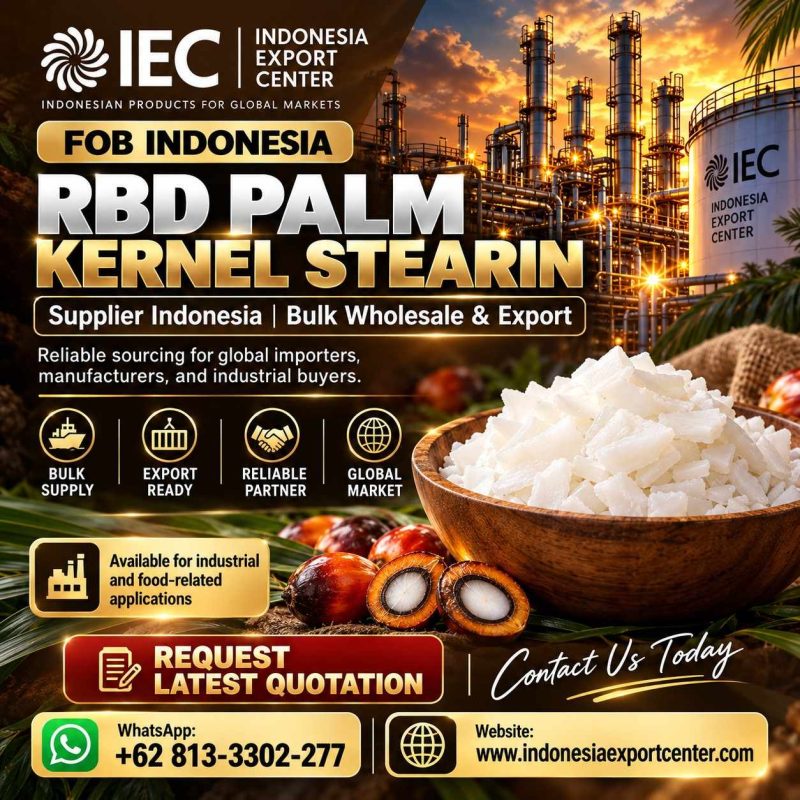
RBD Palm Kernel Stearin for Confectionery Coating Development
Confectionery coatings require carefully selected fat systems to achieve the desired combination of flow behavior, setting characteristics, texture, appearance, and storage stability.
For manufacturers developing compound coatings and related confectionery ingredients, RBD Palm Kernel Stearin may be considered as a raw material for selected specialty fat formulations.
Indonesia Export Center (IEC) supports international buyers seeking Indonesian palm kernel stearin suppliers, technical documentation, sample availability, and bulk export quotations.
We encourage manufacturers to evaluate the complete coating formulation before approving any fat ingredient for commercial production.
Understanding Confectionery Coating Fats
Confectionery coatings are used in products such as coated biscuits, wafers, snack products, confectionery centers, and decorative applications.
The required fat properties vary according to the product.
Some coatings need rapid setting after application.
Others require a softer bite, particular gloss characteristics, or resistance to storage-related changes.
The selection of fat influences these outcomes, but it is only one part of the formulation.
Processing conditions, emulsifiers, cocoa ingredients, sugar, cooling equipment, and storage temperatures also matter.
What Is Palm Kernel Stearin?
Palm kernel stearin is the higher-melting fraction of palm kernel oil.
When refined, bleached, and deodorized, the product is commonly described as RBD Palm Kernel Stearin.
It belongs to the lauric fat family.
Its characteristics differ from conventional palm stearin and palm kernel olein.
Depending on the manufacturing route, palm kernel stearin may be further processed or blended to produce suitable specialty fats.
Potential Role in Compound Coating Systems
Palm kernel stearin-derived fat systems may be evaluated for certain compound coatings.
The exact suitability depends on the required melting and crystallization characteristics.
A higher-melting raw material does not automatically produce the ideal coating.
The finished fat system may require additional processing or blending.
Important Coating Performance Factors
| Performance Factor | Why It Matters |
|---|---|
| Melting Behavior | Influences mouthfeel and processing |
| Setting Characteristics | Affects cooling and production speed |
| Solid Fat Content | Supports temperature-dependent structure |
| Crystallization | Influences texture and appearance |
| Viscosity | Affects coating application |
| Fat Compatibility | Helps prevent undesirable interactions |
| Storage Stability | Supports finished-product quality |
| Sensory Properties | Influences consumer acceptance |
Compound Coatings vs Cocoa Butter-Based Chocolate
Compound coatings and cocoa butter-based chocolate may use different fat systems.
The applicable product definitions and labeling rules depend on the destination market.
A palm kernel-derived coating fat should not automatically be marketed as cocoa butter or a cocoa butter equivalent.
Manufacturers must verify the composition and regulatory classification of the finished product.
Understanding Fat Compatibility
Lauric fats can interact differently with cocoa butter and other non-lauric fats.
Incompatible combinations may affect crystallization, texture, or stability.
For this reason, the amount and type of other fats present in the formulation should be evaluated.
Compatibility testing should be performed under representative manufacturing and storage conditions.
Raw Material Technical Specifications
A manufacturer may request:
- Free Fatty Acid.
- Iodine Value.
- Slip Melting Point.
- Solid Fat Content.
- Fatty Acid Composition.
- Moisture and Impurities.
- Color.
- Relevant oxidation-related parameters.
Actual acceptance limits should come from the approved supplier specification.
Coating Formulation Evaluation
Laboratory Screening
Review the raw material and conduct small-scale formulation tests.
Thermal Analysis
Evaluate melting behavior and solid fat characteristics.
Processing Trials
Test mixing, coating, cooling, and setting behavior.
Appearance Evaluation
Assess gloss, surface characteristics, and other visual requirements.
Texture Evaluation
Determine whether the coating provides the desired bite and mouthfeel.
Storage Assessment
Observe relevant physical and sensory changes under intended storage conditions.
Pilot Production
Confirm that the formulation performs acceptably at representative production scale.
Quality and Food Safety Documentation
For food manufacturing, buyers should request appropriate supplier documentation.
This may include the TDS, COA, traceability information, and applicable food safety records.
Specific certifications must be confirmed with the supplier.
A marketing claim alone is not sufficient evidence of certification.
Bulk Purchasing for Coating Manufacturers
Industrial coating producers may require repeat purchases with consistent quality.
Buyers should establish incoming inspection procedures and define acceptable variation.
The purchasing contract should identify the grade, quantity, delivery terms, and treatment of non-conforming material.
Packaging and Transport
Palm kernel stearin is a higher-melting fat fraction.
Transport arrangements should consider its temperature-dependent physical behavior.
Packaging, loading, and unloading methods require supplier and logistics-provider confirmation.
No single handling temperature should be applied to every grade.
Common Procurement Mistakes
A frequent mistake is purchasing palm kernel stearin without confirming whether the manufacturer needs raw stearin or a finished coating fat.
Another is assuming that the ingredient can replace cocoa butter directly.
Buyers should also avoid relying on a generic COA when their application requires detailed thermal data.
Frequently Asked Questions
Can palm kernel stearin be used in compound coatings?
It may be used as feedstock or a component of selected specialty fat systems, subject to processing and formulation testing.
Is palm kernel stearin a ready-to-use coating fat?
Not necessarily. Additional processing or blending may be required.
Does it replace cocoa butter directly?
Direct substitution should not be assumed.
What technical information should coating manufacturers request?
A TDS, COA, fatty acid profile, and relevant melting or SFC data are useful.
Can I request samples?
Sample availability is supplier-dependent.
Is every grade suitable for food use?
No. Food-grade suitability and regulatory compliance must be verified.
Can IEC help with bulk procurement?
IEC can receive commercial inquiries and coordinate supplier discussions.
Request Palm Kernel Stearin for Confectionery Coatings
Company Name:
Country:
Coating Application:
Required Fat Characteristics:
Target Melting Behavior:
Required Technical Documents:
Sample Quantity:
Initial Order Volume (MT):
Expected Monthly Volume (MT):
Packaging:
Destination Port:
Indonesia Export Center (IEC)
Website: https://indonesiaexportcenter.com/
WhatsApp: +62 813-3302-277
Contact IEC to discuss RBD Palm Kernel Stearin sourcing for compound coating and confectionery fat development.
Finished-product performance, cocoa butter compatibility, food safety compliance, and raw material availability require technical evaluation and supplier verification.
