

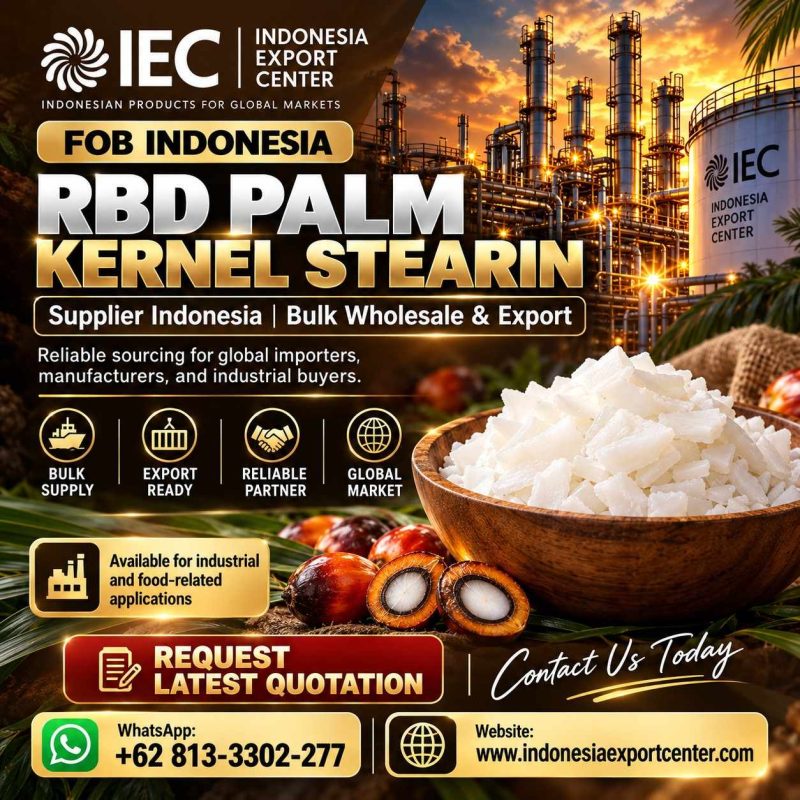
RBD Palm Kernel Stearin for Biscuit and Wafer Cream Fat Development
Biscuit and wafer manufacturers rely on carefully formulated cream fillings to achieve the desired texture, consistency, processing performance, and storage stability.
The fat system plays an important role in determining whether a filling remains sufficiently structured during storage while delivering the intended mouthfeel.
RBD Palm Kernel Stearin may be evaluated as a raw material or component of selected bakery filling fat formulations.
Indonesia Export Center (IEC) supports international manufacturers seeking Indonesian supplier options, technical specifications, samples, and bulk quotations for palm kernel stearin.
Because filling requirements differ between products, manufacturers should assess the ingredient through appropriate formulation and pilot-production trials.
Understanding Biscuit Cream Filling Fats
Cream fillings are used in sandwich biscuits, wafer products, and other bakery applications.
They commonly combine fats with ingredients such as sugar, flavorings, and other formulation components.
The fat phase influences texture, consistency, and processing.
A suitable filling must meet the manufacturer’s requirements throughout production, packaging, distribution, and consumption.
What Is Palm Kernel Stearin?
Palm kernel stearin is the higher-melting fraction of palm kernel oil.
It is a lauric fat fraction with physical characteristics different from palm kernel olein and conventional palm stearin.
Its higher-melting behavior may be relevant to the development of structured fat systems.
However, raw palm kernel stearin is not automatically a complete biscuit cream filling fat.
Additional blending or processing may be required.
Potential Role in Cream Filling Formulations
Structure Development
Certain fillings require sufficient structure to remain stable between biscuit or wafer layers.
A suitable formulated fat system helps provide this structure.
Texture Control
The composition of the fat phase can influence softness, firmness, and mouthfeel.
Temperature Response
A filling must perform under relevant manufacturing and storage conditions.
Processing Consistency
The fat system can influence mixing, depositing, and other production operations.
Product Stability
Appropriate formulation and storage conditions help maintain the intended product characteristics.
Palm kernel stearin’s contribution to these functions must be evaluated in the complete formulation.
Technical Parameters for Bakery Fat Evaluation
| Parameter | Why It Matters |
|---|---|
| Slip Melting Point | Thermal characteristics |
| Solid Fat Content | Temperature-dependent structure |
| Fatty Acid Profile | Raw material composition |
| Crystallization Behavior | Texture and processing |
| FFA | Quality assessment |
| Moisture and Impurities | Raw material control |
| Color | Appearance |
| Oxidative Stability | Storage-related evaluation |
| Sensory Characteristics | Finished-product acceptance |
Melting Behavior and Mouthfeel
Biscuit cream fillings need a balance between structure and sensory quality.
A filling that is too firm may produce an undesirable eating experience.
A filling that is too soft may create processing or storage difficulties.
The appropriate fat profile depends on the finished product.
A high-melting raw material should not automatically be considered beneficial.
The complete blend must be designed to meet the desired characteristics.
Solid Fat Content and Filling Texture
Solid Fat Content provides information about the proportion of solid fat at different temperatures.
An SFC profile can help formulators understand how a fat behaves during processing and storage.
However, the finished filling also depends on sugar particle characteristics, ingredient ratios, processing, and other formulation factors.
SFC data should be interpreted together with practical trials.
Crystallization and Stability
Fat crystallization can influence texture and structural behavior.
Changes in crystal structure during storage may affect product quality.
Manufacturers should evaluate the filling under conditions representative of the intended market.
Testing may include firmness, oil separation, sensory quality, and relevant stability characteristics.
Palm Kernel Stearin and Other Fats
A filling formulation may contain more than one fat or oil.
The compatibility of palm kernel stearin with other ingredients must be assessed.
Lauric and non-lauric fat interactions can be important.
Manufacturers should not replace an existing filling fat with palm kernel stearin without reformulation and testing.
Recommended Product Development Process
Step 1: Define the Filling Application
Identify the product, processing method, target texture, and storage requirements.
Step 2: Establish Technical Targets
Determine the desired thermal and functional characteristics.
Step 3: Request Raw Material Documentation
Obtain the supplier’s TDS, COA, and relevant physical data.
Step 4: Conduct Laboratory Trials
Evaluate candidate formulations.
Step 5: Assess Processing Behavior
Check mixing, depositing, consistency, and other relevant characteristics.
Step 6: Conduct Storage Testing
Monitor texture, stability, and sensory quality.
Step 7: Complete Pilot Production
Confirm that the formulation performs under representative manufacturing conditions.
Food Safety Requirements
Bakery manufacturers should verify that the selected raw material is suitable for the intended food application.
Relevant considerations may include food safety documentation, traceability, contaminant limits, and packaging suitability.
Any required certification must be verified for the specific supplier and product.
Bulk Ingredient Procurement
Once a suitable grade has been approved, buyers may request commercial quantities.
The RFQ should specify the product grade, technical requirements, initial quantity, expected repeat demand, packaging, and destination port.
For recurring orders, consistent quality is particularly important.
Common Mistakes in Filling Fat Procurement
A common mistake is selecting a fat solely because it has a higher melting point.
Another is assuming that a raw fat fraction is equivalent to a finished bakery filling fat.
Buyers should also avoid approving a material without testing its interaction with the complete filling formulation.
Frequently Asked Questions
Can palm kernel stearin be used in biscuit cream fillings?
It may be evaluated as a component or feedstock in selected filling fat systems.
Is it suitable for wafer creams?
Suitability depends on the required formulation and technical performance.
Does palm kernel stearin make fillings firmer?
Its effect depends on the complete fat blend, processing conditions, and formulation.
Is further processing required?
Some applications may require additional blending or processing.
Can I request a sample?
Sample availability must be confirmed with the supplier.
What technical data should I request?
A TDS, COA, melting data, and relevant SFC information.
Can IEC assist with wholesale sourcing?
IEC can receive inquiries and coordinate discussions with potential Indonesian suppliers.
Request Palm Kernel Stearin for Biscuit Cream Applications
Company Name:
Country:
Product Application:
Required Filling Characteristics:
Target Melting Profile:
Technical Documents Required:
Sample Requirement:
Initial Quantity (MT):
Monthly Requirement (MT):
Packaging:
Destination Port:
Shipment Date:
Indonesia Export Center (IEC)
Website: https://indonesiaexportcenter.com/
WhatsApp: +62 813-3302-277
Contact IEC to request RBD Palm Kernel Stearin technical information and supplier quotations for biscuit and wafer cream fat development.
Application suitability, food safety compliance, product specifications, and supplier availability require verification and formulation testing.
