

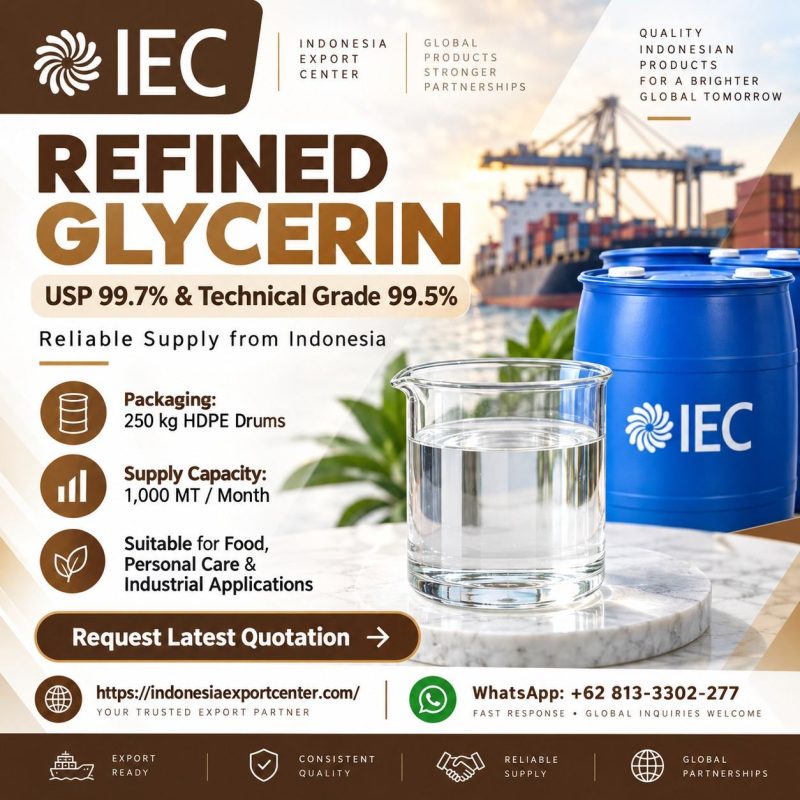
Understanding the Origin of Refined Glycerin from Indonesia
International buyers increasingly request detailed information about the origin of chemical and ingredient raw materials.
For refined glycerin, this may include whether the product is palm-derived, sourced from another vegetable oil, produced through a different industrial pathway, or manufactured using mixed feedstocks.
Indonesia Export Center (IEC) assists buyers seeking Indonesian refined glycerin sourcing options and supplier-confirmed origin information.
This guide explains the differences between palm-based glycerin and other vegetable glycerin, including feedstock identification, traceability, documentation, and sustainability-related purchasing requirements.
What Is Vegetable Glycerin?
Vegetable glycerin is a commercial description commonly used for glycerol derived from vegetable-based feedstocks.
Possible sources include different vegetable oils and related processing streams.
The precise feedstock may vary by manufacturer and production batch.
A product described as vegetable glycerin should not automatically be assumed to be palm-derived.
Likewise, a product supplied from Indonesia should not automatically be assumed to originate from Indonesian palm oil.
The actual source must be verified.
What Is Palm-Based Glycerin?
Palm-based glycerin refers to glycerol derived from palm-related feedstocks.
Depending on the manufacturing process, glycerol may be associated with oil and fat processing or downstream oleochemical operations.
However, a supplier’s product may have a more complex supply chain.
Buyers should request a clear origin declaration identifying the relevant feedstock and manufacturing information.
Other Vegetable Glycerin Sources
Vegetable-derived glycerol may also originate from other plant-based oil feedstocks.
The commercial designation does not necessarily identify a single crop.
Manufacturers may use different raw materials depending on their facilities, sourcing arrangements, and production processes.
The buyer should not infer the source from product appearance or nominal glycerol purity.
Chemical Similarity vs Commercial Origin
Chemically, glycerol has the same molecular structure regardless of its source.
Its formula is C3H8O3.
However, different production and refining processes may produce materials with different impurity profiles or traceability characteristics.
For technical purchasing, the buyer must evaluate both the chemical specification and any required origin declarations.
Palm-Based vs Other Vegetable Glycerin
| Factor | Palm-Based Glycerin | Other Vegetable Glycerin |
|---|---|---|
| Chemical Compound | Glycerol | Glycerol |
| Feedstock | Palm-related source | Other plant-based source |
| Chemical Formula | C3H8O3 | C3H8O3 |
| Purity | Depends on refining and grade | Depends on refining and grade |
| Appearance | Specification-dependent | Specification-dependent |
| Origin Evidence | Supplier documentation | Supplier documentation |
| Sustainability Claims | Require verification | Require verification |
| Application Suitability | Grade-dependent | Grade-dependent |
Why Feedstock Origin Matters
Buyer Procurement Policies
Some companies maintain policies governing the origin of purchased ingredients.
Customer Requirements
Downstream customers may require specific feedstock declarations.
Product Labeling
Certain origin-related marketing statements may require supporting evidence.
Supply-Chain Traceability
Buyers may need to identify manufacturing and upstream sourcing information.
Sustainability Programs
Some companies request certification or traceability information as part of their responsible sourcing programs.
What Does a Feedstock Declaration Include?
A useful declaration may identify the product, supplier, relevant feedstock, manufacturing location, and scope of the statement.
Buyers should clarify whether the declaration applies to a specific batch, product line, or general manufacturing process.
The issuing company should be identifiable.
A general marketing statement may not provide the level of traceability required by the buyer.
Why a COA May Not Prove Origin
A Certificate of Analysis usually reports analytical quality parameters.
It may confirm glycerol assay, water content, and other tested characteristics.
However, a conventional COA does not necessarily establish whether the glycerin is palm-derived or sourced from another vegetable oil.
Origin verification may require separate documentation.
Supplier Traceability
Buyers may request information about the manufacturing facility, upstream feedstock suppliers, production batches, and chain-of-custody arrangements.
The level of documentation available depends on the supplier and supply chain.
Not every supplier can provide the same traceability detail.
Sustainability Certification
Some buyers require specific sustainability certifications or traceability systems.
Any certification claim must be verified against the actual supplier, product, site, certificate scope, and validity period.
A supplier should not be described as certified solely because it operates in a sector where certification programs exist.
RSPO-Related Considerations
Where buyers require palm-related sustainability claims, they may ask about applicable RSPO certification and supply-chain arrangements.
The relevant certification model and claim must be verified.
A general statement that a product is palm-based does not establish RSPO certification.
Likewise, certification held by one company in a supply chain does not automatically prove that a particular shipment carries an eligible claim.
Non-Animal Origin Claims
Buyers may request evidence that glycerin is not derived from animal feedstocks.
The supplier should provide an appropriate declaration.
A vegetable-derived claim must be supported by actual sourcing information.
Food, Cosmetic and Pharmaceutical Considerations
Feedstock origin does not replace product quality requirements.
A vegetable-derived glycerin product is not automatically food grade, cosmetic grade, or pharmaceutical grade.
The buyer must separately verify the relevant quality standards and regulatory suitability.
Technical Grade vs USP Grade
The preliminary IEC sourcing range includes Technical Grade 99.5% and USP 99.7%.
Either grade requires verification of its actual origin if the buyer has feedstock restrictions.
A higher glycerol assay does not prove a particular feedstock source.
Origin Verification Checklist
| Buyer Requirement | Documentation to Request |
|---|---|
| Palm-Derived Feedstock | Supplier origin declaration |
| Non-Palm Vegetable Feedstock | Supplier origin declaration |
| Non-Animal Origin | Relevant supplier statement |
| Manufacturing Location | Facility information |
| Batch Traceability | Batch and production records |
| Sustainability Certification | Valid certificate and scope |
| Chain of Custody | Applicable records |
| Product Quality | TDS and COA |
| Intended-Use Compliance | Relevant regulatory documentation |
Procurement Questions for Suppliers
Buyers should ask whether the declared origin applies to the exact grade offered.
They should also ask whether the supplier uses multiple feedstocks, whether the source can vary between batches, and whether changes are communicated to customers.
For strict origin requirements, the purchasing contract should define the necessary declarations and change-control obligations.
Common Origin Verification Mistakes
One mistake is assuming all Indonesian glycerin is palm-derived.
Another is assuming all vegetable glycerin is interchangeable for every purchasing policy.
A third is treating a quality COA as conclusive evidence of feedstock origin.
Buyers should also avoid relying on unverified sustainability claims.
Frequently Asked Questions
Is all Indonesian glycerin palm-based?
No such universal claim should be made. The source of each product must be verified.
Is vegetable glycerin always made from palm oil?
No. Vegetable-derived glycerin can have different feedstock origins.
Can a COA prove palm origin?
A conventional COA may not establish feedstock origin. Separate documentation may be necessary.
Is palm-based glycerin chemically different from other glycerin?
The glycerol molecule is the same, but product specifications and impurity profiles can vary.
Does palm origin prove RSPO certification?
No. Certification and applicable claims require independent verification.
Can IEC request feedstock declarations?
IEC can facilitate requests for supplier origin documentation.
Is vegetable glycerin automatically food grade?
No. Food suitability must be established separately.
Request Supplier-Confirmed Glycerin Feedstock Origin
Company Name:
Country:
Required Grade:
Required Feedstock: Palm / Non-Palm Vegetable / Other
Origin Restrictions:
Sustainability Documentation Requirements:
Required Certifications:
Initial Quantity (MT):
Monthly Volume (MT):
Destination Port:
Preferred Trade Terms:
Shipment Date:
Indonesia Export Center (IEC)
Website: https://indonesiaexportcenter.com/
WhatsApp: +62 813-3302-277
Contact IEC to inquire about Indonesian refined glycerin supplier options and available feedstock-origin documentation.
Related pages:
- Refined Glycerin Supplier Indonesia
- Refined Glycerin COA Specifications
- USP 99.7% vs Technical 99.5% Glycerin
Palm origin, non-animal origin, sustainability certification, and traceability claims must be supported by current supplier documentation.
