

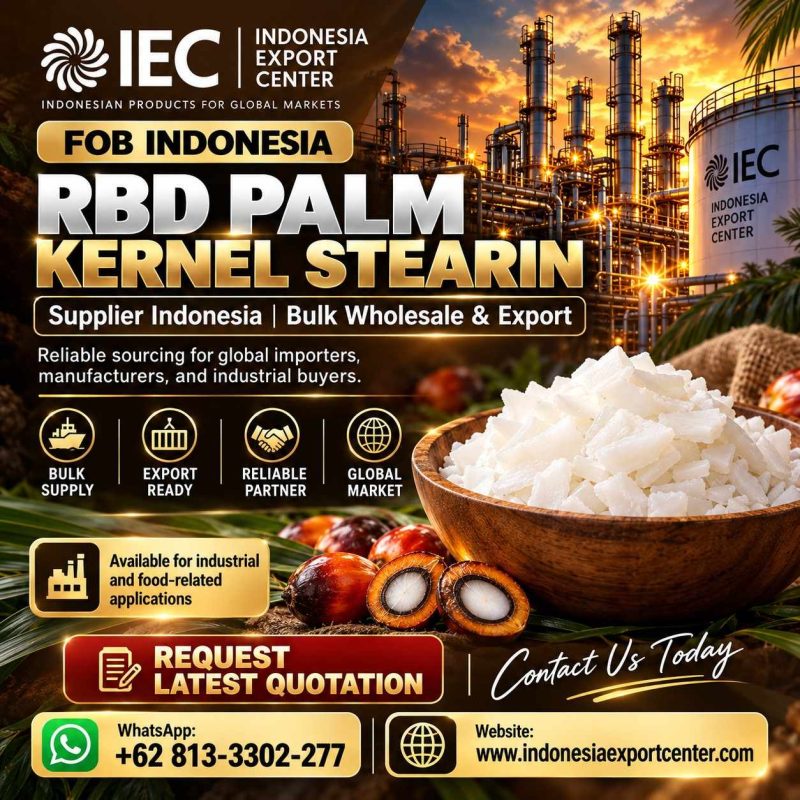
Indonesian RBD Palm Kernel Stearin Sourcing for Ice Cream Coating Manufacturers
Ice cream coatings require carefully formulated fats that can deliver appropriate flow behavior during application, setting characteristics under cold conditions, and the desired texture during consumption.
For manufacturers developing chocolate-flavored ice cream shells and other frozen dessert coatings, the choice of specialty fat is an important technical decision.
RBD Palm Kernel Stearin may be evaluated as a raw material for certain formulated coating fat systems.
Indonesia Export Center (IEC) supports international manufacturers and ingredient suppliers seeking Indonesian palm kernel stearin sourcing opportunities, technical documentation, sample inquiries, and bulk commercial quotations.
Palm kernel stearin should not automatically be treated as a ready-to-use ice cream coating fat. The intended application may require additional processing, blending, and technical qualification.
What Is an Ice Cream Shell Coating?
An ice cream shell coating is a formulated coating applied to a frozen dessert.
Depending on the product, the coating may contain vegetable fats, cocoa ingredients, sweeteners, emulsifiers, and other components.
The formulation must be compatible with the application process and intended sensory characteristics.
The fat system influences flow during coating, setting after application, structural properties, and mouthfeel.
Understanding RBD Palm Kernel Stearin
RBD Palm Kernel Stearin is the higher-melting fraction of refined palm kernel oil.
Palm kernel oil is obtained from the kernel of the oil palm fruit and contains substantial lauric fatty acids.
Through fractionation, the higher-melting fraction is separated from the relatively liquid fraction.
Palm kernel stearin may be considered during specialty fat development because of its physical characteristics.
However, its suitability for a particular frozen dessert coating depends on the final fat blend and processing route.
Why Ice Cream Coating Fats Require Special Evaluation
Ice cream coating production involves different temperature conditions from many ambient confectionery applications.
A coating may be applied in a fluid state and then exposed to a cold product surface.
The resulting coating must achieve the desired structure and sensory performance.
The manufacturer should therefore evaluate both application behavior and performance after setting.
A raw material that is suitable for one confectionery product may not be appropriate for an ice cream shell.
Important Functional Requirements
Flow and Application
The coating must be suitable for the selected dipping, enrobing, spraying, or other application method.
Setting Behavior
The formulation should achieve the required setting characteristics under the manufacturer’s process conditions.
Texture
Some products require a crisp or brittle shell, while others require a different eating texture.
Fracture Characteristics
The coating should provide the desired break or bite without unacceptable defects.
Adhesion
The coating must perform appropriately on the frozen dessert surface.
Sensory Quality
Melting behavior and mouthfeel influence consumer acceptance.
Storage Stability
The coating should maintain acceptable characteristics under the intended frozen storage conditions.
Technical Evaluation Parameters
| Parameter | Relevance |
|---|---|
| Slip Melting Point | Thermal characteristics |
| Solid Fat Content | Structure at different temperatures |
| Fatty Acid Composition | Raw material characterization |
| Crystallization Behavior | Setting and texture |
| Viscosity | Application behavior |
| FFA | Raw material quality |
| Moisture and Impurities | Quality control |
| Color | Appearance |
| Oxidative Stability | Storage-related assessment |
| Compatibility | Interaction with other fats |
The appropriate targets depend on the finished product.
Role of Palm Kernel Stearin in Formulated Coating Fats
Palm kernel stearin may be considered as a component or feedstock during development of selected coating fat systems.
Its higher-melting characteristics may be relevant to fat structure.
However, the finished coating’s properties depend on the complete formulation.
The manufacturer may need to evaluate other fat components and additional processing.
No specific setting time, brittleness, melting point, or sensory performance should be guaranteed without testing.
Palm Kernel Stearin vs Ready-to-Use Coating Fat
| Characteristic | Palm Kernel Stearin | Formulated Ice Cream Coating Fat |
|---|---|---|
| Product Type | Refined fat fraction | Application-specific fat system |
| Primary Role | Potential feedstock | Functional coating ingredient |
| Thermal Properties | Supplier-grade dependent | Designed for coating requirements |
| Processing | Refined and fractionated | May require blending or further processing |
| Performance | Requires evaluation | Must be validated in finished coating |
| Direct Substitution | Not assumed | Depends on formulation |
Coating Fat Development Process
1. Define the Product
Identify the type of frozen dessert, coating method, target texture, and storage conditions.
2. Establish Technical Requirements
Determine the desired thermal behavior, viscosity, setting characteristics, and sensory properties.
3. Request Supplier Specifications
Obtain the TDS, COA, and relevant analytical data.
4. Conduct Laboratory Formulation
Prepare candidate coating fat systems under controlled conditions.
5. Evaluate Application Behavior
Test the coating using the intended application method.
6. Assess Setting and Fracture
Observe the finished shell under relevant conditions.
7. Perform Frozen Storage Trials
Evaluate changes in appearance, texture, and sensory quality.
8. Conduct Pilot Production
Confirm performance under representative manufacturing conditions.
9. Approve Commercial Procurement
Establish raw material specifications and quality controls.
Food Safety and Regulatory Requirements
If the material is intended for food use, the buyer should verify the appropriate grade and regulatory suitability.
Potential documentation includes a TDS, COA, traceability information, and relevant food safety records.
Certification requirements vary by market and customer.
Any claimed certification should be verified against current supplier documentation.
Packaging and Handling
Palm kernel stearin’s physical characteristics may influence loading, transport, storage, and unloading.
The supplier should provide suitable handling guidance.
Temperature management, where required, must be compatible with the product and equipment.
Packaging availability should be confirmed before commercial commitment.
Bulk Procurement for Frozen Dessert Manufacturers
IEC can receive sourcing inquiries from ice cream coating manufacturers, frozen dessert ingredient producers, specialty fat companies, and international distributors.
A complete RFQ should identify the intended coating application and required technical properties.
The supplier’s quotation should specify the exact grade, quantity, packaging, delivery terms, and shipment schedule.
Common Product Development Mistakes
One mistake is assuming that any high-melting fat will produce a desirable ice cream shell.
Another is evaluating the raw material without testing the complete coating formulation.
Manufacturers should also consider the difference between laboratory performance and commercial production conditions.
The final product should be assessed for both processing suitability and consumer acceptance.
Frequently Asked Questions
Can palm kernel stearin be used in ice cream coatings?
It may be evaluated as a feedstock or component of certain formulated coating fat systems.
Is palm kernel stearin a ready-to-use ice cream shell fat?
Not necessarily. Additional processing or blending may be required.
Does it guarantee a crisp shell?
No. Shell texture depends on the complete formulation and processing conditions.
Why is solid fat content important?
It helps characterize temperature-dependent physical behavior.
Can palm kernel stearin replace an existing coating fat?
Substitution requires technical evaluation and may require reformulation.
Is food-grade documentation available?
Buyers can request relevant documentation, subject to supplier confirmation.
Can IEC assist with bulk sourcing?
IEC can receive inquiries and facilitate discussions with potential Indonesian suppliers.
Can I request a sample for pilot production?
Sample availability and commercial terms depend on the supplier.
Request Palm Kernel Stearin for Ice Cream Coating Development
If your company manufactures frozen dessert coatings or specialty coating fats, submit your technical requirements to IEC.
Product Development and Procurement Inquiry
Company Name:
Country:
Finished Product:
Coating Application Method:
Required Fat Characteristics:
Target Melting or SFC Profile:
Food Safety Requirements:
Sample Quantity:
Initial Order Volume (MT):
Expected Monthly Volume (MT):
Packaging Preference:
Destination Port:
Preferred Trade Terms:
Expected Shipment Date:
Indonesia Export Center (IEC)
Website: https://indonesiaexportcenter.com/
WhatsApp: +62 813-3302-277
Contact IEC to discuss RBD Palm Kernel Stearin sourcing for ice cream coating fat development and industrial procurement.
Application performance, suitability for food use, technical specifications, packaging, quantity, and commercial availability require supplier verification and independent formulation testing.
