

INDONESIA EXPORT CENTER
Coumarin Analysis | Cinnamon Extract Quality | Food Ingredient Compliance
Why Coumarin Content Matters in Cinnamon Oleoresin
Coumarin content in cinnamon oleoresin can be an important consideration for industrial buyers, especially when evaluating cassia-derived ingredients for food applications.
Coumarin is a naturally occurring constituent found in certain botanical materials, including some cinnamon species.
Its concentration can vary according to species, raw material, extraction process, and finished product composition.
For food manufacturers, flavor houses, and compliance teams, coumarin testing may help support ingredient qualification and assessment of the intended use.
Indonesia Export Center (IEC) facilitates inquiries with potential Indonesian suppliers and can communicate buyer requirements for analytical documentation.
REQUEST COUMARIN ANALYSIS AND CINNAMON OLEORESIN COA
What Is Coumarin?
Coumarin is a naturally occurring organic compound present in various plants.
Its presence in cinnamon-derived ingredients may be relevant to product characterization and regulatory assessment.
Coumarin should not be confused with anticoagulant medicines derived from different chemical compounds.
Cinnamon Species and Coumarin
Different cinnamon species may have different coumarin profiles.
Cassia-type cinnamon materials may contain appreciable coumarin, while other cinnamon species can have different typical characteristics.
However, species identity alone does not establish the actual concentration in a commercial extract.
Analytical testing is necessary when a quantitative result is required.
Preliminary Coumarin Reference
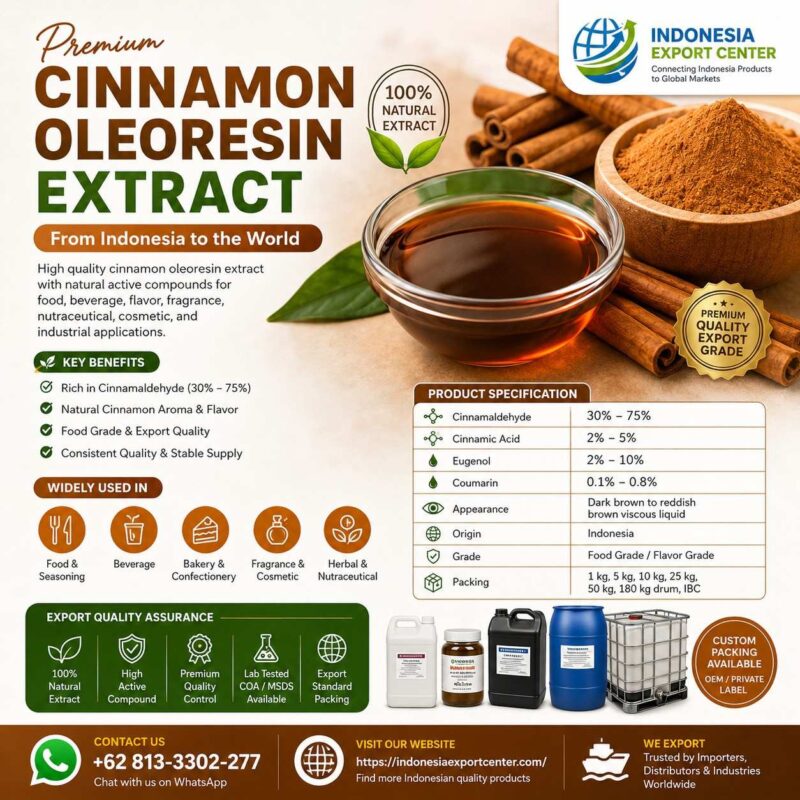
The initial commercial product brief proposes a coumarin content of 0.1–0.8%.
This range is unverified.
It must not be presented as a measured result, universal specification, or approved regulatory limit.
Why Extraction Matters
The composition of an oleoresin can differ from that of the original cinnamon bark.
Extraction may change the relative proportions of constituents recovered.
Therefore, a coumarin value reported for cinnamon powder should not automatically be applied to cinnamon oleoresin.
How Is Coumarin Measured?
Appropriate analytical methods may include liquid chromatography or other validated techniques suitable for the actual sample.
The laboratory should specify the method, reporting units, and relevant performance characteristics.
Understanding Reporting Units
Coumarin may be reported in percentages, milligrams per kilogram, or other units.
For example:
- 0.1% by weight corresponds to 1,000 mg/kg.
- 0.8% by weight corresponds to 8,000 mg/kg.
These conversions are mathematical illustrations of the unverified reference range, not measured product results.
Coumarin in Finished Food Products
The concentration of coumarin in an ingredient is not the same as the concentration in a finished food.
Finished-product exposure depends on the amount of ingredient used, the formulation, serving size, and other relevant factors.
Manufacturers should evaluate applicable restrictions and safety requirements for the specific food category and market.
European Union Considerations
For certain food applications, Regulation (EC) No 1334/2008 and its provisions concerning naturally occurring substances may be relevant.
Requirements can depend on the food category and how the substance enters the finished product.
Buyers should not apply one general numerical limit to every product or ingredient.
Other Destination Markets
Requirements may differ between the United States, Japan, South Korea, India, the UAE, and other markets.
Importers should verify the actual regulatory framework applicable to their intended use.
Supplier Testing Requirements
| Parameter | Purpose |
|---|---|
| Botanical Species | Identify source material |
| Coumarin Content | Quantitative assessment |
| Cinnamaldehyde Content | Chemical characterization |
| Analytical Method | Support result interpretation |
| Reporting Units | Enable accurate comparison |
| Batch Number | Link test to product |
| Composition Statement | Identify carriers or dilution |
| COA | Document measured results |
Coumarin and Supplier Qualification
A supplier should provide consistent and traceable information about the product.
Buyers may require testing of commercial lots rather than relying solely on a generic specification.
Coumarin Reduction or Low-Coumarin Requirements
Some buyers may seek a particular coumarin specification.
Whether such a product can be supplied depends on the actual species, processing method, and manufacturer capability.
IEC does not claim that low-coumarin cinnamon oleoresin is currently available.
Frequently Asked Questions
Does all cinnamon oleoresin contain the same amount of coumarin?
No. Concentration can vary.
Is the proposed 0.1–0.8% range verified?
No. It is an unverified reference.
Does a lower coumarin result automatically mean regulatory compliance?
No. Compliance depends on the intended use and applicable requirements.
Can buyers request batch-specific coumarin testing?
IEC can communicate this requirement to potential suppliers.
Is cinnamon bark powder equivalent to cinnamon oleoresin for coumarin assessment?
No. Extraction can change the chemical composition.
Can IEC arrange samples for independent testing?
IEC can coordinate sample inquiries, subject to supplier availability.
Request Cinnamon Oleoresin Coumarin Documentation
IEC welcomes inquiries from compliance teams, food manufacturers, flavor houses, analytical laboratories, and ingredient importers.
REQUEST COUMARIN TEST RESULTS, TDS, COA, SAMPLE AND QUOTATION
INDONESIA EXPORT CENTER
Website: https://indonesiaexportcenter.com/
WhatsApp: +62 813-3302-277
Related Pages
