

INDONESIA EXPORT CENTER
Oleoresin vs Essential Oil | Botanical Extraction | Flavor Ingredient Selection
Cinnamon Oleoresin vs Cinnamon Essential Oil: What Is the Difference?
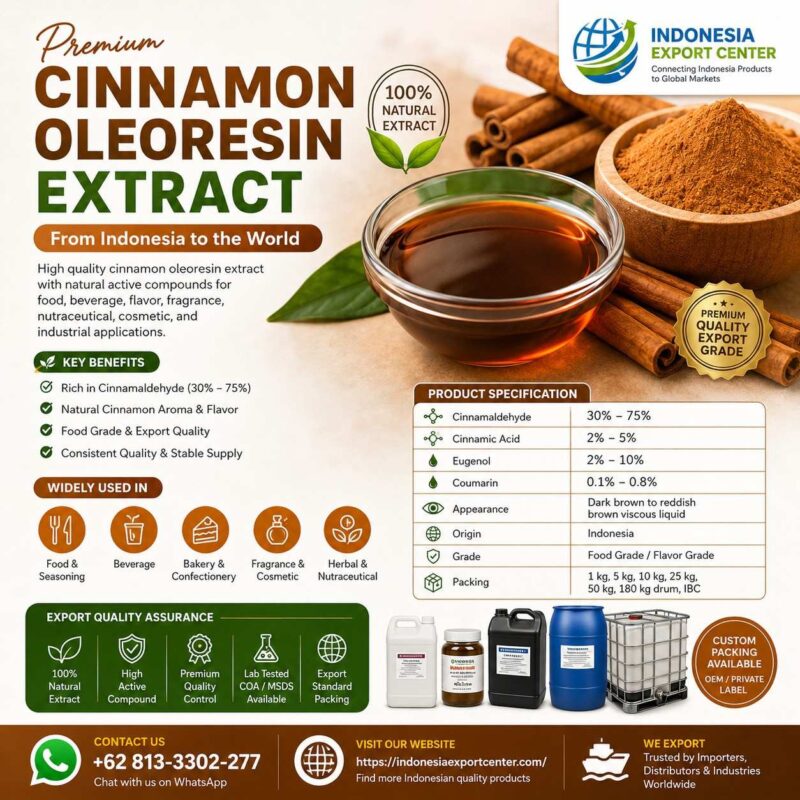
Industrial buyers comparing cinnamon oleoresin vs essential oil should understand that these are different botanical preparations.
Both may be derived from cinnamon materials, but their production methods, chemical compositions, physical properties, and industrial applications can differ.
Selecting the correct ingredient requires an understanding of the intended formulation and technical requirements.
Indonesia Export Center (IEC) facilitates inquiries with potential Indonesian suppliers of cinnamon-derived ingredients.
IEC does not claim that a particular oleoresin or essential oil grade is available without supplier confirmation.
REQUEST CINNAMON EXTRACT COMPARISON AND SUPPLIER INFORMATION
What Is Cinnamon Oleoresin?
Cinnamon oleoresin is a concentrated extract obtained through extraction of cinnamon botanical material.
Depending on the extraction process, it may contain volatile aromatic compounds together with less volatile constituents.
The final composition depends on species, plant part, processing conditions, and any added carriers.
What Is Cinnamon Essential Oil?
Cinnamon essential oil is a volatile oil preparation commonly produced through distillation.
Its chemical profile depends on the cinnamon species and plant part.
Cinnamon bark oil and cinnamon leaf oil should not automatically be treated as equivalent materials.
Cinnamon Oleoresin vs Essential Oil Comparison
| Parameter | Cinnamon Oleoresin | Cinnamon Essential Oil |
|---|---|---|
| General Production Method | Botanical extraction | Commonly distillation |
| Composition | May include volatile and less volatile constituents | Primarily volatile constituents |
| Appearance | Often viscous | Typically more fluid |
| Botanical Identity | Must be confirmed | Must be confirmed |
| Aroma | Depends on extract composition | Depends on oil composition |
| Solubility | Product-specific | Product-specific |
| Food Suitability | Requires verification | Requires verification |
| Fragrance Suitability | Requires safety assessment | Requires safety assessment |
| Analytical Specification | Product-specific | Product-specific |
| Commercial Availability | Supplier confirmation required | Supplier confirmation required |
Extraction Process Differences
Oleoresin Production
Oleoresin production involves extraction of selected constituents from botanical material.
The resulting composition depends on the extraction method and any subsequent processing.
Essential Oil Production
Essential oil production commonly involves steam or hydrodistillation.
The resulting oil contains constituents that are sufficiently volatile to be recovered through the process.
Chemical Composition
Cinnamaldehyde may be relevant to certain cinnamon-derived products.
However, its concentration should not be assumed to be the same in oleoresin and essential oil.
Other constituents, including eugenol and coumarin, may differ according to the source material and extraction process.
Aroma and Sensory Performance
Oleoresins and essential oils may produce different sensory effects in a finished formulation.
Flavor and fragrance developers should compare representative samples under realistic application conditions.
Solubility and Formulation
Neither ingredient should automatically be considered water-soluble.
The actual solubility, carrier composition, and compatibility should be evaluated.
Food Industry Applications
Potential applications may include flavor development, bakery ingredients, confectionery, seasoning systems, and selected beverage preparations.
Suitability depends on the specific ingredient and destination-market regulations.
Fragrance and Cosmetic Considerations
Cinnamon-derived aromatic constituents may present sensitization or irritation concerns.
Fragrance and cosmetic formulators should obtain appropriate safety information and assess applicable restrictions.
Quality Testing Comparison
| Test | Oleoresin | Essential Oil |
|---|---|---|
| Botanical Authentication | Relevant | Relevant |
| Chemical Profile | Relevant | Relevant |
| Cinnamaldehyde Analysis | Where applicable | Where applicable |
| Coumarin Analysis | Where applicable | Where applicable |
| Residual Solvent Testing | Depending on process | Depending on process |
| Physical Properties | Product-specific | Product-specific |
| Sensory Evaluation | Relevant | Relevant |
| Stability Testing | Relevant | Relevant |
| Safety Assessment | Application-specific | Application-specific |
Which Ingredient Should Buyers Choose?
The appropriate choice depends on the formulation, desired sensory profile, processing conditions, quality specification, and regulatory requirements.
Neither ingredient is universally superior.
Supplier Documentation
Buyers should request botanical declarations, TDS, COA, manufacturing information, composition statements, and relevant safety documentation.
Packaging and Bulk Procurement
Packaging, MOQ, lead time, and pricing require supplier confirmation.
Frequently Asked Questions
Is cinnamon oleoresin the same as cinnamon essential oil?
No. They are produced through different processes and may have different compositions.
Is oleoresin always stronger than essential oil?
No universal comparison can be made without defining the property and testing the actual products.
Which is better for food flavoring?
The answer depends on the application and product specification.
Which is better for fragrance manufacturing?
The answer depends on the intended fragrance and safety requirements.
Are both products water-soluble?
Not necessarily.
Can IEC help buyers compare supplier samples?
IEC can coordinate inquiries and sample requests.
Request Cinnamon Oleoresin or Essential Oil Sourcing Information
IEC welcomes inquiries from flavor houses, food manufacturers, fragrance developers, and industrial ingredient buyers.
REQUEST BOTANICAL IDENTITY, TDS, COA, SAMPLES AND QUOTATION
INDONESIA EXPORT CENTER
Website: https://indonesiaexportcenter.com/
WhatsApp: +62 813-3302-277
Related Pages
