

INDONESIA EXPORT CENTER
Chemical Characterization | Flavor Ingredient Analysis | Cinnamon Oleoresin Procurement
Understanding Cinnamaldehyde Content in Cinnamon Oleoresin
Cinnamon oleoresin cinnamaldehyde content is a technical parameter that may be relevant to industrial buyers evaluating concentrated cinnamon-derived ingredients.
Cinnamaldehyde is associated with the characteristic aroma of cinnamon and can be an important component of the chemical profile of certain cinnamon extracts.
However, cinnamaldehyde concentration alone does not establish botanical authenticity, complete flavor quality, safety, or suitability for a specific industrial application.
Indonesia Export Center (IEC) facilitates inquiries with potential Indonesian suppliers to help buyers obtain product-specific analytical information and commercial quotations.
REQUEST CINNAMALDEHYDE SPECIFICATIONS AND COA
What Is Cinnamaldehyde?
Cinnamaldehyde is an aromatic organic compound associated with cinnamon.
It contributes to the characteristic cinnamon aroma and may be an important analytical marker for certain cinnamon-derived products.
Its concentration varies according to the botanical species, plant part, extraction process, and product formulation.
Why Industrial Buyers Measure Cinnamaldehyde
Cinnamaldehyde analysis may support several procurement and quality objectives.
Chemical Characterization
It helps describe a relevant part of the product’s composition.
Batch Consistency
Defined acceptance criteria can support comparison of different production lots.
Flavor Formulation
Analytical data may assist formulation work when considered alongside sensory testing.
Supplier Comparison
Comparable methods and reporting units can help buyers assess different offers.
Quality Control
A defined specification provides a basis for acceptance testing.
Preliminary Cinnamaldehyde Range
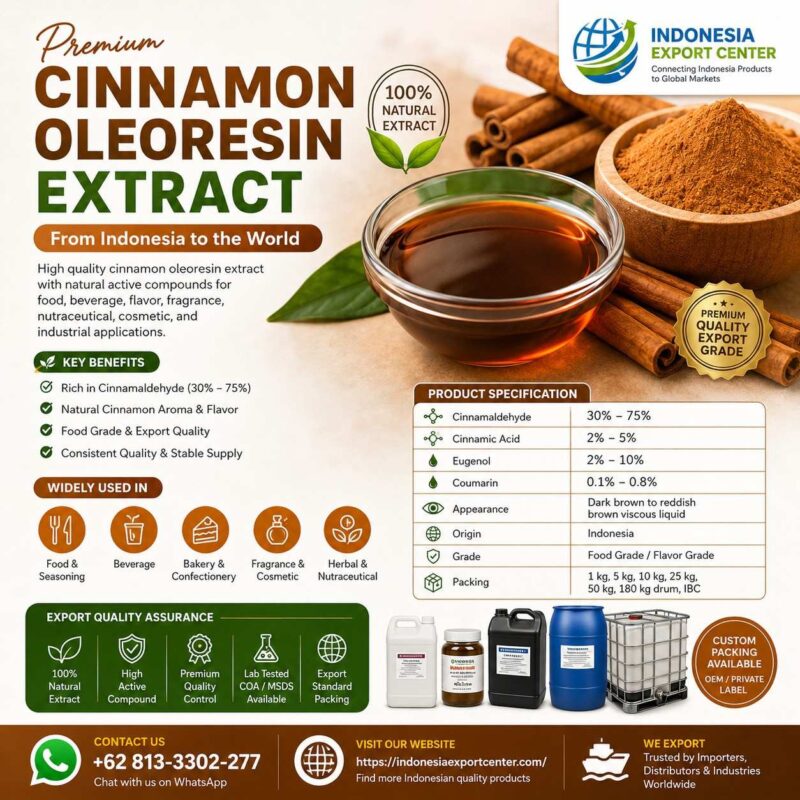
The initial commercial product brief states a cinnamaldehyde range of 30–75%.
This range has not been verified against a specific cinnamon oleoresin batch or manufacturer.
It should not be presented as a guaranteed specification.
Buyers should request actual analytical results from the supplier.
Factors Affecting Cinnamaldehyde Content
Botanical Species
Different cinnamon species can have different chemical profiles.
Plant Part
Bark, leaf, and other plant materials may differ significantly in composition.
Extraction Process
Extraction conditions can influence the constituents recovered.
Raw Material Quality
Raw material characteristics may affect the resulting extract.
Formulation and Dilution
Added carriers or blending may change the reported concentration.
Analytical Method
Different analytical methods and reporting bases may produce results that are not directly comparable.
Preliminary Chemical Profile
| Compound | Unverified Reference |
|---|---|
| Cinnamaldehyde | 30–75% |
| Cinnamic Acid | 2–5% |
| Eugenol | 2–10% |
| Coumarin | 0.1–0.8% |
These values are preliminary references, not verified COA data.
How Is Cinnamaldehyde Measured?
Analytical methods may include gas chromatography or liquid chromatography, depending on the sample and analytical objective.
The laboratory should use a method appropriate to the actual product.
Buyers should request information about sample preparation, calibration, units, method validation, and reporting basis.
Percentage by Weight vs Chromatographic Area Percentage
A critical procurement distinction is whether a reported percentage represents a mass fraction or a chromatographic area percentage.
These are not automatically equivalent.
For example, a chromatographic peak area percentage does not necessarily mean the same percentage by weight of the complete oleoresin.
Buyers should clarify the reporting basis before comparing supplier results.
Does Higher Cinnamaldehyde Mean Better Cinnamon Oleoresin?
Not necessarily.
A higher concentration may be desirable for some technical specifications, but other applications may require a different chemical or sensory profile.
Quality should be assessed against the actual intended use.
Cinnamaldehyde and Sensory Performance
Cinnamaldehyde is relevant to cinnamon aroma, but the full flavor profile may depend on additional constituents.
Sensory evaluation remains important for flavor applications.
Safety and Regulatory Considerations
Cinnamaldehyde can be relevant to safety assessment, including irritation or sensitization concerns in certain applications.
Food and fragrance uses may involve different requirements.
The appropriate concentration and permitted use must be assessed under applicable regulations.
Required Supplier Documents
| Document | Purpose |
|---|---|
| TDS | Product specification |
| Batch COA | Actual cinnamaldehyde result |
| Analytical Method | Result interpretation |
| Botanical Declaration | Species identification |
| Composition Statement | Carrier disclosure |
| Coumarin Analysis | Additional chemical assessment |
| Safety Information | Relevant handling and use considerations |
Sample Qualification
Buyers should test a representative sample using an appropriate method and compare the result with the supplier’s COA.
For flavor applications, sensory testing should also be performed.
Frequently Asked Questions
Is 30–75% cinnamaldehyde guaranteed?
No. It is an unverified preliminary range.
Does higher cinnamaldehyde always mean better quality?
No. Suitability depends on the intended application.
Can GC area percentage be treated as weight percentage?
Not automatically. The reporting basis must be clarified.
Does cinnamaldehyde analysis prove botanical authenticity?
No. Additional evidence may be needed.
Can buyers request a specific target percentage?
IEC can communicate the requirement to potential suppliers.
Can IEC coordinate laboratory documentation requests?
Yes, subject to supplier cooperation.
Request Cinnamon Oleoresin with Defined Cinnamaldehyde Specifications
IEC welcomes inquiries from flavor laboratories, analytical teams, food manufacturers, and ingredient distributors.
REQUEST CHEMICAL PROFILE, TEST METHOD, COA, SAMPLE AND RFQ
INDONESIA EXPORT CENTER
Website: https://indonesiaexportcenter.com/
WhatsApp: +62 813-3302-277
Related Pages
