![Indonesia Export Center [IEC]](https://indonesiaexportcenter.com/wp-content/uploads/2023/07/logo-no-background.svg)
![Indonesia Export Center [IEC]](https://indonesiaexportcenter.com/wp-content/uploads/2023/07/svgviewer-output.svg)
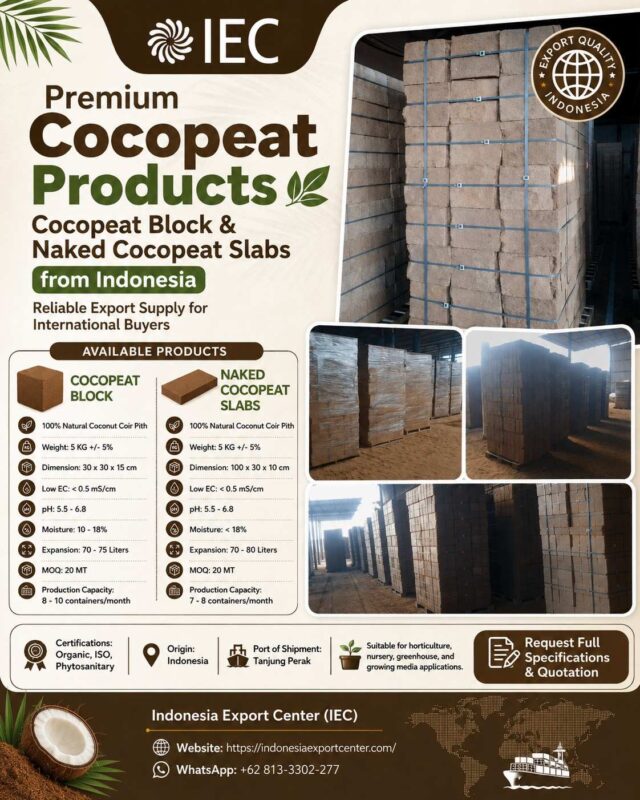
A 5 kg cocopeat block may look like a simple compressed growing-medium product, but its commercial quality cannot be evaluated by weight and dimensions alone. International buyers should also review four essential parameters: electrical conductivity, pH, expansion volume, and moisture content.
These specifications affect how the cocopeat performs after hydration, how easily it can be incorporated into a growing-media formulation, and whether it is suitable for salt-sensitive horticultural applications or general agricultural use.
However, buyers should not evaluate specification numbers without checking the testing method. EC and pH results can differ depending on the water-to-substrate ratio, extraction procedure, water quality, temperature, and laboratory protocol. For reliable comparison, every supplier quotation and Certificate of Analysis should clearly state the testing method used.
What Is a 5 kg Cocopeat Block?
A cocopeat block is produced from coconut coir pith, the fine and sponge-like material separated during coconut husk processing. The material is generally screened, dried, and compressed into compact blocks for more efficient storage and container transportation.
A standard commercial block commonly weighs approximately 5 kg and may measure around 30 × 30 × 15 cm, although dimensions and tolerances differ among manufacturers. After water is added, the compressed material loosens and expands into a lightweight growing medium.
An Indonesian product listing on the government-supported Inaexport platform gives an example specification of a 5 kg block with a 5:1 compression ratio, 70–80 liters of expanded volume, 10–15% moisture, low EC below 0.5 mS/cm, or high EC above 1.0 mS/cm. These figures illustrate common commercial grades rather than a universal international standard.
For international buyers, the block weight should therefore be reviewed together with its usable expanded yield per block.
1. Electrical Conductivity: What Does EC Mean?
Electrical conductivity, normally abbreviated as EC, indicates how well a water extract conducts electricity. In growing media, this conductivity is associated with the concentration of soluble ions such as sodium, chloride, potassium, calcium, magnesium, and other dissolved salts.
EC is generally expressed in:
- mS/cm, or millisiemens per centimeter;
- dS/m, or decisiemens per meter;
- µS/cm, or microsiemens per centimeter.
For practical comparison:
1 mS/cm = 1 dS/m = 1,000 µS/cm.
A higher EC reading normally indicates a greater concentration of water-soluble salts in the tested extract. However, EC does not identify which individual salts are present. A full chemical analysis is required when a buyer needs separate sodium, chloride, potassium, calcium, or magnesium values.
Low EC Cocopeat
Low EC cocopeat is usually washed with fresh water to reduce readily soluble salts. A commonly requested commercial specification is:
EC below 0.5 mS/cm
Low EC material is generally preferred for applications where the grower needs better control over the nutrient program, including:
- hydroponic and soilless cultivation;
- commercial nurseries;
- seedling production;
- greenhouse vegetables;
- berries and ornamentals;
- professional potting-mix manufacturing;
- salt-sensitive crops.
Research has shown that repeated washing can substantially reduce cocopeat conductivity. In one published study, six washing cycles reduced EC to approximately 0.23 mS/cm for the tested coir-pith particle fractions.
Nevertheless, the buyer should confirm whether the product is only washed or has also been calcium buffered. Washing removes soluble salts, while buffering is a separate treatment intended to manage exchangeable potassium and sodium by using calcium-containing solutions. “Low EC” and “buffered” should not automatically be treated as identical specifications.
High EC Cocopeat
High EC cocopeat is generally less extensively washed or supplied in an unwashed condition. A commercial supplier may classify material above approximately 1.0 mS/cm as high EC, but the threshold can differ between suppliers and testing methods.
High EC material may be considered for:
- soil conditioning;
- compost formulation;
- landscaping;
- agricultural blending;
- applications where the buyer performs additional washing;
- non-sensitive crops;
- processing by growing-media manufacturers with their own treatment systems.
High EC does not automatically mean that a product is unusable. It means the buyer must determine whether its soluble-salt level is acceptable for the intended application.
For professional hydroponic or nursery applications, an untreated high-EC block should not be substituted for a specified low-EC product without evaluating the crop, irrigation water, fertilizer program, and expected leaching requirement.
Why the EC Test Method Must Be Stated
EC values are not directly comparable when suppliers use different extraction procedures.
Cocopeat may be tested using methods described as:
- 1:1.5 substrate-to-water extraction;
- 1:2 extraction;
- 1:3 extraction;
- 1:5 extraction;
- saturated-media extract;
- pour-through testing;
- runoff-water testing.
The amount of water used changes the dilution of the extracted salts. Therefore, a 1:5 result cannot be compared directly with a pour-through result without an appropriate conversion or established correlation.
A technical guide from Horiba provides different acceptable EC ranges for a 1:2 extraction and a pour-through procedure, demonstrating why the sampling method changes the numerical interpretation.
European growing-media methods also distinguish standardized procedures for pH and EC. BS EN 13037 addresses pH determination, while BS EN 13038 addresses electrical conductivity in soil improvers and growing media. The ADAS methodology based on these standards specifies controlled sample preparation and distilled-water extraction.
A proper purchase contract should therefore state:
EC: maximum 0.5 mS/cm, tested using the agreed substrate-to-water extraction method at the specified temperature.
Without this information, two laboratories can test the same material and report different EC values.
2. Understanding the pH Specification
The pH value indicates whether the water extract of the cocopeat is acidic, neutral, or alkaline. The pH scale runs from 0 to 14, with 7 representing neutrality.
The pH of the root-zone environment influences nutrient availability. Oklahoma State University explains that pH affects the availability of mineral nutrients in hydroponic and soilless systems, with slightly acidic conditions commonly used to support nutrient availability.
Coir pith generally falls within a mildly acidic to near-neutral range. A review published through North Carolina State University reports that coir pith commonly has a pH of approximately 5.5–7.0. It also notes that pH above 6.5 may reduce the uptake of certain micronutrients in many organic growing media.
A practical commercial specification for a 5 kg cocopeat block may be:
pH 5.5–6.8
This range is broadly suitable for many growing-media and horticultural applications, although the final target should follow the crop and production system.
What Can Change Cocopeat pH?
Cocopeat pH may vary because of:
- origin and maturity of the coconut husk;
- aging or decomposition of the raw coir pith;
- washing-water quality;
- buffering treatment;
- storage conditions;
- residual minerals;
- laboratory extraction method;
- blended particle composition.
The buyer should also distinguish between the pH of the unused block extract and the pH of the root zone during crop production. Irrigation water alkalinity, fertilizer formulation, crop uptake, and drainage management can change root-zone pH after planting.
Is a Higher pH Always Better?
No. A pH close to neutral is not automatically superior.
In professional cultivation, excessively high pH can reduce the availability of iron, manganese, boron, and other micronutrients. Conversely, excessively acidic conditions may create nutrient imbalances and affect root performance.
The correct approach is to specify a range that is appropriate for the intended crop and to monitor the substrate after hydration and during cultivation.
3. Expansion Volume: How Much Usable Cocopeat Does One Block Produce?
Expansion volume indicates how much loose cocopeat is produced after a compressed block has been fully hydrated and loosened.
For example, a product specification may state:
One 5 kg block expands to 70–75 liters.
This is equivalent to:
- 70 liters ÷ 5 kg = 14 liters per kilogram;
- 75 liters ÷ 5 kg = 15 liters per kilogram.
A higher expansion volume can provide more usable substrate from the same nominal block weight. It can also affect the buyer’s cost calculation because buyers ultimately use expanded liters or cubic meters rather than compressed blocks.
Commercial data show that expansion claims can vary significantly. Some 5 kg products are offered at approximately 50–60 liters, while other products are declared at 70 liters or more. The result may depend on raw-material structure, particle size, moisture content, compression pressure, and testing procedure.
What Influences Expansion Volume?
Particle structure
Cocopeat with an appropriate distribution of pith particles can recover into a loose and porous structure after hydration. Excessive fine dust, sand, heavy impurities, or degraded material may reduce useful volume.
Compression ratio
Compression allows more material to be transported in a limited container volume. However, the block must still rehydrate and recover its physical structure properly.
Research on cocopeat-block production confirms that compression ratio and moisture content affect block formation and recovery.
Initial moisture
A wetter block contains more water and less dry cocopeat within the same gross weight. Consequently, unusually high initial moisture can reduce the dry matter purchased per block and may influence the final expanded yield.
Hydration procedure
The measured volume can differ according to:
- amount and quality of water added;
- soaking duration;
- water temperature;
- manual or mechanical loosening;
- drainage time;
- degree of fluffing;
- settling pressure;
- measuring-container dimensions.
How Buyers Should Test Expansion
For repeatable results, the buyer and supplier should agree on an expansion procedure. A practical test can include:
- Weigh the unopened block.
- Record its initial moisture content.
- Place the block in a clean container.
- Add a predetermined volume of clean water.
- Allow sufficient hydration time.
- Break apart and fluff the material uniformly.
- Transfer it into a calibrated container without excessive compaction.
- Record the final volume in liters.
- Repeat the test on several randomly selected blocks.
The purchase specification should state whether the result is measured as loose-filled, lightly settled, or mechanically compacted volume.
4. Moisture Content: Why It Matters
Moisture content indicates the amount of water already present in the compressed block.
A common export specification may range from:
10–18% moisture
The exact acceptable value depends on the manufacturing process, buyer requirement, block stability, storage system, and contractual testing method.
Moisture matters because a buyer purchasing a 5 kg block is paying for both cocopeat dry matter and the water contained in the product. At equal gross weight, a block with lower moisture generally contains more dry material than a block with higher moisture.
Example of Moisture and Dry Matter
Using a simplified wet-basis calculation:
- A 5 kg block at 10% moisture contains approximately 4.5 kg of dry matter.
- A 5 kg block at 18% moisture contains approximately 4.1 kg of dry matter.
- A 5 kg block at 22% moisture contains approximately 3.9 kg of dry matter.
This difference can influence expansion yield, container economics, and product consistency.
Moisture Also Affects Block Formation
A study examining cocopeat blocks at moisture ranges of 11–14%, 15–18%, and 19–22% found that moisture content significantly affected the blocking process. In that specific machine trial, 15–18% moisture produced the highest blocking capacity at a 4:1 compression ratio. The researchers observed that the 19–22% material tended to expand slightly after compression, while the 11–14% material was sufficiently dry for some particles to escape during pressing.
This does not establish one universal moisture specification for every factory. It demonstrates that moisture must be controlled to balance block integrity, recovery, weight consistency, and storage performance.
Moisture Testing Method
The buyer should specify whether moisture is reported on a:
- wet basis; or
- dry basis.
For commercial cocopeat, wet-basis reporting is commonly understood, but the method must still be confirmed.
A standard laboratory procedure normally weighs the sample before and after controlled oven drying. Because test temperature, drying duration, and calculation basis can affect the result, the agreed method should appear in the quality-control protocol.
How EC, pH, Expansion, and Moisture Interact
These four parameters should not be evaluated separately.
A 5 kg block may have excellent expansion but still be unsuitable for a sensitive hydroponic crop because of high EC. Another block may have low EC but deliver poor commercial value if it expands to a much lower volume than agreed.
Likewise, high initial moisture can make a block appear heavier while reducing the amount of dry cocopeat supplied. An acceptable pH does not compensate for excessive sodium or chloride, because pH and EC measure different characteristics.
A balanced cocopeat specification should therefore consider:
- soluble-salt level;
- pH stability;
- dry matter per block;
- expanded liters per block;
- particle structure;
- fiber and impurity content;
- washing and buffering status;
- consistency between production batches.
Example Commercial Specification for a 5 kg Cocopeat Block
The following specification can be used as a starting point for supplier discussions. Final parameters should be confirmed in the sales contract.
| Parameter | Example Specification |
|---|---|
| Raw material | 100% natural coconut coir pith |
| Block weight | 5 kg ±5% |
| Dimensions | Approximately 30 × 30 × 15 cm |
| Compression ratio | 5:1 |
| Low EC grade | Below 0.5 mS/cm |
| High EC grade | Above 1.0 mS/cm or as agreed |
| pH | 5.5–6.8 |
| Expansion volume | 70–75 liters per block |
| Moisture | 10–18% |
| Impurities | Below 3% |
| Fiber content | Below 2% or as agreed |
| Packing | Naked block, stretch-wrapped pallet, or buyer-specific packing |
| EC test method | Must be stated |
| pH test method | Must be stated |
| Moisture basis | Wet or dry basis must be stated |
The EC categories in this table are commercial targets and should not be treated as universal regulatory definitions. Supplier figures must be compared using identical laboratory methods.
Buyer Checklist Before Placing an Order
Before approving a shipment, international buyers should request the following information:
Product and processing details
Confirm whether the cocopeat is:
- washed or unwashed;
- single-washed or repeatedly washed;
- buffered or unbuffered;
- sieved to a defined particle size;
- blended with fiber or coco chips;
- naturally dried or mechanically dried.
Laboratory information
Ask the supplier to state:
- EC result and extraction ratio;
- pH result and extraction ratio;
- water quality used for the test;
- moisture-testing method;
- sodium and chloride values, when required;
- potassium, calcium, and magnesium values, when required;
- sampling date and batch number.
Physical performance
Request confirmation of:
- average expansion volume;
- minimum guaranteed expansion;
- water quantity used for hydration;
- hydration time;
- block weight tolerance;
- block dimensions;
- percentage of fines, fiber, sand, and impurities.
Pre-shipment inspection
For a commercial container order, buyers may use:
- random block weighing;
- independent laboratory testing;
- expansion testing;
- moisture testing;
- packing inspection;
- container-loading supervision;
- photographic and video documentation.
A representative sample is more reliable than testing only one selected block.
Low EC or High EC: Which Grade Should Buyers Choose?
The right grade depends on the final use.
Choose low EC cocopeat when:
- the crop is sensitive to salinity;
- the material will be used directly in hydroponics;
- precise nutrient control is required;
- the buyer operates a commercial nursery;
- the product will be used in propagation media;
- the buyer does not have its own washing system.
High EC cocopeat may be considered when:
- the buyer performs additional processing;
- the product will be blended and diluted;
- it is intended for soil conditioning or compost;
- the crop and production system can tolerate the declared salt level;
- the lower-processing grade is commercially appropriate;
- the buyer has approved the complete mineral analysis.
The supplier and buyer should agree on the grade before production. Replacing low EC with high EC after the contract has been issued can materially change the product’s suitability.
Frequently Asked Questions
What is a good EC for a 5 kg cocopeat block?
For low-EC commercial cocopeat, buyers commonly request a maximum value of approximately 0.5 mS/cm. However, this number is meaningful only when the extraction method is stated. Results from 1:2, 1:5, pour-through, and runoff testing should not be compared directly.
Is high EC cocopeat a defective product?
Not necessarily. It is a different commercial grade that may contain more soluble salts and normally requires additional evaluation or treatment before salt-sensitive horticultural use.
What pH should cocopeat have?
A commercial range of approximately 5.5–6.8 is commonly requested. Published growing-media literature places coir pith generally around pH 5.5–7.0, but the final requirement should follow the crop and application.
How much should a 5 kg block expand?
Many international buyers target approximately 70–75 liters, equal to about 14–15 liters per kilogram. Some commercial products provide lower or higher yields, so the test procedure and minimum guaranteed volume should be included in the contract.
Is expansion volume the same as water-holding capacity?
No. Expansion volume measures the amount of loose material produced after hydration. Water-holding capacity measures how much water the expanded substrate can retain under a defined testing condition.
Why is moisture content important?
Moisture affects block weight, dry-matter content, pressing behavior, storage, and potential expansion yield. Buyers should require a maximum moisture value and a defined test method.
Should buyers request washed or buffered cocopeat?
Washing is important for reducing readily soluble salts. Buffering is a separate process used to modify exchangeable ions, normally with calcium. Professional growers should ask the supplier to declare both conditions separately.
Conclusion
EC, pH, expansion volume, and moisture are among the most important specifications for evaluating a 5 kg cocopeat block.
EC helps buyers assess the concentration of soluble salts. pH indicates the acidity or alkalinity of the substrate extract. Expansion volume determines how much usable growing medium is obtained from each block. Moisture content affects dry matter, block stability, transport efficiency, and consistency.
The most important purchasing principle is not merely to request numerical limits. Buyers should also define the sampling procedure, extraction ratio, laboratory method, tolerance, and minimum batch acceptance criteria.
For sourcing from Indonesia, buyers can review the following product categories:
- Cocopeat Block 5 kg Supplier from Indonesia for general product, packing, capacity, and export information.
- Low EC Cocopeat Block Supplier for washed cocopeat intended for controlled horticultural applications.
- High EC Cocopeat Block Supplier for unwashed or standard-grade material intended for further processing, soil conditioning, or buyer-specific applications.
A clear technical specification, representative pre-shipment testing, and transparent batch documentation can help both buyer and supplier avoid disputes and maintain consistent product quality.
Read Also Our Product
https://indonesiaexportcenter.com/product/product-cocopeat-block-slabs-supplier-exporter-indonesia/
