![Indonesia Export Center [IEC]](https://indonesiaexportcenter.com/wp-content/uploads/2023/07/logo-no-background.svg)
![Indonesia Export Center [IEC]](https://indonesiaexportcenter.com/wp-content/uploads/2023/07/svgviewer-output.svg)
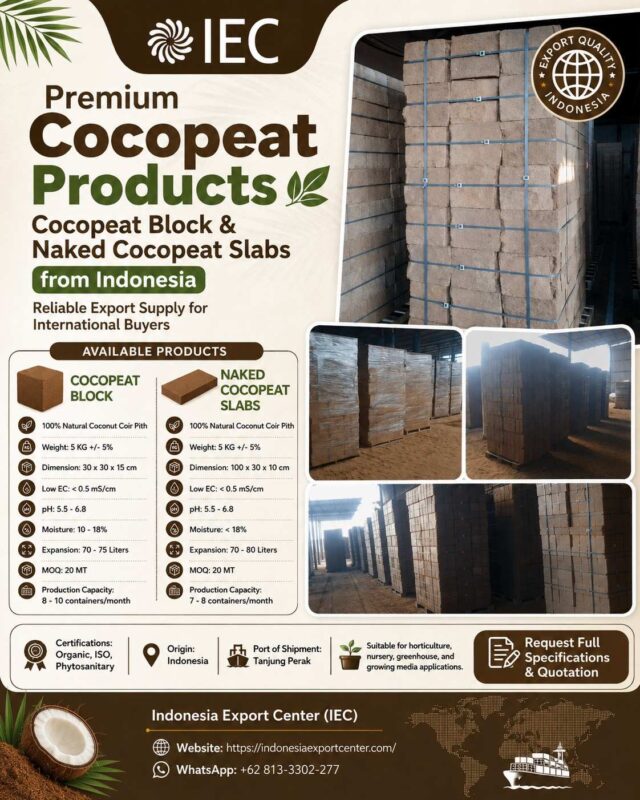
How to Import Cocopeat Block 5 kg from Indonesia: A Practical Guide for International Buyers
Indonesia is one of the world’s important coconut-producing countries and has a growing supply base for coconut-derived products, including cocopeat, cocofiber, coconut shell charcoal, and other horticultural materials.
For greenhouse operators, growing-media manufacturers, nurseries, hydroponic farms, agricultural distributors, and landscaping suppliers, the 5 kg compressed cocopeat block is one of the most practical forms for international trade. Compression reduces cargo volume, while the block can be expanded with water at the destination before use.
However, importing cocopeat successfully requires more than comparing prices. International buyers must confirm the product grade, electrical conductivity, testing method, expansion volume, moisture, packing configuration, phytosanitary requirements, shipping documents, and responsibilities under the selected Incoterm.
This guide explains the practical steps for importing 5 kg cocopeat blocks from Indonesia.
1. Understand the Product You Are Buying
Cocopeat—also known as coir pith, coco pith, or coir dust—is the fine material generated during the processing of coconut husks. It is commonly used as a component of growing media because of its physical characteristics and ability to hold moisture.
For export shipments, loose cocopeat is usually dried, screened, processed, and compressed into blocks. A standard export block commonly weighs approximately 5 kg and may expand into around 70–75 liters after hydration, depending on its composition, moisture level, compression, and testing procedure.
A typical purchasing reference may include:
| Parameter | Typical Purchasing Specification |
|---|---|
| Raw material | 100% natural coconut coir pith |
| Block weight | 5 kg ± 5% |
| Block dimensions | Approximately 30 × 30 × 15 cm |
| Compression ratio | Approximately 5:1 |
| pH | 5.5–6.8 |
| Moisture | 10–18% |
| Expansion | Approximately 70–75 liters |
| Impurities | Below 3% |
| Fiber content | Below 2% |
| Origin | Indonesia |
These values should be treated as purchasing specifications, not universal values for every Indonesian factory. Final specifications must be confirmed in the quotation, sales contract, approved sample, and batch test report.
2. Choose Between Low EC and High EC Cocopeat
Electrical conductivity, or EC, is one of the most important parameters in cocopeat purchasing because it indicates the concentration of water-soluble salts in the tested extract.
Research on coir-based substrates has found that coir dust may contain potassium, sodium, and chloride, which can increase EC. Excessive salt levels require particular attention when the substrate will be used for salt-sensitive crops or controlled horticultural production.
Low EC Cocopeat
Low EC cocopeat is generally processed by washing the coir pith with fresh water to reduce soluble salts. It is commonly selected for:
- Commercial nurseries
- Seedling production
- Hydroponic cultivation
- Greenhouse vegetables
- Berries and other salt-sensitive crops
- Professional growing-media formulations
A commonly requested Low EC specification is:
EC below 0.5 mS/cm
However, the value is meaningful only when the testing method is clearly identified.
Different extraction ratios and testing procedures can produce different EC readings. For example, the European 1:5 volume extraction method and the Dutch 1:1.5 extraction method are different analytical procedures, so results should not be compared without considering the method used.
The purchase contract should therefore state:
- Maximum EC
- Extraction ratio or laboratory method
- Type and initial EC of the test water
- Whether the sample is tested dry or after expansion
- Measurement temperature, where relevant
- Sampling procedure and acceptable tolerance
High EC Cocopeat
High EC cocopeat is generally unwashed or less intensively washed. It may be selected by buyers who:
- Operate their own washing facilities
- Intend to blend cocopeat with other materials
- Use the material for applications that are less sensitive to soluble salts
- Prioritize lower processing costs
- Require natural or minimally processed coir pith
“High EC” does not represent one internationally fixed numerical range. Buyers should establish an agreed maximum EC and testing method instead of ordering only by the description “High EC.”
Before purchasing High EC material, the buyer should evaluate the cost of washing, water availability, wastewater management, labor, drying, and product losses at the destination. A lower factory price may not always produce a lower total processing cost.
Washed and Buffered Are Not the Same
Washing primarily reduces water-soluble salts. Buffering is an additional treatment in which calcium-containing solutions are commonly used to displace sodium and potassium from cation-exchange sites in the coir material.
Therefore, buyers should not assume that every Low EC block is also buffered.
The purchase specification should clearly identify the required grade:
- Unwashed High EC
- Washed Low EC
- Washed and calcium-buffered
- Custom-treated cocopeat
3. Check the Import Regulations in the Destination Country
Before requesting a final quotation, the importer should verify whether cocopeat is regulated as a plant product, growing medium, agricultural material, soil substitute, or other regulated article in the destination country.
Under the International Plant Protection Convention system, phytosanitary import requirements are established by the National Plant Protection Organization of the importing country. Requirements may be stated in national regulations, import permits, bilateral arrangements, or additional declarations.
Import conditions may vary according to:
- Product type
- Processing level
- Intended use
- Country of origin
- Presence of plant residues, soil, seeds, insects, or other contaminants
- Packing material
- Port of entry
- Current pest-risk measures
For example, the United States Department of Agriculture advises importers that requirements for plant commodities vary according to the commodity and country of origin and should be checked through its official import-requirements database.
The buyer should ask the local customs broker or plant-quarantine authority:
- Is an import permit required?
- Is a phytosanitary certificate required?
- Is a specific additional declaration required?
- Is fumigation, heat treatment, sterilization, or another treatment required?
- Are laboratory tests required?
- Must the shipment enter through a designated port?
- Are untreated wooden pallets permitted?
- What HS classification and import duty apply?
These questions should be resolved before production begins. Requirements discovered after container loading may lead to document amendments, port delays, treatment costs, rejection, or re-export.
4. Confirm the HS Code with Your Customs Broker
Cocopeat and coir-pith products are often classified under tariff lines derived from HS heading 5305, which covers coconut and certain other vegetable textile fibers and their waste.
However, national tariff codes may contain eight, ten, or more digits and may distinguish between loose coir pith, compressed blocks, horticultural products, fiber, and other processed forms.
Do not rely only on the HS code printed in a supplier’s previous invoice. The importer should obtain written confirmation from a licensed customs broker or the destination-country customs authority.
Correct tariff classification determines:
- Import eligibility
- Customs duty
- Value-added or goods-and-services taxes
- Required licenses
- Plant-quarantine controls
- Statistical reporting
- Eligibility for preferential tariffs
The code should be consistent across the commercial invoice, certificate of origin, customs declaration, and other relevant documents.
5. Prepare a Detailed Purchase Specification
A professional inquiry should contain more than the product name and required quantity.
Buyers should provide a specification sheet covering the following points:
Product Grade
- Low EC, High EC, or buffered
- Washed or unwashed
- Required EC limit and testing method
- Required pH range
Physical Specifications
- Net weight per block
- Weight tolerance
- Block dimensions
- Compression ratio
- Expansion volume
- Particle-size range
- Maximum fiber content
- Maximum sand and foreign-matter content
- Moisture limit
Packing Requirements
- Naked blocks or individually wrapped blocks
- Number of blocks per bale
- Bale wrapping material
- Palletized or floor-loaded container
- Pallet type
- Required shipping marks
- Private-label requirements
Commercial Requirements
- Trial-order quantity
- Regular monthly volume
- Destination port
- Required Incoterm
- Target shipment date
- Payment method
- Required inspection
- Required certificates
A precise request enables the Indonesian supplier to calculate washing, drying, screening, packing, inland transport, port handling, documentation, and ocean freight correctly.
6. Request Representative Samples
A sample should be approved before a commercial-volume order, especially when the material will be used in professional horticulture.
The buyer should request samples representing the proposed production grade rather than a manually selected premium sample.
Sample evaluation may include:
- EC
- pH
- Moisture
- Expansion volume
- Bulk density
- Particle-size distribution
- Fiber percentage
- Sand and impurities
- Water-holding characteristics
- Rehydration time
- Presence of weeds, seeds, insects, mold, or foreign materials
For EC testing, both parties should use the same method. An EC result obtained through a 1:5 extraction should not be directly compared with a result obtained through a 1:1.5, 1:2, saturated-media, or pour-through method because the extraction procedure affects the reading.
The approved sample and specification sheet should be referenced in the sales contract.
7. Evaluate the Indonesian Supplier
Before transferring a deposit, international buyers should conduct reasonable supplier verification.
Request and review:
- Registered company name
- Company address
- Business-registration documents
- Factory or processing-site information
- Export experience
- Production capacity
- Monthly supply capacity
- Photos or videos of processing and storage
- Previous shipment evidence, where available
- Bank-account ownership
- Quality-control procedures
- Laboratory capabilities
- References from previous buyers, where appropriate
A factory audit can be conducted physically or through an independent inspection company. The audit should examine raw-material storage, washing facilities, drying areas, screening equipment, compression machines, finished-product storage, pest control, batch identification, and loading procedures.
Buyers should also determine whether the contractual seller is:
- The actual manufacturer
- A processing company
- A trading company
- An export agent
- An exporter using an authorized third-party export service
Trading-company involvement is not necessarily a problem, but the responsibilities of the manufacturer, seller, exporter of record, and document issuer should be transparent.
8. Select the Appropriate Incoterm
The quotation should state a named location or port and the applicable version of the Incoterms rules, such as:
- FCA factory or container depot, Incoterms® 2020
- FOB Indonesian port, Incoterms® 2020
- CFR destination port, Incoterms® 2020
- CIF destination port, Incoterms® 2020
Incoterms define the allocation of delivery obligations, risks, costs, transport arrangements, insurance obligations, and export or import clearance responsibilities between seller and buyer.
Many cocopeat shipments are commercially quoted FOB, CFR, or CIF. However, the ICC notes that FCA is generally more appropriate for containerized or multimodal shipments because the seller normally transfers the container to the carrier before it is physically loaded onto the vessel.
The contract should specify:
- Exact named port or place
- Container type
- Freight inclusion
- Origin terminal charges
- Destination charges
- Insurance coverage
- Free time at destination
- Documentation fees
- Responsibility for inspections and treatments
Under CIF, the seller arranges freight and minimum cargo insurance, but risk generally transfers when the goods are placed on board the vessel, not when the container reaches the destination.
9. Agree on Payment and Contractual Protection
Common payment structures may include:
- Advance payment
- Deposit with balance before shipment
- Deposit with balance against shipping documents
- Irrevocable letter of credit
- Documentary collection
- Other bank-supported arrangements
The appropriate method depends on order value, supplier history, buyer creditworthiness, banking costs, destination-country conditions, and the relationship between the parties.
The sales contract should include:
- Product specification
- Quantity and tolerance
- Price and currency
- Incoterm and named place
- Production lead time
- Shipment period
- Packing requirements
- Inspection method
- Required documents
- Payment schedule
- Claims procedure
- Replacement or compensation terms
- Governing law and dispute-resolution method
- Force-majeure provisions
Avoid using only a pro forma invoice for a high-value first transaction without a more complete sales agreement.
10. Arrange Pre-Shipment Quality Control
Quality may vary between raw-material sources and production batches. Pre-shipment inspection reduces the risk of receiving blocks that do not match the approved sample.
Inspection may be performed by:
- The supplier’s internal quality-control team
- The buyer’s representative
- An independent inspection company
- An accredited laboratory
A representative number of blocks should be selected from different production dates and loading areas.
The inspection report should cover:
- Block count
- Net and gross weight
- Weight consistency
- Dimensions
- Moisture
- EC and testing method
- pH
- Expansion
- Fiber and impurities
- Packing condition
- Container cleanliness
- Loading arrangement
- Seal number
The batch Certificate of Analysis should identify the production batch, sample date, testing method, measured results, and responsible laboratory or quality-control department.
11. Prepare the Required Export and Shipping Documents
Indonesia’s customs export procedure requires the exporter to prepare the goods and supporting documents before submitting the export declaration, known as the Pemberitahuan Ekspor Barang or PEB. Physical inspection may be conducted according to customs risk-management procedures.
A cocopeat shipment may involve:
- Commercial invoice
- Packing list
- Bill of lading
- Certificate of origin
- Phytosanitary certificate, when required
- Fumigation or treatment certificate, when required
- Certificate of Analysis
- Weight certificate
- Inspection certificate
- Insurance certificate for insured terms
- Organic or other certification, when contractually required
- Export customs documentation
An export packing list normally provides detailed information about packages, weights, dimensions, shipment mode, and cargo contents and may be used by customs officials to verify the consignment.
Where a phytosanitary certificate is required, it should be issued by the authorized Indonesian quarantine authority and comply with the destination country’s declared import requirements. Indonesia’s quarantine system also provides official verification facilities for phytosanitary and related plant-product certificates.
Document drafts should be checked by the buyer before originals are issued, especially:
- Buyer and consignee names
- Notify-party details
- Product description
- HS code
- Quantity
- Gross and net weight
- Container and seal numbers
- Port names
- Country of origin
- Additional phytosanitary declarations
12. Plan Container Loading and Packaging
Compressed cocopeat is generally transported in full-container loads because it is a relatively low-value, high-volume agricultural material.
Before loading, the container should be checked for:
- Holes or water leakage
- Strong odors
- Chemical residues
- Excessive rust
- Wet flooring
- Pest contamination
- Damaged doors or seals
The cargo should be sufficiently dry before loading. Blocks should also be protected against rain during factory handling, inland transportation, stuffing, and port operations.
The packing configuration must be agreed in advance. Important points include:
- Number of blocks per bale
- Number of bales per pallet
- Total blocks per container
- Net cargo weight
- Gross container weight
- Use of plastic wrapping
- Pallet dimensions
- Floor loading versus pallet loading
- Compliance of wooden packaging with destination requirements
The importer should not calculate purchasing volume only from the nominal 5 kg block weight. Actual container capacity depends on packing dimensions, bale design, pallets, container payload, road-weight restrictions, and the carrier’s acceptance rules.
13. Inspect the Shipment After Arrival
After the container reaches the destination, the buyer should inspect the cargo promptly and document any problem before the goods are distributed or processed.
The arrival inspection should include:
- Container and seal condition
- Signs of water entry
- Mold or unusual odor
- Damaged bales
- Block count
- Random block weights
- Moisture
- EC
- pH
- Expansion
- Impurities and fiber content
Photographs, videos, laboratory reports, tally records, and survey reports should be retained when a claim may be necessary.
Any testing should follow the method stated in the contract. A claim based on a different EC extraction procedure may create disputes even when both laboratories have performed their tests correctly.
Common Importing Mistakes to Avoid
Ordering “Low EC” Without a Test Method
An EC limit without an extraction procedure is incomplete. Always state the testing method in the contract.
Assuming Low EC Means Buffered
Washing and buffering are separate treatments. Ask the supplier to confirm both processes.
Checking Import Requirements After Production
Import permits and phytosanitary declarations should be confirmed before the order enters production.
Selecting a Supplier Only by Price
An unusually low quotation may reflect higher moisture, reduced expansion, inconsistent weight, more fiber, higher impurities, limited washing, weaker packing, or excluded charges.
Skipping the Commercial Sample
Specifications on paper do not replace actual product testing.
Ignoring Destination Charges
CFR and CIF prices do not normally include all destination-port, customs, detention, demurrage, quarantine, and inland-delivery costs.
Accepting Inconsistent Documents
Differences in weight, product description, HS code, consignee name, or country of origin can delay customs clearance.
Practical Import Checklist
Before placing an order, confirm that you have:
- Selected Low EC, High EC, or buffered cocopeat
- Agreed on the EC testing method
- Approved a representative sample
- Confirmed the full physical specification
- Verified the supplier and production facility
- Checked the HS code with a customs broker
- Confirmed import and phytosanitary requirements
- Agreed on packing and container configuration
- Selected the Incoterm and named port
- Signed a clear sales contract
- Agreed on payment security
- Arranged pre-shipment inspection
- Approved draft shipping documents
- Established arrival-testing and claims procedures
Frequently Asked Questions
What is the standard weight of an export cocopeat block?
A common export format is approximately 5 kg per compressed block, normally with an agreed weight tolerance. Buyers should specify whether compliance is measured per individual block or based on the average weight of a sample.
How much does a 5 kg cocopeat block expand?
A properly processed 5 kg block may expand into approximately 70–75 liters, although the actual volume depends on moisture, particle composition, compression, hydration method, and measurement procedure.
Is Low EC cocopeat always better than High EC cocopeat?
Not necessarily. Low EC material is generally preferred for sensitive crops and controlled horticultural systems. High EC material may be suitable for buyers who have their own washing facilities or applications that can tolerate or manage higher salt levels.
Does cocopeat require a phytosanitary certificate?
The requirement depends on the regulations of the destination country. The buyer should obtain confirmation from the destination-country NPPO, customs broker, or import authority before shipment. IPPC standards recognize that importing countries establish their own phytosanitary requirements for regulated commodities.
Can 5 kg cocopeat blocks be shipped without individual wrapping?
Yes. Naked blocks may be consolidated into larger bales or other bulk packing configurations. The acceptable format should be agreed according to handling, moisture protection, labeling, palletization, and destination requirements.
Which Indonesian port can be used?
The port depends on the factory location, container availability, ocean service, inland-transport cost, and destination route. Tanjung Perak in Surabaya is one potential port for suppliers located in East Java and surrounding production areas.
Conclusion
Importing 5 kg cocopeat blocks from Indonesia can provide international buyers with a compact and practical source of growing-media material. Successful procurement, however, depends on controlling both commercial and technical details.
The most important step is to define exactly what is being purchased. Low EC, High EC, washed, and buffered cocopeat are not interchangeable descriptions. EC limits must be supported by an agreed testing method, while expansion, moisture, impurities, fiber content, packing, and block weight must be written into the contract.
Buyers should also verify import regulations before production, approve representative samples, arrange batch-level quality control, check documents before shipment, and work with experienced customs and plant-quarantine professionals.
A structured purchasing process helps reduce quality disputes, customs delays, unexpected costs, and crop-performance risks while building a reliable long-term supply relationship with an Indonesian cocopeat supplier.
Looking for 5 kg cocopeat blocks from Indonesia?
Request a quotation by providing:
- Required grade: Low EC, High EC, or buffered
- Required EC limit and testing method
- Monthly quantity
- Packing preference
- Destination port
- Required Incoterm
- Import and phytosanitary requirements
- Target shipment date
Our supply team can coordinate product specifications, samples, packing, quality control, export documentation, and shipment planning based on the buyer’s confirmed requirements.
Read Also Our Product
https://indonesiaexportcenter.com/product/product-cocopeat-block-slabs-supplier-exporter-indonesia/
