

INDONESIA EXPORT CENTER (IEC)
B2B Coconut Sugar Sourcing for Sauce Producers, Marinade Manufacturers, Condiment Brands and International Food Ingredient Importers
Indonesian Coconut Sugar for Sauce and Marinade Formulations
Are you searching for coconut sugar for sauces and marinades to support industrial food manufacturing, new product development, or international ingredient sourcing?
Indonesia Export Center (IEC) facilitates B2B sourcing inquiries for Indonesian coconut sugar granules, including an organic product variant and a natural, non-certified-organic variant.
Coconut sugar is made from coconut palm sap. Its characteristic colour, aroma, and sweetness may make it relevant to selected savoury and sweet sauce formulations.
For commercial manufacturers, however, ingredient selection involves much more than flavour. Product developers must assess dissolution, colour, viscosity, processing conditions, microbial safety, formulation stability, packaging, and finished-product shelf life.
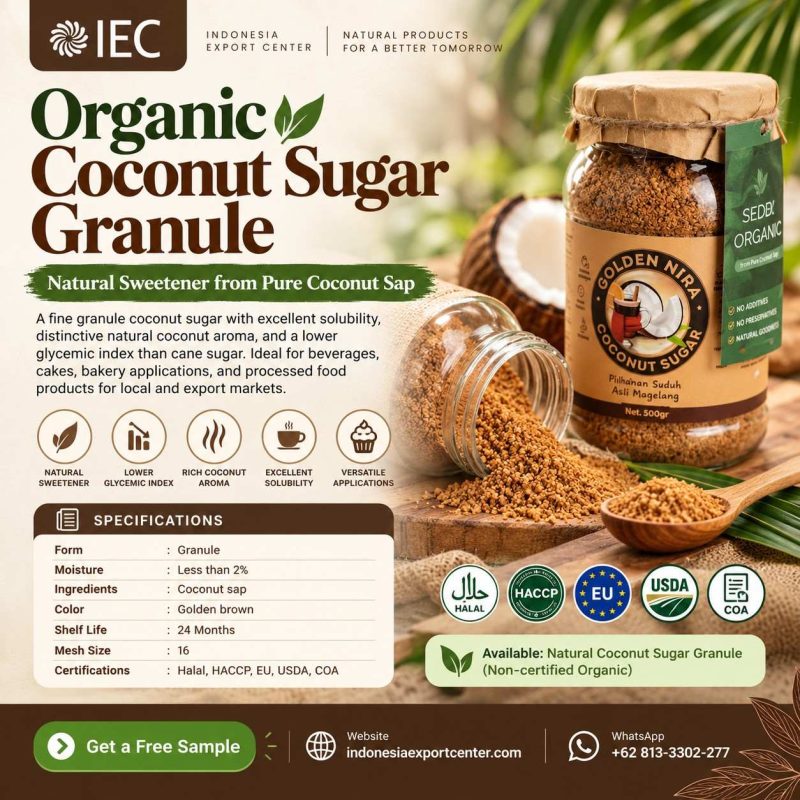
The IEC promotional flyer describes golden-brown coconut sugar granules with good solubility and a distinctive coconut aroma.
These characteristics should be evaluated through application-specific testing before the ingredient is approved for production.
Why Sauce Manufacturers Consider Coconut Sugar
Sauce and condiment manufacturers may evaluate coconut sugar for:
- Sweet and savoury sauces.
- Barbecue sauces.
- Glazes.
- Marinades.
- Dipping sauces.
- Specialty condiments.
- Plant-based sauces.
- Selected seasoning preparations.
Its use may support product differentiation or provide a particular flavour profile.
However, the performance of coconut sugar depends on the complete recipe, including acids, salts, oils, starches, proteins, water, and other ingredients.
IEC Coconut Sugar Product Overview
| Parameter | Information from IEC Flyer |
|---|---|
| Product | Organic Coconut Sugar Granule |
| Ingredient | Coconut Sap |
| Physical Form | Granule |
| Moisture | Less than 2% |
| Colour | Golden Brown |
| Mesh Size | 16 |
| Shelf Life | 24 Months |
| Aroma | Distinctive Coconut Aroma |
| Solubility | Described as Good |
The IEC flyer also identifies a natural coconut sugar variant.
All values are promotional references and require verification against current supplier documentation.
Coconut Sugar in Sweet and Savoury Sauces
Sweet and savoury sauces may contain multiple ingredients that influence the final flavour.
Coconut sugar can be evaluated for its contribution to sweetness, colour, and aroma.
Manufacturers should determine whether the ingredient complements the intended sauce profile.
A sensory evaluation may compare coconut sugar with the sweetener currently used in the formulation.
The evaluation should consider initial sweetness, aftertaste, aroma, and compatibility with spices or other flavouring ingredients.
Coconut Sugar for Barbecue Sauces
Barbecue sauce formulations often require a balance of sweetness, acidity, savoury notes, and spice.
Coconut sugar may be considered in selected formulations.
Manufacturers should assess:
- Sweetness.
- Colour.
- Flavour compatibility.
- Dissolution.
- Heating behaviour.
- Viscosity.
- Product stability.
A change in sweetener can affect more than taste, so a controlled formulation trial is important.
Coconut Sugar for Marinades
Marinades may include water, salt, acids, oils, seasonings, and sweetening ingredients.
Coconut sugar may be evaluated as one component of a marinade formulation.
Technical considerations include:
- Dissolution in the liquid phase.
- Distribution during mixing.
- Compatibility with acids and salts.
- Flavour development.
- Colour contribution.
- Sediment formation.
- Storage stability.
- Processing conditions.
The ingredient should not be assumed to provide any particular preservative or antimicrobial function.
Coconut Sugar for Glazes
Glazes may require sweetness, colour, coating performance, and appropriate viscosity.
Manufacturers may investigate coconut sugar in suitable glaze systems.
The finished result depends on the formulation and processing conditions.
Application testing should evaluate coating uniformity, appearance, heating behaviour, and sensory performance.
Dissolution and Mixing Performance
The IEC flyer describes good solubility.
However, it does not provide a numerical solubility value or standardized dissolution test.
Manufacturers should evaluate dissolution under their actual production conditions.
Relevant factors include:
- Liquid temperature.
- Mixing speed.
- Ingredient concentration.
- Mixing time.
- Product viscosity.
- Other dissolved ingredients.
Dissolution in water does not automatically predict performance in a concentrated sauce.
Colour and Appearance
Coconut sugar is described as golden brown.
Its inclusion may influence the colour of light-coloured sauces or specialty condiments.
Manufacturers should establish acceptable colour ranges and monitor batch consistency.
Colour should be evaluated after processing as well as during storage.
Flavour Compatibility
The distinctive aroma described in the IEC flyer may be desirable in some formulations and less suitable in others.
Product developers should assess flavour compatibility with:
- Tomato-based sauces.
- Spice blends.
- Vinegar-containing sauces.
- Savoury seasonings.
- Fruit-based sauces.
- Plant-based condiments.
No universal flavour compatibility is guaranteed.
Viscosity and Texture
Changing a sweetener may influence the overall solids composition of a sauce.
Manufacturers should monitor viscosity and texture when reformulating.
The effects depend on ingredient concentration and the full formulation.
Coconut sugar should not be treated as a direct replacement for a thickener or stabilizer.
Food Safety and Shelf-Life Considerations
The shelf life of coconut sugar as a dry ingredient is different from the shelf life of a finished sauce.
Sauce manufacturers should evaluate the final product’s:
- pH.
- Water activity.
- Microbiological safety.
- Processing conditions.
- Packaging integrity.
- Storage requirements.
- Shelf-life stability.
These requirements depend on the product and market.
Organic Sauce Manufacturing
Organic sauce brands may request certified organic coconut sugar.
The applicable organic certification, product scope, and supply-chain requirements must be verified.
The natural variant should not be represented as certified organic.
Quality Documentation
Buyers may request:
- Product specification sheet.
- Current COA.
- Moisture test results.
- Particle-size information.
- Microbiological reports.
- Relevant contaminant testing.
- Allergen statement.
- Organic certification where applicable.
- Halal documentation where required.
- Traceability information.
Recommended Industrial Formulation Trial
Stage 1 – Ingredient Qualification
Review the coconut sugar specification and available quality documentation.
Stage 2 – Bench-Scale Formulation
Prepare representative sauce or marinade samples.
Stage 3 – Dissolution Assessment
Evaluate mixing and visible undissolved material.
Stage 4 – Sensory Evaluation
Compare flavour, sweetness, and aroma.
Stage 5 – Processing Assessment
Evaluate heating, pumping, filling, or other relevant production operations.
Stage 6 – Stability Testing
Assess the finished product under appropriate conditions.
Stage 7 – Commercial Approval
Establish an approved ingredient specification and supplier acceptance procedure.
Commercial Purchasing Considerations
Before ordering, confirm the required product variant, technical specification, quantity, packaging, MOQ, price, delivery schedule, and destination.
A complete quotation should identify the seller, currency, Incoterm, loading location, and quotation validity.
Coconut Sugar for Sauces and Marinades RFQ Template
Subject: Indonesian Coconut Sugar for Sauce and Marinade Manufacturing
Company: [Company Name]
Country: [Country]
Application: [Sauce / Marinade / Glaze / Condiment]
Product Variant: [Organic / Natural]
Initial Quantity: [KG or MT]
Monthly Forecast: [Quantity]
Required Moisture: [Specification]
Required Granulation: [Specification]
Required Certifications: [Details]
Packaging: [Details]
Destination Port: [Port]
Preferred Incoterm: [Term]
Target Shipment Period: [Date]
Please provide current specifications, COA, sample feasibility, MOQ, packaging options, and an export quotation.
Frequently Asked Questions
Can coconut sugar be used in sauces?
It may be evaluated as a sweetening ingredient in suitable sauce formulations.
Is coconut sugar suitable for marinades?
Potentially, subject to dissolution and formulation trials.
Does coconut sugar change sauce colour?
It may influence finished-product colour.
Can coconut sugar replace refined sugar directly?
A direct substitution should not be assumed to deliver identical results.
Is coconut sugar suitable for heated processing?
Processing compatibility must be tested under the intended conditions.
Does coconut sugar preserve sauces?
No preservative performance should be assumed without appropriate evidence.
Can buyers request certified organic coconut sugar?
Yes, subject to certification verification.
Are industrial samples available?
Sample feasibility requires supplier confirmation.
Request Indonesian Coconut Sugar for Sauce Manufacturing
Looking for coconut sugar for commercial sauces, marinades, glazes, or condiments?
Contact Indonesia Export Center with your application, ingredient specifications, estimated volume, and destination market.
REQUEST COCONUT SUGAR SAMPLE & EXPORT RFQ
INDONESIA EXPORT CENTER (IEC)
Website: https://indonesiaexportcenter.com/
WhatsApp: +62 813-3302-277
All product specifications, certifications, application claims, samples, prices, MOQ, and supply arrangements require supplier confirmation.
Related Resources
Coconut Sugar for Food Manufacturers
Coconut Sugar COA and Quality Testing
Coconut Sugar Supplier Indonesia
