

INDONESIA EXPORT CENTER (IEC)
Indonesian Coconut Sugar for Plant-Based Food Brands
The global plant-based food industry includes a broad range of products, from dairy alternatives and vegan desserts to plant-based snacks, breakfast foods, and specialty beverages.
For businesses searching for coconut sugar for plant based foods, Indonesia Export Center (IEC) facilitates sourcing inquiries involving Indonesian coconut sugar granules.
Coconut sugar is made from coconut palm sap, making it a plant-derived sweetening ingredient.
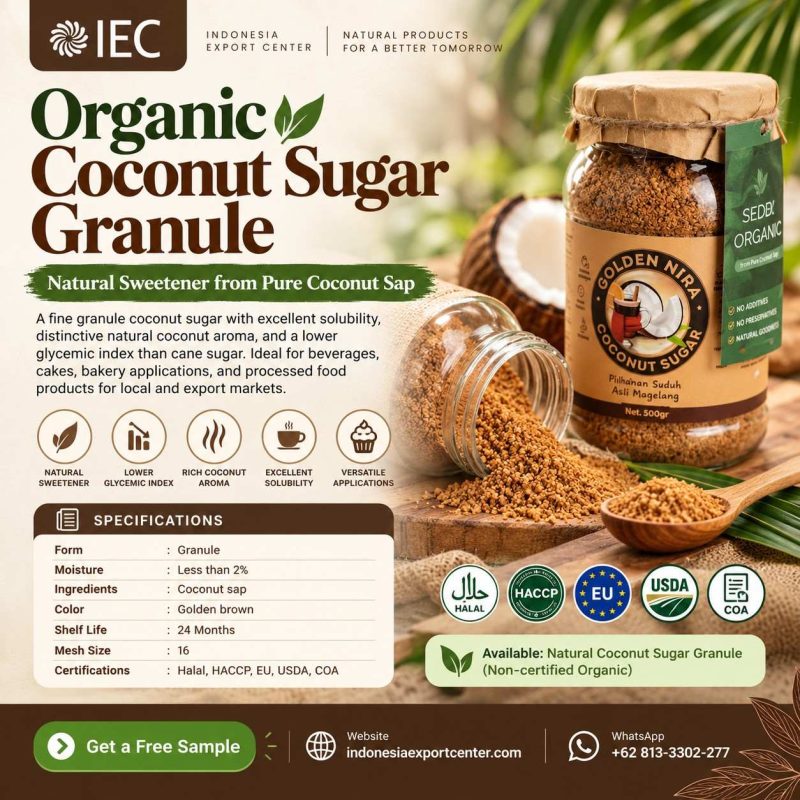
The IEC product flyer describes golden-brown granules with a distinctive coconut aroma and good solubility.
However, the suitability of coconut sugar for a plant-based finished product depends on formulation, processing, quality requirements, and the intended market.
What Is Coconut Sugar?
Coconut sugar is produced from the sap of coconut palm flowers.
The sap is processed into a concentrated sweetening product, which can be supplied in granulated form.
Coconut sugar should not be confused with coconut flour, coconut milk powder, or other coconut-derived ingredients.
It is primarily used as a sweetener and contributes sugars to the finished food.
Why Plant-Based Brands Evaluate Coconut Sugar
Plant-based food manufacturers may consider coconut sugar for:
- Product development.
- Ingredient diversification.
- Distinctive flavour.
- Organic food concepts.
- Alternative sweetener formulations.
- Specialty retail positioning.
- Coconut-derived ingredient sourcing.
Its inclusion should be based on technical performance and truthful product claims.
IEC Product Specifications
| Parameter | Promotional Reference |
|---|---|
| Product | Organic Coconut Sugar Granule |
| Ingredient | Coconut Sap |
| Form | Granule |
| Moisture | Less than 2% |
| Colour | Golden Brown |
| Mesh | 16 |
| Shelf Life | 24 Months |
| Aroma | Distinctive Coconut Aroma |
The IEC flyer also mentions a natural, non-certified-organic variant.
All technical information should be confirmed through current supplier documentation.
Coconut Sugar in Plant-Based Beverages
Potential beverage applications include:
- Plant-based milk alternatives.
- Coffee beverages.
- Tea beverages.
- Powdered drink mixes.
- Specialty beverage products.
Manufacturers should evaluate:
- Dissolution.
- Flavour.
- Colour.
- Sediment.
- Processing stability.
- Microbiological safety.
- Finished-product shelf life.
Coconut Sugar in Dairy Alternatives
Plant-based yogurt alternatives, desserts, and similar products may require careful sweetener selection.
Coconut sugar may influence:
- Sweetness.
- Colour.
- Aroma.
- Texture.
- Product stability.
Manufacturers should verify its compatibility with the complete formulation.
Coconut Sugar in Plant-Based Bakery Products
Plant-based bakery manufacturers may evaluate coconut sugar in cookies, cakes, muffins, and other suitable products.
The ingredient can affect dough behaviour, browning, flavour, and texture.
Recipe testing is essential.
Coconut Sugar in Vegan Snack Products
Potential applications include:
- Granola.
- Snack bars.
- Cereal clusters.
- Baked snacks.
- Selected confectionery products.
Manufacturers should evaluate ingredient distribution, processing compatibility, and finished-product stability.
Plant-Based vs Vegan Claims
Coconut sugar is derived from a plant source.
However, whether a finished product can be labelled vegan depends on the entire formulation, processing arrangements, and the applicable claim standard.
A manufacturer should review relevant processing aids, other ingredients, and possible cross-contact considerations.
Natural vs Organic Coconut Sugar
The IEC flyer identifies both an organic coconut sugar granule product and a natural, non-certified-organic variant.
These are not interchangeable certification categories.
A plant-based product is not automatically organic, and a natural ingredient is not automatically certified organic.
Organic claims require valid documentation.
Ingredient Declaration
Plant-based food brands should determine the correct ingredient name for their destination market.
Relevant labelling matters include:
- Ingredient identification.
- Sugar declarations.
- Nutrition information.
- Organic claims.
- Vegan claims where applicable.
- Country-of-origin information.
- Allergen information.
- Other mandatory labelling requirements.
Coconut sugar should not be described as sugar-free.
Food Safety Requirements
Potential supplier documents include:
- Product specification.
- Current COA.
- Microbiological test reports.
- Relevant contaminant results.
- Ingredient declaration.
- Allergen statement.
- Organic certificate where applicable.
- Halal documentation where relevant.
- Shelf-life support.
Product Development Considerations
Manufacturers should assess:
- Sweetness intensity.
- Flavour compatibility.
- Colour contribution.
- Solubility.
- Moisture.
- Particle size.
- Processing performance.
- Finished-product stability.
- Consumer acceptance.
- Commercial ingredient cost.
Supplier Approval Process
Stage 1: Define the intended application.
Stage 2: Request current specifications.
Stage 3: Verify certification requirements.
Stage 4: Obtain samples.
Stage 5: Conduct formulation trials.
Stage 6: Evaluate finished-product quality.
Stage 7: Review food safety documentation.
Stage 8: Confirm commercial purchasing terms.
Packaging and Export Requirements
Plant-based food manufacturers may request bulk ingredient packaging suitable for industrial processing.
Potential packaging considerations include moisture protection, food-contact compliance, seal integrity, and lot identification.
Available packaging formats require supplier confirmation.
RFQ Template for Plant-Based Food Manufacturers
Subject: Indonesian Coconut Sugar for Plant-Based Food Manufacturing
Company: [Name]
Country: [Country]
Application: [Plant-Based Beverage / Dessert / Bakery / Snack / Other]
Product Variant: [Organic / Natural]
Initial Quantity: [KG or MT]
Monthly Requirement: [Quantity]
Required Moisture: [Specification]
Required Granulation: [Specification]
Certifications: [Details]
Packaging: [Details]
Destination Port: [Port]
Preferred Incoterm: [Term]
Please provide current specifications, COA, sample feasibility, MOQ, and export quotation.
Frequently Asked Questions
Is coconut sugar plant-derived?
Yes. Coconut sugar is produced from coconut palm sap.
Can coconut sugar be used in plant-based milk alternatives?
It may be evaluated through formulation trials.
Is coconut sugar automatically vegan-certified?
No. Certification or claim requirements should be verified.
Is coconut sugar automatically organic?
No.
Can coconut sugar be used in vegan bakery products?
Potentially, subject to formulation and claim requirements.
Does coconut sugar contain sugar?
Yes.
Can buyers request organic coconut sugar?
Yes, subject to certification and supplier confirmation.
Are industrial quantities available?
Availability and MOQ must be confirmed.
Request Coconut Sugar for Plant-Based Food Manufacturing
Developing plant-based foods or sourcing coconut sugar for an existing product range?
Contact Indonesia Export Center with your application, technical specifications, certification requirements, quantity, and destination market.
REQUEST PLANT-BASED FOOD COCONUT SUGAR SAMPLE & RFQ
INDONESIA EXPORT CENTER (IEC)
Website: https://indonesiaexportcenter.com/
WhatsApp: +62 813-3302-277
Specifications, certifications, application suitability, samples, MOQ, prices, and availability require supplier confirmation.
Related Resources
Coconut Sugar for Organic Food Brands
Coconut Sugar for Beverage Manufacturers
Coconut Sugar Supplier Indonesia
