

INDONESIA EXPORT CENTER (IEC)
Source Coconut Sugar for Commercial Food Manufacturing
Food manufacturers evaluating coconut sugar need an ingredient that performs consistently in their specific production processes.
Beyond sweetness, important considerations may include particle size, dissolution, colour, flavour, moisture, process compatibility, storage stability, and regulatory requirements.
Indonesia Export Center (IEC) facilitates sourcing inquiries for Indonesian coconut sugar granules.
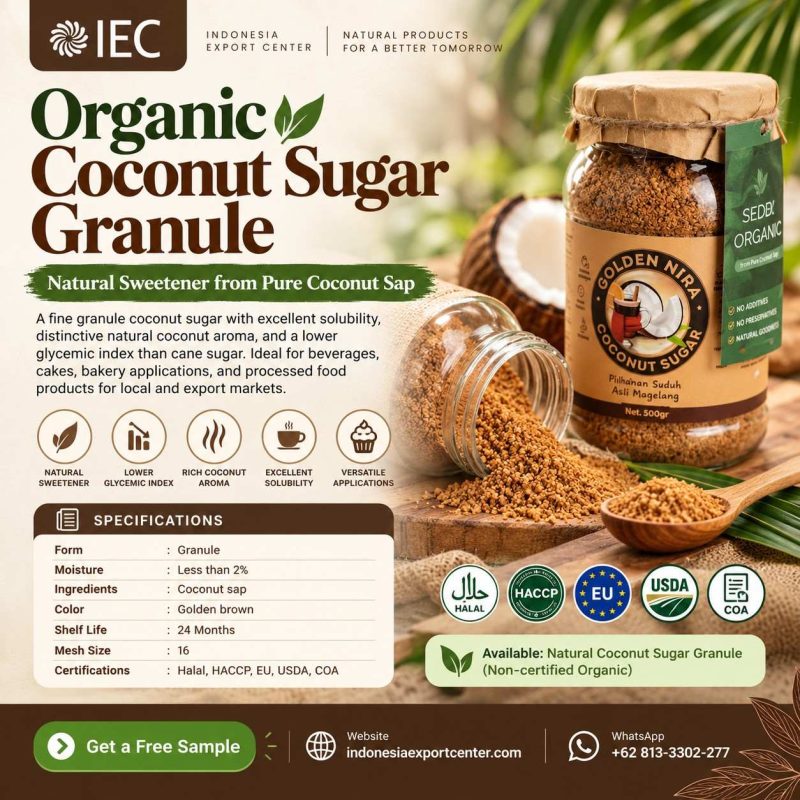
The IEC promotional material describes organic coconut sugar granules made from coconut sap, featuring golden-brown colour, a distinctive coconut aroma, and good solubility.
A natural, non-certified-organic variant is also identified.
Actual ingredient suitability must be established through supplier qualification, laboratory review, and application-specific manufacturing trials.
Coconut Sugar as a Food Manufacturing Ingredient
Coconut sugar is a plant-derived sweetener made from coconut palm sap.
It may be evaluated as an ingredient in various commercial food products.
However, replacing another sugar with coconut sugar can change flavour, colour, texture, processing behaviour, and product stability.
Manufacturers should not assume one-to-one functional equivalence in every recipe.
Potential Industrial Applications
1. Coffee and Tea Products
Coconut sugar may be evaluated for:
- Coffee mixes.
- Tea mixes.
- Specialty beverage powders.
- Ready-to-drink formulations.
Important considerations include dissolution, flavour, colour, sediment, and stability.
2. Bakery Manufacturing
Potential applications include:
- Cakes.
- Cookies.
- Biscuits.
- Muffins.
- Sweet baked goods.
Manufacturers should evaluate sweetness, browning, moisture retention, and final texture.
3. Confectionery
Coconut sugar may be tested in suitable confectionery formulations.
Its behaviour under heating, mixing, and cooling should be assessed.
4. Desserts
Potential applications include:
- Sweet sauces.
- Fillings.
- Dessert mixes.
- Toppings.
- Prepared dessert products.
5. Processed Food
Manufacturers may investigate coconut sugar for sauces, dry mixes, and other suitable formulations.
Each application requires separate technical assessment.
IEC Reported Product Specifications
| Parameter | Flyer Information |
|---|---|
| Product | Organic Coconut Sugar Granule |
| Ingredient | Coconut Sap |
| Form | Granule |
| Moisture | Less than 2% |
| Colour | Golden Brown |
| Mesh | 16 |
| Shelf Life | 24 Months |
| Aroma | Distinctive Coconut Aroma |
| Solubility | Described as Good |
These values are reported promotional information and require verification for the actual commercial ingredient.
Ingredient Selection: Organic vs Natural
Organic Coconut Sugar
Manufacturers developing certified organic products should verify the supplier’s organic certification and the rules governing organic ingredient use in their destination market.
Natural Coconut Sugar
The flyer identifies a natural, non-certified-organic variant.
Manufacturers should request a separate technical specification for this product.
Particle-Size Distribution
Particle size may affect:
- Mixing.
- Dissolution.
- Powder blending.
- Ingredient feeding.
- Product texture.
- Production consistency.
The flyer lists mesh 16, but manufacturers should request the applicable sieve standard and complete particle-size information where needed.
Moisture Control
The reported moisture content is less than 2%.
Moisture can influence:
- Caking.
- Powder flow.
- Storage stability.
- Processing performance.
- Packaging requirements.
Manufacturers should establish an appropriate maximum moisture specification.
Colour and Sensory Characteristics
The flyer describes golden-brown granules and a distinctive coconut aroma.
These characteristics may influence the appearance and flavour of finished foods.
A manufacturer should evaluate:
- Colour consistency.
- Aroma.
- Sweetness.
- Aftertaste.
- Compatibility with other ingredients.
- Consumer sensory acceptance.
Solubility and Beverage Applications
The IEC flyer describes good solubility.
However, the term is not supported by a numerical dissolution test in the supplied material.
Beverage manufacturers may evaluate:
- Dissolution time.
- Water temperature.
- Mixing conditions.
- Sediment.
- Turbidity.
- Flavour.
- Product stability.
Manufacturing Trial Procedure
A practical qualification process may involve:
Stage 1 – Specification Review
Confirm the product variant and technical requirements.
Stage 2 – Documentation Review
Examine COA, certification evidence, and food safety documentation.
Stage 3 – Sample Evaluation
Assess appearance, aroma, moisture, and particle size.
Stage 4 – Laboratory Testing
Conduct required analytical tests.
Stage 5 – Pilot Formulation
Test the ingredient in a representative recipe.
Stage 6 – Process Evaluation
Review mixing, heating, dissolution, and equipment compatibility.
Stage 7 – Finished Product Testing
Assess sensory characteristics, stability, and applicable safety criteria.
Stage 8 – Supplier Approval
Document the qualification decision and commercial specifications.
Batch Consistency Requirements
Food manufacturers may require:
- Lot-specific COAs.
- Approved reference samples.
- Written quality tolerances.
- Change-control procedures.
- Traceability.
- Corrective action processes.
- Receiving inspection.
Food Safety and Certification
The IEC flyer lists Halal, HACCP, EU, USDA, and COA references.
Before approving the ingredient, manufacturers should verify the applicable documents and their scope.
Organic certification does not replace food safety evaluation.
A COA does not replace supplier qualification.
Shelf-Life Evaluation
The flyer reports a shelf life of 24 months.
Manufacturers should request supporting evidence and confirm:
- Packaging conditions.
- Storage temperature.
- Humidity requirements.
- Date-marking basis.
- Product stability.
- Applicable shelf-life conditions.
The shelf life of coconut sugar as a raw ingredient does not automatically establish the shelf life of a finished food product.
Packaging for Industrial Manufacturing
Potential requirements include:
- Food-grade bulk bags.
- Moisture-resistant liners.
- Sealed packaging.
- Lot identification.
- Traceability labels.
- Palletization.
- Suitable storage instructions.
Supplier packaging capability must be confirmed.
Industrial Ingredient Specification Template
| Parameter | Manufacturer Requirement |
|---|---|
| Ingredient | Coconut Sugar Granules |
| Variant | Organic / Natural |
| Maximum Moisture | [%] |
| Mesh | [Specification] |
| Particle-Size Distribution | [Details] |
| Colour | [Reference] |
| Aroma | [Criteria] |
| Microbiological Limits | [Details] |
| Contaminant Limits | [Details] |
| Certification | [Requirements] |
| Packaging | [Details] |
| Shelf Life | [Requirement] |
| Lot Traceability | Required |
Industrial Procurement RFQ Template
Subject: Coconut Sugar Granules for Food Manufacturing – Indonesia
Company: [Name]
Destination Country: [Country]
Manufacturing Application: [Details]
Product Variant: [Organic / Natural]
Required Quantity: [KG or MT]
Monthly Requirement: [Quantity]
Required Mesh: [Specification]
Maximum Moisture: [Specification]
Required Colour: [Details]
Required Aroma: [Details]
Required Food Safety Tests: [Details]
Required Certifications: [Details]
Packaging: [Details]
Sample Requirement: [Details]
Destination Port: [Port]
Preferred Incoterm: [Term]
Target Shipment Period: [Dates]
Please provide available technical specifications, current COA, certification documents, sample feasibility, production capacity, MOQ, and export quotation.
Frequently Asked Questions
Can coconut sugar replace cane sugar in manufacturing?
It may be evaluated as an alternative ingredient, but functional equivalence must be tested.
Is coconut sugar suitable for instant beverages?
Suitability depends on dissolution, formulation, and processing conditions.
Does mesh 16 guarantee compatibility with automated equipment?
No.
Is the reported moisture level guaranteed?
No. It requires current batch verification.
Can food manufacturers request pilot samples?
Yes, subject to availability.
Is organic coconut sugar suitable for certified organic finished products?
That depends on applicable certification and formulation requirements.
Does the reported 24-month shelf life apply to finished products?
No.
Can IEC guarantee a specific monthly manufacturing supply volume?
No. Supplier capacity requires confirmation.
Request Coconut Sugar for Food Manufacturing
Looking for Indonesian coconut sugar granules for bakery, beverages, confectionery, or processed food manufacturing?
Contact IEC with your technical ingredient specification, trial requirements, estimated demand, and destination.
REQUEST MANUFACTURING SAMPLE & COCONUT SUGAR RFQ
INDONESIA EXPORT CENTER (IEC)
Indonesian Commodity Sourcing for Global Businesses
Website: https://indonesiaexportcenter.com/
WhatsApp: +62 813-3302-277
All specifications, certifications, samples, MOQ, prices, production capacity, and export arrangements require supplier confirmation.
Related Resources
Coconut Sugar Granules Manufacturer Sourcing
Coconut Sugar for Food Ingredient Importers
Organic Coconut Sugar Supplier Indonesia
Coconut Sugar Bulk Export RFQ Guide
