

INDONESIA EXPORT CENTER (IEC)
Technical Procurement Guide for Coconut Sugar Quality Documentation, Laboratory Testing, Food Safety and International Ingredient Approval
Understanding Coconut Sugar COA and Quality Requirements
For international ingredient buyers, a coconut sugar Certificate of Analysis (COA) is an important part of supplier qualification.
A COA can provide analytical information about a specific product sample or production lot.
However, not all COAs contain the same information, and a COA should not be treated as proof of every aspect of food safety, certification, or regulatory compliance.
Indonesia Export Center (IEC) facilitates sourcing inquiries for Indonesian coconut sugar granules.
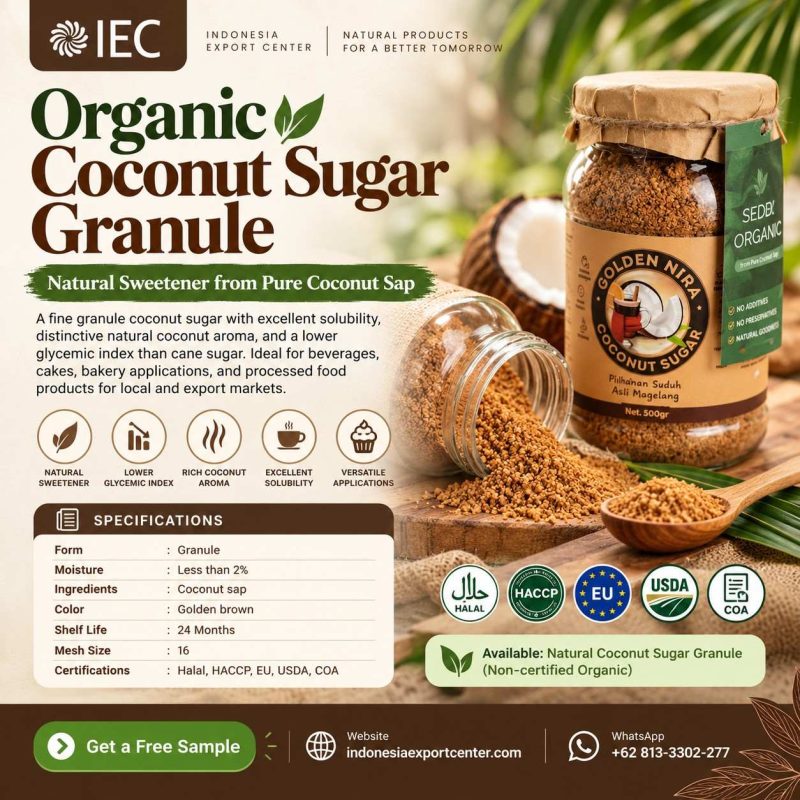
The IEC product flyer describes organic coconut sugar made from coconut sap, with moisture below 2%, mesh size 16, golden-brown colour, and a stated shelf life of 24 months.
These are promotional references. Buyers should verify the current product specification and request relevant quality documentation before commercial purchasing.
What Is a Certificate of Analysis?
A Certificate of Analysis is a document reporting test results or analytical findings for an identified sample or lot.
A useful COA should allow the buyer to determine:
- What product was tested.
- Which lot or sample was tested.
- Who performed the analysis.
- Which methods were used.
- What results were obtained.
- Whether the results meet agreed specifications.
A COA may be issued by a manufacturer or testing laboratory, depending on the arrangement.
The buyer should evaluate the credibility and relevance of the issuing party.
IEC Coconut Sugar Product Reference
| Parameter | IEC Promotional Information |
|---|---|
| Product | Organic Coconut Sugar Granule |
| Ingredient | Coconut Sap |
| Form | Granule |
| Moisture | Less than 2% |
| Mesh | 16 |
| Colour | Golden Brown |
| Shelf Life | 24 Months |
| Aroma | Distinctive Coconut Aroma |
A natural, non-certified-organic variant is also mentioned.
Each variant should have its own appropriate specification and supporting documentation.
Why COA Verification Matters
Food manufacturers may rely on ingredient quality information to support:
- Supplier approval.
- Incoming goods inspection.
- Production consistency.
- Food safety assessment.
- Traceability.
- Contractual acceptance.
- Regulatory compliance.
- Customer documentation.
A COA can support these activities, but it is only one component of a complete quality management process.
Essential COA Identification Fields
A useful coconut sugar COA may include:
- Product name.
- Product grade or variant.
- Manufacturer or supplier identification.
- Lot number.
- Sample identification.
- Production or sampling date.
- Testing date.
- Laboratory identification.
- Analytical methods.
- Test results.
- Units.
- Specification limits.
- Authorized approval.
The precise requirements depend on the buyer’s quality system.
Physical and Chemical Testing
Potential analytical parameters include:
| Parameter | Why Buyers May Test It |
|---|---|
| Moisture | Storage and processing performance |
| Particle Size | Granulation and application suitability |
| Colour | Product consistency |
| Appearance | Visual quality |
| Foreign Matter | Ingredient cleanliness |
| Water Activity | Product stability assessment |
| Sugar Composition | Formulation or authenticity assessment |
| Relevant Contaminants | Food safety compliance |
Not every parameter is necessarily required for every application.
Moisture Testing
The IEC flyer reports moisture below 2%.
Buyers should request the actual test result for the offered lot.
The COA should identify the method and units.
The reported moisture value should be compared with the agreed contractual specification.
Mesh Size and Sieve Analysis
The flyer reports mesh size 16.
A buyer may need additional particle-size information, especially for industrial processing.
Where necessary, request a sieve analysis or other suitable particle-size report.
Microbiological Testing
Coconut sugar is a food ingredient, so microbiological quality may be relevant to supplier approval.
Depending on risk assessment and applicable standards, testing may address:
- Total viable count.
- Yeasts and moulds.
- Relevant indicator organisms.
- Relevant foodborne pathogens.
The appropriate organisms, methods, sampling plans, and limits should be determined by applicable law, product risk, and buyer specifications.
No microbiological results are provided in the IEC flyer.
Contaminant Testing
Food ingredient buyers may require testing for relevant contaminants.
The required scope depends on raw material sourcing, production conditions, destination regulations, and risk assessment.
Potential categories include:
- Heavy metals.
- Pesticide residues where relevant.
- Other contaminants identified through risk assessment.
Buyers should not assume that an organic claim eliminates the need for contaminant assessment.
Foreign Matter and Physical Contamination
Physical quality checks may evaluate:
- Visible foreign material.
- Unwanted particles.
- Packaging fragments.
- Other contamination risks.
Manufacturers should maintain appropriate foreign matter controls.
Product Authenticity
Buyers may also wish to verify that the supplied ingredient corresponds to the agreed product identity.
Where appropriate, authenticity assessment may involve supplier traceability, production records, and analytical testing.
A product description alone does not establish authenticity.
Organic Certification Verification
The IEC flyer references organic coconut sugar and lists EU and USDA.
However, a COA is not the same as an organic certificate.
Organic verification may require:
- Current certificate.
- Certificate holder identification.
- Certification body.
- Product scope.
- Facility scope.
- Validity.
- Chain-of-custody information.
- Destination-market recognition.
Halal and HACCP References
The flyer also lists Halal and HACCP.
These references should be supported by current documents.
HACCP-related evidence should be evaluated according to the specific food safety system and issuing arrangement.
A laboratory COA does not automatically establish HACCP certification.
Lot Traceability
Traceability helps connect the analytical result to the goods being purchased.
Buyers should check whether the lot number on the COA matches:
- Product packaging.
- Packing list.
- Supplier production records.
- Shipment documents.
- Inspection records.
Unclear or inconsistent lot identification should be investigated before acceptance.
Independent Laboratory Testing
For higher-risk or higher-value transactions, buyers may request testing by an independent laboratory.
The parties should agree on:
- Sampling procedure.
- Sample custody.
- Laboratory selection.
- Test methods.
- Applicable specifications.
- Testing costs.
- Result interpretation.
- Rejection or dispute procedures.
COA Review Checklist
| Verification Item | Buyer Review |
|---|---|
| Product Name | Matches purchase specification |
| Lot Number | Matches commercial goods |
| Laboratory | Identified |
| Test Date | Relevant |
| Methods | Appropriate |
| Moisture | Meets agreed limit |
| Particle Size | Meets requirement |
| Microbiology | Meets applicable criteria |
| Contaminants | Meets applicable criteria |
| Authorized Approval | Present |
| Document Authenticity | Verified where necessary |
Common COA Warning Signs
Buyers should investigate:
- Missing lot numbers.
- Results without units.
- Unidentified test methods.
- Documents unrelated to the offered product.
- Outdated results presented as current.
- Inconsistent supplier information.
- Altered or unclear documents.
- Certification claims unsupported by certificates.
These issues do not automatically prove fraud, but they warrant clarification.
Supplier Approval Workflow
Step 1: Obtain the current product specification.
Step 2: Request a representative COA.
Step 3: Verify product and lot identification.
Step 4: Review methods and results.
Step 5: Compare results with buyer requirements.
Step 6: Verify relevant certifications separately.
Step 7: Request samples or independent testing if necessary.
Step 8: Approve commercial purchasing conditions.
Coconut Sugar COA Request Template
Subject: Request for Coconut Sugar COA and Technical Documents
Company: [Name]
Country: [Country]
Product Variant: [Organic / Natural]
Application: [Details]
Required Quantity: [KG or MT]
Please provide:
- Current product specification.
- Representative lot COA.
- Moisture test method and result.
- Particle-size specification.
- Relevant microbiological reports.
- Relevant contaminant results.
- Organic certificate if applicable.
- Halal or food safety documents if required.
- Shelf-life information.
- Packaging specification.
- Lot traceability information.
Please also confirm sample feasibility, MOQ, and export quotation.
Frequently Asked Questions
What is a coconut sugar COA?
A document reporting analytical information for an identified sample or lot.
Does a COA prove organic certification?
No.
Does the IEC flyer include a verified COA?
It references COA but does not provide an independently verified current lot report.
Is moisture below 2% guaranteed?
No. The actual batch result should be checked.
Can buyers request microbiological testing?
Yes, subject to supplier and laboratory arrangements.
Is third-party testing possible?
It may be arranged by agreement between the parties.
Should a COA match the shipment lot?
Yes, where lot-specific acceptance is required.
Does a COA guarantee regulatory compliance?
No. Compliance involves additional requirements.
Request Coconut Sugar COA and Export Quotation
Are you qualifying an Indonesian coconut sugar supplier for food manufacturing or ingredient distribution?
Contact IEC with your required test parameters, product variant, order volume, and destination market.
REQUEST COCONUT SUGAR COA, SAMPLE & RFQ
INDONESIA EXPORT CENTER (IEC)
Website: https://indonesiaexportcenter.com/
WhatsApp: +62 813-3302-277
Testing, documentation, certification, samples, pricing, and commercial availability require supplier confirmation.
Related Resources
Low Moisture Coconut Sugar Granules
Organic Coconut Sugar Supplier Indonesia
