

INDONESIA EXPORT CENTER (IEC)
Indonesian Coconut Sugar Sourcing for Breakfast Cereal Manufacturing, Dry Blending, Product Development and International Ingredient Procurement
Source Indonesian Coconut Sugar for Breakfast Cereal Production
Are you looking for coconut sugar for breakfast cereals to support your cereal manufacturing operations, product innovation, or international ingredient procurement?
Indonesia Export Center (IEC) facilitates B2B sourcing inquiries for Indonesian coconut sugar granules, including organic coconut sugar and natural, non-certified-organic coconut sugar.
Breakfast cereal manufacturers need ingredients that perform consistently throughout industrial processing. Beyond sweetness, manufacturers must consider particle size, dry-blend uniformity, moisture, flavour, colour, ingredient cost, packaging, and production compatibility.
Coconut sugar is made from coconut palm sap and may be evaluated as a sweetening ingredient in selected breakfast cereal formulations.
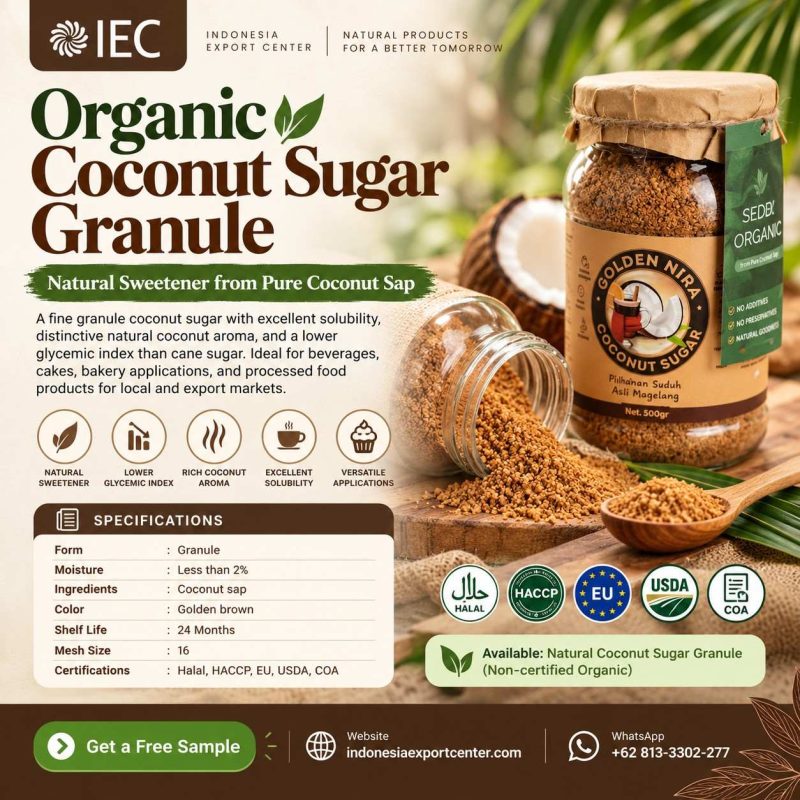
The IEC product flyer describes golden-brown granules with a distinctive coconut aroma and good solubility. These characteristics may be relevant to cereal brands seeking a different ingredient profile.
However, suitability must be established through laboratory evaluation, pilot trials, and finished-product testing.
Why Breakfast Cereal Manufacturers Consider Coconut Sugar
Breakfast cereal manufacturers may evaluate coconut sugar for several commercial and technical reasons.
These include:
- Developing new cereal formulations.
- Introducing coconut-derived ingredients.
- Exploring different sweetness and flavour profiles.
- Supporting selected organic product concepts.
- Developing specialty breakfast products.
- Diversifying ingredient sourcing.
- Evaluating alternative sweeteners for dry cereal blends.
The ingredient should be assessed against the finished product’s nutritional, sensory, processing, and regulatory requirements.
Coconut sugar is still a sugar-containing ingredient and should not be represented as sugar-free.
Indonesian Coconut Sugar Product Overview
The IEC promotional flyer presents an organic coconut sugar granule product.
It also identifies a natural coconut sugar granule variant that is not represented as certified organic.
Reported Technical Specifications
| Parameter | IEC Product Flyer |
|---|---|
| Product | Organic Coconut Sugar Granule |
| Raw Material | Coconut Sap |
| Physical Form | Granules |
| Moisture Content | Less than 2% |
| Colour | Golden Brown |
| Mesh Size | 16 |
| Shelf Life | 24 Months |
| Aroma | Distinctive Coconut Aroma |
| Solubility | Described as Good |
These values are promotional references. Buyers should request a current product specification and representative Certificate of Analysis.
Coconut Sugar Applications in Breakfast Cereals
Ready-to-Eat Breakfast Cereals
Ready-to-eat cereal manufacturers may evaluate coconut sugar in selected formulations.
Potential technical considerations include:
- Sweetness intensity.
- Flavour contribution.
- Colour development.
- Processing temperature.
- Ingredient distribution.
- Finished-product crispness.
- Moisture stability.
The suitability of coconut sugar depends on the cereal type and manufacturing method.
Granola and Toasted Cereals
Granola manufacturers may consider coconut sugar in sweetening and coating systems.
The ingredient may influence the flavour and appearance of toasted cereal products.
Manufacturers should assess coating uniformity, adhesion, heating behaviour, and storage stability.
Granulated coconut sugar alone should not be assumed to provide all the binding properties required for a particular granola recipe.
Muesli and Dry Cereal Blends
Dry cereal blends may require particularly careful ingredient distribution.
Particle-size differences can cause segregation during mixing, handling, transportation, and packaging.
Manufacturers should evaluate whether coconut sugar remains evenly distributed throughout the finished blend.
Children’s Breakfast Cereals
Manufacturers developing breakfast cereals for children should assess applicable nutrition standards, sugar declarations, product claims, and market-specific labelling requirements.
The use of coconut sugar does not automatically make a cereal healthier or lower in sugar.
Dry-Blend Uniformity
Uniform distribution is an important consideration for industrial cereal production.
If sugar granules differ significantly from the size or density of other ingredients, the blend may separate during processing.
Potential causes include:
- Particle-size differences.
- Bulk-density differences.
- Vibration.
- Transfer between equipment.
- Mixing duration.
- Filling conditions.
Manufacturers may conduct blend-uniformity studies and sample material from multiple positions within a production batch.
Particle Size and Mesh 16
The IEC flyer reports mesh size 16.
Mesh is commonly associated with sieve classification, but the designation alone does not describe the complete particle-size distribution.
Buyers should request clarification of:
- Applicable sieve standard.
- Nominal opening size.
- Percentage retained.
- Percentage passing.
- Fines content.
- Particle-size distribution.
- Batch-to-batch consistency.
The appropriate granulation depends on the cereal manufacturing process.
Moisture and Caking Control
The flyer reports moisture below 2%.
Moisture control may influence:
- Ingredient flowability.
- Caking.
- Dry-blend uniformity.
- Packaging performance.
- Storage stability.
Manufacturers should also consider the humidity of the processing environment and the moisture sensitivity of other ingredients.
The raw ingredient’s moisture specification does not establish the finished cereal’s moisture or water activity.
Colour and Flavour in Cereal Formulations
The IEC product material describes golden-brown coconut sugar with a distinctive coconut aroma.
These characteristics may contribute to the sensory profile of breakfast cereals.
Manufacturers should assess whether the colour and flavour remain appropriate after processing.
High-temperature operations may change the finished product’s sensory characteristics.
Organic Breakfast Cereal Production
Certified organic cereal manufacturers may request certified organic coconut sugar.
Before approving the ingredient, verify:
- Organic certificate.
- Certificate holder.
- Product scope.
- Processing facility scope.
- Applicable organic standard.
- Chain-of-custody documentation.
- Destination-market recognition.
The flyer mentions EU and USDA references, but these alone do not prove valid organic certification.
Quality Documentation for Cereal Manufacturers
A commercial ingredient qualification process may require:
- Product specification sheet.
- Current COA.
- Moisture test results.
- Particle-size analysis.
- Microbiological results.
- Relevant contaminant testing.
- Foreign matter specification.
- Allergen information.
- Organic documentation where applicable.
- Packaging specification.
- Traceability records.
Coconut Sugar Cost Evaluation
Ingredient cost should be assessed in relation to actual manufacturing performance.
A useful calculation is:
Ingredient cost per batch = coconut sugar quantity used × delivered price per kilogram.
Manufacturers may also evaluate:
- Cost per finished kilogram.
- Processing losses.
- Packaging costs.
- Freight.
- Import duties.
- Storage costs.
- Quality rejection risk.
- Formulation adjustment costs.
A lower ingredient price does not necessarily produce the lowest total manufacturing cost.
Recommended Cereal Manufacturing Trial
Step 1: Define the desired cereal application.
Step 2: Request coconut sugar samples and technical specifications.
Step 3: Evaluate moisture, granulation, and sensory characteristics.
Step 4: Conduct small-scale formulation trials.
Step 5: Test dry-blend uniformity.
Step 6: Assess production equipment compatibility.
Step 7: Evaluate finished-product flavour and texture.
Step 8: Conduct appropriate stability testing.
Step 9: Review ingredient cost and supply feasibility.
Step 10: Approve the supplier against documented criteria.
Coconut Sugar for Breakfast Cereals RFQ Template
Subject: Indonesian Coconut Sugar for Breakfast Cereal Manufacturing
Company: [Company Name]
Country: [Country]
Cereal Application: [Ready-to-Eat / Granola / Muesli / Other]
Product Variant: [Organic / Natural]
Required Quantity: [KG or MT]
Monthly Forecast: [Quantity]
Required Granulation: [Specification]
Maximum Moisture: [Specification]
Colour Requirements: [Details]
Required Certifications: [Details]
Packaging: [Details]
Destination Port: [Port]
Preferred Incoterm: [FOB / CIF / Other]
Target Shipment Date: [Date]
Please provide the current product specification, COA, sample feasibility, MOQ, packaging options, production lead time, and export quotation.
Frequently Asked Questions
Can coconut sugar be used in breakfast cereals?
It may be evaluated as a sweetening ingredient, subject to formulation and processing trials.
Is coconut sugar suitable for dry cereal blends?
Suitability depends on particle size, flowability, mixing performance, and ingredient segregation.
Does mesh 16 guarantee good blending?
No. Buyers should evaluate the complete particle-size distribution.
Can coconut sugar be used in organic cereals?
Potentially, where valid organic certification and applicable requirements are satisfied.
Does coconut sugar make cereal sugar-free?
No.
Can coconut sugar affect cereal colour?
Yes. Its colour may influence the appearance of finished products.
Is the advertised 24-month shelf life guaranteed?
No. Supporting documentation and applicable storage conditions must be confirmed.
Can manufacturers request bulk quotations?
Yes, subject to supplier confirmation.
Request Indonesian Coconut Sugar for Breakfast Cereal Manufacturing
Looking for coconut sugar granules for commercial cereal production?
Indonesia Export Center welcomes inquiries from cereal brands, food manufacturers, ingredient importers, and international distributors.
Provide your product specifications, estimated purchasing volume, packaging requirements, and destination market.
REQUEST COCONUT SUGAR SAMPLE & RFQ
INDONESIA EXPORT CENTER (IEC)
Website: https://indonesiaexportcenter.com/
WhatsApp: +62 813-3302-277
Product specifications, certifications, samples, prices, MOQ, and commercial availability require supplier confirmation.
Related Resources
Coconut Sugar for Granola and Snack Bars
Coconut Sugar for Food Manufacturers
Coconut Sugar COA and Quality Testing
