

INDONESIA EXPORT CENTER (IEC)
Indonesian Coconut Sugar for Beverage Ingredient Sourcing
Are you searching for coconut sugar for beverage manufacturers developing coffee beverages, tea products, powdered drink mixes, or specialty beverages?
Indonesia Export Center (IEC) facilitates B2B sourcing inquiries for Indonesian coconut sugar granules.
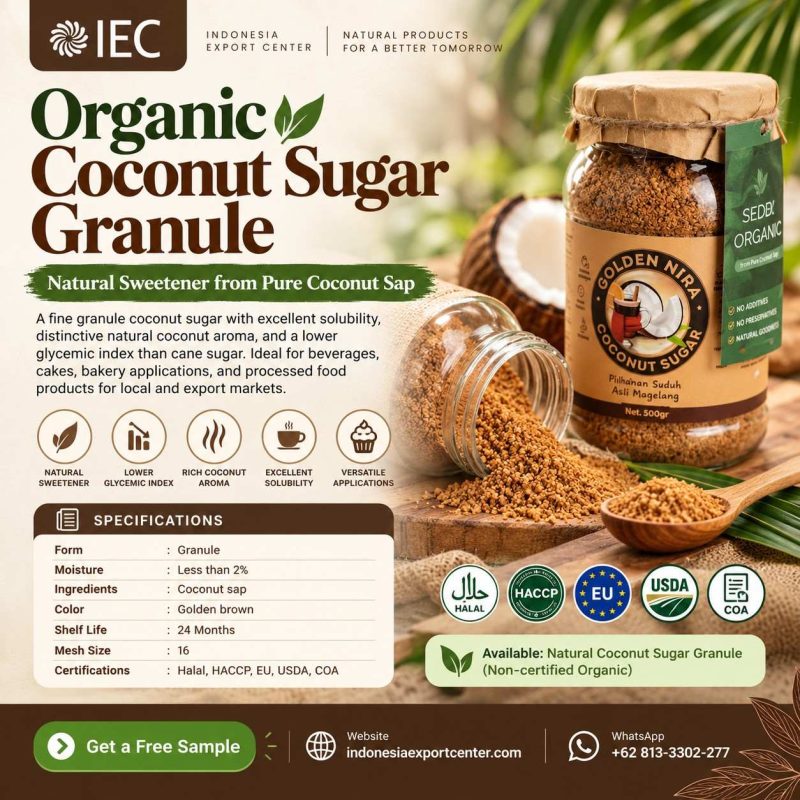
The IEC promotional flyer describes coconut sugar made from coconut sap, featuring good solubility, golden-brown colour, and a distinctive coconut aroma.
These characteristics may be relevant to beverage formulation, but actual suitability must be verified through laboratory and production trials.
Why Beverage Manufacturers Consider Coconut Sugar
Beverage manufacturers may evaluate coconut sugar for:
- Specialty coffee drinks.
- Tea beverages.
- Powdered beverage mixes.
- Café-style drink products.
- Selected ready-to-drink formulations.
- Beverage syrups.
- Private-label beverage products.
The ingredient’s performance depends on beverage composition, processing conditions, and the desired sensory profile.
IEC Coconut Sugar Product Specifications
| Parameter | Promotional Information |
|---|---|
| Product | Organic Coconut Sugar Granule |
| Ingredient | Coconut Sap |
| Form | Granule |
| Moisture | Less than 2% |
| Colour | Golden Brown |
| Mesh | 16 |
| Shelf Life | 24 Months |
| Solubility | Described as Good |
| Aroma | Distinctive Coconut Aroma |
The flyer also identifies a natural, non-certified-organic variant.
Specifications for each offered variant should be confirmed separately.
Solubility in Beverage Manufacturing
Solubility is an important consideration when selecting sweeteners for drinks.
The IEC flyer describes good solubility, but it does not provide a numerical dissolution rate or a standardized test method.
Manufacturers should evaluate:
- Water temperature.
- Mixing speed.
- Sugar concentration.
- Dissolution time.
- Sediment.
- Clarity.
- Product stability.
Performance in hot water may differ from performance in cold water.
Coconut Sugar in Hot Beverages
Hot beverage applications may include coffee, tea, and other suitable drinks.
Manufacturers should assess:
- Dissolution.
- Aroma.
- Flavour balance.
- Colour.
- Sweetness.
- Compatibility with other ingredients.
Coconut Sugar in Cold Beverages
Cold beverages may present different challenges.
A formulation trial may need to investigate:
- Dissolution at low temperatures.
- Undissolved particles.
- Sediment formation.
- Mixing requirements.
- Appearance.
- Storage stability.
The product should not be described as fully soluble in all cold beverage systems without test evidence.
Coconut Sugar in Powdered Drink Mixes
Dry beverage mixes may require control over:
- Particle-size distribution.
- Bulk density.
- Powder flow.
- Caking.
- Moisture.
- Mixing uniformity.
- Packaging barrier properties.
The reported mesh 16 value should be reviewed against the manufacturer’s equipment and finished-product requirements.
Coconut Sugar in Ready-to-Drink Beverages
Ready-to-drink products require additional considerations such as:
- Ingredient dissolution.
- Processing compatibility.
- Microbiological safety.
- Heat treatment.
- Product stability.
- Sediment.
- Packaging compatibility.
- Shelf life.
The shelf life of raw coconut sugar does not establish the shelf life of a finished beverage.
Colour Contribution
The IEC flyer describes a golden-brown product.
Coconut sugar may influence beverage colour, especially in light-coloured formulations.
Manufacturers should establish acceptable colour variation through formulation trials.
Flavour Profile
The flyer describes a distinctive coconut aroma.
In beverage applications, this may interact with coffee, tea, dairy, plant-based ingredients, flavourings, and other components.
Sensory evaluation should determine whether the flavour contribution is desirable.
Organic Beverage Products
Certified organic beverage brands should verify the coconut sugar’s organic certification and chain of custody.
The IEC flyer references EU and USDA, but these references alone do not establish valid certification.
Food Safety and Quality Documentation
Beverage manufacturers may request:
- Product specification.
- Current COA.
- Microbiological reports.
- Relevant contaminant testing.
- Ingredient declaration.
- Organic certification where applicable.
- Halal documentation where required.
- Packaging specifications.
- Shelf-life information.
Beverage Trial Evaluation Matrix
| Evaluation | Purpose |
|---|---|
| Dissolution Time | Assess mixing performance |
| Sediment | Evaluate physical stability |
| Colour | Assess appearance |
| Flavour | Evaluate sensory compatibility |
| Sweetness | Compare formulation targets |
| Moisture | Assess dry ingredient quality |
| Microbiological Quality | Evaluate food safety |
| Shelf-Life Testing | Assess finished product stability |
Beverage Manufacturing Trial Workflow
- Obtain product specifications.
- Request representative samples.
- Verify relevant laboratory results.
- Conduct bench-scale dissolution testing.
- Evaluate sensory performance.
- Assess processing compatibility.
- Conduct pilot production.
- Test finished-product stability.
- Establish commercial acceptance criteria.
- Approve supplier documentation.
Commercial Sourcing Requirements
Before purchasing, define:
- Organic or natural variant.
- Required quantity.
- Monthly demand.
- Granulation.
- Moisture specification.
- Quality testing.
- Packaging.
- Destination.
- Preferred Incoterm.
- Delivery schedule.
Beverage Coconut Sugar RFQ Template
Subject: Indonesian Coconut Sugar for Beverage Manufacturing
Company: [Name]
Country: [Country]
Beverage Application: [Details]
Product Variant: [Organic / Natural]
Required Quantity: [KG or MT]
Monthly Demand: [Quantity]
Required Mesh: [Specification]
Maximum Moisture: [Specification]
Solubility Requirements: [Details]
Colour Requirements: [Details]
Required Certifications: [Details]
Packaging: [Details]
Destination Port: [Port]
Preferred Incoterm: [Term]
Please provide current specifications, COA, sample feasibility, MOQ, and export quotation.
Frequently Asked Questions
Is coconut sugar soluble in beverages?
The flyer describes good solubility, but performance must be tested in the intended formulation.
Can coconut sugar be used in cold drinks?
It may be evaluated, subject to dissolution and stability trials.
Is coconut sugar suitable for powdered beverage mixes?
Potentially, depending on particle size and powder handling requirements.
Can coconut sugar affect beverage colour?
Yes, it may contribute colour.
Does coconut sugar have a neutral flavour?
The flyer describes a distinctive coconut aroma.
Is the product certified organic?
Certification must be verified.
Can manufacturers request samples?
Yes, subject to supplier confirmation.
Is there a guaranteed MOQ?
No verified MOQ is provided.
Request Coconut Sugar for Beverage Production
Looking for Indonesian coconut sugar granules for commercial beverage manufacturing?
Contact IEC with your beverage application, technical requirements, expected volume, and destination.
REQUEST BEVERAGE COCONUT SUGAR SAMPLE & RFQ
INDONESIA EXPORT CENTER (IEC)
Website: https://indonesiaexportcenter.com/
WhatsApp: +62 813-3302-277
Application suitability, specifications, certification, sample availability, and commercial terms require verification.
Related Resources
Coconut Sugar for Coffee and Tea Brands
Coconut Sugar for Food Manufacturers
Coconut Sugar Supplier Indonesia
