![Indonesia Export Center [IEC]](https://indonesiaexportcenter.com/wp-content/uploads/2023/07/logo-no-background.svg)
![Indonesia Export Center [IEC]](https://indonesiaexportcenter.com/wp-content/uploads/2023/07/svgviewer-output.svg)
Coconut Fiber Pots vs Plastic Nursery Pots: Benefits and Limitations
Choosing the right nursery pot affects more than product presentation. The container can influence irrigation frequency, root handling, labor requirements, transportation, production costs, and waste management.
Plastic nursery pots remain widely used because they are lightweight, durable, uniform, and compatible with automated nursery systems. Coconut fiber pots, also known as coir pots or cocopots, offer a plantable alternative made primarily from natural coconut husk fiber.
However, neither option is automatically better for every nursery. Coconut fiber pots can reduce plastic use and simplify transplanting, but they may require closer irrigation management and careful handling. Plastic pots offer operational efficiency, although their end-of-life management can create environmental and recycling challenges.
This article compares the benefits and limitations of coconut fiber pots and conventional plastic nursery pots to help growers, nursery operators, distributors, and international buyers choose the appropriate container.
What Are Coconut Fiber Pots?
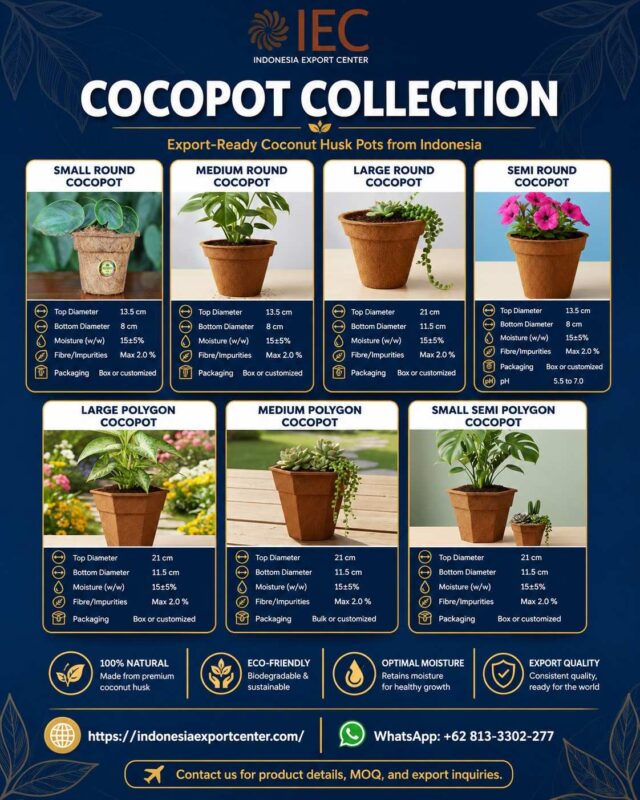
Coconut fiber pots are molded containers manufactured from fibers obtained from coconut husks. The fibers are formed into pots, commonly with a natural or biodegradable binding material, to create a container that can hold growing media and seedlings during nursery production.
Unlike conventional plastic pots, many coconut fiber pots are designed to be planted together with the seedling. After being placed in moist soil, the pot gradually weakens and decomposes.
Coconut fiber pots should not be confused with loose cocopeat growing media. A cocopot is a formed container, while cocopeat is a finer material frequently used as a component of growing substrates.
For product sizes, customization, export packing, and sourcing information, buyers can visit the Cocopot Supplier from Indonesia page.
Quick Comparison: Coconut Fiber Pots vs Plastic Nursery Pots
| Comparison Factor | Coconut Fiber Pots | Plastic Nursery Pots |
|---|---|---|
| Main raw material | Coconut husk fiber | Usually petroleum-based plastic |
| Plantable with seedling | Generally yes | No |
| Root disturbance during transplanting | Lower when properly planted | Seedling must normally be removed |
| Water requirement | May be higher because of porous walls | Usually lower because walls are nonporous |
| Durability | Suitable for limited production cycles | High durability |
| Reusability | Generally designed for single planting | Can potentially be reused |
| Handling when wet | Can soften or lose strength | Remains relatively stable |
| Size uniformity | Depends on manufacturing quality | Usually highly consistent |
| Plastic waste generation | Low or none from the pot itself | Can generate persistent waste |
| Compatibility with automation | Requires product testing | Commonly compatible |
| Typical unit cost | Often higher than basic plastic pots | Usually lower |
| Best application | Seedlings, vegetables, herbs, flowers, retail eco-lines | Long production cycles, heavy plants, automated nurseries |
Benefits of Coconut Fiber Pots
1. Reduced Root Disturbance During Transplanting
One of the main advantages of plantable coconut fiber pots is that the seedling does not always need to be removed from its container before transplantation.
Removing a plant from a conventional plastic pot can disturb fine roots, especially when the root ball is still weak or the species is sensitive to handling. With a properly manufactured cocopot, the nursery worker can plant the seedling together with the container.
Multilocation research evaluating plantable biocontainers found that these containers generally did not prevent plant establishment or post-transplant growth. Nevertheless, performance varied according to plant species, climate, and container material.
This characteristic can make coconut fiber pots attractive for:
- Vegetable seedlings
- Herbs
- Flowering annuals
- Forestry seedlings
- Fruit and ornamental plant propagation
- Plants that are sensitive to root disturbance
2. Lower Dependence on Conventional Plastic
Coconut fiber pots can help nurseries reduce their use of disposable petroleum-based nursery containers.
This benefit is particularly relevant when plastic pots cannot be collected or economically recycled after the plants have been sold. Black plastic nursery pots may be difficult for some sorting systems to identify, while soil and organic contamination can create additional recycling barriers.
Using coconut fiber pots does not eliminate every environmental impact associated with nursery production, but it can reduce the quantity of conventional plastic containers entering the distribution chain.
3. Potentially Simpler Transplanting Operations
Plantable pots can eliminate several steps normally required when transplanting plastic-grown seedlings:
- Removing the seedling from the plastic pot.
- Collecting the empty pot.
- Cleaning or sorting the used container.
- Transporting it for reuse, recycling, or disposal.
For large planting projects, this can simplify field operations. The exact labor savings will depend on planting technique, pot design, worker experience, and whether used plastic pots would otherwise be recovered.
4. Natural Appearance for Sustainable Product Lines
Coconut fiber has a natural brown appearance that can strengthen the environmental positioning of seedlings, herbs, flowers, and nursery products.
Cocopots can be particularly attractive for:
- Organic and environmentally positioned nurseries
- Garden-center retail displays
- Plastic-reduction programs
- Corporate planting projects
- Reforestation and restoration programs
- Sustainable promotional products
The visible natural fiber can help buyers immediately distinguish the product from plants sold in standard plastic pots.
5. Similar Plant Growth Is Possible with Proper Management
Studies comparing fiber-based and plastic nursery containers have often found that plants grown in alternative containers can achieve growth similar to plants grown in plastic pots.
A multistate study involving plastic, wood-pulp, fabric, keratin, and coir containers found that plants in alternative containers generally produced growth comparable to those in plastic pots. However, irrigation requirements and water-use efficiency varied by container, crop, and climate.
This means that changing to cocopots does not necessarily reduce crop quality, provided that irrigation, nutrition, production duration, and handling systems are adjusted appropriately.
Limitations of Coconut Fiber Pots
1. Higher Water Requirements May Be Necessary
Coconut fiber pots have porous walls. Moisture can therefore be lost through both the surface of the growing medium and the sides of the container.
Research conducted across multiple US states found that plants grown in fiber containers, including coir containers, generally used more water than plants grown in plastic containers.
Other greenhouse research also found that producing marketable plants in coconut fiber and several other plantable containers could require more water or shorter intervals between irrigation than production in plastic pots.
Nurseries adopting coconut fiber pots may need to:
- Increase irrigation frequency.
- Use bottom watering or capillary irrigation.
- Place pots in supporting trays.
- Group plants according to water demand.
- Monitor moisture at the outer edge of the growing medium.
- Avoid placing small pots in excessively dry or windy locations.
This limitation is particularly important in hot climates, low-humidity greenhouses, and nurseries where water availability is restricted.
2. Lower Wet Strength and Durability
Coconut fiber pots are intended to degrade eventually. This characteristic creates an unavoidable trade-off: a pot must remain strong during filling, growing, packing, and shipping, yet become degradable after planting.
Prolonged exposure to water, high humidity, algae, microorganisms, and growing media can gradually reduce the pot’s mechanical strength. Pot quality therefore depends heavily on:
- Fiber density
- Fiber length
- Pot-wall thickness
- Binder composition
- Drying process
- Compression
- Storage conditions
- Irrigation method
Research on alternative nursery containers has shown that strength and durability vary considerably between materials and designs. Coconut fiber containers have demonstrated adequate strength in some trials, but individual products should still be tested under the buyer’s actual production and shipping conditions.
3. Decomposition Is Not Immediate
The term “biodegradable” should not be interpreted as meaning that a pot will disappear immediately after planting.
In a two-year, five-location study, coir containers had decomposed by an average of approximately 25% after three to four months in the landscape. Other container materials decomposed either faster or more slowly. Plant establishment was generally not prevented, but the results demonstrate that degradation rates vary substantially according to material and environmental conditions.
Decomposition can be influenced by:
- Soil moisture
- Temperature
- Microbial activity
- Pot thickness
- Burial depth
- Binder formulation
- Contact between the pot and surrounding soil
The pot should normally be fully covered with soil. Any rim left above the soil may dry out and potentially draw moisture away from the root zone.
For thick or highly compressed pots, buyers should conduct transplant trials to confirm that roots can penetrate the pot walls within the required period.
4. The Purchase Price May Be Higher
Plastic pots are manufactured at very large scale and are often inexpensive. Coconut fiber pots may have a higher initial unit price due to raw-material preparation, molding, drying, quality control, packaging, and international transportation.
An economic analysis of alternative nursery containers found that the purchase price of the pot was the main factor creating differences in total production cost. The researchers concluded that alternative container prices would need to become more competitive for routine commercial adoption.
Nevertheless, buyers should compare total operating cost rather than pot price alone. Potential savings may arise from:
- Reduced plastic-waste handling
- Less pot-removal labor during field planting
- No return logistics for empty pots
- Premium retail positioning
- Compliance with plastic-reduction policies
- Higher perceived value among environmentally conscious customers
5. Greater Variation Between Suppliers
Plastic pots are highly standardized. Natural fiber pots can vary more in weight, wall thickness, color, shape, moisture content, and mechanical strength.
A nursery purchasing coconut fiber pots wholesale should request detailed tolerances rather than relying only on nominal dimensions.
Important specifications include:
- Top diameter
- Bottom diameter
- Height
- Wall thickness
- Unit weight
- Moisture content
- Fiber composition
- Binder type
- Wet strength
- Drainage design
- Dimensional tolerance
- Packing quantity
- Carton or bale dimensions
Buyers should also confirm whether the product contains synthetic additives or non-biodegradable binders.
Benefits of Plastic Nursery Pots
1. High Durability
Plastic pots can tolerate long production periods, frequent irrigation, fertilizer application, transport, and repeated handling. This makes them suitable for woody ornamentals, larger trees, and plants that remain in nurseries for many months.
They are less likely than fiber pots to soften, deform, or develop structural damage under continuously wet conditions.
2. Lower Irrigation Demand
Because plastic pot walls are not porous, water is primarily lost through the surface of the growing medium, drainage holes, and plant transpiration.
This generally provides plastic pots with an irrigation-efficiency advantage over uncoated fiber containers. Studies comparing nursery containers found that plants in coir and other porous containers frequently required more water than comparable plants in plastic pots.
3. Uniformity and Automation Compatibility
Plastic pots are usually consistent in dimensions, wall strength, rim structure, and nesting behavior. This makes them well suited to:
- Automatic pot dispensers
- Pot-filling machines
- Conveyor systems
- Mechanical transplanting
- Standard shuttle trays
- Automated labeling
- High-speed packaging
Coconut fiber pots can also be used in commercial systems, but samples should first be tested for denesting, filling, conveyance, and wet handling.
4. Potential for Reuse
A durable plastic nursery pot can be reused when an appropriate collection, washing, sanitation, and redistribution system exists.
Reusing a pot several times can significantly change its environmental and economic performance compared with treating it as a single-use item. For this reason, comparisons should distinguish between disposable plastic pots and pots operated within an effective reuse system.
Limitations of Plastic Nursery Pots
1. Persistent Waste
Conventional plastic pots do not naturally decompose in soil. When collection and recycling systems are unavailable, damaged or unwanted containers may be landfilled, incinerated, or improperly discarded.
Most horticultural pots are commonly made from polypropylene, and recycling can be hindered by dark coloration, labels, mixed polymers, and contamination with soil or plant material.
2. Seedlings Must Be Removed Before Planting
Plastic pots cannot normally be planted with the seedling. Nursery workers must remove the root ball, creating an additional handling stage.
When plants are overgrown, roots may circle along the inside of a smooth plastic container. Removal may also damage an insufficiently developed root ball or delicate roots.
3. Reverse Logistics May Be Required
Large planting projects using plastic pots can generate thousands of empty containers at the planting site. These pots must be collected, stacked, transported, cleaned, reused, recycled, or discarded.
The environmental benefit of reusing plastic therefore depends on whether a practical recovery system actually exists.
4. Sustainability Depends on End-of-Life Management
Plastic pots are not necessarily the poorest option in every life-cycle scenario. A lightweight plastic pot reused many times and properly recycled may perform differently from a single-use pot that is transported long distances and discarded.
Similarly, a plant-based or biodegradable product should not automatically be considered environmentally superior without considering raw-material sourcing, energy use, transportation, production efficiency, usable lifespan, and end-of-life conditions. The European Commission recommends evaluating these materials across their full life cycle and recognizes that biodegradable alternatives involve both opportunities and trade-offs.
Which Pot Should a Nursery Choose?
Coconut Fiber Pots Are Usually More Suitable When:
- Seedlings will be transplanted directly into soil.
- Root disturbance must be minimized.
- The production cycle is relatively short.
- Customers actively prefer plastic-free products.
- Used pots cannot be efficiently collected.
- The nursery can adjust its irrigation schedule.
- The product is intended for vegetables, herbs, annual flowers, forestry, or restoration planting.
- Natural product presentation is commercially valuable.
Plastic Pots Are Usually More Suitable When:
- Plants have a long nursery production cycle.
- Containers must withstand heavy mechanical handling.
- Irrigation water is limited.
- The nursery uses high-speed automation.
- Plants are large or heavy.
- A pot-return or reuse system is available.
- Exact dimensional consistency is critical.
- Containers will be exposed to prolonged wet conditions.
A Hybrid Strategy May Be the Best Solution
Commercial nurseries do not necessarily need to replace every plastic pot at once.
A practical strategy may include:
- Coconut fiber pots for transplant-ready seedlings.
- Plastic pots for mother plants and long-cycle crops.
- Reusable plastic trays to support cocopots.
- Trial programs for selected customers.
- Cocopots for premium sustainable product lines.
- Plastic containers for crops requiring extended nursery storage.
This approach allows the nursery to reduce disposable plastic while maintaining production efficiency where durable containers remain necessary.
Best Practices for Using Coconut Fiber Pots
Conduct a Nursery Trial
Test the pots with the intended crop, growing medium, fertilizer program, irrigation system, and production duration. Do not base a large order only on dry-pot samples.
Test Wet Strength
Irrigate sample pots repeatedly and evaluate whether they can still be lifted, moved, labeled, packed, and transported safely.
Use Supporting Trays
Shuttle trays can support pot walls, improve spacing, simplify handling, and reduce direct evaporation from some parts of the container. Research has shown that trays can reduce water requirements for certain biocontainer systems, including coconut fiber containers.
Adjust Irrigation
Coconut fiber pot walls may dry faster than the center of the growing medium. Irrigation decisions should therefore be based on actual root-zone moisture rather than surface appearance alone.
Match Pot Size to Production Duration
Small, thin-walled cocopots may be suitable for short-cycle vegetable seedlings. Larger or thicker pots may be necessary for ornamental plants and longer production schedules.
Store in a Dry Place
Unused coconut fiber pots should be protected from rain, excessive humidity, pests, and direct contact with the floor. Moist storage can encourage deformation or biological growth before use.
Wholesale Buying Checklist for Coconut Fiber Pots
Before placing a commercial order, international buyers should ask the supplier for:
- Complete dimensions and dimensional tolerances.
- Unit weight and acceptable weight variation.
- Fiber and binder composition.
- Confirmation of whether synthetic material is present.
- Dry and wet strength information.
- Recommended nursery production duration.
- Sample quantity for irrigation and transplant testing.
- Packaging method and units per carton or bale.
- Pallet dimensions and container-loading quantity.
- Private-label or customized packaging options.
- Production capacity and lead time.
- Photos or videos of production and quality inspection.
- Export documentation capability.
- Phytosanitary or treatment information when required by the destination country.
- Procedures for handling damaged or deformed products.
For high-volume procurement, customized dimensions, and nursery distribution, visit Coconut Fiber Pots Wholesale for Nurseries.
Frequently Asked Questions
Are coconut fiber pots better than plastic pots?
Coconut fiber pots are better for applications requiring direct planting, reduced plastic use, and limited root disturbance. Plastic pots are generally better for long production cycles, heavy plants, automated operations, and water-efficient nursery systems.
Can coconut fiber pots be planted directly into the ground?
Many cocopots are designed for direct planting. The pot should be moist, placed in good contact with the surrounding soil, and completely buried. Buyers should verify that the specific pot contains a suitable binder and has passed root-penetration trials.
How long do coconut fiber pots take to decompose?
There is no universal decomposition period. Pot thickness, density, binder, soil moisture, temperature, and microbial activity all affect degradation. One multilocation study reported an average decomposition level of about 25% for coir pots after three to four months in the landscape.
Do plants in coconut fiber pots need more water?
They frequently do. The porous walls allow additional evaporation, and research has found higher water use in coir and other fiber containers compared with plastic pots under several nursery conditions.
Are coconut fiber pots suitable for commercial nurseries?
Yes, especially for seedlings and short-cycle crops. Commercial buyers should test pot strength, irrigation demand, machine compatibility, shipping durability, and transplant performance before scaling up.
Conclusion
Coconut fiber pots and plastic nursery pots serve different operational needs.
Coconut fiber pots provide a plantable, natural-fiber solution that can reduce disposable plastic and minimize root handling during transplantation. Their main limitations are potentially higher irrigation demand, lower wet strength, variable decomposition, and a higher initial purchase price.
Plastic nursery pots remain durable, inexpensive, uniform, and efficient for long-cycle and automated nursery production. Their disadvantages are persistent waste, additional transplant handling, and dependence on effective collection and recycling systems.
For many nurseries, the best decision is not to select one material for every crop. Instead, container choice should be based on plant species, production duration, irrigation capacity, logistics, customer expectations, and end-of-life management.
International buyers seeking export-ready cocopots can work with an experienced Cocopot Supplier from Indonesia to develop suitable sizes, packing configurations, and wholesale supply programs for nurseries, distributors, garden centers, and commercial planting projects.
References
- Brumfield, R.G., et al. “Economics of Utilizing Alternative Containers in Ornamental Crop Production Systems.” HortTechnology, Vol. 25, No. 1, 2015.
- Evans, M.R., Taylor, M., and Kuehny, J.S. “Physical Properties of Biocontainers for Greenhouse Crops Production.” HortTechnology, Vol. 20, No. 3, 2010.
- Nambuthiri, S., et al. “Moving Toward Sustainability with Alternative Containers for Greenhouse and Nursery Crop Production: A Review and Research Update.” HortTechnology, Vol. 25, No. 1, 2015.
- Sun, Y., et al. “Impact of Biocontainers on Plant Performance and Container Decomposition in the Landscape.” HortTechnology, Vol. 25, No. 1, 2015.
- Wang, X., et al. “Multistate Evaluation of Plant Growth and Water Use in Plastic and Alternative Nursery Containers.” HortTechnology, Vol. 25, No. 1, 2015.
- European Commission. “Biobased, Biodegradable and Compostable Plastics.”
- Blanke, M.M. “Innovative Strategy to Reduce Single-Use Plastics in Sustainable Horticulture by a Refund Strategy for Flowerpots.” Sustainability, 2021.
