![Indonesia Export Center [IEC]](https://indonesiaexportcenter.com/wp-content/uploads/2023/07/logo-no-background.svg)
![Indonesia Export Center [IEC]](https://indonesiaexportcenter.com/wp-content/uploads/2023/07/svgviewer-output.svg)
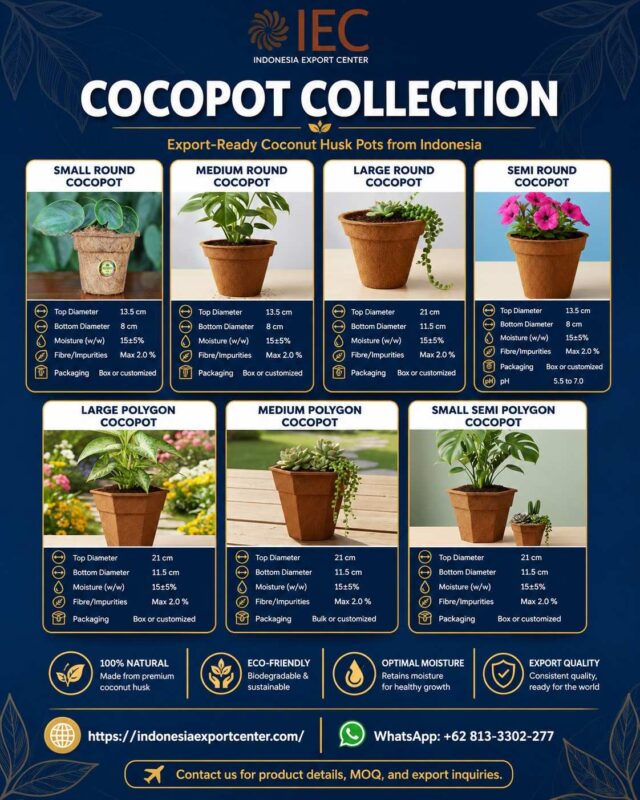
International buyers sourcing coconut fiber pots from Indonesia need to consider more than the price per piece. Packaging design, minimum order quantity, carton dimensions, container utilization, moisture protection, export documentation, and shipping terms can significantly affect the final landed cost.
This is particularly important for nurseries, horticultural distributors, garden-product wholesalers, seedling producers, and agricultural supply companies purchasing coconut fiber pots in large quantities. Although cocopots are relatively lightweight, they can occupy substantial container space if their dimensions and nesting arrangements are not properly planned.
This guide explains how buyers can organize coconut fiber pot packaging, determine a practical MOQ, select the appropriate shipping method, and reduce avoidable logistics risks when importing from Indonesia.
What Are Coconut Fiber Pots?
Coconut fiber pots—also called cocopots, coir pots, or biodegradable nursery pots—are planting containers made primarily from coconut husk fiber. They are commonly used for seedlings, vegetables, herbs, flowers, tree saplings, and nursery propagation.
Depending on the product design, coconut fiber pots may be supplied as:
- Round nursery pots
- Square planting pots
- Seedling starter pots
- Large tree-planting pots
- Hanging baskets
- Custom-molded horticultural containers
- Multi-cell seedling trays
The required packaging method depends on the pot’s diameter, height, wall thickness, density, shape, and resistance to compression.
Why Packaging Planning Is Important
Coconut fiber pots are normally low-density products. In many shipments, the container reaches its practical volume limit before reaching its maximum allowable cargo weight.
For reference, Hapag-Lloyd lists an example capacity of approximately 33.2 cubic meters for a 20-foot standard container and 76.3 cubic meters for a 40-foot high-cube container. However, the carrier also emphasizes that container dimensions and capacities may vary by manufacturer, so the final loading plan must be checked against the actual equipment supplied for the shipment.
For this reason, international buyers should not request quotations based only on the number of pieces. A reliable quotation should include:
- Number of pots per bundle
- Number of bundles per carton
- Number of cartons per container
- Carton dimensions
- Net and gross weight per carton
- Total shipment volume in cubic meters
- Estimated container loading quantity
- Packaging materials
- Loading method
Without these details, two offers with similar unit prices may produce very different landed costs.
Recommended Packaging Methods for Coconut Fiber Pots
1. Nested and Bundled Packaging
Many round or tapered coconut fiber pots can be placed inside one another. This nesting method reduces the space between individual pots and improves container utilization.
The nested pots may be secured using:
- Paper sleeves
- Recycled plastic straps
- Twine
- Shrink wrap
- Polybags
- Corrugated paper wrapping
The number of pots in each bundle should remain manageable for warehouse workers and nursery employees. Excessively large bundles may be difficult to handle and can cause the bottom pots to deform.
Before confirming an order, buyers should request photographs or videos showing:
- The nesting arrangement
- The number of pots per bundle
- The complete master carton
- The carton after a stacking or compression test
2. Corrugated Master Cartons
Corrugated cartons are generally suitable for smaller pots, retail-ready orders, private-label programs, mixed-size shipments, and products requiring protection from dust or handling damage.
A carton should be strong enough to withstand:
- Warehouse stacking
- Inland trucking
- Container loading
- Port handling
- Ocean movement
- Unloading at the destination
Recommended carton markings include:
- Product name
- Pot dimensions
- Quantity per carton
- Net weight
- Gross weight
- Carton dimensions
- Purchase-order number
- Production batch number
- Country of origin
- Handling instructions
- Buyer’s brand or item code, when required
Buyers should ask whether the stated carton dimensions are measured before or after final sealing. Even a small dimensional difference can materially change the total container-loading calculation across hundreds of cartons.
3. Polybag or Moisture-Barrier Packaging
A sealed liner or polybag may help protect cocopots against dust, water leakage, and humid air during handling. However, the products must already be sufficiently dry before they are enclosed.
Packaging a damp natural-fiber product inside a sealed plastic bag can trap moisture rather than solve the problem. Buyers should therefore establish an agreed dryness or moisture-control requirement and require the supplier to inspect the product before packing.
When moisture-sensitive routes are involved, the shipment plan may also include:
- Container desiccants
- Kraft-paper container lining
- Moisture-absorbing sheets
- Raised cargo placement
- Protection from direct contact with container walls
- Humidity indicators inside selected cartons
Desiccants should be installed according to the supplier’s or manufacturer’s instructions and must not come into direct contact with the cocopots.
4. Palletized Packaging
Palletized cargo can simplify loading, unloading, warehouse movement, and stock management. However, pallets also consume container space and add weight and cost.
Palletization may be appropriate when:
- The buyer’s warehouse requires forklift handling
- Carton protection is more important than maximum container utilization
- The buyer orders several product sizes
- The destination requires rapid unloading
- The products are packed for retail distribution
For high-volume nursery orders, floor-loaded cartons or bundles may provide better container utilization.
When solid-wood pallets, crates, or wooden dunnage are used, buyers should confirm compliance with ISPM 15. This international phytosanitary standard covers wood packaging made from raw wood and aims to reduce the movement of quarantine pests. Processed wood materials such as plywood are generally outside the scope described by the standard.
What Is the Typical MOQ for Coconut Fiber Pots?
There is no single international MOQ that applies to every coconut fiber pot supplier. The minimum order depends on the product design, production process, packaging requirements, customization level, and shipping method.
A supplier may establish its MOQ according to:
- Pot diameter and height
- Standard or custom mold
- Product density and wall thickness
- Number of sizes ordered
- Natural or customized color
- Individual packaging requirements
- Printed labels or private branding
- Carton specifications
- Production scheduling
- Destination-country requirements
Sample Orders
Samples are normally used to evaluate:
- Pot dimensions
- Shape consistency
- Wall thickness
- Fiber bonding
- Surface finish
- Drainage design
- Odor
- Cleanliness
- Resistance to handling
- Nesting efficiency
Sample shipping costs may be relatively high compared with the value of the products because international courier charges are based partly on dimensional weight.
Nevertheless, obtaining and testing representative samples is strongly recommended before placing a commercial order.
Trial Commercial Orders
A trial order may be shipped as less-than-container-load cargo, commonly known as LCL. This allows the buyer to test product acceptance without immediately purchasing a full container.
However, LCL shipments involve additional consolidation, handling, and deconsolidation. The products may also share a container with unrelated cargo. Buyers should therefore request strong outer packaging and clear instructions against exposure to liquids, strong odors, or contaminating materials.
Full-Container Orders
For established nursery distributors and importers, full-container-load shipping normally offers better control over:
- Container cleanliness
- Cargo arrangement
- Loading sequence
- Moisture-control materials
- Product segregation
- Shipping schedule
- Handling frequency
Because cocopots are generally space-consuming relative to their weight, a 40-foot high-cube container may offer better freight efficiency for high-volume orders. The final decision should be based on confirmed carton dimensions and a detailed loading simulation rather than a general estimate.
MOQ Should Be Specified in More Than One Unit
A professional supplier quotation should state the MOQ using several measurements, for example:
- Pieces
- Bundles
- Cartons
- Cubic meters
- Net weight
- Gross weight
- Container quantity
For example, an offer expressed only as “50,000 pieces” does not tell the buyer whether the order will occupy half a container, one full container, or more than one container.
Buyers should request the following calculation:
Quantity per bundle × bundles per carton × number of cartons = total pieces
The supplier should then provide the total gross weight and cubic volume of the complete shipment.
Factors That Can Increase the MOQ
Custom Sizes
A non-standard diameter, height, or wall thickness may require a dedicated mold or production setup. Suppliers may therefore request a higher MOQ or charge a tooling fee.
Private-Label Packaging
Customized cartons, barcode labels, product inserts, printed sleeves, and retail packaging may have their own minimum printing quantities.
Buyers should ask whether the private-label MOQ applies to:
- Each pot size
- Each printed design
- Each carton size
- The complete order
- Each language version
Mixed Sizes
Combining several pot sizes in one container may help a buyer test different products, but it can reduce loading efficiency. Smaller pots may nest well, while larger or square pots may create unused spaces.
A mixed-size order should be supported by a carton-by-carton loading plan.
Special Testing or Certification
Additional inspection, laboratory testing, fumigation, quarantine treatment, or destination-specific certification may increase production costs or require a larger commercial order.
How to Calculate Container Loading
The most reliable approach is to calculate the shipment from the finished packaging dimensions.
Step 1: Confirm the Product Dimensions
Specify:
- Top diameter
- Bottom diameter
- Pot height
- Wall thickness
- Drainage-hole arrangement
- Acceptable dimensional tolerance
Step 2: Confirm the Nesting Ratio
Request the height of:
- One individual pot
- A stack of 10 pots
- A complete commercial bundle
This information shows how efficiently the pots can be nested.
Step 3: Confirm the Carton Details
For every stock-keeping unit, request:
- Pieces per carton
- External carton length
- External carton width
- External carton height
- Net weight
- Gross weight
Step 4: Calculate Total Shipment Volume
The basic carton-volume formula is:
Length × width × height × number of cartons
All dimensions must be converted into meters before calculating cubic meters.
Step 5: Prepare a Container-Loading Plan
The supplier or freight forwarder should determine:
- Number of cartons per row
- Number of rows per layer
- Number of layers
- Door-clearance requirements
- Space required for desiccants or protective lining
- Remaining unused space
- Final gross cargo weight
The IMO/ILO/UNECE CTU Code provides international guidance covering cargo loading, packing, and securing throughout intermodal transport. It is intended to support the safe stowage of cargo in containers and other cargo transport units.
20-Foot or 40-Foot High-Cube Container?
A 20-Foot Container May Be Suitable When:
- The buyer is placing an initial commercial order
- The destination market is still being tested
- Warehouse space is limited
- Several products are being consolidated
- The supplier cannot complete a larger quantity within the required schedule
A 40-Foot High-Cube Container May Be Suitable When:
- The buyer has regular nursery demand
- Products are lightweight but bulky
- The buyer wants a lower freight cost per piece
- Carton dimensions allow efficient loading
- The supplier can provide consistent production volume
The buyer should compare the total landed cost per usable pot, not only the ocean-freight price per container.
FCL Versus LCL Shipping
| Shipping Method | Main Advantages | Main Considerations |
|---|---|---|
| LCL | Lower initial quantity and suitable for market testing | More handling, consolidation charges, and possible exposure to other cargo |
| 20-foot FCL | Better cargo control and lower commitment than a 40-foot container | Higher freight cost per piece when cargo is highly volumetric |
| 40-foot high-cube FCL | Strong volume efficiency for lightweight, bulky products | Requires higher inventory commitment and warehouse capacity |
For recurring wholesale orders, buyers should compare annual purchasing plans rather than evaluating each shipment separately. Ordering one efficiently loaded container may be more economical than several small LCL shipments.
Moisture and Container Inspection
Before loading, the container should be inspected to ensure that it is:
- Clean
- Dry
- Free from holes
- Free from standing water
- Free from strong odors
- Free from chemical residues
- Free from insects and visible contamination
- Suitable for dry natural-fiber products
A practical light test can be conducted inside the closed container. Visible daylight entering through the roof or side walls may indicate holes that could permit water ingress.
The supplier should also photograph:
- The empty container
- Container number
- Interior walls and floor
- Products before loading
- Each loading stage
- Moisture-control materials
- Final cargo arrangement
- Closed container doors
- Seal number
These records can be valuable if a cargo claim arises.
Verified Gross Mass
For containerized ocean shipments, the shipper is responsible for providing the Verified Gross Mass, or VGM, in the shipping documentation. Under the SOLAS requirements described by the International Maritime Organization, a packed container’s verified gross mass is a condition for loading it onto a vessel.
The VGM can be established either by weighing the complete packed container or by weighing all cargo packages, pallets, dunnage, and securing materials and then adding the container’s tare weight using an approved method.
Although coconut fiber pots are normally volume-limited rather than weight-limited, accurate cargo and packaging weights remain necessary for documentation and safe transport.
Choosing the Appropriate Incoterm
The chosen Incoterm should be written together with the exact named place or port and the wording Incoterms® 2020.
Common options include:
- FCA supplier’s warehouse or named container terminal
- FOB Indonesian port
- CFR destination port
- CIF destination port
The ICC explains that FCA is particularly suitable for containerized and multimodal shipments because delivery and risk transfer can occur when the goods are handed to the carrier at an agreed facility or container terminal. FOB is specifically a maritime rule under which delivery occurs after the goods are loaded on board the vessel.
International buyers should not rely solely on the three-letter term. The sales contract should clarify:
- Named loading point or port
- Destination port
- Export customs responsibility
- Inland trucking
- Terminal handling charges
- Ocean freight
- Cargo insurance
- Destination charges
- Import clearance
- Inspection fees
- Demurrage and detention exposure
For CIF quotations, buyers should also review the scope and level of cargo insurance rather than assuming that every type of damage is fully covered.
Export Documents for Coconut Fiber Pots from Indonesia
The documentation package may include:
- Commercial invoice
- Packing list
- Bill of lading or sea waybill
- Export customs declaration
- Certificate of Origin
- Phytosanitary Certificate, when required
- Certificate for a processed or non-regulated product, when applicable
- Fumigation or treatment certificate, when required
- Inspection report
- Insurance certificate for insured shipments
Indonesia’s Directorate General of Customs and Excise requires exporters to submit a Pemberitahuan Ekspor Barang, or PEB, as part of the export customs process. Goods and supporting documents must be prepared before the declaration, document review, loading, and departure stages.
An Indonesian Certificate of Origin, locally known as Surat Keterangan Asal, confirms that the exported goods originate from or were produced or processed in Indonesia. The Ministry of Trade distinguishes between preferential certificates, which may support preferential import-duty treatment, and non-preferential certificates used for origin or import-control purposes.
Indonesia’s quarantine certificate system also recognizes both a Phytosanitary Certificate for Export and a Certificate for Export of Processed Product/Non-Regulated Article for plant and plant-product consignments. The appropriate document depends on product classification and destination-country requirements.
Buyers should confirm the required documents with their customs broker or national plant-protection authority before production begins. Plant-health requirements are commodity- and destination-specific. For example, European Union rules distinguish between regulated plants, plant products, growing media, wood packaging, and specific exempt commodities.
Pre-Shipment Quality-Control Checklist
A pre-shipment inspection for wholesale coconut fiber pots should verify:
Product Specifications
- Correct model and size
- Pot shape
- Wall thickness
- Product density
- Drainage holes
- Color consistency
- Surface finish
- Fiber distribution
- Cleanliness
- Absence of foreign materials
Quantity
- Pieces per bundle
- Bundles per carton
- Carton count
- Total pieces
- Sample weight verification
Packaging
- Correct carton dimensions
- Carton strength
- Bundle security
- Label accuracy
- Barcode readability
- Private-label artwork
- Country-of-origin marking
Container Loading
- Container cleanliness
- Container condition
- Correct product sequence
- Carton stacking
- Cargo stability
- Moisture protection
- Container number
- Seal number
- Loading photographs
Buyers may appoint an independent inspection company when they require third-party verification.
Recommended Shipment-Planning Timeline
A practical shipment plan may follow these stages:
Stage 1: Product Confirmation
The buyer confirms sizes, specifications, quantities, packaging, labeling, and destination requirements.
Stage 2: Sample Approval
Representative samples are produced, shipped, tested, and formally approved.
Stage 3: Proforma Invoice and Payment
The parties agree on pricing, Incoterm, port, production period, inspection, payment terms, and required documents.
Stage 4: Production and Packaging
The supplier produces the cocopots, conducts internal quality checks, and prepares the approved packaging.
Stage 5: Freight Booking
The exporter or buyer books the required container based on the agreed Incoterm.
Stage 6: Final Inspection
Quantity, quality, packaging, markings, and documents are verified before loading.
Stage 7: Container Loading
The supplier records the container condition, loading process, container number, and seal number.
Stage 8: Customs and Shipping Documents
The exporter completes the required customs and supporting documentation.
Stage 9: Document Review
Draft shipping documents should be sent to the buyer for review before final issuance whenever the carrier’s timeline permits.
Stage 10: Arrival Planning
The buyer prepares import clearance, port payments, transportation, unloading labor, and warehouse space before the vessel arrives.
Information Buyers Should Include in an RFQ
To receive an accurate quotation from a coconut fiber pots supplier in Indonesia, the buyer should provide:
- Required pot sizes
- Product drawings or photographs
- Quantity for each size
- Target application
- Packaging preference
- Private-label requirements
- Required certifications
- Destination country
- Port of destination
- Preferred Incoterm
- Trial-order or recurring-order status
- Expected purchasing frequency
- Required delivery date
A request stating only “Please quote one container of coconut fiber pots” is usually insufficient because different sizes and packaging configurations can produce significantly different container quantities.
Common Mistakes to Avoid
International buyers should avoid:
- Comparing prices without comparing packaging
- Assuming that all 40-foot containers have identical dimensions
- Accepting an MOQ without knowing the total cubic volume
- Ordering several sizes without a loading simulation
- Using unmarked raw-wood pallets
- Packing products that are not sufficiently dry
- Confirming a shipment before checking import requirements
- Failing to specify dimensional tolerances
- Ignoring destination charges
- Approving private-label production without final artwork confirmation
- Waiting until the vessel arrives to arrange customs clearance and warehousing
Final Recommendations for International Buyers
Successful coconut fiber pot procurement requires coordination between the buyer, manufacturer, packaging team, freight forwarder, exporter, customs broker, and destination authorities.
Before confirming a purchase order, buyers should obtain:
- An approved product sample
- Complete product dimensions and tolerances
- A detailed packaging specification
- External carton dimensions
- Quantity per carton
- Total CBM and gross weight
- A container-loading estimate
- Export-document confirmation
- Destination import-requirement confirmation
- Agreed inspection and claim procedures
For large nursery orders, the most economical option is often the packaging configuration that maximizes the number of usable pots per container while maintaining adequate protection against deformation, contamination, and moisture.
Source Coconut Fiber Pots from Indonesia
Indonesia has an established coconut-processing industry and can supply coconut fiber pots for nurseries, horticultural distributors, agricultural projects, garden-product wholesalers, and private-label programs.
Buyers can request:
- Standard and customized pot sizes
- Wholesale nursery packaging
- Trial orders
- Full-container shipments
- Mixed-size loading plans
- Private-label cartons
- Export documentation assistance
- FOB, CFR, CIF, or FCA quotations
Send your required pot dimensions, quantity, destination port, packaging preference, and expected purchasing schedule to receive a tailored quotation and preliminary container-loading calculation.
Frequently Asked Questions
What is the MOQ for coconut fiber pots from Indonesia?
The MOQ varies according to pot size, mold, packaging, customization, and shipping method. Buyers should request the MOQ in pieces, cartons, cubic meters, and estimated container quantities.
Can coconut fiber pots be shipped by LCL?
Yes. LCL can be used for samples and trial orders, but stronger packaging is recommended because the cargo will undergo additional handling and may share a container with unrelated products.
Which container is best for wholesale coconut fiber pots?
A 40-foot high-cube container is often efficient for lightweight and bulky products. However, buyers should confirm the decision using actual carton dimensions and a container-loading plan.
Can different cocopot sizes be loaded in one container?
Yes, but mixed-size shipments require careful carton and loading calculations. Too many sizes may reduce container utilization.
Do coconut fiber pots need a Phytosanitary Certificate?
The requirement depends on the product’s processing status, customs classification, and destination-country regulations. Buyers should confirm this with the importing authority or customs broker before shipment.
Do wooden pallets need ISPM 15 treatment?
Raw-wood pallets, crates, and dunnage used in international trade generally fall under ISPM 15. Buyers should request properly treated and marked wood packaging when pallets are used.
What documents should buyers request?
Typical documents include a commercial invoice, packing list, bill of lading, export customs documents, and Certificate of Origin when required. A phytosanitary or processed-product certificate may also be required depending on the destination.
Should buyers choose FOB or CIF?
The choice depends on which party will arrange freight and insurance. For containerized shipments, FCA may also be appropriate. The named port or place, transfer of risk, insurance, and destination charges should be clearly stated in the contract.
References
- International Plant Protection Convention. ISPM 15: Regulation of Wood Packaging Material in International Trade.
- International Maritime Organization. IMO/ILO/UNECE Code of Practice for Packing of Cargo Transport Units.
- International Maritime Organization. Verification of the Gross Mass of a Packed Container.
- International Chamber of Commerce Academy. Incoterms® 2020: FCA or FOB?
- Directorate General of Customs and Excise, Republic of Indonesia. Export Customs Procedures.
- Ministry of Trade, Republic of Indonesia. Electronic Certificate of Origin Service.
- Indonesian Quarantine Authority. Indonesian Quarantine Certificate Verification.
- European Commission. Trade in Plants and Plant Products from Non-EU Countries.
- Hapag-Lloyd. 20-Foot Standard and 40-Foot Standard High-Cube Container Specifications.
