

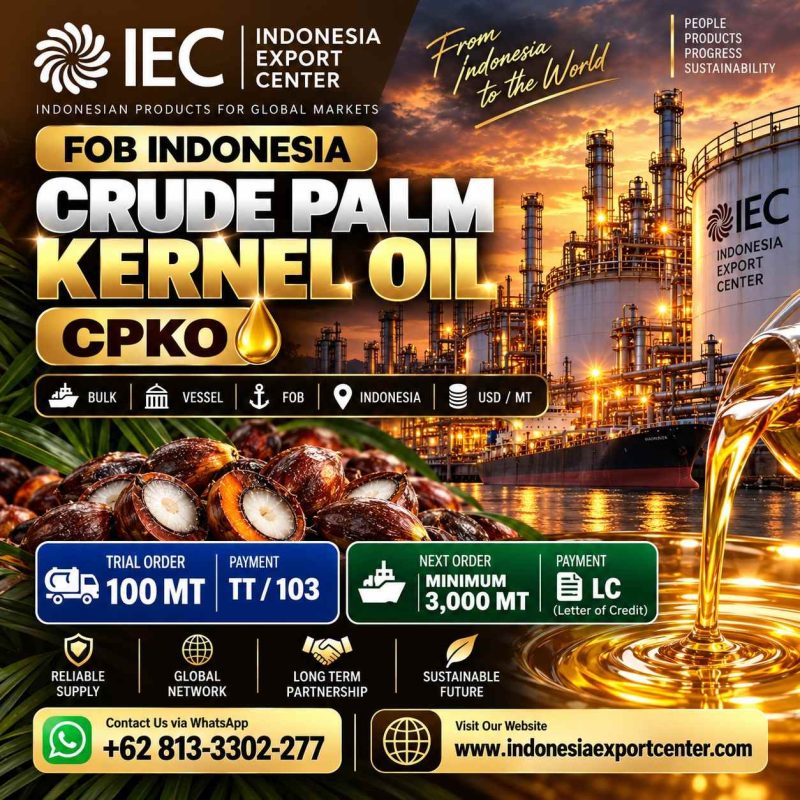
Understand CPKO Quality Parameters Before Purchasing from Indonesia
Purchasing Crude Palm Kernel Oil for industrial manufacturing requires careful evaluation of technical specifications and supplier quality documentation.
Indonesia Export Center (IEC) facilitates Indonesian CPKO sourcing inquiries for oil refineries, oleochemical manufacturers, soap factories, commodity traders, and industrial procurement companies.
A clear understanding of CPKO specifications helps buyers compare supplier offers, establish material acceptance criteria, evaluate manufacturing compatibility, and reduce commercial misunderstandings.
One of the most important documents in technical procurement is the Certificate of Analysis, commonly referred to as a COA.
This guide explains the main CPKO quality parameters, their industrial relevance, and the information buyers should request before confirming commercial purchases.
Indicative Crude Palm Kernel Oil Specifications
| Technical Parameter | Indicative Reference | Reporting Basis |
|---|---|---|
| Free Fatty Acids | Maximum 5.0% | As Lauric Acid |
| Moisture and Impurities | Maximum 0.5% | Combined Reference |
| Iodine Value | Approximately 16–19 | g Iodine per 100 g Oil |
| Lauric Acid | Approximately 45–52% | Proportion of Total Fatty Acids |
| Product Grade | Crude | Unrefined Oil |
| Origin | Indonesia | Supplier Confirmation Required |
These are indicative product reference values.
They are not actual laboratory results, guaranteed contractual limits, or a verified COA for an available batch.
What Is a Certificate of Analysis?
A Certificate of Analysis is a document reporting analytical results for a defined material or production batch.
A COA may include product identification, sample information, testing methods, measured results, acceptance limits, laboratory details, and authorization information.
For CPKO procurement, a COA may help buyers assess whether the tested sample meets the agreed quality requirements.
However, a COA must be evaluated according to its scope, sample representativeness, testing methods, and relationship to the commercial shipment.
Product Specification Sheet Versus COA
| Document | Main Purpose |
|---|---|
| Product Specification Sheet | Defines Target or Acceptable Product Characteristics |
| Technical Data Sheet | Provides Technical Product Information |
| Certificate of Analysis | Reports Actual Analytical Results for a Defined Sample or Batch |
| Safety Data Sheet | Provides Relevant Handling and Safety Information |
| Inspection Report | Records Findings from an Agreed Inspection |
| Certificate of Origin | Provides Origin Documentation Where Applicable |
A specification sheet does not establish that a particular batch has been tested.
A COA does not automatically establish regulatory approval or suitability for every industrial application.
Free Fatty Acids in Crude Palm Kernel Oil
Free fatty acids are fatty acids present in an unesterified form.
FFA content may be influenced by raw material handling, oil processing, storage conditions, and other factors.
For CPKO, FFA may be expressed as lauric acid.
The indicative maximum FFA reference is 5.0%.
Buyers should confirm whether the supplier’s FFA result is expressed as lauric acid, palmitic acid, oleic acid, or another reporting basis.
Different reporting bases may produce different numerical values for the same measured acidity.
FFA Versus Acid Value
FFA percentage and acid value are related but are not identical reporting parameters.
Acid value is commonly expressed as milligrams of potassium hydroxide required to neutralize the free acids in one gram of oil.
The approximate relationship depends on the molecular weight of the fatty acid used as the reporting basis.
For FFA expressed as lauric acid:
FFA as lauric acid (%) ≈ Acid Value × 0.357.
For illustration, an acid value of 10 mg KOH/g corresponds to approximately 3.57% FFA expressed as lauric acid.
This is a theoretical conversion example.
Buyers should use the agreed analytical standard and reporting method for contractual quality evaluation.
Why FFA Matters to Industrial Buyers
FFA may influence refining requirements, process compatibility, commercial valuation, and material handling considerations.
Refineries may evaluate FFA according to their refining technology and expected recovery.
Oleochemical manufacturers may assess FFA differently depending on their downstream chemical processes.
Soap manufacturers may account for FFA during material qualification and formulation development.
The appropriate FFA limit depends on the intended application.
Moisture and Impurities
The reference combined moisture and impurity limit is maximum 0.5%.
Moisture and impurities are important because they may influence the effective oil content, storage conditions, processing requirements, and product consistency.
Buyers should confirm whether moisture and impurities are measured separately or reported as a combined result.
Additional requirements may include restrictions on insoluble impurities, sediment, or specific contaminants.
Iodine Value
Iodine value is a measure related to the degree of unsaturation in fats and oils.
It is commonly expressed as grams of iodine absorbed per 100 grams of oil under the specified test method.
The indicative CPKO iodine value range is approximately 16–19.
This characteristic reflects the relatively saturated fatty acid composition of palm kernel oil.
Actual iodine value must be confirmed through agreed analytical testing.
Lauric Acid Content
Lauric acid is a major fatty acid associated with palm kernel oil.
The reference proportion is approximately 45–52% of total fatty acids.
Lauric acid content may be particularly relevant to oleochemical manufacturing, fatty acid processing, soap production, and other downstream applications.
Buyers should confirm the analytical method and whether the result is reported using an agreed fatty acid profile methodology.
Additional CPKO Quality Parameters
Depending on the industrial application, buyers may request additional technical information.
| Parameter | Potential Relevance |
|---|---|
| Saponification Value | Soap and Oleochemical Feedstock Evaluation |
| Peroxide Value | Primary Oxidation Assessment |
| Unsaponifiable Matter | Material Composition and Processing Evaluation |
| Color | Refining and Finished Product Appearance |
| Odor | Material Condition and Processing Requirements |
| Fatty Acid Profile | Downstream Product Compatibility |
| Trace Metals | Process-Specific Quality Requirements |
| Phosphorus | Selected Refining and Processing Considerations |
| Density | Handling and Quantity Evaluation |
| Melting Characteristics | Storage and Transfer Planning |
No guaranteed values are provided for these additional parameters.
They should be obtained from actual supplier documentation or agreed laboratory testing.
Illustrative CPKO COA Format
The following example demonstrates how a COA might be structured.
It is not an actual supplier certificate.
| Parameter | Illustrative Acceptance Limit | Actual Batch Result |
|---|---|---|
| FFA as Lauric Acid | Maximum 5.0% | To Be Tested |
| Moisture and Impurities | Maximum 0.5% | To Be Tested |
| Iodine Value | Agreed Range | To Be Tested |
| Lauric Acid | Agreed Range | To Be Tested |
| Additional Parameters | As Contracted | To Be Tested |
Additional COA fields may include:
- Supplier name.
- Production facility.
- Product name.
- Batch or lot number.
- Sample identification.
- Sampling date.
- Testing date.
- Analytical methods.
- Laboratory identification.
- Authorized signatory.
The actual document must be obtained from the responsible supplier or testing organization.
Reviewing a Supplier COA
Buyers should check whether the product name matches the purchased grade, whether the batch number is identifiable, whether the testing date is relevant, and whether the analytical methods are clearly stated.
The measured results should be compared with the agreed contractual limits.
A COA without identifiable sample information may have limited value for shipment acceptance.
Buyers should also verify the authenticity of documentation when commercially necessary.
Representative Sampling and Inspection
Bulk liquid cargo quality evaluation requires appropriate sampling.
The parties should agree on the sampling location, timing, sample preparation, sample retention, testing laboratory, and analytical methods.
Depending on the shipment arrangement, sampling may occur at storage tanks, loading points, or other agreed locations.
The inspection contract should identify how the sample relates to the commercial cargo.
Independent Laboratory Testing
International buyers may request independent laboratory testing to support supplier qualification or shipment acceptance.
The selected laboratory should be capable of performing the required analyses using appropriate methods.
Where relevant, buyers may request evidence of laboratory accreditation for the specific tests.
Independent testing arrangements, costs, and timelines should be agreed before shipment.
Contractual Quality Acceptance Criteria
A commercial CPKO contract should define the agreed technical specification.
Important provisions may include maximum FFA, moisture and impurity limits, iodine value range, additional quality parameters, sampling method, analytical methods, inspection responsibility, and procedures for nonconforming cargo.
The contract should also address whether particular deviations result in rejection, price adjustment, or another agreed commercial remedy.
These arrangements should be established before shipment.
Batch Consistency for Recurring Industrial Procurement
Manufacturers requiring continuous CPKO supply should monitor quality across multiple shipments.
Historical COA records may help identify variation in FFA, moisture, iodine value, fatty acid composition, and other relevant parameters.
A structured supplier quality program may include incoming inspection, periodic supplier review, process performance monitoring, and corrective action procedures.
A single acceptable batch does not guarantee consistent future quality.
Frequently Asked Questions
What is the indicative FFA limit for CPKO?
The reference maximum is 5.0%, expressed as lauric acid.
What is the reference moisture and impurity limit?
The indicative combined maximum is 0.5%.
What is the typical iodine value reference?
Approximately 16–19, subject to actual testing.
Does a specification sheet count as a COA?
No. A COA should report analytical results for an identified sample or batch.
Can IEC provide an actual supplier COA?
Supplier-specific COA requests may be coordinated during sourcing discussions.
Can I request additional testing?
Yes. Additional analytical requirements may be submitted for supplier evaluation.
Is the reference product food grade?
No food-grade status is established by the reference crude industrial specification.
Can I request independent inspection?
Inspection arrangements may be discussed before commercial contract confirmation.
Related Technical CPKO Resources
- Crude Palm Kernel Oil Supplier Indonesia
- CPKO for Oleochemical Manufacturing
- CPKO for Soap Manufacturing
- Crude Palm Kernel Oil Price per MT
- CPKO vs RBD Palm Kernel Oil
Request CPKO Specifications and Supplier COA
Indonesia Export Center welcomes technical inquiries from quality assurance teams, industrial procurement departments, refineries, and oleochemical manufacturers.
Submit your required specifications, testing methods, documentation requirements, purchasing quantity, and intended application.
Indonesia Export Center (IEC)
CPKO Technical Specifications | Supplier COA Inquiries | Industrial Quality Procurement
Website: https://indonesiaexportcenter.com/
WhatsApp: +62 813-3302-277
Contact IEC today to request supplier-specific CPKO technical information and commercial quotations.
All reference values require confirmation through actual supplier documentation and written commercial agreement.
