

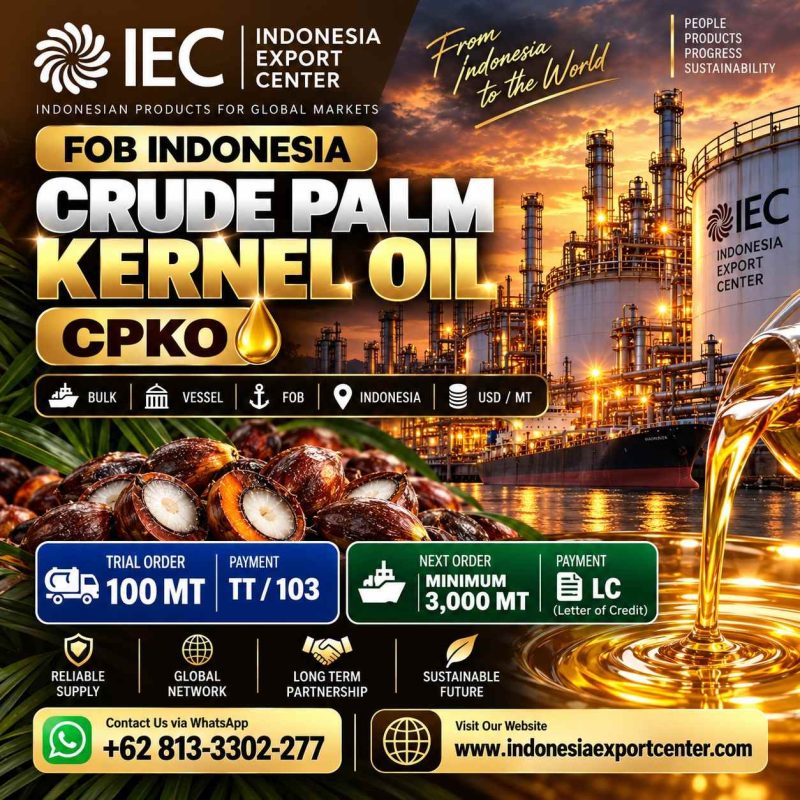
Indonesian CPKO Sourcing for Dutch Traders, Refineries and Industrial Manufacturers
Are you a Netherlands-based vegetable oil importer, commodity trader, oleochemical manufacturer, or industrial refinery seeking Crude Palm Kernel Oil from Indonesia?
Indonesia Export Center (IEC) facilitates Indonesian CPKO sourcing inquiries for Dutch and European industrial buyers.
The Netherlands is an important international logistics and commodity trading location, offering access to industrial processing facilities, European distribution networks, and international maritime transportation infrastructure.
For Dutch businesses evaluating lauric oil feedstock, Indonesian Crude Palm Kernel Oil may represent a potential sourcing option for refining, fatty acid production, fatty alcohol manufacturing, soap production, and related industrial applications.
IEC supports supplier matching, technical communication, preliminary quotation discussions, and potential FOB Indonesia export arrangements.
Indonesian CPKO Product Information
| Parameter | Reference Information |
|---|---|
| Product | Crude Palm Kernel Oil |
| Abbreviation | CPKO |
| Origin | Indonesia |
| Target Market | Netherlands |
| Raw Material | Oil Palm Kernels |
| Product Grade | Crude Industrial Feedstock |
| Reference Trade Term | FOB Indonesia |
| Shipment Format | Bulk, Subject to Confirmation |
| Reference HS Code | 1513.21 |
| MOQ | Subject to Supplier Confirmation |
| Loading Port | To Be Confirmed |
| Pricing | Upon Request |
All product and commercial information requires supplier-specific confirmation.
Indicative Technical Specifications
| Technical Parameter | Indicative Reference |
|---|---|
| Free Fatty Acids as Lauric Acid | Maximum 5.0% |
| Moisture and Impurities | Maximum 0.5% |
| Iodine Value | Approximately 16–19 |
| Lauric Acid | Approximately 45–52% of Total Fatty Acids |
| Processing Stage | Crude / Unrefined |
These values are preliminary technical references, not actual batch results or verified European regulatory specifications.
Dutch buyers should establish their own technical and commercial acceptance criteria.
CPKO for Dutch Vegetable Oil Refineries
Crude palm kernel oil may be evaluated as a feedstock for producing refined, bleached and deodorized palm kernel oil.
Further processing may support the production of specialty palm kernel oil fractions.
Refineries should assess the crude oil according to FFA, moisture, impurities, fatty acid composition, color, and other process-specific requirements.
The economic suitability of a particular feedstock depends on purchase price, refining costs, recovery, and finished product value.
CPKO for European Oleochemical Manufacturing
Palm kernel oil is a relevant lauric feedstock for selected oleochemical manufacturing processes.
Potential downstream applications include fatty acids, fatty alcohols, surfactant intermediates, esters, and specialty chemical derivatives.
Dutch manufacturers should establish their technical requirements according to the intended downstream product.
Crude CPKO is not equivalent to a finished oleochemical ingredient.
CPKO for Commodity Traders and Distributors
Netherlands-based trading companies may evaluate Indonesian CPKO for international distribution or resale to European industrial customers.
Commodity traders should establish clearly defined purchasing specifications, shipment quantities, delivery schedules, inspection arrangements, and customer documentation requirements.
Commercial resale agreements should not rely solely on indicative supplier specifications.
Actual product quality and availability must be verified.
Rotterdam and European Bulk Oil Logistics
Dutch buyers may identify Rotterdam or another suitable receiving location according to their commercial and operational requirements.
Rotterdam is a potential destination for buyer evaluation because of its extensive international maritime and industrial logistics infrastructure.
However, the availability of a specific terminal, storage tank, vessel service, or CPKO handling arrangement must be confirmed.
IEC does not claim an established shipping route or terminal partnership.
Buyers should coordinate with their selected logistics providers regarding cargo acceptance, unloading arrangements, storage, inland distribution, and customs clearance.
FOB Indonesia Procurement for Netherlands Buyers
FOB Indonesia is the reference trade arrangement.
Under FOB Incoterms 2020, the seller delivers the goods on board the nominated vessel at the agreed loading port.
The buyer generally arranges main ocean transportation.
Dutch commodity traders with established freight arrangements may evaluate FOB purchasing according to their commercial requirements.
The exact loading port and shipment conditions must be confirmed.
For containerized arrangements involving delivery before vessel loading, FCA may be more appropriate.
European Union Customs Classification
The reference international HS subheading for crude palm kernel oil is 1513.21.
Dutch importers should confirm the applicable EU Combined Nomenclature and TARIC classification.
The appropriate classification may influence customs duties, regulatory measures, reporting requirements, and applicable import restrictions.
Buyers should also establish importer registration and EORI requirements where applicable.
The final customs treatment should be verified using current official information and qualified customs advice.
EU Deforestation and Supply Chain Due Diligence
European palm-based commodity procurement may involve requirements under the EU Deforestation Regulation and related legislation.
Whether a particular CPKO transaction is covered, which obligations apply, and the applicable implementation dates must be verified against the current legal framework.
Depending on the applicable requirements and supply chain role, relevant information may include:
- Country of production.
- Supply chain identification.
- Production origin information.
- Geolocation data where required.
- Evidence relating to lawful production.
- Deforestation-related due diligence.
- Risk assessment documentation.
- Due diligence statement information where applicable.
Buyers should establish their documentation requirements before supplier selection.
IEC does not claim that the reference CPKO product is EUDR compliant or that all required traceability information is available.
Responsible Palm Oil Sourcing
Dutch and European industrial customers may establish additional responsible sourcing policies.
These policies may include RSPO certification requirements, supplier codes of conduct, traceability standards, environmental reporting, and social responsibility documentation.
Where certification is required, buyers should specify the exact certification scheme and supply chain model.
Certification availability must be verified with the selected supplier.
A sustainability-related statement should not be treated as a substitute for valid certification or regulatory due diligence.
EU Industrial Chemical Compliance Considerations
Depending on the product characteristics, intended use, and commercial role of the importer, European chemical-related regulatory requirements may need to be evaluated.
Potential considerations may include REACH, CLP, safety documentation, and other applicable product obligations.
Some naturally occurring oils may qualify for particular exemptions under defined conditions, but such exemptions should not be assumed without product-specific assessment.
Dutch buyers should consult qualified regulatory professionals.
Food and Personal Care Applications
The reference crude palm kernel oil product is intended for industrial feedstock sourcing.
Buyers intending to use palm kernel oil in food, cosmetic, or personal care manufacturing should separately establish the required processing grade, contaminant limits, safety documentation, and regulatory compliance.
No food-grade, cosmetic-grade, or European regulatory approval is established by the reference CPKO specification.
Technical Documentation for Netherlands Buyers
Dutch procurement teams may request:
| Document | Purpose |
|---|---|
| Product Specification | Technical Acceptance Requirements |
| Certificate of Analysis | Batch-Specific Analytical Results |
| Safety Data Sheet | Relevant Handling and Safety Information |
| Fatty Acid Profile | Manufacturing Compatibility |
| Certificate of Origin | Origin Documentation |
| Traceability Records | Supply Chain Evaluation |
| Certification Documents | Where Required and Verified |
| Independent Inspection Report | Contractual Quality or Quantity Verification |
The availability and validity of each document should be confirmed.
Bulk CPKO Quality Inspection
Dutch importers may request independent inspection at the agreed loading location.
Inspection arrangements may include representative sampling, laboratory analysis, quantity measurement, and relevant cargo tank checks.
The parties should agree on the inspection organization, analytical methods, sampling procedures, acceptance limits, and claims provisions.
Independent inspection does not replace supply chain due diligence.
Comparing European Landed Costs
Dutch procurement teams should evaluate total landed costs rather than comparing FOB prices alone.
Potential expenses include ocean freight, insurance, destination terminal charges, customs duties, applicable taxes, storage, inland transportation, documentation, and additional processing costs.
Recoverable VAT should be distinguished from nonrecoverable commercial expenses where relevant.
Actual tax treatment should be confirmed with qualified professionals.
Netherlands CPKO Buyer RFQ Checklist
Please provide:
- Company name and European business location.
- Intended industrial application.
- Required quantity in metric tons.
- Monthly or annual purchasing requirements.
- Maximum FFA as lauric acid.
- Moisture and impurity requirements.
- Required iodine value.
- Additional analytical requirements.
- Preferred receiving port or terminal.
- Shipment schedule.
- Proposed trade and payment terms.
- Traceability and sustainability requirements.
- Required certification and compliance documentation.
- Independent inspection requirements.
Frequently Asked Questions
Can Dutch buyers source CPKO from Indonesia through IEC?
IEC welcomes Netherlands-based industrial sourcing inquiries.
Can CPKO be shipped to Rotterdam?
Potential shipment arrangements may be evaluated, subject to terminal, carrier, supplier, and commercial confirmation.
Is IEC CPKO EUDR compliant?
No verified EUDR compliance claim is made.
Is RSPO-certified CPKO available?
Certification-specific sourcing inquiries may be submitted, but availability requires verification.
Can I request a supplier COA?
Yes. Supplier and batch-specific documentation may be requested.
Can IEC provide traceability information?
Traceability requirements may be communicated to potential suppliers for evaluation.
What is the minimum order quantity?
MOQ depends on the selected supplier and shipment arrangement.
Can I request recurring European industrial supply?
Recurring inquiries are welcome, subject to verified supply capacity and contractual agreement.
Related CPKO Resources
- Crude Palm Kernel Oil Supplier Indonesia
- CPKO FOB Indonesia
- CPKO Specifications and COA
- CPKO Export Documents
- CPKO RFQ Template
Submit Your Netherlands CPKO RFQ
Indonesia Export Center welcomes Dutch commodity traders, oil refineries, oleochemical manufacturers, industrial processors, and European procurement organizations.
Submit your technical requirements, purchasing quantity, traceability expectations, and destination logistics requirements.
Indonesia Export Center (IEC)
Indonesian Crude Palm Kernel Oil | Netherlands Industrial Procurement | European B2B Sourcing
Website: https://indonesiaexportcenter.com/
WhatsApp: +62 813-3302-277
Contact IEC today to discuss your Netherlands-bound CPKO sourcing requirements.
All product availability, technical specifications, European regulatory requirements, traceability documentation, and commercial conditions require verification and written agreement.
