

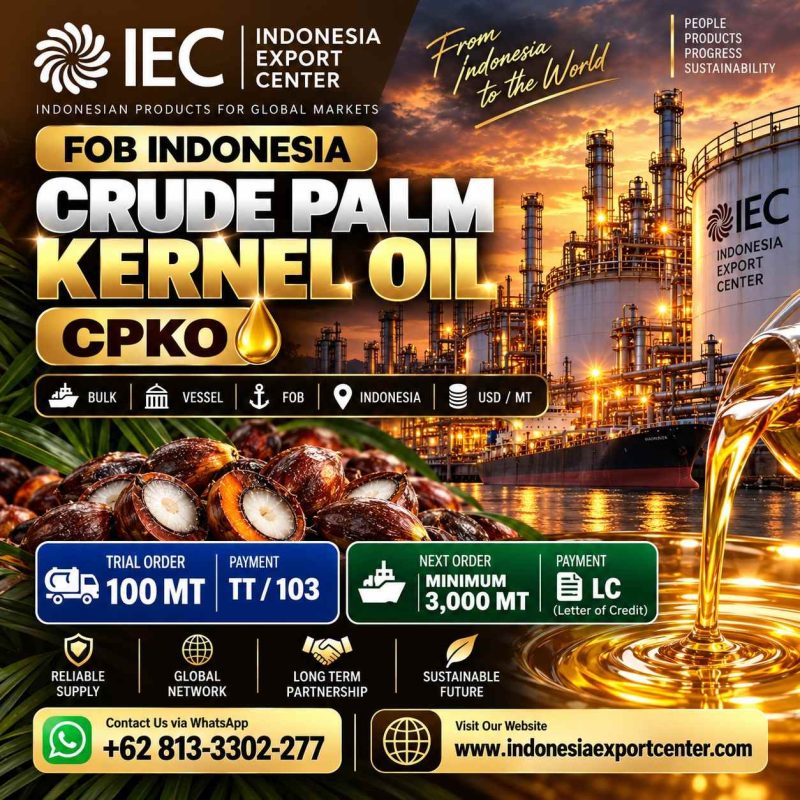
Source Indonesian CPKO for Industrial Fatty Acid Manufacturing
Indonesia Export Center (IEC) facilitates Indonesian Crude Palm Kernel Oil sourcing for fatty acid manufacturers, oleochemical processors, industrial chemical companies, specialty ingredient producers, and international procurement organizations.
Crude Palm Kernel Oil is an important lauric vegetable oil feedstock that may be processed into fatty acid streams through suitable industrial technologies.
Its characteristic fatty acid composition makes it particularly relevant to manufacturers seeking lauric acid-rich raw materials for downstream chemical production.
Industrial fatty acid manufacturers require more than a competitive crude oil price. Feedstock composition, impurity levels, processing compatibility, product recovery, fractionation requirements, and recurring supply consistency are essential purchasing considerations.
IEC welcomes technical inquiries from manufacturers evaluating Indonesian CPKO for fatty acid production.
What Is Crude Palm Kernel Oil?
Crude Palm Kernel Oil is an unrefined vegetable oil extracted from the kernels of oil palm fruits.
It contains triglycerides and varying amounts of free fatty acids, moisture, impurities, and naturally occurring minor constituents.
The oil is distinguished by its characteristic proportion of lauric acid and other fatty acids.
Unlike conventional crude palm oil, which originates from the fruit mesocarp, CPKO belongs to the lauric oil category.
This distinction is important for manufacturers producing specific fatty acid fractions.
Indicative CPKO Feedstock Specifications
| Parameter | Indicative Reference |
|---|---|
| Product | Crude Palm Kernel Oil |
| Origin | Indonesia |
| Feedstock Category | Lauric Vegetable Oil |
| Processing Grade | Crude |
| FFA as Lauric Acid | Maximum 5.0% |
| Moisture and Impurities | Maximum 0.5% |
| Iodine Value | Approximately 16–19 |
| Lauric Acid | Approximately 45–52% of Total Fatty Acids |
| Supply Format | Bulk, Subject to Confirmation |
| Reference Trade Term | FOB Indonesia |
| Reference HS Code | 1513.21 |
The listed values are indicative references only.
Actual supplier specifications, batch composition, and analytical results must be verified.
Why Palm Kernel Oil Is Relevant to Fatty Acid Production
Palm kernel oil contains a mixture of fatty acids associated with its natural triglyceride composition.
Potentially relevant fatty acids include:
| Fatty Acid | Carbon Chain |
|---|---|
| Caprylic Acid | C8 |
| Capric Acid | C10 |
| Lauric Acid | C12 |
| Myristic Acid | C14 |
| Palmitic Acid | C16 |
| Stearic Acid | C18 |
| Oleic Acid | C18:1 |
| Linoleic Acid | C18:2 |
The actual proportions should be established through supplier-specific fatty acid profile testing.
Lauric acid is a principal component of palm kernel oil, with an indicative reference proportion of approximately 45–52% of total fatty acids.
Industrial Oil Splitting and Fatty Acid Recovery
Fatty acid manufacturers may process suitable vegetable oils through industrial hydrolysis or other appropriate conversion technologies.
Oil splitting separates triglyceride-derived fatty acid components from glycerol-related streams.
Further processing may involve purification, distillation, and fractionation to produce fatty acid grades with defined commercial specifications.
The selected manufacturing pathway depends on the plant’s technology and intended products.
Crude palm kernel oil is an upstream feedstock rather than a purified fatty acid product.
General CPKO-to-Fatty-Acid Value Chain
A typical industrial value chain may involve:
- Crude palm kernel oil procurement.
- Incoming feedstock inspection.
- Appropriate oil preparation.
- Industrial oil splitting or conversion.
- Fatty acid and glycerol stream separation.
- Purification and distillation.
- Fractionation where required.
- Finished fatty acid quality evaluation.
- Packaging or bulk storage.
- Distribution to downstream industrial customers.
Actual processing arrangements depend on facility design and commercial requirements.
CPKO for Lauric Acid Production
Lauric acid is an important fatty acid used in selected oleochemical and specialty chemical applications.
Palm kernel oil may be evaluated as a feedstock for producing lauric acid-rich streams.
However, crude oil containing approximately 45–52% lauric acid in its fatty acid profile does not automatically produce the same percentage of saleable purified lauric acid relative to the total crude oil weight.
Manufacturing recovery depends on triglyceride composition, oil preparation, conversion efficiency, separation performance, fractionation, and final purity requirements.
Actual production yields should be established through verified material balances.
CPKO for Mixed Fatty Acid Production
Some industrial manufacturers may require mixed palm kernel fatty acid streams rather than highly purified individual fatty acids.
The desired composition depends on the downstream application.
Potential requirements may include acid value, fatty acid distribution, color, moisture, unsaponifiable matter, and other product-specific characteristics.
CPKO may be evaluated as an upstream feedstock for such production routes.
CPKO for Fractionated Fatty Acid Products
Fatty acid fractionation may support the production of streams enriched in particular carbon chain ranges.
Manufacturers may evaluate palm kernel oil according to their desired C8, C10, C12, C14, or broader fatty acid fractions.
The commercial feasibility depends on actual feedstock composition, processing technology, recovery, product purity, and market demand.
IEC does not guarantee a particular downstream fatty acid yield.
Importance of FFA in Fatty Acid Manufacturing
Free fatty acids are an important component of crude oil quality evaluation.
Unlike some conventional oil refining processes, fatty acid manufacturing may utilize both triglyceride-derived fatty acids and existing free fatty acids.
Therefore, FFA should not automatically be interpreted as an equivalent percentage of unusable feedstock.
The reference FFA limit for CPKO is maximum 5.0%, expressed as lauric acid.
Manufacturers should establish the appropriate acceptance limit according to their process technology.
Moisture and Impurity Requirements
The reference combined moisture and impurity limit is maximum 0.5%.
Fatty acid manufacturers may require additional controls depending on their oil preparation and processing arrangements.
Potential considerations include insoluble impurities, sediment, trace metals, phosphorus, oxidation products, and unsaponifiable matter.
No guaranteed limits are provided for these additional parameters.
Buyers should request actual analytical information.
Fatty Acid Profile and Feedstock Qualification
A detailed fatty acid profile may be more useful than a single lauric acid value when evaluating CPKO for fractionated fatty acid production.
Manufacturers should identify their required carbon chain distribution and acceptable variation.
Representative samples may be evaluated using appropriate analytical methods.
The parties should agree on the required test methods and reporting basis before commercial acceptance.
CPKO Versus Coconut Oil for Fatty Acid Production
Both palm kernel oil and coconut oil belong to the lauric oil category.
However, their fatty acid distributions and commercial characteristics may differ.
| Evaluation Area | CPKO | Coconut Oil |
|---|---|---|
| Agricultural Source | Oil Palm Kernels | Coconut Kernel |
| Oil Category | Lauric Oil | Lauric Oil |
| Fatty Acid Profile | Supplier and Batch Specific | Supplier and Batch Specific |
| Feedstock Grade | Crude or Refined | Crude or Refined |
| Manufacturing Compatibility | Requires Qualification | Requires Qualification |
| Commercial Price | Market Dependent | Market Dependent |
Manufacturers should not assume complete interchangeability.
Feedstock substitution should be evaluated using actual analytical and manufacturing data.
CPKO Versus Refined Palm Kernel Oil
Fatty acid processors may evaluate either crude or refined palm kernel oil.
Crude oil may be suitable for facilities equipped to manage its natural impurities and quality variation.
Refined oil may offer advantages for processes requiring more controlled input characteristics.
The appropriate grade should be selected according to process requirements and overall manufacturing economics.
Feedstock Cost and Fatty Acid Recovery
A meaningful procurement comparison should evaluate the effective cost of usable fatty acid output.
For example:
| Hypothetical Parameter | Feedstock A | Feedstock B |
|---|---|---|
| Landed Oil Cost per MT | USD 1,000 | USD 1,040 |
| Additional Processing Cost per MT | USD 100 | USD 80 |
| Saleable Product Recovery | 85% | 90% |
| Illustrative Cost per MT of Saleable Output | USD 1,294.12 | USD 1,244.44 |
These figures are hypothetical and do not represent actual CPKO prices or manufacturing yields.
The calculation excludes potential coproduct revenue and other expenses.
Manufacturers should use verified plant-specific data for commercial decisions.
Bulk CPKO Supply for Fatty Acid Plants
Fatty acid manufacturing facilities may require recurring industrial quantities of lauric oil feedstock.
Buyers should identify their average daily consumption, monthly requirement, inventory capacity, and preferred shipment frequency.
IEC welcomes bulk sourcing inquiries, subject to supplier capacity and transportation verification.
No particular production volume or shipment size is guaranteed.
Quality Control for Recurring Fatty Acid Production
Consistent feedstock characteristics may help manufacturers manage production variability.
A supplier quality program may include batch identification, incoming COA review, periodic fatty acid profile testing, representative sampling, and manufacturing performance monitoring.
The parties should establish contractual quality tolerances and procedures for nonconforming cargo.
Technical RFQ for Fatty Acid Manufacturers
Please provide:
- Intended fatty acid product.
- Required carbon chain distribution.
- Required CPKO quantity in metric tons.
- Maximum FFA as lauric acid.
- Moisture and impurity limits.
- Required iodine value.
- Detailed fatty acid profile requirements.
- Additional contaminant limits.
- Sample requirements.
- Monthly manufacturing demand.
- Preferred shipment schedule.
- Destination port.
- Proposed trade and payment terms.
- Required inspection and documentation.
Frequently Asked Questions
Can CPKO be used for fatty acid production?
Suitable CPKO may be evaluated as an industrial fatty acid feedstock.
Is CPKO a source of lauric acid?
Yes. Lauric acid is a major component of its fatty acid profile.
Does 50% lauric acid content guarantee 50% purified lauric acid recovery?
No. Actual recovery depends on the complete manufacturing process and reporting basis.
Is lower FFA always better for fatty acid production?
Not necessarily. The appropriate FFA limit depends on the process technology.
Can I request a complete fatty acid profile?
Yes. Detailed analytical requirements may be submitted for supplier evaluation.
Can CPKO replace coconut oil?
Substitution requires technical and commercial qualification.
Can IEC facilitate recurring bulk sourcing?
Recurring procurement inquiries are welcome, subject to verified supplier arrangements.
Related Fatty Acid Feedstock Resources
- Crude Palm Kernel Oil Supplier Indonesia
- CPKO for Oleochemical Manufacturing
- CPKO for Fatty Alcohol Production
- CPKO Specifications and COA
- CPKO RFQ Template
Request CPKO Feedstock Specifications for Fatty Acid Production
Indonesia Export Center welcomes fatty acid manufacturers and oleochemical processors seeking Indonesian lauric oil feedstock.
Submit your required fatty acid profile, technical specifications, purchasing quantity, and shipment schedule.
Indonesia Export Center (IEC)
Crude Palm Kernel Oil | Fatty Acid Feedstock | Indonesian Oleochemical Raw Material Sourcing
Website: https://indonesiaexportcenter.com/
WhatsApp: +62 813-3302-277
Contact IEC today to discuss CPKO sourcing for your fatty acid manufacturing facility.
All feedstock specifications, manufacturing suitability, supply availability, and commercial arrangements require verification.
