![Indonesia Export Center [IEC]](https://indonesiaexportcenter.com/wp-content/uploads/2023/07/logo-no-background.svg)
![Indonesia Export Center [IEC]](https://indonesiaexportcenter.com/wp-content/uploads/2023/07/svgviewer-output.svg)
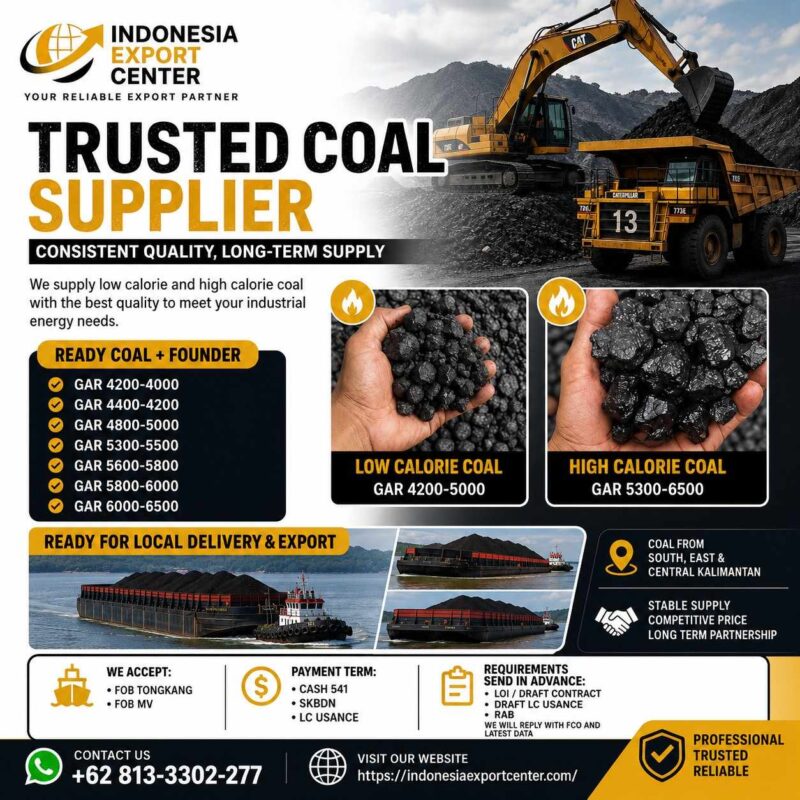
International buyers purchasing Indonesian steam coal need to understand that coal procurement is different from ordering conventional packaged products. The cargo is normally handled in bulk, the minimum order quantity is influenced by the logistics arrangement, and the shipment schedule must be coordinated with the mine, stockpile, barge, loading terminal, surveyor, and vessel.
Indonesia Export Center supports international inquiries for Indonesian thermal coal from selected supply networks in South Kalimantan, East Kalimantan, and Central Kalimantan. Available supply may include low-calorie coal and high-calorie coal, subject to the latest mine source, stockpile condition, seller confirmation, survey results, and loading availability.
Buyers can explore the following related product categories:
- Indonesian Steam Coal Supplier
- Low Calorie Coal GAR 4200–5000 Supplier
- High Calorie Coal GAR 5300–6600 Supplier
This guide explains the practical considerations related to coal packaging, MOQ, loading arrangements, shipment planning, quality inspection, and the information buyers should provide before requesting a quotation.
How Is Indonesian Steam Coal Packaged?
Steam Coal Is Normally Shipped as Bulk Cargo
For large international orders, Indonesian steam coal is generally not packed into individual bags, cartons, or retail containers. It is usually supplied as solid bulk cargo and loaded directly into a barge or the cargo holds of a bulk carrier.
The International Maritime Organization defines solid bulk cargo as particles, granules, or larger pieces of generally uniform material that are loaded directly into a ship’s cargo spaces without an intermediate form of containment.
Therefore, when a coal quotation refers to “packaging,” the term normally describes:
- Bulk loading into a barge
- Bulk loading into a mother vessel
- ROM, crushed, or screened coal size
- Stockpile segregation
- Cargo-hold preparation
- Weight and quantity determination
- Shipment documents and cargo declarations
Individual bags may be considered for certain small industrial or specialized domestic requirements, but bagged or containerized coal is not the normal format for large international steam-coal shipments. Any non-standard packing request must be discussed separately with the seller.
Bulk Loading by Barge
Coal from Kalimantan is frequently transported from the mine or stockpile to a river or coastal loading point. The cargo is then loaded into a barge, locally known as a tongkang.
Under an agreed FOB Barge or FOB Tongkang arrangement, the seller prepares and loads the coal onto the nominated barge at the agreed loading point. The exact transfer of costs, responsibilities, quantity measurement, risk, and title should be clearly stated in the sales contract.
Indonesia Export Center currently prioritizes inquiries based on FOB Barge, FOB Tongkang, or FOB Mother Vessel arrangements, subject to seller confirmation.
Bulk Loading to a Mother Vessel
For international shipment, several barge deliveries may be coordinated to load a larger ocean-going bulk carrier or mother vessel.
This process may involve:
- Loading coal from the stockpile into barges
- Transporting the barges to the anchorage or transshipment area
- Conducting draft surveys, sampling, and inspection
- Transferring the coal from the barges to the mother vessel
- Trimming the cargo inside the vessel’s holds
- Issuing the final shipping and survey documents
The exact loading method depends on the loading location, vessel configuration, floating crane availability, loading rate, weather, sea conditions, and contractual responsibilities.
Is a Packing List Required for Bulk Coal?
A packing list may still be issued for a bulk coal shipment even though the cargo has no individual packages.
Instead of listing cartons, bags, or pallets, a bulk-cargo packing list may contain information such as:
- Product name
- Coal grade
- Gross or net shipment weight
- Number of barges or cargo lots
- Loading point
- Mother-vessel name
- Contract or invoice reference
- Origin of cargo
- Shipment date
The final document format must be aligned with the buyer’s import requirements, banking requirements, letter-of-credit conditions, customs procedures, and the agreed sales contract. IEC states that packing lists, bills of lading, certificates of origin, coal analysis reports, and surveyor reports may be arranged depending on the confirmed transaction and shipment scheme.
What Is the MOQ for Indonesian Steam Coal?
There Is No Universal MOQ for Every Coal Offer
The minimum order quantity for Indonesian steam coal should not be presented as one fixed number for every buyer.
IEC’s published coal information states that the MOQ for export orders is subject to vessel or barge capacity and final seller confirmation. Spot cargoes also depend on the latest stock availability.
The actual MOQ may be influenced by:
- Available quantity at the mine or stockpile
- Required GAR specification
- Whether the cargo is ROM, crushed, or screened
- Loading-point capability
- Barge availability and capacity
- Mother-vessel size
- Destination port restrictions
- Water depth and vessel draft
- Loading and discharge equipment
- Commercial viability of freight
- Spot order or long-term contract
- Seller’s monthly production allocation
- Survey and document requirements
A buyer should therefore request a confirmed MOQ for the specific grade, loading location, delivery term, and shipment period.
Trial Orders
A small trial order may be difficult to arrange when the cargo must be transported by barge and loaded into an ocean-going bulk carrier. A quantity that appears commercially attractive to the buyer may not be operationally efficient for the mine, barge operator, terminal, or vessel owner.
Trial inquiries remain possible, but they must be evaluated based on:
- Available spot stock
- Possibility of combining cargoes
- Barge scheduling
- Quality segregation
- Freight efficiency
- Seller approval
Buyers should not assume that a sample shipment will automatically be accepted.
Spot Cargo
A spot cargo is normally negotiated against currently available or expected stock. The seller must verify that the requested specification and quantity can be assembled without creating unacceptable quality variation.
Spot buyers should provide a realistic shipment window rather than requesting immediate loading without prior nomination, vessel details, and commercial documentation.
Monthly or Long-Term Supply
For regular industrial consumption, a monthly supply agreement may provide better planning than repeated spot purchases.
A long-term arrangement should specify:
- Monthly contracted quantity
- Permitted quantity tolerance
- Coal specification and rejection limits
- Loading schedule
- Nomination procedure
- Surveyor appointment
- Price adjustment mechanism
- Payment method
- Demurrage and despatch provisions
- Force-majeure conditions
- Quality and weight determination
- Contract duration
Long-term supply remains subject to mine production, regulatory compliance, weather, logistical capacity, and seller approval.
How Low-Calorie and High-Calorie Coal Affect Shipment Planning
Low-Calorie Coal GAR 4200–5000
Low-calorie Indonesian steam coal may be suitable for buyers seeking a competitive fuel source for industrial boilers, power generation, cement production, and other thermal applications.
Because the usable energy delivered per metric ton is lower than that of higher-calorie coal, buyers may require a larger tonnage to meet the same total energy requirement. This can affect:
- Vessel size
- Number of shipments
- Storage capacity
- Port-handling volume
- Inland transportation
- Annual procurement planning
The final decision should not be based on GAR alone. Buyers must also review total moisture, ash, sulfur, volatile matter, fixed carbon, HGI, size distribution, and combustion-system compatibility.
High-Calorie Coal GAR 5300–6600
High-calorie coal is generally selected when buyers require more heat energy per metric ton, a lower transport volume for a given energy target, or a particular boiler-performance profile.
However, a higher GAR does not automatically mean that every other parameter will be better. The buyer must still confirm:
- Total moisture
- Inherent moisture
- Ash content
- Total sulfur
- Volatile matter
- Fixed carbon
- HGI
- Coal size
- Ash-fusion characteristics, where required
- Actual mine source and stockpile condition
Availability at the upper end of the GAR 5300–6600 category must always be confirmed against the latest mine data, current stock, seller information, and independent analysis.
Quality Inspection and Sampling Before Shipment
A representative coal sample is essential because the commercial value and operational suitability of the cargo depend on its actual characteristics.
ISO standards provide procedures for sampling coal from moving streams and stationary lots such as barges, ships, wagons, and stockpiles. ISO also provides methods for determining parameters such as total moisture.
Depending on the contract, inspection may include:
- Stockpile sampling
- Sampling during barge loading
- Sampling from moving conveyor streams
- Sampling during mother-vessel loading
- Moisture analysis
- Calorific-value analysis
- Ash and sulfur analysis
- Draft survey
- Weight determination
- Hold inspection
- Loading supervision
- Final certificate of analysis
The sales contract must identify which result is commercially binding. For example, the parties should determine whether payment is based on the load-port certificate, discharge-port analysis, or another agreed procedure.
Maritime Safety and Cargo Information
Coal requires careful handling because its properties may create maritime risks, including self-heating, gas emissions, oxygen depletion, or other cargo-specific hazards.
The mandatory IMSBC Code establishes requirements for the safe loading, stowage, carriage, and discharge of solid bulk cargoes. The IMO explains that improper cargo distribution, stability problems, and chemical reactions are among the major risks associated with bulk cargo transportation.
The shipper must provide the vessel’s master or representative with appropriate cargo information sufficiently in advance so that the necessary precautions can be included in the stowage and voyage plan.
For this reason, serious shipment planning should include:
- Accurate cargo declaration
- Latest coal analysis
- Relevant safety information
- Confirmation of cargo characteristics
- Vessel suitability
- Cargo-hold cleanliness
- Loading and trimming plan
- Monitoring procedures during the voyage
- Compliance with the current IMSBC Code
The final safety classification and carriage instructions must be based on the actual cargo offered, not only on its GAR category.
Choosing the Shipment Term
FOB Barge or FOB Tongkang
FOB Barge is useful when the buyer or an appointed trader controls the onward movement from the agreed barge-loading point.
The contract should clarify:
- Exact loading point
- Barge nomination
- Loading responsibility
- Draft-survey procedure
- Quality sampling point
- Transfer of risk
- Barge waiting time
- Demurrage
- Documentation
- Accepted quantity tolerance
FOB Mother Vessel
Under an FOB Mother Vessel arrangement, the seller coordinates delivery and loading to the nominated ocean-going vessel according to the agreed contract.
The buyer normally needs to provide vessel nomination information, laycan, destination, vessel specifications, and agent details within the agreed nomination period.
IEC’s current coal page identifies FOB Barge, FOB Tongkang, and FOB MV as its recommended inquiry schemes. CFR or CIF requests require separate and specific seller confirmation.
CFR and CIF
The International Chamber of Commerce’s Incoterms® 2020 rules define the allocation of costs, obligations, and risks between buyers and sellers. CIF is a maritime term and includes seller-arranged insurance at the coverage level required under the rule, while CFR does not require the seller to provide that insurance.
Buyers should not request “CIF price only” without providing sufficient information. A meaningful freight calculation requires:
- Destination port
- Required quantity
- Vessel size
- Loading location
- Shipment window
- Port restrictions
- Discharge rate
- Demurrage terms
- Insurance requirements
- Sanctions and compliance review
- Current ocean-freight availability
Where the seller accepts only FOB arrangements, the buyer should appoint its own vessel, shipping broker, freight partner, or nominated carrier.
Practical Shipment-Planning Timeline
1. Buyer Submits an Official Inquiry
The inquiry should include:
- Buyer’s company name
- Company profile
- Required coal grade
- Complete specification
- Required quantity
- Destination port
- Preferred delivery term
- Target shipment period
- Payment method
- Expected monthly consumption
- LOI or ICPO, where required
2. Seller Verifies Supply
The seller checks:
- Mine source
- Stock availability
- Production allocation
- Latest analysis
- Loading location
- Barge availability
- Commercial feasibility
- Payment acceptability
3. Parties Agree on the Commercial Structure
The parties negotiate the specification, quantity, price basis, delivery term, payment method, inspection procedure, laycan, and contract conditions.
4. Vessel or Barge Is Nominated
The nominated transportation must match the loading point, water depth, cargo volume, loading rate, and required shipment window.
5. Cargo Is Prepared and Inspected
Coal is assembled at the agreed stockpile and may be crushed, screened, blended, sampled, or inspected according to the contract.
6. Loading Is Conducted
The cargo is loaded into the barge or mother vessel. Sampling, weighing, draft surveys, loading supervision, and cargo documentation are completed as agreed.
7. Final Documents Are Issued
Documents may include:
- Commercial invoice
- Packing list or bulk-cargo weight list
- Bill of lading
- Certificate of origin
- Certificate of analysis
- Surveyor certificate
- Draft-survey report
- Export declaration
- Insurance certificate, where applicable
- Vessel and barge documents
Common Shipment-Planning Mistakes
International buyers should avoid several common mistakes:
Requesting a Price Without a Complete Specification
A request stating only “we need Indonesian coal” is not sufficient. GAR, moisture, ash, sulfur, size, quantity, destination, and shipment term directly affect supply selection and commercial calculation.
Treating MOQ as a Fixed Website Number
MOQ must be confirmed for the actual cargo, loading point, and transportation arrangement.
Booking a Vessel Before Confirming the Cargo
Premature vessel nomination can create waiting time, cancellation costs, or demurrage if the cargo and loading window have not been formally confirmed.
Comparing Prices on Different Bases
A GAR 4200 FOB Barge offer cannot be directly compared with a GAR 5500 CFR destination-port offer without adjusting for quality, freight, handling, insurance, and energy value.
Ignoring Discharge-Port Limitations
The buyer must confirm maximum vessel draft, berth length, unloading equipment, discharge rate, port working hours, storage capacity, and local import requirements.
Information Required for an Accurate Coal Quotation
To request a serious quotation from Indonesia Export Center, buyers should provide:
| Required Information | Buyer’s Details |
|---|---|
| Coal category | Low-calorie or high-calorie coal |
| Required GAR | For example, GAR 4200–5000 or GAR 5300–6600 |
| Total moisture | Maximum acceptable level |
| Ash content | Maximum acceptable level |
| Total sulfur | Maximum acceptable level |
| Volatile matter | Required range |
| Fixed carbon | Required range |
| HGI | Required range, if applicable |
| Coal size | ROM, crushed, or screened |
| Order quantity | Spot, monthly, or annual quantity |
| Delivery term | FOB Barge, FOB Tongkang, or FOB MV |
| Destination | Country and port |
| Shipment period | Target laycan or delivery month |
| Payment method | Proposed bank and payment structure |
| Inspection | Preferred independent surveyor |
| Buyer documents | Company profile, license, LOI, or other required documents |
Source Indonesian Steam Coal Through Indonesia Export Center
Indonesia Export Center helps international buyers coordinate Indonesian steam coal inquiries based on the required specification, quantity, loading scheme, destination, and commercial structure.
Available categories may include:
Indonesian Steam Coal Supplier
A general sourcing option for international buyers, power plants, cement factories, industrial boilers, manufacturers, importers, and commodity traders seeking Indonesian thermal coal.
Low Calorie Coal GAR 4200–5000 Supplier
Suitable for buyers prioritizing competitive fuel cost and requiring coal for approved boilers, industrial heating, cement production, or power-generation applications.
High Calorie Coal GAR 5300–6600 Supplier
Designed for buyers seeking higher heat value per metric ton, subject to current mine availability, seller confirmation, and the latest independent coal analysis.
All offers remain subject to final confirmation of the mine source, stockpile, specification, quantity, loading point, barge or vessel availability, payment terms, survey results, and contractual agreement.
Request a Quotation
Please provide the following information when contacting Indonesia Export Center:
Required GAR:
Detailed specification:
Required quantity:
Monthly requirement:
Destination port:
Preferred term: FOB Barge / FOB Tongkang / FOB MV
Target shipment date:
Payment method:
Buyer company profile:
LOI or purchase document:
Indonesia Export Center
WhatsApp: +62 813-3302-277
Email: info@indonesiaexportcenter.com
Reliable Indonesian sourcing. Clear specification matching. Practical shipment coordination.
