![Indonesia Export Center [IEC]](https://indonesiaexportcenter.com/wp-content/uploads/2023/07/logo-no-background.svg)
![Indonesia Export Center [IEC]](https://indonesiaexportcenter.com/wp-content/uploads/2023/07/svgviewer-output.svg)
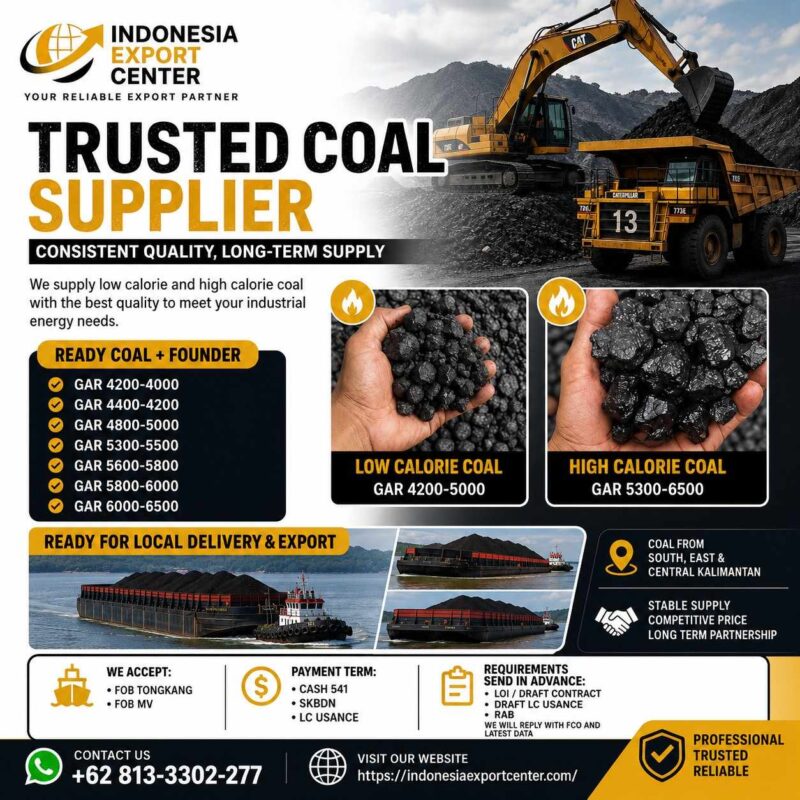
Low-Calorie vs High-Calorie Indonesian Coal: Which Specification Fits Your Requirement?
When purchasing Indonesian steam coal, selecting the correct calorific value is one of the most important commercial and technical decisions. A higher GAR number does not automatically mean that the coal is the best option for every buyer. Likewise, lower-calorie coal should not be considered inferior without first evaluating the buyer’s boiler design, fuel budget, required heat output, emissions limits, handling system, and transportation costs.
Indonesia Export Center supports international buyers seeking Indonesian steam coal across several calorific-value ranges. Depending on mine availability, stockpile conditions, production batches, and seller confirmation, available grades may include low-calorie coal around GAR 4200–5000 and higher-calorie coal around GAR 5300–6600.
This guide explains the differences between these two commercial categories and helps buyers determine which specification may be more suitable for their operational requirements.
Understanding GAR in Indonesian Coal Trading
GAR means Gross Calorific Value on an As-Received Basis. It represents the total heat released when coal is completely burned, measured while taking the coal’s as-delivered moisture condition into account.
Calorific value is commonly expressed in kilocalories per kilogram, or kcal/kg. The higher the GAR number, the more gross heat energy is contained in each kilogram of coal.
International laboratory methods commonly used to determine coal calorific value include ASTM D5865 and ISO 1928. Testing is normally performed using a combustion calorimeter under controlled conditions.
Buyers must distinguish between:
- GAR: Gross calorific value on an as-received basis.
- NAR: Net calorific value on an as-received basis.
- ADB: Analysis reported on an air-dried basis.
- DB: Analysis reported on a dry basis.
These values are not interchangeable. A quotation offering GAR 5000 should not be directly compared with another quotation offering 5000 kcal/kg ADB or NAR without first converting both analyses to the same reporting basis.
The gross calorific value assumes that water produced during combustion is condensed, while the net calorific value reflects the heat remaining when water exits as vapour. In practical combustion systems, NAR may therefore provide a more realistic indication of usable heat.
What Is Low-Calorie Indonesian Coal?
For the commercial segmentation used in this article, low-calorie Indonesian coal refers primarily to coal within the GAR 4200–5000 kcal/kg range.
This range may include:
- GAR 4200–4400
- GAR 4600–4800
- GAR 4800–5000
The Indonesian Coal Index provides useful market reference points. Its published benchmark grades include ICI 4 at GAR 4200 and ICI 3 at GAR 5000. However, these benchmark specifications should not be treated as specifications for every Indonesian mine or cargo. Actual moisture, ash, sulfur, volatile matter, and size distribution vary by source and shipment.
Main Advantages of GAR 4200–5000 Coal
1. More Competitive Price per Metric Ton
Low-calorie coal is generally marketed at a lower price per metric ton than higher-calorie coal. This can make it attractive to industrial users whose combustion systems are capable of consuming a larger volume of fuel without reducing production performance.
However, buyers should calculate the cost per unit of delivered energy—not only the price per ton.
A useful simplified comparison is:
Fuel cost per million kcal = Coal price per metric ton × 1,000 ÷ GAR
This calculation helps determine whether a cheaper low-GAR offer actually provides a lower energy cost.
2. Suitable for Cost-Sensitive Industrial Applications
GAR 4200–5000 coal may be considered for:
- Industrial boilers
- Steam generation systems
- General manufacturing plants
- Textile and paper factories
- Food-processing facilities
- Cement operations with compatible fuel systems
- Power plants designed for lower-rank coal
- Blending with higher-calorie coal
Its suitability depends on the boiler’s design fuel, pulverizer capacity, furnace volume, feeder capacity, and emissions-control equipment.
3. Potential for Coal Blending
Some buyers combine lower-calorie coal with higher-calorie material to achieve a target blended calorific value.
Blending may help buyers manage:
- Fuel costs
- Heat output
- Moisture levels
- Sulfur limits
- Ash characteristics
- Combustion stability
- Stockpile availability
A blending plan should be based on laboratory analysis and technical calculations rather than only averaging the GAR numbers. Ash chemistry, grindability, volatile matter, and sulfur also need to be evaluated.
Considerations Before Buying Low-Calorie Coal
Lower-calorie Indonesian coal frequently has higher total moisture than higher-rank coal. More energy is therefore consumed to heat and evaporate the water before useful thermal energy becomes available.
High total moisture can also affect:
- Coal feeder capacity
- Pulverizer output
- Stockpile management
- Transportation efficiency
- Handling during wet weather
- Spontaneous-heating risk
- Net heat available at the boiler
SUCOFINDO explains that total moisture combines free moisture and inherent moisture. High total moisture can increase the primary air required to dry the coal before combustion.
Buyers should confirm whether their plant can process the required coal volume. A facility that normally consumes GAR 5800 coal may need substantially more GAR 4200 coal to produce the same theoretical heat input.
What Is High-Calorie Indonesian Coal?
For this commercial comparison, high-calorie Indonesian coal refers to coal within approximately the GAR 5300–6600 kcal/kg range.
Commonly requested ranges may include:
- GAR 5300–5500
- GAR 5600–5800
- GAR 5800–6000
- GAR 6000–6500
- GAR 6500–6600, subject to availability
Published Indonesian Coal Index references include GAR 5800 under ICI 2 and GAR 6500 under ICI 1. These market benchmarks demonstrate that Indonesian coal is commercially traded across several different quality bands rather than under one standard national specification.
Main Advantages of GAR 5300–6600 Coal
1. More Heat per Metric Ton
Higher-GAR coal supplies more gross heat energy per kilogram. A buyer may therefore require less coal mass to obtain the same theoretical thermal input.
SUCOFINDO notes that higher calorific value can reduce the required coal flow per hour, although feeder and pulverizer settings must still be adjusted according to the actual fuel characteristics.
This can benefit facilities with:
- Limited coal-feeding capacity
- Limited storage areas
- High steam demand
- High boiler-load requirements
- Long-distance transportation
- Strict cargo-volume limitations
2. Reduced Transportation Cost per Unit of Energy
High-calorie coal may cost more per metric ton, but each shipment carries more energy.
This can improve the economics of:
- Ocean freight
- Port handling
- Inland transportation
- Stockpile storage
- Conveyor operation
- Material handling
For international buyers, the correct comparison is often the landed cost per gigajoule or million kilocalories, rather than the FOB price per ton.
3. Suitable for High-Performance Energy Requirements
Higher-calorie coal may be preferred by:
- Utility-scale power plants
- Cement factories
- Large industrial boilers
- High-capacity steam systems
- Energy-intensive manufacturing plants
- Buyers with limited storage or fuel-feeding capacity
- Traders supplying premium thermal-coal markets
The final decision must still match the plant’s approved fuel envelope.
Considerations Before Buying High-Calorie Coal
Higher GAR does not guarantee lower ash, lower sulfur, better grindability, or better ash-fusion behaviour.
For example, the published ICI benchmark specifications assign different limits for total moisture, ash, and sulfur across GAR 4200, GAR 5000, GAR 5800, and GAR 6500 grades. These parameters do not move in a perfectly linear relationship with calorific value.
A buyer must therefore request a complete coal analysis rather than selecting coal based only on GAR.
Low-Calorie vs High-Calorie Indonesian Coal
| Comparison Factor | GAR 4200–5000 | GAR 5300–6600 |
|---|---|---|
| Heat per kilogram | Lower | Higher |
| Typical price per metric ton | Generally more competitive | Generally higher |
| Coal consumption for equal heat input | Higher | Lower |
| Total moisture tendency | Often higher | Often lower, depending on source |
| Storage volume required | Higher | Lower for equal energy demand |
| Freight cost per unit of energy | May be higher | May be more efficient |
| Boiler compatibility | Requires systems designed for higher coal flow and moisture | Suitable for systems requiring concentrated heat input |
| Common applications | General boilers, manufacturing, blending and cost-sensitive operations | Power plants, cement plants and high-energy industrial systems |
| Main purchasing advantage | Lower initial cost per ton | More energy per ton |
| Main purchasing risk | High moisture and higher fuel-volume requirement | Higher purchase price and possible boiler incompatibility |
The descriptions above are general tendencies, not guaranteed cargo specifications.
Why GAR Alone Is Not Enough
Calorific value is important, but it should never be the only parameter included in a coal purchase contract.
Total Moisture
Total moisture affects the amount of usable heat, transportation efficiency, handling behaviour, and pulverizer performance.
Testing should specify the reporting basis, normally ARB for total moisture. ASTM D3302 is among the standards used for determining total moisture in coal.
Ash Content
Ash is the non-combustible residue remaining after coal combustion.
Higher ash may increase:
- Fly-ash and bottom-ash generation
- Disposal costs
- Erosion and equipment wear
- Slagging or fouling risk
- Maintenance requirements
- Effective freight paid for non-combustible material
SUCOFINDO notes that high ash can affect equipment wear, deposits, and corrosion.
Total Sulfur
Sulfur affects potential sulfur emissions, corrosion risk, flue-gas treatment requirements, and compliance with environmental regulations.
Total sulfur is commonly tested using methods such as ASTM D4239. Buyers should define sulfur limits according to plant requirements and destination-country regulations.
Volatile Matter
Volatile matter affects ignition, flame stability, combustion intensity, and burnout characteristics.
Coal with unsuitable volatile matter may create operational problems even when its calorific value meets the contract.
Fixed Carbon
Fixed carbon represents the solid combustible residue calculated after accounting for moisture, volatile matter, and ash.
It provides additional information about combustion characteristics and potential heat release.
Hardgrove Grindability Index
HGI indicates how easily coal can be pulverized.
Low-HGI coal normally requires more grinding effort and may reduce pulverizer throughput. Buyers using pulverized-coal boilers should include an acceptable HGI range in the specification.
Coal Size
Size distribution affects handling, crushing, feeding, combustion, and the quantity of fines generated during transportation.
The contract should state:
- Maximum particle size
- Permitted fines percentage
- Whether the coal is ROM, crushed, or screened
- Sampling and testing method
- Applicable rejection limits
How to Select the Correct Coal Grade
Choose GAR 4200–5000 When:
- Your boiler is designed for lower-rank Indonesian coal.
- Your facility can handle a higher coal-feeding rate.
- Fuel cost per ton is a major purchasing consideration.
- Storage and handling capacity are sufficient.
- Total moisture is within your plant’s operating limit.
- You require coal for blending.
- The calculated landed cost per unit of energy is competitive.
Choose GAR 5300–6600 When:
- Your plant requires higher heat output from a smaller fuel volume.
- Coal feeder, storage, or transportation capacity is limited.
- You need to reduce the mass of coal consumed per unit of production.
- Freight represents a significant portion of the landed cost.
- Your boiler and pulverizer are compatible with the proposed grade.
- The higher purchase price is justified by energy efficiency and operational performance.
Information Buyers Should Include in an Inquiry
To receive an accurate coal offer, buyers should provide:
- Required GAR or NAR.
- Maximum total moisture.
- Maximum inherent moisture, if applicable.
- Maximum ash.
- Maximum total sulfur.
- Required volatile matter.
- Required fixed carbon.
- Required HGI.
- Required coal size.
- Monthly or spot-order quantity.
- Destination country and port.
- Preferred delivery term.
- Target shipment schedule.
- Preferred payment method.
- Inspection and surveyor requirements.
Indonesia Export Center currently presents Indonesian steam-coal supply from selected networks in South, East, and Central Kalimantan. Available grades, loading points, commercial terms, and shipment schemes remain subject to the latest mine data, stock availability, seller approval, and survey results.
Request a Current Coal Specification
There is no single coal grade that is best for every buyer.
GAR 4200–5000 may offer competitive fuel costs for plants designed to handle higher coal volumes and moisture. GAR 5300–6600 may provide stronger energy density, lower coal consumption, and more efficient transportation per unit of heat.
The correct choice should be based on:
- Boiler compatibility
- Required steam or heat output
- Landed energy cost
- Moisture tolerance
- Ash and sulfur limits
- Grinding performance
- Storage capacity
- Environmental requirements
- Shipment availability
International buyers may contact Indonesia Export Center to discuss Indonesian steam coal, low-calorie coal GAR 4200–5000, or high-calorie coal GAR 5300–6600.
Please submit your required specification, quantity, destination port, delivery term, payment preference, and target shipment schedule. Final quality and commercial terms will be confirmed through the latest seller data, certificate of analysis, independent surveyor report, and official contract.
Indonesia Export Center — Connecting International Buyers with Selected Indonesian Coal Supply Networks.
