![Indonesia Export Center [IEC]](https://indonesiaexportcenter.com/wp-content/uploads/2023/07/logo-no-background.svg)
![Indonesia Export Center [IEC]](https://indonesiaexportcenter.com/wp-content/uploads/2023/07/svgviewer-output.svg)
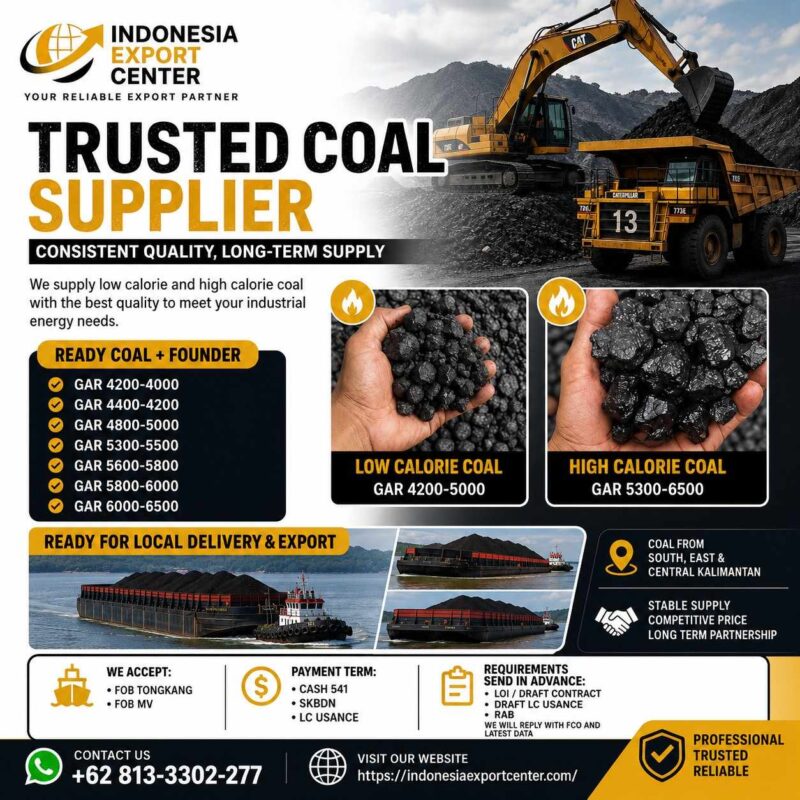
International buyers frequently ask coal suppliers a simple question:
“What is your best price for Indonesian steam coal?”
However, a reliable coal quotation cannot be calculated from the calorific value alone. The final price depends on the coal specification, order quantity, loading point, vessel arrangement, destination port, inspection requirements, payment terms, and the selected Incoterm.
A request for FOB Indonesian steam coal is therefore fundamentally different from a request for CFR or CIF delivery.
Understanding these differences helps buyers obtain faster, more accurate, and commercially comparable offers from an Indonesian steam coal supplier.
Why the Incoterm Matters in a Coal Quotation
Incoterms® are standardized international trade terms created by the International Chamber of Commerce. They clarify the allocation of costs, transportation responsibilities, export and import formalities, insurance obligations, and the point at which risk transfers from the seller to the buyer.
For bulk Indonesian thermal coal shipments, the most frequently discussed terms are:
- FOB — Free on Board
- CFR — Cost and Freight
- CIF — Cost, Insurance and Freight
These terms apply to sea or inland waterway transportation. They must always be followed by a clearly named port or delivery point and the applicable Incoterms® version, preferably Incoterms® 2020.
For example:
- FOB Taboneo Anchorage, Indonesia, Incoterms® 2020
- CFR Chattogram Port, Bangladesh, Incoterms® 2020
- CIF Mundra Port, India, Incoterms® 2020
A quotation that only says “FOB Indonesia” or “CIF buyer’s country” is not sufficiently precise.
What Is an FOB Indonesian Coal Quotation?
Under FOB, the seller delivers and loads the coal on board the vessel nominated by the buyer at the agreed port of shipment. The seller handles the export formalities, while the buyer normally appoints the vessel, pays the ocean freight, arranges marine insurance, and assumes the risk after the coal has been loaded on board.
In the Indonesian coal market, buyers may encounter several FOB-based arrangements.
FOB Barge or FOB Tongkang
Under an FOB barge arrangement, coal is delivered and loaded onto a barge at the agreed loading point.
The quotation may include:
- Coal supply from the mine or stockpile
- Hauling to the loading point
- Stockpile handling
- Coal sampling and analysis
- Loading onto the barge
- Relevant local documentation
- Export-related arrangements, where applicable
The buyer should confirm what happens after the coal is loaded onto the barge. Transshipment to a mother vessel, floating crane costs, barge waiting time, anchorage costs, and ocean freight may remain outside the seller’s quotation unless expressly included.
Therefore, “FOB barge” should identify:
- The exact loading point or jetty
- The barge capacity
- The delivery and risk-transfer point
- Who arranges the mother vessel
- Who pays for transshipment
- Who bears demurrage or waiting costs
FOB Mother Vessel or FOB MV
Under an FOB MV arrangement, the seller delivers and loads the coal onto the nominated mother vessel according to the agreed contractual arrangement.
Compared with FOB barge, an FOB MV price may include additional costs such as:
- Barge transportation to anchorage
- Floating crane or transshipment services
- Loading onto the mother vessel
- Anchorage-related handling
- Draft survey or independent inspection
- Export documentation
Indonesia Export Center currently prioritizes inquiries based on FOB barge, FOB tongkang, and FOB mother vessel, subject to seller confirmation, coal availability, loading arrangements, buyer documentation, and commercial feasibility.
What Is a CFR Indonesian Coal Quotation?
CFR means Cost and Freight.
Under CFR, the seller:
- Supplies the coal
- Completes export formalities
- Loads the coal onto the vessel
- Contracts and pays for freight to the named destination port
However, the risk of loss or damage still transfers to the buyer when the coal is loaded on board the vessel at the Indonesian port of shipment—not when it arrives at the destination.
The seller is not required to purchase marine cargo insurance under CFR. The buyer should arrange suitable insurance coverage independently.
A simplified CFR calculation is:
CFR price = FOB price + ocean freight and agreed carriage costs
A CFR quotation cannot be calculated accurately unless the buyer provides:
- Exact destination port
- Required shipment quantity
- Vessel size
- Preferred shipment period or laycan
- Port draft restrictions
- Discharge rate
- Vessel gear requirements
- Any destination-specific restrictions
For example, a freight estimate for a 10,000 MT shipment may differ substantially from the freight for a 50,000 MT shipment, even when the coal specification and destination country are the same.
What Is a CIF Indonesian Coal Quotation?
CIF means Cost, Insurance and Freight.
The commercial responsibilities under CIF are generally similar to CFR, but the seller must also arrange marine insurance covering the buyer’s transit risk.
Despite the seller paying the freight and insurance to the destination port, the risk normally transfers to the buyer when the coal is loaded onto the vessel at the port of shipment. CIF does not mean that the seller retains all cargo risk until arrival.
Under Incoterms® 2020, the default insurance requirement for CIF generally corresponds to Institute Cargo Clauses (C), unless the parties agree on broader insurance coverage. Buyers requiring more extensive protection should clearly specify the required insurance clauses in the inquiry and contract.
A simplified CIF calculation is:
CIF price = CFR price + agreed marine insurance cost
The CIF quotation should clearly state:
- Insured value
- Insurance coverage level
- Insurance company or eligibility requirements
- Covered voyage
- Claims procedure
- Exclusions
- Required insurance certificate
FOB vs CFR vs CIF: Quick Comparison
| Commercial Point | FOB | CFR | CIF |
|---|---|---|---|
| Seller supplies and loads the coal | Yes | Yes | Yes |
| Seller handles export formalities | Yes | Yes | Yes |
| Seller pays ocean freight | No | Yes | Yes |
| Seller arranges cargo insurance | No | No | Yes |
| Buyer normally nominates vessel | Yes | Usually no | Usually no |
| Risk transfers when loaded on board | Yes | Yes | Yes |
| Destination port must be specified | For freight planning | Yes | Yes |
| Suitable for bulk coal | Yes | Yes | Yes |
The critical distinction is that the party paying the freight is not necessarily the party bearing the cargo risk during the voyage.
Which Incoterm Is Most Suitable for a Coal Buyer?
Choose FOB When:
FOB may be suitable when the buyer:
- Has access to competitive vessel or chartering rates
- Has experience arranging bulk cargo shipments
- Wants control over the vessel, freight, and insurance
- Has a nominated shipping line or chartering partner
- Can coordinate the laycan with the seller’s loading schedule
FOB can also make it easier to compare the underlying coal price separately from ocean freight.
Choose CFR When:
CFR may be appropriate when the buyer:
- Wants the seller to arrange ocean freight
- Has its own marine cargo insurance
- Wants a delivered-to-port freight calculation without seller-arranged insurance
- Can provide complete destination-port and vessel information
CFR is commonly suitable for bulk commodities because it allows the seller to arrange freight while the buyer controls insurance. ICC guidance specifically recognizes CFR as appropriate for bulk, non-containerized goods and raw materials.
Choose CIF When:
CIF may be considered when the buyer:
- Wants the seller to arrange both freight and marine insurance
- Does not have an established cargo-insurance arrangement
- Requires an insurance certificate for banking or import documentation
- Accepts the insurance coverage arranged by the seller
However, buyers should review the insurance terms carefully instead of assuming that all possible risks are covered.
Information Required for an Accurate Indonesian Coal Quotation
To receive a workable offer, the buyer should submit the following information.
1. Required Coal Grade
State the required calorific value clearly.
Examples include:
- Low-calorie coal GAR 4200–4400
- Low-calorie coal GAR 4800–5000
- High-calorie coal GAR 5300–5500
- High-calorie coal GAR 5600–5800
- High-calorie coal GAR 5800–6000
- Premium high-calorie coal above GAR 6000, subject to availability
Buyers sourcing low-calorie coal GAR 4200–5000 should not request only “low-grade coal.” Similarly, buyers looking for high-calorie coal GAR 5300–6600 should identify the exact target GAR and acceptable tolerance.
The final offerable grade must be confirmed according to the latest mine source, stockpile condition, production batch, certificate of analysis, and independent survey results.
2. Complete Coal Specification
GAR alone is insufficient. The inquiry should include:
- Gross calorific value on an as-received basis
- Total moisture
- Inherent moisture
- Ash content
- Total sulfur
- Volatile matter
- Fixed carbon
- Hardgrove Grindability Index
- Coal size
- Acceptable tolerance
- Rejection limits
- Required testing standard
The buyer should also state the analytical basis for every parameter, such as ARB, ADB, or DB. Comparing ash or sulfur values without confirming the analytical basis can lead to incorrect commercial comparisons.
Indonesia Export Center advises buyers to request the latest COA, surveyor report, stockpile information, loading-point details, mine-source confirmation, and seller-readiness confirmation before final purchase documents are issued.
3. Required Quantity
Specify whether the requirement is:
- Spot cargo
- Trial shipment
- One barge
- One mother-vessel cargo
- Monthly supply
- Annual contract
- Long-term supply program
Include the exact quantity in metric tons and the acceptable operational tolerance, such as “50,000 MT ±10% at seller’s option,” when applicable.
The shipment quantity affects:
- Barge requirements
- Mother-vessel size
- Loading schedule
- Freight rate
- Port compatibility
- Inspection costs
- Commercial price
4. Exact Incoterm and Delivery Point
Avoid writing only:
“Please quote FOB, CFR, and CIF.”
Instead, request a specific basis:
“Please quote FOB mother vessel at Taboneo Anchorage, Indonesia, Incoterms® 2020.”
Or:
“Please quote CFR Mundra Port, India, Incoterms® 2020.”
Or:
“Please quote CIF Chattogram Port, Bangladesh, Incoterms® 2020, including details of marine insurance coverage.”
When asking for several options, list each option separately.
5. Destination Port
For CFR or CIF quotations, provide:
- Destination-port name
- Country
- Port terminal, if known
- Maximum vessel draft
- Maximum vessel size
- Discharge rate
- Port working hours
- Required vessel gear
- Any port restrictions
The destination country alone is not enough because freight and port conditions may vary between ports in the same country.
6. Shipment Schedule
Provide:
- Preferred loading month
- Target laycan
- Latest acceptable shipment date
- Required monthly frequency
- Contract duration
Coal availability, barge scheduling, loading equipment, weather, vessel availability, and stockpile readiness can affect the proposed shipment window.
7. Inspection and Surveyor Requirements
State whether inspection will be conducted by:
- An independent international surveyor
- A mutually agreed surveyor
- A government-appointed surveyor
- The seller’s laboratory
- The mine laboratory
Clarify whether the analysis at the loading port is final and binding for:
- Quality
- Weight
- Draft survey
- Moisture
- Sampling
- Rejection
- Price adjustment
Coal is transported as a solid bulk cargo. The IMO’s mandatory IMSBC Code provides safety requirements for the loading, trimming, carriage, and discharge of solid bulk cargoes and addresses hazards including cargo stability and chemical reactions. Shipment planning and documentation should therefore follow the applicable bulk-cargo safety requirements.
8. Required Export Documents
Depending on the transaction and destination, buyers may request:
- Commercial invoice
- Bill of lading
- Certificate of origin
- Certificate of analysis
- Surveyor report
- Weight certificate
- Draft survey report
- Export declaration
- Insurance certificate for CIF shipments
- Vessel and barge documents
- Other destination-country documents
Buyers should verify import requirements in their own country before finalizing the contract.
9. Payment Terms
The inquiry should state the preferred payment method and provide the necessary banking or supporting documentation.
Possible arrangements are subject to the seller’s procedure, buyer credibility, transaction structure, issuing bank, cargo size, and final contract.
Payment terms, Incoterms, and shipment terms are separate commercial matters and should all be stated clearly.
10. Buyer Company Information
A serious RFQ should include:
- Buyer company name
- Registered address
- Company website
- Contact person
- Company profile
- Business registration
- Import license, where applicable
- Previous coal-import experience
- End-user or trading status
- Letter of Intent
- Target quantity and schedule
- Proof of financial capability when requested
Complete company information allows the supplier to assess commercial feasibility and coordinate with the relevant mine, stockpile, logistics, surveyor, exporter, and vessel partners.
Recommended RFQ Format for Indonesian Steam Coal
Buyers can use the following format:
Product: Indonesian Steam Coal / Thermal Coal
Required Grade: GAR ______ kcal/kg, ARB
Total Moisture: ______% maximum, ARB
Ash: ______% maximum, basis ______
Total Sulfur: ______% maximum, basis ______
Volatile Matter: %, basis ______
HGI: ______ minimum
Coal Size: ______ mm
Quantity: ______ MT ±%
Order Type: Spot / Monthly / Annual Contract
Delivery Term: FOB Barge / FOB MV / CFR / CIF
Named Loading or Destination Port: ______
Shipment Schedule or Laycan: ______
Discharge Rate: ______ MT per day
Inspection: ______
Required Documents: ______
Payment Method: ______
Target Price, if available: USD ______ per MT
Buyer Company: ______
Destination Country: ______
Additional Requirements: ______
Submitting this information does not guarantee immediate acceptance, but it allows the supplier to calculate a quotation based on realistic specifications and shipment conditions.
How to Compare Two Indonesian Coal Offers
Do not compare two quotations based only on the USD-per-ton figure.
Before selecting an offer, confirm that both quotations use the same:
- GAR level
- Analytical basis
- Moisture and ash limits
- Sulfur limit
- Quantity
- Loading point
- Incoterm
- Freight assumption
- Vessel size
- Inspection procedure
- Payment terms
- Offer validity
- Price-adjustment mechanism
- Rejection limits
A lower-priced coal offer may become more expensive when its lower calorific value, higher moisture, additional transshipment cost, or unfavorable freight arrangement is considered.
For a basic energy-cost comparison, buyers may calculate:
Energy per metric ton in GJ = GAR × 0.0041868
Then:
Delivered fuel cost per GJ = Landed price per MT ÷ Energy per MT
This helps compare GAR 4200 coal with GAR 5000, GAR 5500, or higher-calorie coal on an energy basis rather than only on the price per metric ton.
Operational suitability, boiler design, combustion efficiency, emissions requirements, and ash-handling costs should also be considered.
Why Quotations Should Have a Validity Period
Coal prices, barge availability, ocean freight, fuel costs, port congestion, vessel schedules, insurance premiums, and currency conditions can change.
Every quotation should therefore state:
- Quotation date
- Price validity
- Shipment period
- Subject-to-availability clause
- Freight validity
- Conditions requiring price revision
A freight-based CFR or CIF quotation generally requires stricter validity than an indicative FOB coal price because vessel rates may change before the buyer accepts the offer.
Requesting a Quotation from Indonesia Export Center
Indonesia Export Center connects international buyers with selected Indonesian coal supply networks and supports inquiries for industrial users, coal traders, power plants, cement manufacturers, and commodity-trading companies.
Available inquiries may include:
- Indonesian steam coal supplier requirements
- Low-calorie coal GAR 4200–5000
- High-calorie coal GAR 5300–6600 requirements, subject to exact seller and mine confirmation
- FOB barge or FOB tongkang
- FOB mother vessel
- Spot cargo
- Monthly supply
- Long-term contract discussions
The company’s currently stated commercial preference is for FOB-based inquiries. CFR or CIF requests may only be considered when specifically confirmed by the seller.
To request a quotation, send:
- Required GAR
- Full coal specification
- Quantity
- FOB, CFR, or CIF requirement
- Loading or destination port
- Shipment schedule
- Payment preference
- Required documents
- Buyer company profile
- Letter of Intent
Conclusion
Choosing between FOB, CFR, and CIF is not simply a matter of selecting the lowest price.
FOB gives the buyer greater control over the vessel, ocean freight, and insurance. CFR allows the seller to arrange freight while the buyer manages insurance. CIF adds seller-arranged marine insurance, although the risk generally still transfers when the coal is loaded on board at the Indonesian port of shipment.
The most accurate Indonesian steam coal quotation begins with a complete inquiry.
Buyers should provide the exact GAR, full quality specification, quantity, named loading or destination port, shipment schedule, inspection requirements, payment method, and preferred Incoterm.
A detailed RFQ allows the Indonesian coal supplier to evaluate mine availability, stockpile condition, logistics, vessel requirements, documentation, and commercial feasibility before issuing a formal offer.
Indonesia Export Center
WhatsApp: +62 813-3302-277
Email: info@indonesiaexportcenter.com
Recommended Internal Links
- Indonesian Steam Coal Supplier
- Low Calorie Coal GAR 4200–5000 Supplier
- High Calorie Coal GAR 5300–6600 Supplier
References
- International Chamber of Commerce — Incoterms® 2020 guidance for FOB, CFR, and CIF.
- International Chamber of Commerce — Incoterms® 2020 insurance requirements.
- International Trade Administration — recognized Incoterms® for maritime transportation.
- International Maritime Organization — International Maritime Solid Bulk Cargoes Code.
- Indonesia Export Center — Indonesian steam coal product and quotation requirements.
