

Develop Your Own Frozen Shrimp Brand with Indonesian Seafood Sourcing
Are you looking for private-label frozen shrimp sourcing opportunities for your supermarket, seafood distribution company, retail brand, or international frozen food business?
Indonesia Export Center (IEC) assists commercial buyers with private-label vannamei shrimp inquiries from Indonesia.
Private-label procurement allows buyers to develop seafood products under their own brand identity, subject to supplier manufacturing capability, packaging requirements, regulatory compliance, and commercial agreements.
IEC helps buyers communicate product specifications, packaging designs, quality requirements, target markets, order quantities, and shipment schedules to potential Indonesian seafood suppliers.
Whether you are launching a new frozen seafood brand or expanding an existing supermarket product portfolio, we welcome your B2B inquiry.
What Is Private-Label Frozen Shrimp?
Private-label frozen shrimp refers to seafood products manufactured or packed by a supplier for sale under another company’s brand.
The brand owner may establish product specifications, packaging design, labeling requirements, quality criteria, and commercial positioning.
The actual manufacturer remains responsible for its agreed production obligations, while the importer and brand owner must establish their applicable regulatory responsibilities.
A private-label project requires more than placing a logo on a frozen shrimp bag.
It involves product development, supplier qualification, packaging approval, food safety verification, and production planning.
Who Can Develop Private-Label Shrimp Products?
- Supermarket chains.
- Grocery retailers.
- Frozen food brands.
- Seafood importers.
- Wholesale distributors.
- Online grocery businesses.
- Foodservice brands.
- International trading companies.
- Specialty seafood retailers.
- Private-label procurement agencies.
IEC welcomes commercial projects targeting the United States, European Union, Japan, United Kingdom, Middle East, and other international markets.
Private-Label Shrimp Product Options
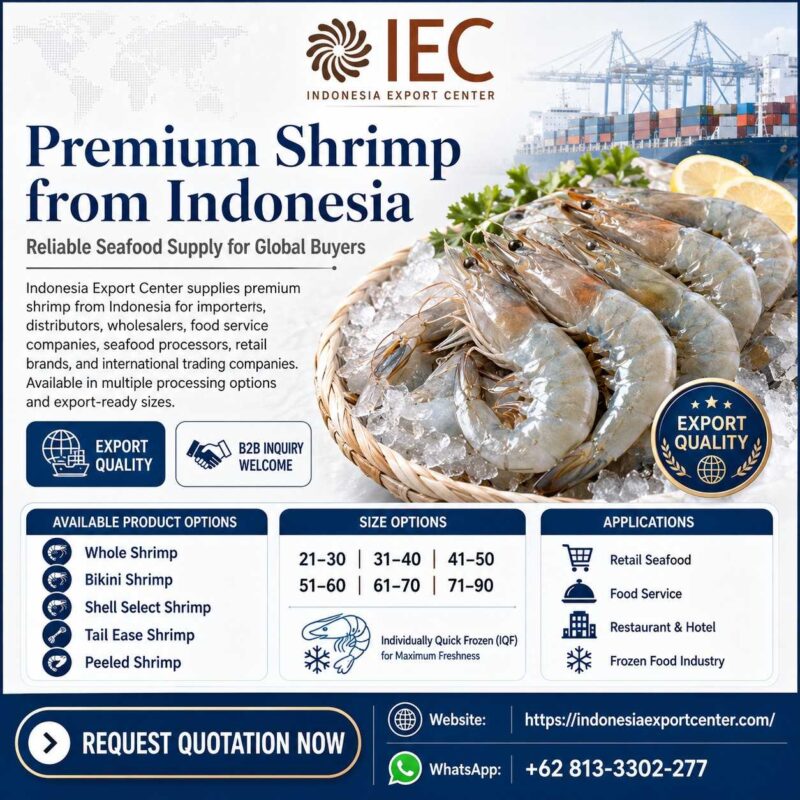
IEC’s preliminary product range includes Whole Shrimp, Bikini Shrimp, Shell Select Shrimp, Tail Ease Shrimp, and Peeled Shrimp.
Additional private-label sourcing inquiries may include:
| Product Format | Potential Retail Positioning |
|---|---|
| Whole Shrimp | Traditional seafood preparation |
| HLSO Shrimp | Shell-on seafood products |
| Peeled Deveined | Convenient home cooking |
| Peeled Tail-Off | Ready-to-cook ingredients |
| PDTO | Presentation-focused meals |
| Easy Peel | Consumer convenience |
| IQF Shrimp | Flexible portioning |
| Cooked Shrimp | Selected prepared seafood |
| Breaded Shrimp | Value-added frozen seafood |
Actual production and packing capability must be confirmed.
Develop a Branded Frozen Shrimp Product Portfolio
A retail seafood brand may offer several shrimp SKUs to serve different customer preferences.
An illustrative private-label portfolio could include:
| SKU | Product | Illustrative Pack |
|---|---|---|
| SKU 01 | Whole Vannamei Shrimp | 500 g |
| SKU 02 | Peeled Deveined Shrimp | 400 g |
| SKU 03 | Peeled Tail-Off Shrimp | 250 g |
| SKU 04 | Tail-On Shrimp | 500 g |
| SKU 05 | Cooked Shrimp | 200 g |
| SKU 06 | Family Pack Shrimp | 1 kg |
These are illustrative product concepts rather than confirmed supplier offerings.
The buyer should establish its target retail price, customer segment, pack size, and desired product positioning.
Custom Retail Packaging Options
Potential packaging inquiries include:
- Printed frozen food bags.
- Branded pouches.
- Transparent product windows.
- Resealable packaging.
- Retail cartons.
- Foodservice branded bags.
- Private-label stickers.
- Buyer-specific master cartons.
Packaging materials should be suitable for food contact, frozen storage, sealing, handling, and transportation.
Actual printing and packaging capability require supplier confirmation.
Private-Label Packaging Sizes
Potential retail pack sizes include 180 g, 200 g, 250 g, 300 g, 400 g, 500 g, 750 g, and 1 kg.
Foodservice and wholesale buyers may request larger packaging configurations.
The appropriate pack size depends on consumer preferences, retail pricing, freezer shelf space, product count, and packaging costs.
Custom packaging may involve minimum printing quantities separate from the shrimp production MOQ.
Vannamei Shrimp Size Selection
IEC’s preliminary promotional information identifies size references of 21–30, 31–40, 41–50, 51–60, 61–70, and 71–90.
The buyer should confirm the counting unit and processing form before designing packaging.
Retail size descriptions must accurately represent the actual product.
A size grade measured in pieces per pound should not be presented as pieces per kilogram.
Private-Label Product Development Process
Step 1: Define Your Target Market
Identify the destination country, customer segment, retail channel, target price, and intended product positioning.
Step 2: Select the Shrimp Product
Choose the required processing form, size, freezing method, raw or cooked condition, glaze, and net weight.
Step 3: Establish the Technical Specification
Define quality tolerances, ingredient restrictions, food safety requirements, packaging, and acceptance criteria.
Step 4: Qualify the Supplier
Verify the actual manufacturing establishment, export eligibility, food safety documentation, production capability, and traceability.
Step 5: Evaluate Samples
Request representative product samples and assess appearance, grading, preparation performance, and net weight.
Step 6: Develop Packaging Artwork
Prepare the brand design and mandatory food information according to the destination market.
Step 7: Approve Packaging Materials
Confirm material suitability, dimensions, printing quality, seal performance, and frozen storage compatibility.
Step 8: Confirm Commercial Terms
Establish MOQ, price, production lead time, payment terms, Incoterms, and shipment schedule.
Step 9: Approve Production
Finalize the product specification and packaging artwork before commercial manufacturing.
Step 10: Inspect and Ship
Complete the agreed inspection, documentation, and export logistics arrangements.
Private-Label Food Information Requirements
Retail packaging should provide accurate and legally applicable product information.
Potential label elements include:
- Product name.
- Brand name.
- Scientific species name where required.
- Country of origin.
- Production method where applicable.
- Ingredient declaration.
- Allergen information.
- Net quantity.
- Nutrition information where required.
- Storage instructions.
- Preparation instructions.
- Date marking.
- Lot identification.
- Manufacturer or responsible business details.
- Importer information where applicable.
- Barcode and retail identification.
The exact requirements depend on the destination country and product category.
Private-Label Frozen Shrimp for the USA
US retail buyers should verify applicable FDA seafood requirements, food labeling rules, allergen declarations, and importer obligations.
Depending on the transaction, relevant considerations may include Seafood HACCP, facility registration, prior notice, and applicable importer verification requirements.
Additional country-of-origin labeling or seafood traceability obligations may apply.
FDA registration should not be described as FDA product approval.
The responsible importer should approve the final label and verify current requirements.
Private-Label Frozen Shrimp for the European Union
EU retail seafood procurement may require verification of country and establishment eligibility, official health certification, border control procedures, traceability, and food labeling requirements.
Depending on the product category, additional fishery and aquaculture marketing information may apply.
For glazed foods, applicable EU rules generally require declared net quantity to exclude protective glaze.
Retail buyers should confirm the appropriate destination-language information.
Private-Label Frozen Shrimp for Japan
Japanese buyers should verify applicable food import notification, food sanitation requirements, ingredient restrictions, residue controls, and Japanese-language labeling.
Product consistency, appearance, processing accuracy, and packaging presentation may be important commercial requirements.
The importer should approve all technical and labeling information before production.
Allergen and Ingredient Declaration
Shrimp is a crustacean allergen.
Private-label seafood packaging must communicate applicable allergen information according to the destination market.
Breaded, marinated, seasoned, or further-processed shrimp may contain additional allergens and ingredients.
The supplier should provide a complete ingredient declaration and relevant allergen documentation.
Claims such as gluten-free, additive-free, phosphate-free, or preservative-free require appropriate verification.
Glazing and Retail Net Weight
Protective glaze should be distinguished from actual shrimp weight.
The private-label specification should establish the declared net quantity, glaze target or maximum, calculation convention, sampling method, and acceptance criteria.
Packaging artwork should reflect the applicable legal weight declaration.
Buyers should evaluate commercial quotations using a consistent net shrimp weight basis.
Barcode and Retail SKU Management
Private-label retail brands may require barcodes, SKU numbers, carton identification, lot codes, and other commercial identifiers.
The brand owner should establish the required identification system and verify barcode ownership and accuracy.
The supplier should confirm its ability to reproduce approved artwork and production codes.
Food Safety Audits and Certifications
Retail brands may establish supplier approval requirements that exceed minimum regulatory obligations.
Potential certification inquiries include BRCGS, IFS Food, FSSC 22000, ISO 22000, ASC, BAP, and other buyer-recognized programs.
The actual certificate scope, facility coverage, validity, and product eligibility must be verified.
IEC does not claim that every potential supplier holds these certifications.
Sustainability Claims on Private-Label Packaging
Claims concerning responsible aquaculture, environmental performance, certified sourcing, or social responsibility should be supported by appropriate evidence.
Where certification logos are used, the brand owner should verify licensing, chain-of-custody requirements, product coverage, and artwork authorization.
No sustainability claim should be based solely on the country of origin.
Packaging Artwork Approval Checklist
Before approving commercial printing, buyers should verify:
- Correct brand identity.
- Accurate product description.
- Approved shrimp size.
- Correct net quantity.
- Complete ingredient information.
- Applicable allergen declarations.
- Destination-language requirements.
- Correct storage and preparation instructions.
- Valid barcode.
- Accurate origin information.
- Authorized certification logos.
- Required business information.
- Suitable date and lot coding areas.
The importer and brand owner should approve the final artwork.
Private-Label MOQ and Lead Time
Private-label minimum order quantities may depend on product form, size grade, production batch requirements, packaging material, printing method, and number of SKUs.
Custom printed packaging may have a separate minimum order quantity.
Lead time may include product sampling, artwork approval, packaging production, shrimp processing, quality inspection, documentation, and shipping arrangements.
No fixed MOQ or production lead time should be assumed.
Private-Label Frozen Shrimp Pricing
Pricing may depend on raw material availability, shrimp size, processing yield, freezing method, glaze, packaging, printing, inspection, certifications, order volume, and freight.
The buyer should distinguish one-time development expenses from recurring production costs.
Potential development expenses may include artwork preparation, printing setup, packaging samples, laboratory testing, and supplier audits.
Actual commercial charges require supplier confirmation.
Long-Term Private-Label Supply Programs
A successful private-label procurement program should establish approved product specifications, artwork versions, forecast quantities, quality tolerances, production schedules, change-control procedures, and complaint management.
Suppliers should not change ingredients, processing methods, or packaging without following the agreed approval process.
Actual capacity and recurring delivery commitments must be confirmed.
Why Work with Indonesia Export Center?
IEC assists international brands with independent sourcing and trade facilitation services.
Our support may include supplier matching, product specification coordination, sample inquiries, packaging discussions, documentation requests, and commercial quotation coordination.
IEC does not claim ownership of manufacturing facilities or independently certify product compliance.
Frequently Asked Questions
Can I sell Indonesian shrimp under my own brand?
Private-label inquiries are welcome, subject to supplier capability and commercial agreement.
Can I provide my own packaging design?
Yes. Artwork must be reviewed and approved before production.
Can I request different pack sizes?
Yes, subject to packaging capability and minimum quantities.
Can I request supermarket food safety certifications?
Yes. Actual certification status must be verified.
Can IEC source private-label shrimp for the USA, EU, or Japan?
Yes, as sourcing inquiries. Destination-market eligibility must be confirmed.
What is the private-label MOQ?
MOQ depends on the product, packaging, printing requirements, and supplier.
Request a Private-Label Vannamei Shrimp Quotation
| RFQ Field | Buyer Requirement |
|---|---|
| Company Name | |
| Brand Name | |
| Destination Market | |
| Retail Channel | |
| Product Form | |
| Size Grade | |
| Counting Unit | |
| Raw or Cooked | |
| Freezing Method | |
| Glaze | |
| Net Weight per Pack | |
| Packaging Material | |
| Artwork Availability | |
| Label Language | |
| Number of SKUs | |
| Required Certifications | |
| Initial Quantity per SKU | |
| Annual Forecast | |
| Destination Port | |
| Preferred Incoterms | |
| Target Launch Date |
Contact Indonesia Export Center
INDONESIA EXPORT CENTER (IEC)
Website: https://indonesiaexportcenter.com/
WhatsApp: +62 813-3302-277
Direct inquiry: https://wa.me/628133302277
Request Your Private-Label Indonesian Vannamei Shrimp Quotation and Develop Your Frozen Seafood Brand Today.
Related resources:
- Vannamei Shrimp Supplier for USA Importers
- Vannamei Shrimp Supplier for Germany
- Vannamei Shrimp Exporter to Japan
- Frozen Vannamei Shrimp Export Documents Guide
Private-label capability, packaging options, certifications, regulatory eligibility, MOQ, prices, and production lead time require verification.
