

Source Frozen Vannamei Shrimp for Commercial Ready Meal Production
Indonesia Export Center (IEC) assists prepared meal manufacturers, frozen convenience food factories, seafood ingredient procurement teams, and international food brands with sourcing inquiries for Indonesian vannamei shrimp.
Ready meal manufacturing requires ingredients that meet defined product specifications, portion requirements, food safety criteria, and manufacturing performance standards.
Whether your company produces frozen seafood pasta, shrimp fried rice, microwave meals, seafood curries, prepared noodles, meal kits, or refrigerated prepared foods, IEC welcomes your commercial sourcing inquiry.
We help buyers communicate their shrimp ingredient requirements to potential Indonesian seafood suppliers.
The actual product must be evaluated according to the manufacturer’s recipe, processing method, intended use, and destination-market requirements.
Vannamei Shrimp for the Global Prepared Food Industry
Vannamei shrimp is a versatile seafood ingredient that may be considered for numerous convenience food applications.
Prepared meal manufacturers often require standardized ingredients that can be incorporated into repeatable production processes.
The appropriate shrimp format depends on the recipe, finished meal weight, cooking process, appearance, texture, portion requirements, and target manufacturing cost.
Raw, cooked, whole, peeled, and customized shrimp ingredients have different processing characteristics.
They should not be treated as automatically interchangeable.
Ready Meal Applications
| Finished Product | Potential Shrimp Ingredient |
|---|---|
| Shrimp Fried Rice | Peeled tail-off shrimp |
| Seafood Pasta | Peeled deveined shrimp |
| Shrimp Curry | Peeled shrimp |
| Frozen Noodle Meals | Small or medium peeled shrimp |
| Seafood Soup | Buyer-defined shrimp format |
| Microwave Seafood Meals | Raw or cooked according to process |
| Seafood Risotto | Peeled shrimp |
| Seafood Dumplings | Approved shrimp pieces |
| Seafood Pizza | Small peeled shrimp |
| Prepared Seafood Salad | Suitable cooked shrimp |
| Seafood Meal Kits | Portion-controlled shrimp |
| Frozen Seafood Bowls | Peeled or tail-on shrimp |
Actual ingredient suitability must be validated through manufacturing trials.
Peeled Tail-Off Shrimp for Ready Meals
Peeled tail-off shrimp may be considered for prepared meals where consumers are not expected to remove shells or tails.
Potential applications include pasta, rice meals, seafood bowls, noodles, and sauces.
The manufacturer should define the required size, individual piece weight, vein removal, shell fragment tolerance, tail removal quality, and ingredient composition.
The supplier should provide representative samples for evaluation.
Peeled Deveined Shrimp for Industrial Recipes
Peeled deveined shrimp may support efficient ingredient preparation in food factories.
The actual processing quality should be evaluated according to the manufacturer’s specification.
Deveining requirements should identify the required removal quality and acceptable defects.
The buyer should also assess product appearance, texture, moisture, cooking performance, and usable yield.
Cooked Shrimp for Prepared Meal Manufacturing
Cooked frozen shrimp may be considered for products requiring a previously cooked seafood ingredient.
However, cooked shrimp is not automatically ready to eat.
The manufacturer must establish the actual cooking process, intended use, microbiological criteria, post-process handling controls, and whether further cooking is required.
The supplier should provide relevant processing and food safety documentation.
Shrimp Pieces and Customized Cuts
Certain prepared food manufacturers may require smaller shrimp pieces rather than whole individual shrimp.
Potential applications include dumpling fillings, seafood patties, spring rolls, sauces, and composite seafood products.
Buyers may submit requirements for piece dimensions, acceptable variation, composition, and processing quality.
Customized shrimp cuts, broken pieces, and minced products are additional sourcing inquiries rather than confirmed IEC product offerings.
Vannamei Shrimp Size Options
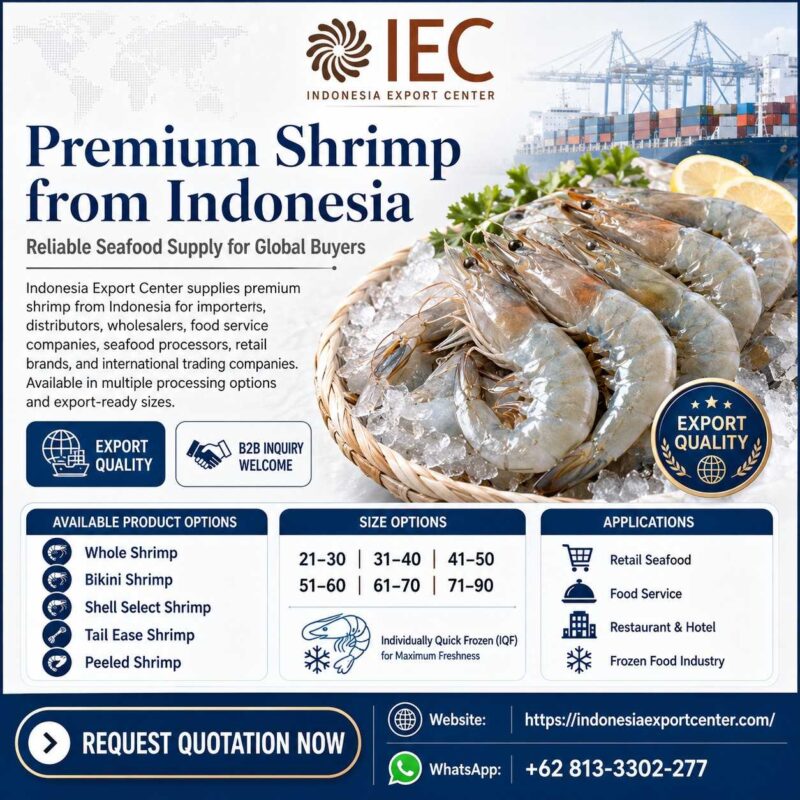
The preliminary IEC product range identifies the following size references:
21–30, 31–40, 41–50, 51–60, 61–70, and 71–90.
Smaller count-grade numbers generally represent larger shrimp within the same counting system and processing form.
Prepared meal manufacturers should select grades according to the desired number of shrimp per meal, ingredient weight, visual appearance, and production cost.
The counting unit must be confirmed.
Portion Standardization in Ready Meal Production
A prepared meal factory may require a defined shrimp portion in every finished meal.
Portion requirements may be based on individual piece count, raw ingredient weight, cooked ingredient weight, or a combination of these parameters.
For example, a hypothetical meal manufacturer using 60 shrimp pieces per kilogram and allocating six pieces per meal would obtain approximately ten portions per kilogram before accounting for processing losses.
Actual portion performance depends on count tolerance and manufacturing yield.
IQF Shrimp for Automated and Semi-Automated Production
Individually Quick Frozen shrimp may support flexible ingredient weighing and portioning.
Manufacturers using batch production or automated assembly systems may evaluate IQF products for their handling characteristics.
Important evaluation parameters include product separation, clumping, piece dimensions, physical damage, surface glaze, and temperature.
The product should be tested within the manufacturer’s actual production equipment.
Cooking Yield and Moisture Loss
Shrimp may lose weight during thawing, trimming, cooking, or subsequent manufacturing.
The manufacturer should establish a standardized yield test using its actual production process.
Relevant measurements may include incoming net weight, thawed weight, trimmed weight, cooked weight, and final usable ingredient weight.
A simple calculation is:
Cooking Yield (%) = Cooked Product Weight ÷ Pre-Cooking Product Weight × 100
The actual result depends on the shrimp specification and cooking conditions.
No fixed yield should be assumed.
Cost per Finished Meal
Ready meal manufacturers should calculate the ingredient cost based on the quantity of usable shrimp incorporated into each finished product.
For example:
| Hypothetical Parameter | Value |
|---|---|
| Shrimp Purchase Price per Net kg | USD 6.00 |
| Measured Usable Yield | 80% |
| Cost per Usable kg | USD 7.50 |
| Usable Shrimp per Meal | 40 g |
| Shrimp Ingredient Cost per Meal | USD 0.30 |
This example excludes other ingredients, manufacturing labor, packaging, freight, and overhead.
It is illustrative and does not represent an IEC quotation.
Shrimp Texture in Prepared Foods
Shrimp texture may be affected by raw material quality, processing treatments, freezing, thawing, cooking, reheating, and the finished meal formulation.
Manufacturers should evaluate the ingredient within the complete recipe rather than assessing the shrimp in isolation.
A product suitable for freshly cooked restaurant dishes may perform differently in a frozen microwave meal.
Pilot production and finished-product evaluation are important parts of ingredient approval.
Ingredient and Additive Specifications
Ready meal manufacturers should request a complete ingredient declaration.
Certain shrimp products may contain processing additives or moisture-retention treatments.
The buyer should establish whether these substances are compatible with the recipe, customer specifications, applicable regulations, and finished-product labeling.
Claims concerning untreated, additive-free, or phosphate-free shrimp require appropriate verification.
Crustacean Allergen Management
Shrimp is a crustacean allergen.
Prepared food factories should manage shrimp within their allergen control systems.
Relevant considerations include ingredient identification, storage segregation, production scheduling, cleaning validation, cross-contact controls, supplier documentation, and finished-product labeling.
Further-processed shrimp may contain additional allergens.
The complete formulation should be reviewed before ingredient approval.
Food Safety for Raw and Cooked Shrimp
Raw shrimp and cooked shrimp may require different hazard assessments.
The manufacturer should evaluate relevant microbiological hazards, veterinary drug residues, contaminants, processing hygiene, temperature control, and intended use.
Ready-to-eat applications may require additional attention to contamination after cooking and during subsequent handling.
The applicable criteria should be established according to current regulations and the manufacturer’s food safety system.
Product Specification for Ready Meal Manufacturers
| Parameter | Buyer Specification |
|---|---|
| Species | Vannamei shrimp |
| Origin | Indonesia |
| Processing Form | Peeled, tail-off, cooked or other |
| Size Grade | Buyer-defined |
| Count Basis | Confirmed unit |
| Individual Weight | Agreed tolerance |
| Piece Dimensions | Where applicable |
| Raw or Cooked | According to process |
| Glaze | Approved specification |
| Net Weight | Defined basis |
| Ingredients | Complete declaration |
| Additives | Approved restrictions |
| Allergen Information | Required |
| Shell Fragments | Agreed acceptance criteria |
| Microbiology | Product-specific |
| Residue Testing | Applicable requirements |
| Yield | Manufacturer-validated |
| Packaging | Industrial specification |
| Storage | Approved frozen conditions |
Shrimp Ingredients for USA Ready Meal Factories
US food manufacturers should evaluate applicable seafood ingredient requirements, FDA regulations, allergen declarations, and supplier verification obligations.
The actual regulatory responsibilities depend on the product, facility, importer, and manufacturing activity.
The finished meal manufacturer should verify its own applicable food safety and labeling requirements.
IEC does not claim FDA approval for unverified suppliers or products.
Shrimp Ingredients for European Ready Meal Factories
European buyers should verify applicable EU import eligibility, official documentation, food hygiene requirements, residue controls, traceability, and ingredient labeling.
The finished meal manufacturer should establish the relevant microbiological and allergen requirements for its actual product.
Supplier certifications should be checked for validity and scope.
Industrial Packaging and Batch Handling
Prepared meal factories may request standardized inner packs designed around their production batch requirements.
Potential packaging inquiries include 1 kg, 2 kg, 5 kg, and other industrial configurations.
The buyer should specify packaging materials, net weight, carton dimensions, lot coding, and handling requirements.
Actual packaging capability must be confirmed.
Traceability and Change Control
Ready meal manufacturers should establish traceability from incoming shrimp lots to finished meal batches.
The supplier should provide appropriate lot identification and relevant production records.
A commercial supply agreement may also require advance notification of changes to raw material sourcing, ingredients, processing methods, packaging, or production facilities.
Unapproved changes may affect finished-product performance and regulatory compliance.
Recurring Ingredient Supply
Prepared meal factories may require consistent monthly ingredient volumes.
Procurement teams should communicate anticipated production demand, seasonal changes, approved specifications, safety stock requirements, and delivery schedules.
The actual supplier must confirm production capacity, raw material availability, and shipment commitments.
Why Work with Indonesia Export Center?
IEC provides independent sourcing assistance for international ready meal manufacturers.
Our support may include supplier matching, specification coordination, product sample inquiries, ingredient documentation requests, industrial packaging discussions, and commercial quotations.
We help buyers communicate their manufacturing requirements to potential Indonesian seafood suppliers.
Frequently Asked Questions
Can IEC source shrimp for frozen ready meals?
Yes. Prepared meal ingredient inquiries are welcome.
Can I request cooked peeled shrimp?
Yes, subject to supplier capability and the intended food safety specification.
Can I request specific piece dimensions?
Yes. Include the required dimensions and acceptable tolerance.
Can I request shrimp without particular additives?
Yes. Actual ingredient composition must be verified.
Can I request a guaranteed cooking yield?
A yield requirement may be proposed, but actual performance must be validated and commercially agreed.
Can IEC coordinate recurring industrial orders?
Yes, subject to confirmed supplier capacity and shipment arrangements.
Request a Ready Meal Shrimp Ingredient Quotation
Please provide your company name, destination country, finished meal application, product form, raw or cooked requirement, size grade, count basis, portion weight, piece dimensions, glaze, net weight, target yield, ingredient restrictions, allergen documentation, microbiological criteria, packaging, monthly consumption, destination port, and shipment schedule.
Contact Indonesia Export Center
INDONESIA EXPORT CENTER (IEC)
Website: https://indonesiaexportcenter.com/
WhatsApp: +62 813-3302-277
Direct inquiry: https://wa.me/628133302277
Request Your Indonesian Vannamei Shrimp Ingredient Quotation for Ready Meal Manufacturing Today.
Explore related pages:
- Frozen Shrimp for Food Manufacturers
- Vannamei Shrimp Product Types Guide
- Vannamei Shrimp Sizes and Count Chart
Product availability, customized processing capability, ingredient composition, manufacturing yield, food safety compliance, and commercial arrangements require verification.
