

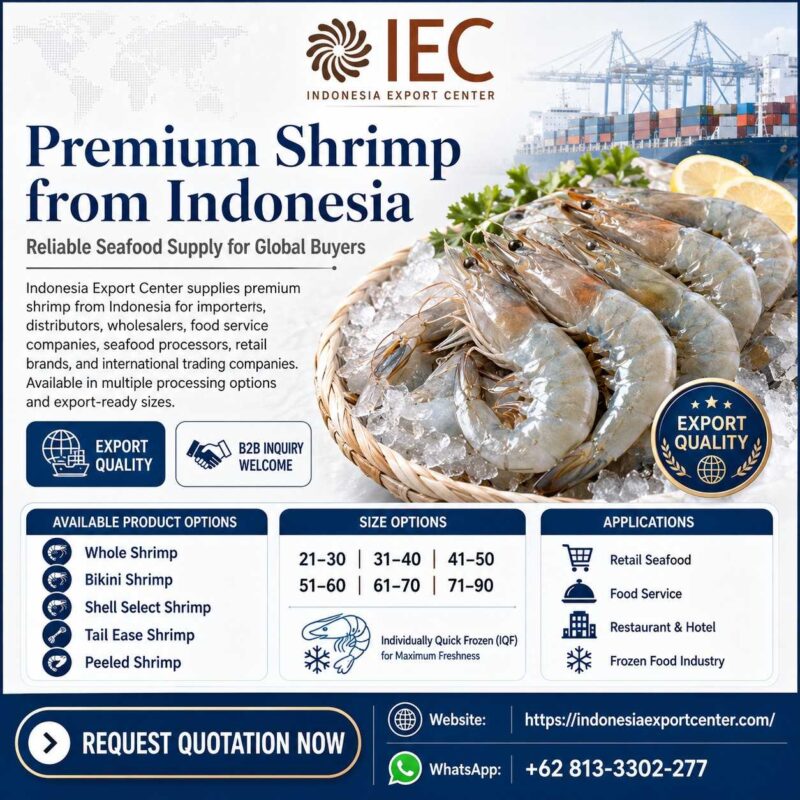
Indonesian Vannamei Shrimp for Hospitality and Foodservice Businesses
Indonesia Export Center (IEC) welcomes B2B sourcing inquiries from hotel suppliers, restaurant distributors, catering companies, hospitality procurement businesses, commercial kitchens, and international foodservice wholesalers.
We assist commercial buyers seeking Indonesian frozen vannamei shrimp in different processing formats, size grades, and packaging configurations.
Restaurants and hotels require seafood products that support consistent menu presentation, efficient preparation, portion control, predictable food costs, and appropriate food safety standards.
IEC helps buyers communicate these requirements to potential Indonesian seafood suppliers.
Whether your distribution business serves luxury hotels, seafood restaurants, buffet operators, catering companies, or international restaurant chains, we welcome your procurement inquiry.
Frozen Shrimp for the Global HORECA Industry
HORECA generally refers to hotels, restaurants, and catering businesses.
These businesses may require different shrimp products according to their menu, service model, kitchen facilities, and target customer segment.
A premium seafood restaurant may prioritize large whole shrimp and presentation quality, while a catering company may prioritize standardized portions and efficient preparation.
A hotel buffet may require tail-on shrimp, while a restaurant chain may prefer peeled shrimp with consistent individual weights.
The appropriate product should be selected according to the buyer’s approved foodservice specification.
Who Can Source HORECA Shrimp Through IEC?
- Hotel procurement companies.
- Restaurant supply distributors.
- Seafood restaurant chains.
- International catering companies.
- Resort and hospitality suppliers.
- Buffet operators.
- Commercial kitchen distributors.
- Institutional foodservice suppliers.
- Cruise and travel catering procurement businesses.
- Frozen food wholesalers.
- International restaurant ingredient distributors.
IEC focuses on commercial sourcing inquiries rather than individual consumer purchases.
Whole Vannamei Shrimp for Seafood Restaurants
Whole Head-On Shell-On shrimp retains the head, shell, and tail.
This presentation may be considered for grilled seafood, seafood platters, buffet displays, traditional shrimp dishes, and restaurant menus where visual presentation is important.
Buyers should establish requirements for size consistency, head attachment, shell integrity, color, physical defects, black spot tolerance, and net weight.
The actual product should be evaluated after thawing and cooking.
Headless Shell-On Shrimp for Foodservice
HLSO shrimp retains the shell while the head has been removed.
This format may be considered by restaurants requiring a shell-on product with reduced head-removal preparation.
Potential applications include grilling, frying, seafood curries, and commercial seafood dishes.
The buyer should evaluate preparation time, usable yield, cooking performance, and menu presentation.
Peeled Deveined Shrimp for Commercial Kitchens
Peeled deveined shrimp may support convenient preparation in restaurants and catering kitchens.
Potential applications include seafood pasta, shrimp fried rice, curries, stir-fried dishes, seafood soups, and prepared appetizers.
The required processing specification should identify vein removal, shell fragments, tail condition, size tolerance, glaze, and net weight.
Peeled shrimp may reduce certain preparation requirements, but actual labor savings should be evaluated.
Tail-On Shrimp for Hotels and Buffets
Peeled deveined tail-on shrimp may be considered for presentation-focused applications.
Potential uses include appetizers, buffet seafood, tempura, grilled shrimp, and plated restaurant dishes.
The buyer should establish the required tail condition, individual piece dimensions, appearance, and processing quality.
Actual PDTO availability requires supplier confirmation.
Shrimp Product Selection by Menu Application
| Menu Application | Potential Shrimp Format |
|---|---|
| Grilled Whole Shrimp | HOSO |
| Seafood Platters | HOSO or tail-on |
| Garlic Butter Shrimp | HLSO or peeled |
| Tempura | PDTO with agreed dimensions |
| Seafood Pasta | Peeled deveined |
| Shrimp Fried Rice | Peeled tail-off |
| Seafood Curry | Peeled or shell-on |
| Buffet Appetizers | Tail-on or suitable cooked shrimp |
| Seafood Salad | Suitable cooked shrimp |
| Catering Meals | Portion-controlled peeled shrimp |
These are potential culinary applications rather than guaranteed product recommendations.
Vannamei Shrimp Size Options for Restaurants
IEC’s preliminary product information includes size references of 21–30, 31–40, 41–50, 51–60, 61–70, and 71–90.
Within the same processing form and counting system, lower numerical count grades generally represent larger individual shrimp.
Restaurants should select size grades according to menu presentation, portion requirements, and food cost.
The actual counting unit must be confirmed.
Portion Control for Commercial Kitchens
Consistent portioning is important for restaurant profitability.
A foodservice buyer may establish portions based on the number of shrimp, total raw weight, or finished cooked weight.
For example, a hypothetical restaurant using 40 pieces per kilogram and serving five shrimp per portion would obtain approximately eight portions per kilogram before accounting for processing or cooking losses.
Actual portion yield depends on count tolerance, net weight, preparation method, and cooking performance.
Restaurants should validate portion costs using representative products.
IQF Shrimp for Flexible Foodservice Preparation
Individually Quick Frozen shrimp may support flexible portioning because individual pieces are intended to remain separated.
This may be useful for restaurants managing variable customer demand or multiple shrimp menu items.
IQF products may allow kitchens to remove the required quantity while keeping the remaining product frozen under appropriate conditions.
Actual product separation depends on freezing, glaze, packaging, and storage conditions.
IQF does not eliminate the need for appropriate food safety procedures.
Raw and Cooked Shrimp for Hospitality
Hotels and restaurants may require raw shrimp for freshly cooked menu items or cooked shrimp for selected prepared applications.
The buyer should establish whether the product is raw, fully cooked, partially cooked, ready to eat, or intended for further preparation.
Cooked shrimp should not automatically be classified as ready to eat.
Appropriate cooking, handling, and storage procedures must be established within the buyer’s food safety system.
Foodservice Packaging Options
| Customer Type | Illustrative Pack Inquiry |
|---|---|
| Small Restaurants | 500 g or 1 kg |
| Hotel Kitchens | 1 kg or 2 kg |
| Buffet Operators | 1 kg or 2 kg |
| Catering Companies | 2 kg or 5 kg |
| Foodservice Wholesalers | Multiple inner packs per carton |
| Central Kitchens | Buyer-defined industrial packs |
Actual packaging sizes and carton configurations require supplier confirmation.
Menu Consistency Across Restaurant Chains
Restaurant chains may require standardized shrimp products across multiple branches.
A purchasing specification should define the processing form, size grade, count basis, individual piece weight, glaze, net weight, ingredient declaration, and acceptable variation.
Representative samples should be tested using the chain’s actual recipes.
A recurring procurement program may help support menu consistency when supplier capacity and quality performance are verified.
Shrimp for Luxury Hotels and Resorts
Premium hospitality businesses may prioritize visual appearance, size uniformity, tail presentation, texture, and preparation flexibility.
Whole shrimp and tail-on shrimp may be considered for presentation-focused menus.
The actual product should be evaluated for its intended culinary application rather than relying solely on premium marketing terminology.
IEC welcomes detailed specifications from hospitality procurement teams.
Shrimp for Large-Scale Catering
Catering companies may require high-volume seafood ingredients with predictable preparation characteristics.
Peeled shrimp may be considered for standardized meals, rice dishes, pasta, and commercial food production.
Catering buyers should evaluate usable yield, portion cost, packaging efficiency, storage capacity, and delivery schedules.
Actual supplier production capacity must be confirmed before large contracts are established.
Managing Shrimp Food Costs
Restaurant buyers should compare the total cost of serving a shrimp portion.
Relevant costs may include purchase price, preparation labor, shell removal, thawing losses, cooking losses, storage, and product waste.
A hypothetical shrimp ingredient costing USD 6 per net kilogram with an 80% usable yield would have a usable ingredient cost of USD 7.50 per kilogram.
This example is illustrative and does not represent an IEC quotation.
Glazing and Net Weight for Foodservice
Protective glaze may help maintain frozen shrimp quality.
However, restaurants should distinguish protective ice from actual shrimp weight.
Foodservice distributors should establish the agreed glaze percentage, net weight, deglazing procedure, and sampling method.
Accurate net weight supports transparent purchasing and reliable menu costing.
Food Safety for Hotel and Restaurant Supply
Foodservice buyers should request relevant product specifications, ingredient declarations, allergen information, laboratory reports, traceability documentation, and supplier food safety records.
Shrimp is a crustacean allergen and must be managed appropriately in commercial kitchens.
The applicable requirements depend on the destination market and intended use.
The buyer should maintain appropriate receiving, storage, preparation, cooking, and cross-contact controls.
Cold-Chain Requirements
Frozen shrimp requires appropriate temperature-controlled transportation and storage.
Approximately -18°C or colder is a common frozen storage reference, subject to the approved product specification.
Foodservice distributors should establish cold storage capacity, delivery schedules, temperature monitoring, and receiving inspection procedures.
The supplier should provide appropriate storage and handling information.
Global HORECA Shrimp Sourcing Markets
IEC welcomes inquiries from foodservice distributors serving the United States, Europe, United Kingdom, Japan, South Korea, China, UAE, Saudi Arabia, Southeast Asia, Australia, and other markets.
Each destination may have different import, food safety, and labeling requirements.
The actual processing establishment must meet applicable destination-country requirements.
Bulk Orders and Recurring Foodservice Supply
Foodservice distributors may require trial orders followed by recurring procurement.
A commercial sourcing inquiry should identify expected monthly volume, product assortment, packaging, customer requirements, destination port, and preferred delivery schedule.
Actual MOQ, production capacity, and shipping commitments require supplier confirmation.
Why Work with Indonesia Export Center?
IEC provides independent sourcing assistance for global hospitality and foodservice procurement.
Our support may include supplier matching, product specification coordination, sample inquiries, packaging discussions, documentation requests, commercial quotations, and recurring supply planning.
We help buyers communicate their menu and distribution requirements to potential Indonesian seafood suppliers.
Frequently Asked Questions
Which shrimp format is suitable for seafood restaurants?
Whole, shell-on, peeled, or tail-on shrimp may be considered depending on the menu.
Can IEC source shrimp for hotel buffets?
Yes. Submit the required size, processing form, presentation, and expected volume.
Can I request IQF foodservice shrimp?
Yes, subject to the requested specification and availability.
Can I request specific portion counts?
Yes. Include the count basis, size tolerance, and portion requirements.
Can I purchase shrimp in bulk catering packs?
Bulk packaging inquiries are welcome, subject to supplier capability.
Can IEC guarantee a particular cooking yield?
No. Actual cooking yield should be established through product testing.
Request a HORECA Vannamei Shrimp Quotation
Please provide:
Company Name:
Destination Country:
Customer Segment:
Menu Application:
Product Form:
Size Grade:
Counting Unit:
Portion Requirement:
Raw or Cooked:
Freezing Method:
Glaze:
Net Weight:
Foodservice Packaging:
Initial Order Quantity:
Monthly Requirement:
Destination Port:
Preferred Incoterms:
Required Documents:
Shipment Schedule:
Contact Indonesia Export Center
INDONESIA EXPORT CENTER (IEC)
Website: https://indonesiaexportcenter.com/
WhatsApp: +62 813-3302-277
Direct inquiry: https://wa.me/628133302277
Request Your Indonesian Vannamei Shrimp Quotation for Restaurants, Hotels and Catering Businesses Today.
Explore related sourcing pages:
- Vannamei Shrimp Supply for Seafood Distributors
- Vannamei Shrimp Product Types Guide
- Vannamei Shrimp Sizes and Count Chart
Product availability, processing quality, cooking performance, food safety documentation, MOQ, prices, and delivery schedules require confirmation.
