![Indonesia Export Center [IEC]](https://indonesiaexportcenter.com/wp-content/uploads/2023/07/logo-no-background.svg)
![Indonesia Export Center [IEC]](https://indonesiaexportcenter.com/wp-content/uploads/2023/07/svgviewer-output.svg)
How to Import Indonesian Steam Coal from Indonesia: A Practical Guide for International Buyers
Indonesia remains one of the most important sources of thermal coal for international power plants, cement factories, industrial boilers, manufacturing facilities, and commodity traders. According to Indonesia’s Ministry of Energy and Mineral Resources, approximately 514 million tonnes of coal produced in 2025 were allocated to export markets.
However, importing coal is not simply a matter of requesting a price per metric tonne. A successful transaction requires the buyer to define the correct coal specification, verify the legal supply chain, appoint an independent surveyor, agree on a clear pricing formula, choose an appropriate shipment term, and prepare the import documents required by the destination country.
This guide explains the practical steps international buyers should follow when sourcing Indonesian steam coal.
1. Understand the Coal Grade You Need
The first step is to determine which coal specification is compatible with your boiler, power plant, cement kiln, or industrial process.
International buyers often search for “low calorie coal” or “high calorie coal.” The more accurate technical expression is lower or higher calorific value coal.
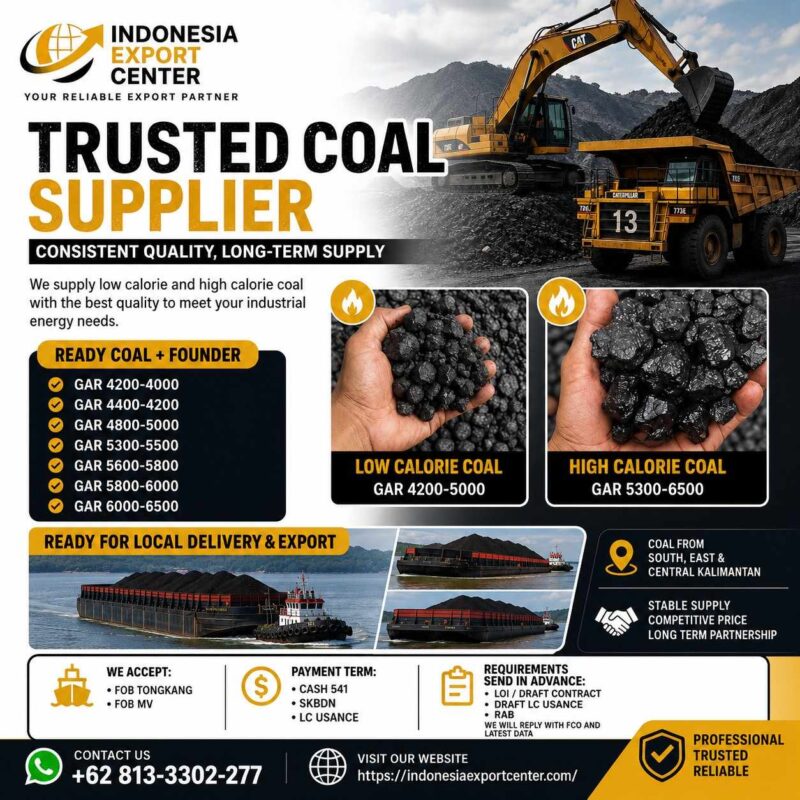
Indonesia Export Center currently receives inquiries for Indonesian thermal coal in several GAR ranges, subject to mine availability, stockpile conditions, production batches, loading location, and final seller confirmation.
Low-Calorific-Value Coal
Buyers seeking a lower acquisition cost may consider products covered by the Low Calorie Coal GAR 4200–5000 Supplier category.
Typical inquiry ranges include:
- GAR 4200–4400 kcal/kg
- GAR 4800–5000 kcal/kg
This category is frequently considered for industrial boilers, general manufacturing, cement production, and power-generation facilities designed to handle coal with higher moisture levels.
The commercial advantage may be a lower price per metric tonne. However, buyers should calculate the delivered cost per usable unit of energy, not only the price per tonne.
High-Calorific-Value Coal
Buyers requiring a higher heat value may submit inquiries through the High Calorie Coal GAR 5300–6600 Supplier category.
Typical inquiry ranges may include:
- GAR 5300–5500 kcal/kg
- GAR 5600–5800 kcal/kg
- GAR 5800–6000 kcal/kg
- GAR 6000–6500 or other specifications subject to current mine availability
Higher-calorific-value coal can reduce the quantity of coal required to produce a given amount of heat, although actual plant performance also depends on boiler design, combustion controls, coal sizing, moisture, ash characteristics, and operating conditions.
The availability of coal near the upper end of the GAR 5300–6600 range must always be confirmed using the latest mine data and Certificate of Analysis.
2. Do Not Compare GAR and NAR as Identical Values
One of the most common mistakes in coal purchasing is comparing calorific values reported on different bases.
GAR means Gross Calorific Value on an As-Received basis. It includes the effect of the coal’s moisture in the condition in which the cargo is received.
NAR means Net Calorific Value on an As-Received basis. NAR is normally lower than GAR because it accounts for the energy required to evaporate water during combustion.
ISO 1928:2025 establishes a method for determining gross calorific value. It also explains the distinction between gross heat measurement and the net heat available under practical combustion conditions.
A buyer should never compare:
- GAR with NAR;
- As-Received with Air-Dried Basis;
- Air-Dried Basis with Dry Basis; or
- a preliminary mine analysis with a final loading-port analysis
without an agreed conversion method.
The purchase contract should specify the reporting basis for every parameter.
3. Prepare a Complete Coal Specification
A serious Request for Quotation should contain more than the required GAR value.
At a minimum, the buyer should specify:
| Parameter | Information to State |
|---|---|
| Calorific value | Required GAR or NAR in kcal/kg |
| Total moisture | Maximum percentage, As-Received basis |
| Inherent moisture | Maximum percentage and analysis basis |
| Ash content | Maximum percentage and analysis basis |
| Total sulfur | Maximum percentage and analysis basis |
| Volatile matter | Required range and analysis basis |
| Fixed carbon | Required range and analysis basis |
| HGI | Minimum or acceptable range |
| Coal size | ROM, crushed, screened, or required millimetres |
| Quantity | Trial cargo, spot cargo, monthly supply, or annual contract |
| Delivery term | FOB barge, FOB mother vessel, CFR, or CIF |
| Destination | Country and destination port |
| Shipment period | Required laycan or delivery month |
ISO 589 describes recognized methods for determining total moisture in hard coal. The applicable laboratory method and reporting basis should be stated in the contract.
The buyer should also establish contractual values for:
- typical specification;
- guaranteed specification;
- rejection limits;
- price adjustments or penalties; and
- the final laboratory whose results will be binding
Without these provisions, even a genuine cargo may lead to a commercial dispute.
4. Send a Professional RFQ or Letter of Intent
A supplier cannot prepare an accurate offer if the inquiry only asks, “What is your coal price?”
Coal prices depend on quality, mine location, loading point, shipment quantity, barge or vessel size, laycan, payment method, freight conditions, and current stock availability.
A professional inquiry should include:
Buyer company information
- Full legal company name
- Registered address and country
- Company profile
- Business registration or import licence
- Authorized contact person
- Corporate email address
Purchase requirement
- Required GAR or NAR
- Complete technical specification
- Quantity per shipment
- Monthly or annual quantity
- Destination port
- Preferred Incoterm
- Target shipment date
- Preferred payment method
- Inspection requirements
Indonesia Export Center recommends that serious buyers provide an official LOI, company profile, required GAR, required quantity, destination, delivery scheme, payment preference, and supporting documents so that seller availability can be checked properly.
5. Verify the Supplier and the Legal Coal Source
The company communicating with the buyer may be a mine owner, licensed coal trader, marketing representative, sourcing company, or export partner. These parties do not necessarily have the same legal role.
Before signing a contract or transferring money, request documentation that identifies:
- the legal contractual seller;
- the mine or stockpile source;
- the party holding the relevant mining or coal trading permit;
- the registered exporter;
- the party receiving payment;
- the loading port or anchorage;
- the appointed surveyor; and
- the party responsible for Indonesian export clearance
The bank beneficiary should match the contractual seller or another party whose payment role is clearly explained and documented in the contract.
Important Indonesian Regulatory Update for 2026
Indonesia introduced Ministry of Trade Regulation No. 15 of 2026 concerning the export of strategic natural-resource coal commodities. The regulation took effect on 1 June 2026.
It requires regulated coal exports to meet registered-exporter requirements and undergo technical verification or tracing by an appointed surveyor. The resulting Surveyor Report is used as a supporting customs document for the Indonesian export declaration.
During the 2026 transition period, existing registered coal exporters and Surveyor Reports are used for exports routed through the designated state-owned export entity. The regulation states that coal exports after 31 December 2026 may only be carried out by the designated BUMN Export.
Because export regulations can change, buyers should request written confirmation of the current export structure before concluding each transaction.
6. Review the Seller’s Offer Carefully
A proper coal offer should clearly state:
- Seller’s legal name
- Product and origin
- Mine or stockpile location
- Complete typical specification
- Guaranteed specification
- Rejection limits
- Quantity and tolerance
- Price and currency
- Price basis or index reference
- Loading point
- Delivery term
- Laycan
- Loading rate
- Demurrage and despatch
- Inspection company
- Quantity-determination method
- Quality-determination method
- Payment term
- Offer validity
- Required documents
Avoid accepting an offer that only states a GAR value and a price.
The contract should explain whether the price is fixed or linked to an agreed index. It should also specify how the price will be adjusted if the final calorific value, sulfur, ash, or moisture differs from the contractual reference.
7. Appoint an Independent Surveyor
A preliminary Certificate of Analysis is useful for evaluating an offer, but it should not automatically be treated as the final cargo quality.
The buyer should appoint or mutually approve an independent inspection company to supervise:
- stockpile condition;
- sampling during loading;
- sample preparation and sealing;
- laboratory analysis;
- draft survey;
- quantity determination;
- vessel-hold cleanliness;
- loading progress; and
- final cargo documentation
ISO 18283:2022 provides procedures for manual sampling during the transfer of coal or coke, including sampling schemes, sample handling, preparation, storage, and reporting. The ISO 13909 series covers mechanical coal sampling.
Sampling during a moving stream or loading operation is generally more representative than taking a small sample from the surface of a stationary stockpile.
The contract should identify:
- who appoints the surveyor;
- who pays the inspection cost;
- where sampling takes place;
- which laboratory conducts the analysis;
- how many sealed samples are retained;
- which result is final and binding; and
- how an umpire analysis will be conducted if a dispute occurs
8. Select the Correct Shipment Term
Incoterms® clarify the allocation of tasks, costs, and risks between buyer and seller. The contract should state the full term, the named port or delivery point, and “Incoterms® 2020.”
FOB Mother Vessel
Under standard FOB, the seller delivers the cargo on board the buyer-nominated vessel at the named port of shipment. Risk transfers when the goods have been loaded on board the vessel. FOB is suitable for non-containerized bulk cargo transported by sea or inland waterway.
A proper contract description might read:
FOB Named Indonesian Loading Port, Incoterms® 2020
FOB Barge or FOB Tongkang
“FOB barge” is widely used as a commercial expression in Indonesian coal trading, especially when coal is loaded onto a barge at a river jetty before being transported to a mother vessel.
However, the contract must define:
- the exact delivery point;
- whether risk transfers at the jetty or after barge loading;
- who charters the barge;
- who pays barge freight;
- who bears transshipment risk;
- where final sampling occurs; and
- whether quantity is determined at the jetty, barge, or mother vessel
Do not rely on the words “FOB barge” alone.
CFR or CIF
Under CFR, the seller pays the ocean freight to the destination port, while marine risk transfers when the cargo is loaded at the port of shipment.
Under CIF, the seller also arranges the contractually required cargo insurance. CIF does not mean that the seller retains all cargo risk until the destination.
Indonesia Export Center’s current coal sourcing scheme prioritizes FOB barge and FOB mother-vessel inquiries. CFR or CIF requests require specific confirmation from the seller.
9. Confirm Maritime Safety Requirements
Coal is shipped as a solid bulk cargo and must comply with the applicable International Maritime Solid Bulk Cargoes Code requirements.
The IMSBC Code addresses hazards including cargo instability, chemical reactions, improper cargo distribution, and loss of vessel stability.
Certain coal cargoes containing fine particles and moisture may require assessment of their actual moisture content and Transportable Moisture Limit. IMO guidance notes that coal may liquefy if shipped above its TML under applicable cargo characteristics.
Before loading, the shipper, vessel owner, master, terminal, and surveyor should confirm the required:
- cargo declaration;
- IMSBC cargo classification;
- moisture certificate;
- TML certificate, where applicable;
- self-heating precautions;
- gas-monitoring requirements;
- ventilation procedures; and
- loading and trimming plan
These requirements should be handled by qualified maritime professionals.
10. Agree on a Secure Payment Structure
Payment terms depend on the seller, buyer profile, banking relationship, quantity, and contract duration.
Possible structures include:
- Documentary Letter of Credit
- Usance Letter of Credit
- Telegraphic Transfer with agreed milestones
- Domestic Indonesian banking instruments for local transactions
For a first transaction, the parties may consider a smaller trial cargo if operationally and commercially feasible.
Buyers should avoid:
- transferring a large advance to an unrelated personal account;
- paying before verifying the seller and legal source;
- accepting sudden beneficiary changes without documentation;
- relying only on messages sent through social media;
- accepting unverifiable inspection reports; or
- issuing a financial instrument that does not match the signed contract
Banks should independently authenticate Letters of Credit, amendments, guarantees, and other financial messages through official banking channels.
11. Prepare the Export and Import Documents
The document package may include:
- Commercial Invoice
- Bill of Lading
- Certificate of Origin
- Certificate of Analysis
- Surveyor Report
- Weight Certificate or Draft Survey Report
- Moisture and TML certificates when applicable
- Cargo declaration
- Insurance certificate for CIF shipments
- Vessel and shipping documents
- Indonesian customs-export documentation
- Documents required by the destination country
Indonesian Customs requires the exporter to submit a Pemberitahuan Ekspor Barang, or PEB, together with the relevant supporting customs documents. Goods may also be subject to selective physical inspection based on customs risk management.
Indonesia’s Certificate of Origin, known locally as Surat Keterangan Asal or SKA, certifies that the exported goods originate from the exporting country.
The exact HS classification must be confirmed with the buyer’s customs broker. Indonesian Regulation No. 15 of 2026 covers several coal headings under HS Chapter 27, including bituminous fuel coal and other coal classifications.
The importer remains responsible for confirming:
- import licences;
- customs duties and taxes;
- environmental permits;
- power-plant or industrial-fuel restrictions;
- sanctions and banking compliance;
- destination-port requirements; and
- local coal-quality regulations
12. Include Clear Claims and Settlement Provisions
The Sales and Purchase Agreement should explain how claims will be handled after loading or discharge.
Important provisions include:
- final quantity determination;
- final quality determination;
- document-presentation deadline;
- demurrage and despatch;
- quality adjustment formula;
- rejection procedure;
- retained sample period;
- umpire laboratory procedure;
- claims-notification deadline;
- governing law;
- dispute-resolution mechanism; and
- force-majeure provisions
A cargo that is commercially acceptable but slightly different from the typical specification should be settled using the agreed adjustment formula. A cargo outside the rejection limits should follow the rejection or renegotiation procedure stated in the contract.
Common Warning Signs in Coal Transactions
International buyers should conduct additional due diligence when they encounter:
- Prices substantially below comparable market levels
- No identifiable mine or stockpile source
- Refusal to permit independent inspection
- No clear loading point
- Unverifiable mining or trading permits
- A bank account unrelated to the contractual seller
- Repeated requests for unofficial fees
- A copied or altered Certificate of Analysis
- No rejection limits or quality-adjustment formula
- A seller promising any quantity, grade, port, and payment term without verification
- Requests for financial documents before basic seller information is provided
A genuine supplier should be able to explain the commercial and legal supply chain clearly, although some confidential documents may only be disclosed after the buyer has passed company verification.
How Indonesia Export Center Supports International Buyers
Indonesia Export Center works as a sourcing and coordination partner connecting international buyers with selected Indonesian suppliers and export-oriented supply networks. Its website states that it supports specification matching, supplier communication, product sourcing, and export preparation.
Buyers looking for an Indonesian Steam Coal Supplier may submit an official inquiry for available thermal-coal grades from selected Indonesian supply areas.
Support may include:
- Matching the buyer’s required GAR with available supply
- Coordinating preliminary seller information
- Checking current stock and loading options
- Communicating buyer specifications
- Coordinating COA and surveyor information
- Discussing FOB barge or FOB mother-vessel arrangements
- Assisting communication between buyer, supplier, and export partners
The legal seller, registered exporter, designated BUMN export channel, mine source, inspection company, and payment beneficiary must be identified and agreed separately for each transaction.
Information Required to Request a Quotation
Please provide:
- Required coal grade and complete specification
- Quantity per shipment and monthly requirement
- Destination country and port
- Preferred shipment term
- Target shipment period
- Preferred payment method
- Buyer’s legal company name and profile
- Import licence or company registration, where applicable
- Official LOI or RFQ
- Required inspection and documentation
Incomplete inquiries may only receive an indicative response because the final price depends on the latest mine availability, stockpile condition, loading point, surveyor result, vessel schedule, and seller approval.
Frequently Asked Questions
What is the minimum order quantity for Indonesian steam coal?
MOQ depends on the loading point, barge capacity, mother-vessel size, seller policy, and current stock availability. Buyers should state their required quantity rather than assuming a fixed MOQ.
Is GAR 5000 the same as NAR 5000?
No. GAR and NAR use different heat-value definitions. The contract must state the required basis and the applicable test standard.
Can buyers purchase Indonesian coal on CIF terms?
CIF may be possible when specifically approved by the seller. Indonesia Export Center’s current sourcing scheme primarily receives FOB barge and FOB mother-vessel inquiries.
Is a preliminary COA sufficient?
A preliminary COA helps buyers evaluate the product, but the contract should normally rely on representative sampling and independent analysis during the agreed loading stage.
Which coal grade should a buyer choose?
The correct grade depends on boiler design, fuel-handling system, permitted emissions, delivered energy cost, ash-disposal capacity, and operational requirements. Buyers should obtain technical approval from their plant team before signing a purchase contract.
Conclusion
Importing Indonesian steam coal requires careful coordination between the buyer, legal seller, mine or stockpile operator, registered exporter, designated export channel, surveyor, shipping company, bank, and customs authorities.
The safest approach is to:
- define a complete specification;
- verify the seller and legal coal source;
- appoint an independent surveyor;
- use a detailed Sales and Purchase Agreement;
- select a precise Incoterm and delivery point;
- secure payment through verifiable banking channels; and
- confirm both Indonesian export requirements and destination-country import rules.
International buyers seeking GAR 4200–5000 or GAR 5300–6600 coal may contact Indonesia Export Center with a complete RFQ, company profile, destination port, required quantity, payment preference, and target shipment schedule.
Indonesia Export Center
WhatsApp: +62 813-3302-277
Email: info@indonesiaexportcenter.com
Regulatory notice: This article was updated in July 2026 and is intended as general commercial information. Export, customs, banking, sanctions, shipping, and import regulations should be reconfirmed with the relevant authorities and licensed professionals before each transaction.
