![Indonesia Export Center [IEC]](https://indonesiaexportcenter.com/wp-content/uploads/2023/07/logo-no-background.svg)
![Indonesia Export Center [IEC]](https://indonesiaexportcenter.com/wp-content/uploads/2023/07/svgviewer-output.svg)
Learning how to expand a 5 kg cocopeat block correctly is essential for growers, nurseries, greenhouse operators, potting-mix producers, and hydroponic farms. Although a compressed cocopeat block appears hard, dry, and relatively small, it transforms into a large quantity of light growing medium after water is added.
The expansion process is straightforward, but using the wrong container, adding too much water at once, or failing to separate dry sections can produce an uneven growing medium. Growers should also understand that hydration, washing, and buffering are different processes. A block may need only hydration, or it may require additional preparation depending on its electrical conductivity, processing history, and intended application.
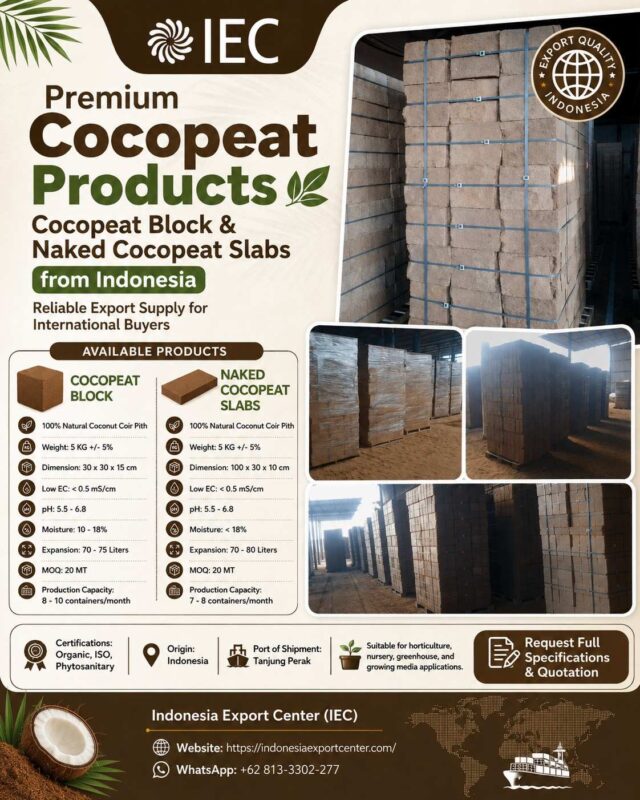
Indonesia Export Center supplies Indonesian 5 kg cocopeat blocks for international buyers. Its current product specification indicates a block weight of approximately 5 kg, a 5:1 compression ratio, and an expected expansion volume of approximately 70–75 liters after hydration. The product is offered for hydroponic systems, greenhouse cultivation, nurseries, potting-mix production, soil conditioning, and other commercial agricultural applications.
This guide explains how to rehydrate a compressed block safely, how much water to use, how to identify complete expansion, and what to check before using the material for planting.
What Is a 5 kg Cocopeat Block?
A 5 kg cocopeat block is a compressed form of coir pith produced from coconut husk processing. Coir pith consists mainly of the smaller, sponge-like particles separated from longer coconut fibers.
Compression makes cocopeat more practical for storage and international transportation. Instead of shipping a large volume of loose material, producers compress it into dense blocks. The end user then adds water to recover the loose substrate.
Coir is valued as a horticultural substrate because its fibrous structure can support both water retention and root-zone aeration. Research published through the USDA Agricultural Research Service explains that coir has a fibrous texture that provides aeration and water-holding capacity. The same research also notes its relatively strong rewetting capacity, which helps reduce hydrophobic behavior when the substrate becomes dry.
University of Minnesota Extension similarly lists coconut coir as an organic hydroponic substrate with good water retention, while explaining that compressed coir bricks must be rehydrated before use.
How Much Cocopeat Does a 5 kg Block Produce?
The final volume depends on several factors, including:
- Compression ratio
- Initial moisture content
- Particle-size distribution
- Percentage of fine pith and fiber
- Processing and drying conditions
- Amount of water added
- Time allowed for expansion
- Method used to break apart the block
Indonesia Export Center lists an estimated expansion of 70–75 liters for its 5 kg cocopeat block. Its published specification also indicates a block dimension of approximately 30 × 30 × 15 cm, moisture content of 10–18%, and a compression ratio of 5:1. Final specifications should still be confirmed for each commercial order because agricultural substrate properties may vary by production batch.
Do not assume that every 5 kg block from every producer will yield exactly the same volume. Expansion volume should be treated as a measurable quality parameter rather than a universal figure.
What You Need to Expand a 5 kg Cocopeat Block
Prepare the following equipment before starting:
- One compressed 5 kg cocopeat block
- A clean container with a capacity of at least 80–100 liters
- Approximately 20–25 liters of clean water as an initial working range
- A watering can, hose, or measured bucket
- A garden fork, hand cultivator, shovel, or clean mixing tool
- Gloves, especially for commercial-scale preparation
- An EC meter and pH meter when preparing substrate for professional cultivation
- A drainage screen or perforated container when rinsing is required
The container must be considerably larger than the dry block. A block capable of producing 70–75 liters should not be placed in a small household bucket. A large plastic tub, clean wheelbarrow, mixing tank, substrate tray, or concrete mixing area with controlled drainage is more appropriate.
For commercial nurseries, the preparation area should also be clean enough to prevent the hydrated medium from being contaminated with soil, weeds, chemical residues, or plant pathogens.
Step 1: Inspect the Block Before Hydration
Check the block before adding water.
A normal compressed cocopeat block should be relatively firm and dry. Minor cracks along the sides are generally not a problem because the block has been mechanically compressed. However, buyers should document unusual conditions such as excessive moisture, mold, unpleasant odor, foreign material, broken packaging, or major weight inconsistency.
Also check the product documentation to determine whether the material is:
- Unwashed
- Washed
- Low EC
- Buffered
- Unbuffered
- Intended for soil amendment
- Intended for professional hydroponics
These descriptions influence what must be done after the block expands.
A low-EC block is not automatically the same as a buffered block. Washing primarily reduces soluble salts, while buffering changes the cation balance of the coir through treatment with calcium-containing materials. Therefore, the buyer should ask the supplier to state both EC status and buffering status clearly.
Step 2: Place the Block in a Large Container
Place the cocopeat block flat in the center of the container. Leave enough open space around all sides because the material will expand outward and upward.
The orientation is not critically important, but laying the block on its broadest surface can help keep it stable while water is being added.
Do not break the completely dry block forcefully with heavy equipment unless necessary. Dry compressed cocopeat can generate dust, and aggressive mechanical breaking may make the preparation area unnecessarily messy. It is normally easier to soften the outside first and separate the block gradually.
Step 3: Add Water Gradually
A practical starting range is approximately 20–25 liters of water for one 5 kg block, but the exact requirement varies by product and desired final moisture.
Commercial coir guidance from Botanicoir identifies about 25 liters per 5 kg block as a typical hydration quantity. It recommends adding water slowly and allowing the material time to absorb moisture evenly.
Start by pouring approximately 15–20 liters evenly over the top and around the sides of the block. Avoid directing all the water onto only one corner.
Gradual watering offers several advantages:
- The exterior softens without becoming excessively saturated.
- Water has time to move into the compressed center.
- Dry sections can be identified.
- The operator can stop before the substrate becomes waterlogged.
- Moisture distribution is easier to control.
Clean water should be used. For professional hydroponic production, check the source water’s EC and pH before preparing the substrate. University of Minnesota Extension recommends establishing baseline EC and pH values for source water because dissolved salts and alkalinity affect nutrient-solution management.
Step 4: Allow the Block to Absorb the Water
Wait approximately 15–30 minutes after the first water application. Some dense blocks may require more time.
The block will begin to swell, crack, and separate into layers. The outer material usually expands first, while the central portion remains compressed for longer.
Do not judge the final volume during the first few minutes. Complete hydration takes time, particularly when cold water is used or the block has been compressed very densely.
Commercial preparation guidance indicates that allowing up to an hour can improve uniformity and give the operator enough time to identify dry patches.
Room-temperature or slightly warm water can be used to support faster wetting. Boiling water is unnecessary and could create workplace safety risks.
Step 5: Break Apart the Softened Cocopeat
Once the block begins to soften, use gloved hands, a garden fork, or a clean cultivator to pull away the expanded layers.
Work from the outside toward the center.
Do not simply stir the wet surface while leaving a hard core underneath. Turn the block over if necessary and expose the compressed sections to water.
Break apart all visible lumps until the material becomes loose and relatively uniform. Correctly expanded cocopeat should have a light, crumbly, sponge-like texture. It should not contain large, dry slabs.
For commercial-scale expansion, mechanical substrate mixers can reduce labor requirements. However, mixing should be controlled to avoid destroying the desired particle structure or unnecessarily pulverizing larger fractions.
Step 6: Add the Remaining Water in Small Increments
After separating the first layers, inspect the medium for pale, hard, or dusty areas. These indicate incomplete hydration.
Add the remaining water in small increments of approximately 2–5 liters. Mix after each addition.
This method is safer than pouring a large quantity of water into the container at the beginning. The objective is not to submerge the cocopeat. The objective is to distribute enough moisture for the particles to recover their volume.
The required amount may be slightly below or above 25 liters depending on the block’s initial moisture and physical composition. Product-specific instructions should take priority over a generic water ratio.
Step 7: Check the Final Moisture and Texture
Take a handful of the expanded cocopeat and squeeze it gently.
Properly hydrated material should:
- Feel uniformly moist
- Separate easily when released
- Contain no hard inner pieces
- Have a light and fluffy structure
- Produce little or no freely flowing water
- Avoid forming a heavy, muddy mass
A few drops during squeezing may be acceptable, but water should not continuously stream from the material. Standing water at the bottom of the container indicates that too much water was added or that the block has not yet absorbed it fully.
Allow additional absorption time before draining. When excess water remains after resting and mixing, drain it in a controlled manner.
Step 8: Measure the Expanded Volume
For quality-control purposes, transfer the hydrated material into a known-volume container without pressing it down excessively.
Measure the loose-filled volume rather than compacting the substrate by hand. Excessive compaction will make the expansion result appear lower than it actually is.
International buyers can use expansion testing as part of incoming quality inspection. Test multiple blocks from different parts of a shipment instead of relying on only one sample.
In addition to expanded volume, commercial buyers commonly evaluate:
- Block weight
- Moisture content
- EC
- pH
- Sand content
- Fiber percentage
- Impurities
- Particle-size distribution
- Bulk density
- Packaging condition
- Batch consistency
The IEC product page lists an indicative Low EC specification below 0.5 mS/cm and a pH range of 5.5–6.8 for its 5 kg block. These values, together with expansion, moisture, impurities, and fiber content, should be reconfirmed against the final specification or certificate of analysis for each order.
Does Expanded Cocopeat Need to Be Rinsed?
Rinsing depends on the product specification and the application.
A properly processed Low EC product may not require the same intensive rinsing as untreated coir. Nevertheless, professional growers should verify the EC of the expanded material or drainage solution rather than relying only on appearance.
EC measures the concentration of dissolved ions in a solution. Excessive EC can make water uptake more difficult and contribute to plant stress, while an EC that is too low in a nutrient solution can indicate inadequate fertility. The correct target depends on the crop, growth stage, source water, and production system.
When the measured EC exceeds the buyer’s crop-specific limit, the hydrated cocopeat can be rinsed using clean, low-EC water and allowed to drain. Continue testing the drainage until it reaches the required specification.
Do not dispose of high-salinity drainage water carelessly, especially near cultivated land or freshwater systems.
Does Cocopeat Need to Be Buffered?
Buffering is different from simple hydration.
Coir can contain exchangeable potassium and sodium. During cultivation, calcium and magnesium may bind to exchange sites in the substrate, potentially affecting their availability to plants. Washed and buffered coir is pretreated to improve this cation balance. Purdue Extension notes that coir-based substrates can require different calcium, sulfur, copper, iron, and potassium management compared with peat-based materials.
Do not create a buffering recipe based only on a general internet recommendation. Calcium concentration, soaking period, water quality, crop sensitivity, and starting coir chemistry all matter.
Commercial buyers should ask:
- Has the block been washed?
- What EC test method was used?
- Has it been calcium buffered?
- Which buffering chemical was used?
- Is a batch certificate available?
- Is the product intended for direct hydroponic use?
- Does the supplier recommend further rinsing or buffering?
When the product is unbuffered and intended for sensitive hydroponic cultivation, use a buffering protocol developed by an agronomist or substrate specialist.
Should Fertilizer Be Added During Expansion?
Do not automatically add fertilizer during the first hydration step.
Plain, clean water makes it easier to evaluate the block’s natural EC and expansion performance. Adding fertilizer immediately changes the drainage EC and makes it difficult to determine whether the measured salts originated from the cocopeat, the source water, or the fertilizer.
After the cocopeat has been hydrated, tested, rinsed, and buffered when necessary, growers can apply a crop-specific nutrient solution.
Cocopeat should not be treated as a complete fertilizer. It is primarily a physical growing-medium component. Nutrient management must be designed around the crop and production system.
Common Mistakes When Expanding a Cocopeat Block
Using a container that is too small
A 5 kg block can produce around 70 liters or more of loose material. A small bucket will overflow and prevent proper mixing.
Adding all the water to one area
This produces a wet outer section and a dry center. Water should be distributed across the block.
Using too much water immediately
Flooding the block can produce a heavy, saturated mixture and may require unnecessary draining.
Failing to break apart the center
A block may look expanded on the outside while remaining dry internally. Always inspect and separate the core.
Confusing Low EC with buffered cocopeat
Low soluble salt content does not by itself confirm that the coir has received calcium buffering.
Adding fertilizer before testing
Fertilizer changes EC measurements and can hide the starting condition of the material.
Compressing the material during volume measurement
Expansion should generally be evaluated as a loose-filled volume using a consistent method.
Using contaminated tools or surfaces
Hydrated cocopeat can be contaminated by soil, disease residues, weeds, dirty drainage water, or previously used substrate.
How Can Expanded Cocopeat Be Used?
After appropriate hydration and chemical preparation, cocopeat can be used for:
- Hydroponic vegetable production
- Greenhouse growing systems
- Seedling and propagation mixes
- Nursery containers
- Grow-bag filling
- Potting-mix production
- Raised-bed mixtures
- Soil conditioning
- Moisture-retaining substrate blends
The ideal formulation depends on the crop. Fine coir pith generally contributes water retention, while larger particles, chips, fiber, perlite, bark, or other structural components may increase air space and drainage.
Research has shown that adding coir to substrate blends can increase water availability while retaining pore space for oxygen. However, the resulting physical behavior changes with the proportion of coir and the particle-size composition.
Therefore, growers should conduct a small crop trial before changing a commercial growing-medium formulation.
Buying 5 kg Cocopeat Blocks from Indonesia
International buyers should evaluate much more than the dry block’s price. Expansion volume affects how much usable growing medium is obtained from every metric ton and shipping container.
Important purchasing information includes:
- Weight tolerance
- Compression ratio
- Expansion volume
- EC and test method
- pH and test method
- Washed or unwashed status
- Buffered or unbuffered status
- Moisture percentage
- Sand and impurities
- Fiber content
- Particle-size distribution
- Packaging configuration
- Pallet requirements
- Loading quantity
- Certification availability
- Production lead time
- Port of shipment
Indonesia Export Center currently presents 5 kg Low EC cocopeat blocks made from natural coconut coir pith for international buyers, importers, hydroponic farms, greenhouse growers, nurseries, and growing-media producers. Its listed commercial specification includes approximately 70–75 liters of expansion, EC below 0.5 mS/cm, pH 5.5–6.8, and a minimum commercial order of 20 metric tons. Packing, certification, production schedule, and final technical parameters are subject to order confirmation.
Buyers requesting a quotation should provide the required quantity, destination port, intended application, EC requirement, buffering requirement, preferred packaging, certification needs, and shipment schedule. This allows the supplier to match the inquiry with the appropriate production and export arrangement.
Frequently Asked Questions
How much water is needed for a 5 kg cocopeat block?
Approximately 20–25 liters is a practical starting range for many commercial 5 kg blocks. Add the water gradually because initial moisture, compression, and particle composition vary. Botanicoir identifies approximately 25 liters per 5 kg block as a typical hydration quantity.
How long does a cocopeat block take to expand?
Initial expansion may occur within 15–30 minutes. Dense blocks can require more mixing and resting time to hydrate completely.
How many liters does a 5 kg cocopeat block produce?
The IEC specification indicates approximately 70–75 liters per block after hydration. Actual results should be verified using a consistent expansion-testing method.
Can I plant directly in expanded cocopeat?
That depends on EC, buffering status, water quality, crop requirements, and nutrient management. Test the substrate before planting, particularly for professional hydroponic production.
Is cocopeat already fertilized?
Cocopeat is primarily a growing-medium component, not a complete fertilizer. Plants normally require a suitable nutrient program.
Can cold water be used?
Yes. Room-temperature water works, although absorption may take longer than with slightly warm water.
Should cocopeat be soaked overnight?
It is not always necessary. The block is ready when it has expanded evenly, no hard dry sections remain, and the target moisture has been reached. Longer resting can help equalize moisture in dense material.
Conclusion
Understanding how to expand a 5 kg cocopeat block helps growers obtain a uniform, predictable, and usable growing medium.
Place the block in a container large enough to hold the final volume, apply clean water gradually, allow time for absorption, separate the softened layers, and add additional water only where needed. For many products, approximately 20–25 liters of water is a useful starting range, while the final expanded volume may reach approximately 70–75 liters.
Hydration is only the physical preparation stage. Before planting, professional users should also verify EC, pH, washing status, buffering status, moisture consistency, and crop-specific nutrient requirements.
For bulk Indonesian cocopeat requirements, international buyers can contact Indonesia Export Center regarding 5 kg cocopeat blocks, technical specifications, packing preferences, documentation, production availability, and export shipment arrangements. The company’s published contact number is WhatsApp +62 813-3302-277.
