

IEC | INDONESIA EXPORT CENTER
Your Global Sourcing Partner
Understanding the Thermal Properties of Gum Copal
Thermal behavior is an important consideration when evaluating natural Gum Copal for industrial manufacturing.
Materials engineers, laboratory technicians, and formulation specialists may need to understand how a resin responds to changes in temperature during handling, preparation, processing, and finished-product use.
However, natural resins are not always characterized by a single sharp melting temperature.
Depending on the material, softening and other thermal transitions may occur over a range of conditions.
Indonesia Export Center (IEC) facilitates B2B inquiries involving potential Indonesian Gum Copal suppliers.
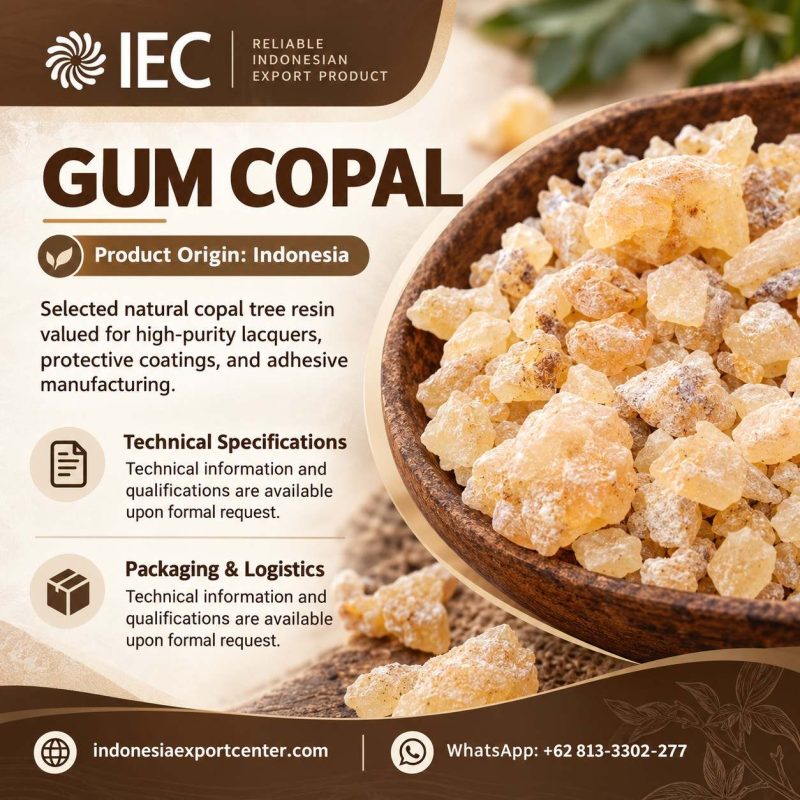
The IEC brochure identifies the material as selected natural copal tree resin originating from Indonesia.
No verified numerical softening point or melting point is supplied in the brochure.
What Is a Softening Point?
A softening point is a temperature-related measurement describing the behavior of a material under a defined test procedure.
Unlike the sharp melting point of some pure crystalline substances, resin softening may occur gradually.
The reported result depends on the material and test method.
Therefore, a softening point should always be interpreted together with its analytical procedure.
Softening Point vs Melting Point
These terms should not automatically be treated as equivalent.
Softening Point: A method-dependent measure of when a material reaches a specified softened condition.
Melting Point: A thermal transition associated with melting, where applicable.
Thermal Decomposition: Chemical breakdown caused by exposure to conditions that exceed the material’s stability.
Glass Transition: A change in the mobility of certain amorphous materials, where applicable.
Different thermal measurements describe different phenomena.
Why Thermal Behavior Matters
Manufacturing
Processing equipment may operate under conditions where resin softening or other changes are relevant.
Formulation
Thermal properties may influence compatibility with other ingredients.
Handling
Material behavior can change during storage or transfer.
Product Development
Thermal characterization may help engineers compare candidate raw materials.
Quality Control
A defined thermal test can support batch comparison.
Factors Influencing Gum Copal Thermal Behavior
Resin Identity
Different copal materials may have different chemical and physical characteristics.
Grade
Commercial grades may vary in composition and preparation.
Moisture and Volatile Components
These may influence observed mass loss or thermal behavior.
Sample Preparation
Particle size and sample preparation can affect certain measurements.
Heating Rate
Some analytical results depend on how quickly the temperature changes.
Test Method
Different methods may produce different results.
Sample History
Previous thermal exposure or processing may influence behavior.
Common Thermal Characterization Approaches
Depending on the laboratory objective and material suitability, techniques may include:
- Standardized softening point procedures.
- Differential scanning calorimetry.
- Thermogravimetric analysis.
- Other validated thermal methods.
The selected method should be appropriate for the resin and the required decision.
Differential Scanning Calorimetry
Differential scanning calorimetry, commonly called DSC, can be used to investigate heat-flow changes associated with certain thermal events.
The resulting data require appropriate interpretation.
A DSC feature should not automatically be labelled a melting point without supporting evidence.
Thermogravimetric Analysis
Thermogravimetric analysis, or TGA, measures changes in sample mass during a defined thermal program.
It may help investigate mass-loss behavior.
However, a mass-loss event does not by itself identify which substance was lost.
Softening Point Testing
Where a suitable softening point method is selected, the report should identify:
- Method.
- Sample preparation.
- Instrument.
- Heating conditions.
- Result.
- Units.
- Laboratory.
- Relevant limitations.
Suggested Thermal Testing Checklist
| Parameter | Required Information |
|---|---|
| Product Identity | Confirmed |
| Grade | Identified |
| Sample Lot | Recorded |
| Sample Preparation | Documented |
| Test Method | Specified |
| Heating Conditions | Recorded |
| Softening Result | Measured |
| Thermal Events | Described |
| Repeatability | Evaluated |
| Laboratory | Identified |
Why Buyers Should Avoid Universal Processing Temperatures
A temperature suitable for one resin and manufacturing process may be unsuitable for another.
Uncontrolled heating may create risks involving:
- Material degradation.
- Discoloration.
- Vapour generation.
- Equipment damage.
- Fire hazards.
- Changes in product properties.
Processing conditions should be established by qualified personnel using appropriate data and safety controls.
Thermal Behavior in Varnish Manufacturing
Relevant evaluation may include:
- Resin preparation.
- Formulation compatibility.
- Processing conditions.
- Film properties.
- Stability.
Thermal Behavior in Lacquer Manufacturing
Manufacturers may consider:
- Processing feasibility.
- Compatibility.
- Colour changes.
- Product stability.
- Equipment requirements.
Thermal Behavior in Adhesive Manufacturing
Where thermal processing is relevant, formulators may investigate:
- Resin compatibility.
- Viscosity behavior.
- Processing stability.
- Finished adhesive performance.
Establishing a Thermal Specification
A commercial specification should identify:
- Required thermal parameter.
- Test method.
- Acceptance criteria.
- Sampling procedure.
- Reporting requirements.
- Retesting procedure.
No numerical limit should be assumed without technical evidence.
Supplier Questions
- Is a softening point result available?
- Which method was used?
- Are DSC or TGA results available?
- What is the sample grade?
- Are results representative of commercial lots?
- Can independent testing be arranged?
- Are handling recommendations documented?
- Can samples be supplied for qualification?
Gum Copal Thermal Data RFQ
Subject: Indonesian Gum Copal Softening Point and Thermal Data Request
Company: [Name]
Country: [Country]
Product: Natural Gum Copal
Application: [Details]
Required Grade: [Details]
Required Thermal Tests: [Details]
Preferred Test Methods: [Details]
Buyer Acceptance Criteria: [Details]
Sample Quantity: [KG]
Commercial Quantity: [KG / MT]
Destination: [Port, Country]
Please provide available supplier technical information and representative samples for thermal characterization.
Frequently Asked Questions
What is the softening point of Indonesian Gum Copal?
No verified numerical value is provided in IEC’s brochure.
Is the softening point the same as the melting point?
Not necessarily.
Can DSC be used to characterize Gum Copal?
It may be suitable for certain thermal investigations, subject to method selection.
Does Gum Copal have one fixed processing temperature?
No universal processing temperature is established.
Can buyers request thermal testing?
Yes, subject to supplier and laboratory arrangements.
Does IEC guarantee thermal performance?
No.
Request Gum Copal Thermal Specifications
Need Indonesian Gum Copal for a manufacturing process requiring thermal qualification?
Contact IEC with your application, required testing, sample quantity, and purchasing requirements.
REQUEST GUM COPAL THERMAL INFORMATION
IEC | INDONESIA EXPORT CENTER
Website: https://indonesiaexportcenter.com/
WhatsApp: +62 813-3302-277
Related Resources
Gum Copal Technical Specifications Guide
Gum Copal Solubility and Compatibility
