

IEC | INDONESIA EXPORT CENTER
Your Global Sourcing Partner
Understanding Acid Value in Gum Copal Resin
Acid value is an analytical parameter that may be relevant when evaluating natural resins for industrial formulations.
For quality control laboratories, materials engineers, and chemical procurement teams, acid value testing can provide information about titratable acidic constituents in a material under a defined analytical procedure.
However, the meaning and usefulness of acid value depend on the resin’s chemistry, sample preparation, test method, and intended application.
Indonesia Export Center (IEC) facilitates B2B sourcing inquiries involving potential Indonesian Gum Copal suppliers.
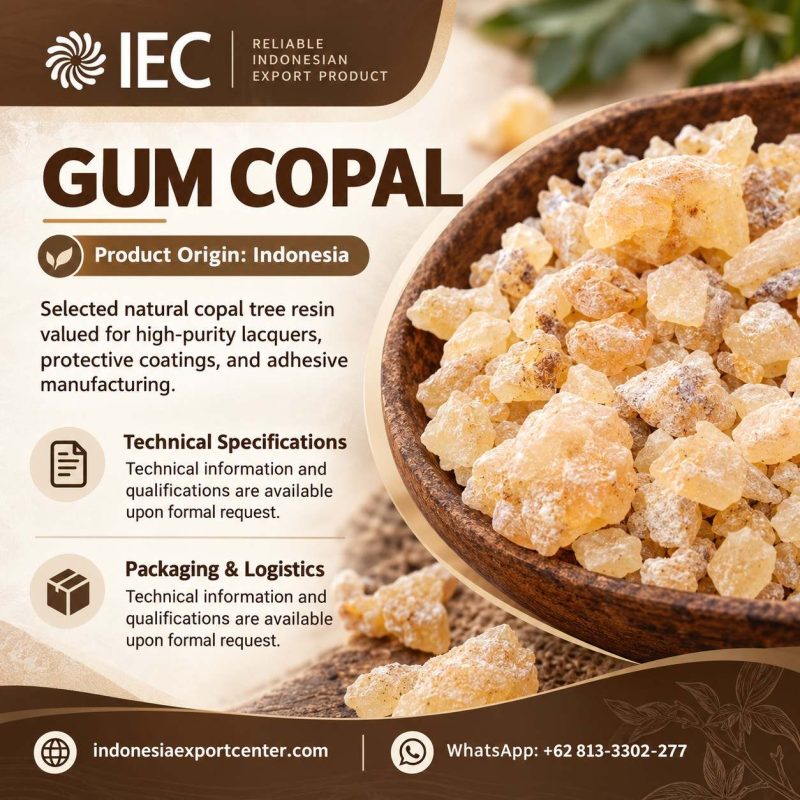
The IEC brochure identifies the material as selected natural copal tree resin originating from Indonesia. Technical information and qualifications are available upon formal request.
No verified numerical acid value is provided in the IEC brochure. Buyers should not assume a particular result or acceptance range without appropriate laboratory evidence.
What Is Acid Value?
Acid value, also called acid number, is commonly expressed as the milligrams of potassium hydroxide equivalent required to neutralize titratable acidic constituents in one gram of sample, according to a defined method.
The usual reporting unit is:
mg KOH/g
This is an analytical expression, not a direct statement of the percentage of a particular acid.
For complex natural resins, acid value may reflect contributions from different acidic components.
Why Acid Value May Matter
Depending on the formulation, acid value may be useful for:
- Comparing resin batches.
- Supporting raw material identification.
- Investigating formulation compatibility.
- Evaluating chemical processing requirements.
- Establishing purchasing specifications.
- Monitoring changes in a material.
A particular acid value does not automatically establish resin purity, quality, or suitability.
Acid Value vs Other Resin Properties
| Property | What It Evaluates |
|---|---|
| Acid Value | Titratable acidity under a defined method |
| Moisture | Water content under a suitable method |
| Foreign Matter | Extraneous material |
| Colour | Visual or instrumental appearance |
| Softening Behavior | Temperature-dependent physical response |
| Solubility | Behavior in a specified medium |
| Resin Identity | Nature of the material being tested |
These parameters should not be used interchangeably.
How Acid Value Is Determined
A laboratory may use an appropriate titrimetric method, provided the procedure is suitable for the resin.
A typical analytical approach involves preparing a defined sample, applying a suitable analytical medium, and determining the amount of standardized reagent required to reach a specified endpoint.
The exact procedure depends on the selected method.
Important Method Considerations
The laboratory should consider:
- Sample identity and homogeneity.
- Appropriate dissolution or dispersion.
- Reagent standardization.
- Blank correction.
- Endpoint determination.
- Analytical interferences.
- Replicate measurements.
- Reporting units.
- Method suitability.
A procedure that works for one resin may not be suitable for every Gum Copal material.
General Acid Value Calculation
For an appropriate titrimetric method using potassium hydroxide:
Acid Value (mg KOH/g) = [(V − B) × N × 56.1] ÷ m
Where:
- V = titrant volume for the sample, in mL.
- B = blank titrant volume, in mL.
- N = titrant normality.
- 56.1 = molar mass factor for KOH.
- m = sample mass, in grams.
This formula is illustrative of a common calculation framework. The laboratory must follow its validated method, including any required corrections.
Why Test Method Identification Is Essential
Two reported acid values may not be directly comparable if laboratories use different procedures.
Differences may arise from:
- Sample preparation.
- Analytical medium.
- Endpoint determination.
- Reagent concentration.
- Instrument calibration.
- Interfering substances.
- Reporting conventions.
Buyers should request the method used for every reported result.
Acid Value in a Supplier Certificate of Analysis
If acid value is included in a supplier COA, the buyer should verify:
| Information | Buyer Check |
|---|---|
| Product | Gum Copal |
| Grade | Clearly identified |
| Lot Number | Traceable |
| Sample Date | Recorded |
| Test Method | Identified |
| Acid Value | Reported in mg KOH/g |
| Specification | Buyer-agreed limit, if applicable |
| Test Date | Recorded |
| Laboratory | Identified |
| Report Status | Reviewed |
The presence of a value on a document does not independently prove that the tested sample represents the commercial shipment.
Acid Value for Varnish Manufacturing
Varnish manufacturers may investigate acid value when studying resin chemistry or interactions with other formulation ingredients.
Its relevance should be established by the formulation chemist.
Acid Value for Coatings and Lacquer
Coating manufacturers may use acid value as one element of raw material characterization.
However, film properties such as gloss, adhesion, and resistance cannot be predicted from acid value alone.
Acid Value for Adhesive Formulations
Adhesive developers may evaluate acid value where chemical functionality or compatibility is relevant.
Finished adhesive performance still requires application-specific testing.
Establishing an Acceptance Specification
A buyer should avoid adopting an arbitrary acid value limit.
Instead:
- Identify the actual resin.
- Determine whether acid value matters to the application.
- Select a suitable analytical method.
- Test representative samples.
- Evaluate formulation performance.
- Establish an evidence-based acceptance range.
- Agree on the specification with the supplier.
Gum Copal Acid Value Inquiry Template
Subject: Indonesian Gum Copal Acid Value and Laboratory Data Request
Company Name: [Company]
Country: [Country]
Product: Natural Gum Copal
Application: [Details]
Required Grade: [Details]
Required Acid Value Range: [If Established]
Preferred Test Method: [Details]
Other Technical Parameters: [Details]
Sample Quantity: [KG]
Commercial Quantity: [KG / MT]
Destination Port: [Port]
Please provide available acid value results, test methods, sample information, and relevant supplier documentation.
Frequently Asked Questions
What is the acid value of Indonesian Gum Copal?
IEC’s supplied brochure does not provide a verified numerical value.
Is acid value the same as acidity percentage?
No. They are different measurements.
Does a lower acid value always mean better resin?
No. Suitability depends on the material and application.
Can acid value determine Gum Copal purity?
Not by itself.
Should acid value appear on every COA?
Only where relevant and included in the agreed testing requirements.
Can buyers request independent acid value testing?
Yes, subject to laboratory and commercial arrangements.
Request Gum Copal Acid Value Information
Need Indonesian Gum Copal with technical documentation for laboratory qualification or industrial manufacturing?
Send IEC your resin requirements, analytical parameters, quantity, and destination.
REQUEST GUM COPAL ACID VALUE INFORMATION
IEC | INDONESIA EXPORT CENTER
Website: https://indonesiaexportcenter.com/
WhatsApp: +62 813-3302-277
Related Resources
Gum Copal Technical Specifications Guide
Gum Copal COA and Laboratory Reports
