

IEC | INDONESIA EXPORT CENTER
Your Global Sourcing Partner
Understanding Gum Copal Resin Solubility for Industrial Applications
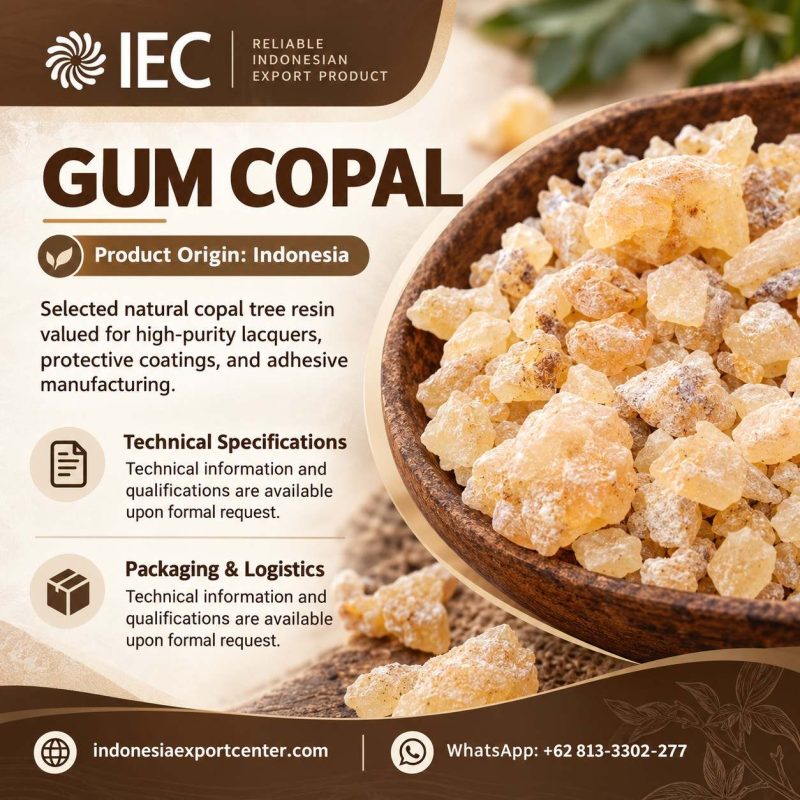
Gum Copal is a natural tree resin associated with varnish, lacquer, protective coating, and selected adhesive manufacturing applications.
For research and development chemists, solubility and compatibility are among the most important considerations when evaluating a natural resin for industrial use.
A resin may be commercially described as Gum Copal, but its actual processing behavior can vary depending on botanical identity, grade, age, preparation, and formulation conditions.
Therefore, it is important to distinguish between a supplier’s general product description and experimentally verified performance.
Indonesia Export Center (IEC) facilitates B2B inquiries involving potential Indonesian Gum Copal suppliers.
The IEC product brochure identifies the material as selected natural copal tree resin originating from Indonesia. Technical information and qualifications are available upon formal request.
IEC does not guarantee Gum Copal solubility in any particular solvent or formulation.
What Does Resin Solubility Mean?
Solubility refers to the ability of a substance to form a solution in a particular medium under defined conditions.
For natural resins, observed behavior may include complete dissolution, partial dissolution, swelling, dispersion, or the presence of undissolved material.
These outcomes are not equivalent.
A resin that appears dispersed may not have formed a true solution.
A transparent mixture may also require further testing to establish its stability.
Why Solubility Matters to Industrial Buyers
Solubility can influence:
- Raw material selection.
- Manufacturing processes.
- Mixing efficiency.
- Filtration requirements.
- Product appearance.
- Formulation stability.
- Equipment compatibility.
- Production costs.
In some applications, dissolution may be necessary. In others, an alternative processing approach may be used.
The relevant requirements should be established by the manufacturer.
Factors That Influence Gum Copal Solubility
1. Resin Identity
Commercial copal materials can differ in chemical composition and physical characteristics.
The exact material being evaluated should be identified.
2. Commercial Grade
Different grades may contain different proportions of components or foreign matter.
3. Solvent Selection
Solvent characteristics can influence interactions with resin components.
No universal solvent recommendation can be made without material-specific testing.
4. Temperature
Temperature may influence dissolution behavior, but heating can introduce safety and degradation risks.
5. Concentration
A resin may behave differently at different concentrations.
6. Mixing Conditions
Mixing intensity and duration may influence the observed result.
7. Particle Size
Physical form can influence the rate of material interaction with the selected medium.
8. Processing History
A resin’s preparation and prior exposure may affect its characteristics.
Solubility vs Compatibility
Solubility is only one aspect of formulation qualification.
A resin may dissolve under laboratory conditions but still be incompatible with other ingredients.
Compatibility testing may consider:
- Phase separation.
- Precipitation.
- Changes in viscosity.
- Colour development.
- Stability during storage.
- Interactions with other resins.
- Finished-product performance.
Designing a Gum Copal Solvent Screening Program
A structured screening program should begin with clear objectives.
Stage 1 – Identify the Resin
Record:
- Supplier.
- Product identity.
- Grade.
- Lot number.
- Physical appearance.
- Available technical information.
Stage 2 – Define Candidate Media
Select screening media based on the intended industrial process, compatibility requirements, and safety assessment.
Stage 3 – Establish Controlled Conditions
Define:
- Sample mass.
- Solvent quantity.
- Concentration.
- Mixing method.
- Temperature.
- Observation time.
- Evaluation criteria.
Stage 4 – Conduct Screening
A qualified laboratory can evaluate the material using appropriate safety controls and documented procedures.
Stage 5 – Record Observations
Record whether the sample:
- Dissolves.
- Partially dissolves.
- Swells.
- Forms a dispersion.
- Produces visible residue.
- Changes colour.
- Separates after standing.
Stage 6 – Assess Stability
A mixture that initially appears acceptable may change during storage.
Stage 7 – Conduct Formulation Trials
Promising screening results should be followed by testing in the intended formulation.
Suggested Laboratory Screening Matrix
| Evaluation Parameter | Information to Record |
|---|---|
| Resin Identity | Supplier and grade |
| Sample Lot | Unique identification |
| Test Medium | Exact identity |
| Concentration | Defined |
| Temperature | Recorded |
| Mixing Procedure | Documented |
| Test Duration | Recorded |
| Visual Result | Dissolved, partial, swollen, dispersed |
| Residue | Observed or measured |
| Colour Change | Recorded |
| Stability | Evaluated |
| Safety Conditions | Documented |
This is a planning template, not a validated laboratory method.
Solubility Testing for Varnish Manufacturing
Varnish manufacturers may evaluate:
- Resin dissolution.
- Formulation compatibility.
- Clarity.
- Viscosity.
- Film formation.
- Appearance.
- Drying or curing characteristics.
A successful solubility result does not establish finished-film performance.
Solubility Testing for Industrial Lacquer
Lacquer formulators may examine:
- Compatibility with the intended processing system.
- Mixing behavior.
- Stability.
- Filtration.
- Film appearance.
- Substrate performance.
Compatibility Testing for Protective Coatings
Protective coating manufacturers should consider:
- Formulation stability.
- Adhesion.
- Hardness.
- Flexibility.
- Resistance to relevant exposure.
- Application conditions.
The complete coating system must be qualified.
Compatibility Testing for Adhesives
Adhesive manufacturers may evaluate:
- Resin compatibility.
- Viscosity.
- Tack.
- Adhesion.
- Cohesion.
- Storage stability.
- Processing behavior.
No universal adhesive compatibility is claimed.
Safety Considerations
Solvent screening and thermal processing should be conducted only under suitable laboratory controls.
Depending on the chemicals and conditions, risks may include:
- Flammable vapours.
- Chemical exposure.
- Heating hazards.
- Pressure buildup.
- Decomposition.
- Equipment incompatibility.
Qualified personnel should review relevant safety information and applicable procedures.
Supplier Questions About Gum Copal Solubility
- What is the exact resin identity?
- Which commercial grade is offered?
- Are technical test results available?
- Has solubility been evaluated?
- Which methods were used?
- Are representative samples available?
- Is the material consistent between batches?
- What processing information is available?
- Can independent testing be arranged?
- What quantity can be supplied?
Gum Copal Solubility RFQ Template
Subject: Indonesian Gum Copal Solubility and Compatibility Inquiry
Company: [Name]
Country: [Country]
Product: Natural Gum Copal
Intended Application: [Details]
Required Grade: [Details]
Formulation System: [Details]
Solubility Requirements: [Details]
Compatibility Requirements: [Details]
Required Testing: [Details]
Sample Quantity: [KG]
Commercial Quantity: [KG / MT]
Destination Port: [Port]
Preferred Incoterm: [Term]
Please provide potential supplier information, available technical documentation, and sample arrangements for laboratory qualification.
Frequently Asked Questions
Is Gum Copal soluble in every industrial solvent?
No. Solubility must be evaluated for the actual resin and conditions.
Does heating always improve solubility?
Not necessarily, and heating can introduce safety or degradation risks.
Is partial dissolution acceptable?
That depends on the intended application.
Does a clear solution guarantee formulation compatibility?
No.
Can IEC provide a verified solvent compatibility chart?
No verified chart is included in the supplied product information.
Can buyers request samples for laboratory screening?
Yes, subject to supplier availability.
Request Gum Copal Technical and Sample Information
Evaluating Indonesian Gum Copal for industrial formulation development?
Send IEC your required resin grade, application, laboratory testing requirements, and purchasing quantity.
REQUEST GUM COPAL SOLUBILITY INFORMATION
IEC | INDONESIA EXPORT CENTER
Website: https://indonesiaexportcenter.com/
WhatsApp: +62 813-3302-277
Related Resources
Gum Copal Technical Specifications Guide
Gum Copal Sample Request Indonesia
