

IEC | INDONESIA EXPORT CENTER
Your Global Sourcing Partner
Evaluate Indonesian Gum Copal as a Candidate Ingredient for Adhesive Formulations
Adhesive manufacturers select raw materials according to the bonding requirements of the intended application.
Important factors may include substrate compatibility, adhesion strength, tack, viscosity, processing conditions, environmental resistance, and finished-product stability.
Natural resins may be evaluated as ingredients or modifiers in selected adhesive systems.
Gum Copal is one such natural resin that may be investigated for suitable formulations. However, its compatibility and contribution to adhesive performance depend on the particular resin grade and complete formulation.
Indonesia Export Center (IEC) facilitates sourcing inquiries involving potential Indonesian Gum Copal suppliers.
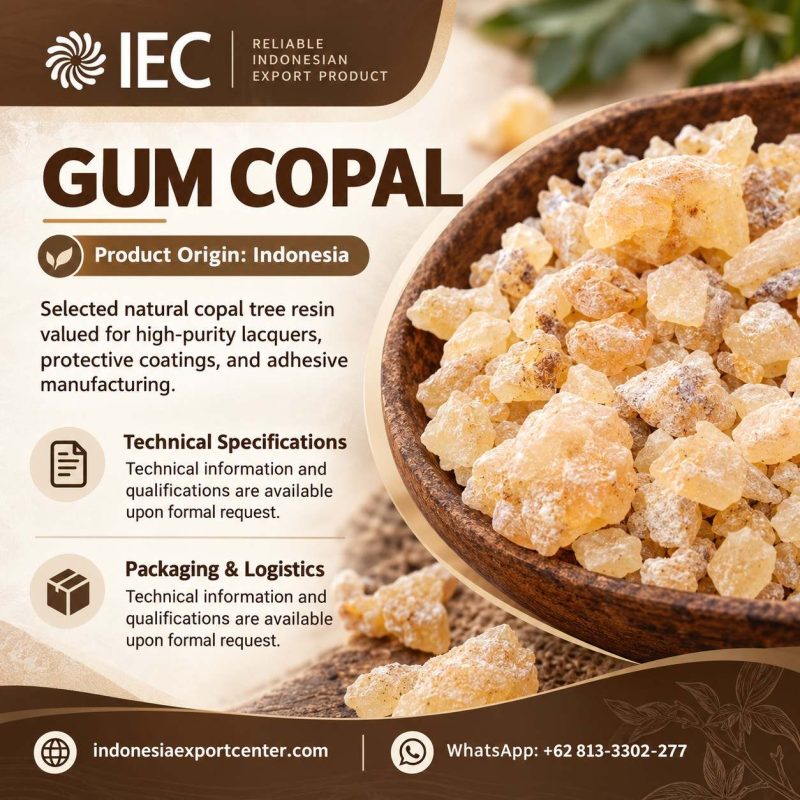
The IEC brochure identifies Indonesia as the product origin and includes adhesive manufacturing among the potential application areas.
Understanding Adhesive Formulation Requirements
Adhesives are not a single uniform product category.
Different adhesive technologies may use different binders, additives, solvents, and curing mechanisms.
Examples of adhesive categories include:
- Solvent-based adhesives.
- Water-based adhesives.
- Hot-melt adhesives.
- Reactive adhesives.
- Specialty industrial bonding formulations.
Gum Copal should not be assumed suitable for every adhesive category.
The material must be evaluated against the intended formulation.
The Potential Role of Natural Resin Ingredients
Depending on the resin and adhesive system, formulators may investigate natural resins for their effects on:
- Tack.
- Adhesion.
- Cohesion.
- Viscosity.
- Film formation.
- Processing.
- Compatibility with other ingredients.
These are evaluation objectives, not guaranteed benefits of Gum Copal.
Step 1 – Define the Adhesive Application
Before selecting a resin, the manufacturer should establish:
- Substrate type.
- Bonding method.
- Required strength.
- Application temperature.
- Service temperature.
- Environmental exposure.
- Processing equipment.
- Curing or drying requirements.
- Regulatory restrictions.
A resin suitable for one formulation may be unsuitable for another.
Step 2 – Confirm Gum Copal Identity
Commercial copal resins can vary.
Buyers should request:
- Product identity.
- Commercial grade.
- Botanical source, where available.
- Physical form.
- Colour.
- Foreign matter information.
- Available analytical data.
- Representative samples.
Step 3 – Evaluate Formulation Compatibility
Compatibility testing may consider:
- Mixing behavior.
- Solubility or dispersion.
- Interaction with the primary binder.
- Viscosity changes.
- Phase separation.
- Storage stability.
- Processing requirements.
A natural resin should not be added to an adhesive formulation without an appropriate technical evaluation.
Step 4 – Assess Adhesion Performance
Adhesive performance depends on the complete formulation, substrate preparation, and test conditions.
Potential testing may include:
Peel Testing
Where appropriate, peel tests can evaluate resistance to separation under defined conditions.
Shear Testing
Shear tests may be relevant to certain bonded assemblies.
Tack Evaluation
Tack may be important for some adhesive systems.
Bond Strength
Bond strength should be measured using a method appropriate to the substrate and application.
Durability
Testing may consider relevant temperature, moisture, aging, or chemical exposure.
The correct testing program depends on the adhesive product.
Step 5 – Evaluate Processing Requirements
Industrial adhesive manufacturing may require control over:
- Mixing sequence.
- Material preparation.
- Processing temperature.
- Mixing time.
- Viscosity.
- Filtration.
- Equipment compatibility.
- Product stability.
No fixed Gum Copal processing temperature or solvent system is asserted.
Step 6 – Review Finished-Product Performance
A successful raw material compatibility test is only one stage of adhesive development.
The finished adhesive may also require:
- Application trials.
- Bond strength testing.
- Storage stability testing.
- Aging studies.
- Substrate compatibility testing.
- Relevant regulatory evaluation.
Adhesive Qualification Matrix
| Evaluation Area | Buyer Testing Objective |
|---|---|
| Resin Identity | Confirm product |
| Grade | Establish consistency |
| Appearance | Inspect |
| Foreign Matter | Evaluate |
| Moisture | Test if relevant |
| Solubility or Dispersion | Determine compatibility |
| Mixing Behavior | Assess processing |
| Tack | Test if relevant |
| Adhesion | Measure |
| Cohesion | Evaluate |
| Viscosity | Measure |
| Storage Stability | Assess |
| Durability | Test intended exposure |
Step 7 – Establish a Buyer Specification
After a candidate resin has passed initial testing, the manufacturer should establish purchasing requirements.
These may include:
- Approved grade.
- Sample reference.
- Physical form.
- Appearance.
- Foreign matter limit.
- Moisture requirement.
- Application-specific test results.
- Batch consistency.
- Packaging.
The supplier should confirm whether the proposed grade can meet these requirements.
Step 8 – Review Supplier Technical Documentation
IEC’s brochure states that technical information and qualifications are available upon formal request.
The buyer should request:
- Product description.
- Grade information.
- Available test results.
- Sample details.
- Origin information.
- Packaging details.
- Available safety documentation.
No unsupported adhesive-performance data should be treated as confirmed.
Step 9 – Verify the Indonesian Supplier
Before purchasing, verify:
- Legal company identity.
- Product source.
- Selling authority.
- Material grade.
- Available quantity.
- Export arrangements.
- Payment details.
- Inspection terms.
Step 10 – Evaluate Commercial Suitability
A technically suitable material must also be commercially practical.
Consider:
- Purchase price.
- Required processing.
- Material consumption.
- Quality consistency.
- Packaging.
- Storage.
- Freight.
- Testing.
- Production yield.
- Supplier reliability.
The most appropriate material is not necessarily the one with the lowest purchase price.
Adhesive Manufacturing RFQ Template
Subject: Indonesian Gum Copal for Adhesive Manufacturing
Company Name: [Name]
Country: [Country]
Product: Natural Gum Copal
Adhesive Type: [Details]
Target Substrate: [Details]
Required Resin Grade: [Details]
Required Physical Form: [Details]
Compatibility Requirements: [Details]
Adhesion Testing Requirements: [Details]
Additional Specifications: [Details]
Sample Quantity: [KG]
Trial Order Quantity: [KG]
Commercial Quantity: [KG / MT]
Destination Port: [Port]
Preferred Incoterm: [Term]
Required Documents: [Details]
Please provide potential supplier information and available technical documentation for adhesive formulation evaluation.
Frequently Asked Questions
Can Gum Copal be used in adhesive manufacturing?
It may be evaluated as a candidate ingredient in suitable formulations. Testing is required.
Does Gum Copal automatically improve adhesion?
No. Performance depends on the complete formulation.
Can Gum Copal be used in hot-melt adhesives?
Suitability must be evaluated for the specific system. No universal compatibility is claimed.
Is Gum Copal compatible with all adhesive binders?
No.
Can manufacturers request samples for laboratory testing?
Yes, subject to supplier availability.
Does IEC guarantee a specific adhesive grade?
No. Grade availability and suitability require verification.
Can buyers request recurring commercial quantities?
Yes, subject to supplier confirmation.
Request Gum Copal for Adhesive Manufacturing
Looking for Indonesian natural copal resin for adhesive research, formulation testing, or industrial raw material procurement?
Share your application, technical requirements, sample quantity, and purchasing volume with Indonesia Export Center.
REQUEST GUM COPAL FOR ADHESIVE MANUFACTURING
IEC | INDONESIA EXPORT CENTER
Your Global Sourcing Partner
Website: https://indonesiaexportcenter.com/
WhatsApp: +62 813-3302-277
Related Resources
Natural Copal Resin Supplier Indonesia
Gum Copal for Protective Coatings
