

IEC | INDONESIA EXPORT CENTER
Your Global Sourcing Partner
Indonesian Gum Copal for Industrial Lacquer Formulation Development
Industrial lacquer manufacturers evaluate raw materials based on processing compatibility, film appearance, drying characteristics, substrate adhesion, and the requirements of the final coating system.
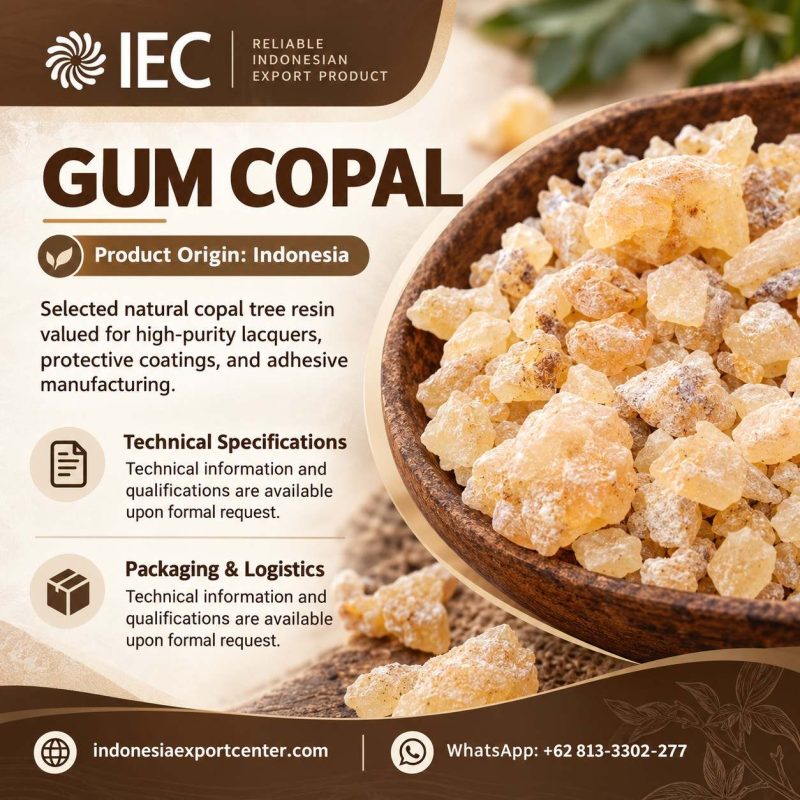
Gum Copal is a natural resin associated with traditional lacquer and varnish applications. Depending on the particular resin grade, it may be considered for specialized lacquer formulation research or other compatible industrial coating applications.
However, Gum Copal should not be assumed to dissolve in a particular solvent, work with every binder, or provide predictable performance without testing.
Indonesia Export Center (IEC) facilitates B2B inquiries involving potential Indonesian Gum Copal suppliers.
The IEC product brochure identifies Indonesian-origin natural copal tree resin and lists high-purity lacquer among its potential application areas. Actual purity and technical qualifications must be verified through supplier information.
Understanding the Role of Resins in Lacquer Manufacturing
A lacquer is a coating formulation designed to form a film through an appropriate drying, curing, or film-forming process.
Depending on the system, resins may influence:
- Film appearance.
- Gloss.
- Hardness.
- Adhesion.
- Flexibility.
- Compatibility with other ingredients.
- Application viscosity.
- Drying or curing behavior.
- Resistance properties.
The contribution of Gum Copal depends on its actual characteristics and the complete formulation.
Why Investigate Natural Copal Resin?
Lacquer manufacturers may evaluate natural copal when developing:
- Specialty lacquer formulations.
- Traditional resin-based coating products.
- Alternative resin systems.
- Formulation modifications.
- Research and development projects.
- Application-specific coating products.
A material should be selected based on measured performance rather than its natural origin alone.
Step 1 – Identify the Gum Copal Grade
The term Gum Copal may refer to materials with different origins and characteristics.
Buyers should request:
- Product identity.
- Botanical source, where available.
- Commercial grade.
- Physical appearance.
- Colour.
- Particle or lump size.
- Foreign matter information.
- Processing history.
- Available analytical data.
A representative sample is important for laboratory evaluation.
Step 2 – Evaluate Solubility
Solubility is a critical consideration in many lacquer formulation processes.
The buyer should determine whether the resin can be processed under the intended conditions.
Relevant variables may include:
- Solvent or solvent mixture.
- Resin concentration.
- Temperature.
- Mixing conditions.
- Processing time.
- Particle size.
- Resin grade.
No universal Gum Copal solvent compatibility is claimed.
Solubility testing should be conducted under appropriate laboratory and safety controls.
Step 3 – Review Processing Behavior
Depending on the formulation, relevant processing questions may include:
- Does the material disperse or dissolve adequately?
- Is filtration required?
- Does the resin introduce unwanted colour?
- Is the mixture stable?
- Are processing temperatures compatible with equipment?
- Are there unacceptable residues?
- Does the formulation meet viscosity requirements?
These questions must be answered experimentally.
Step 4 – Assess Film Appearance
For lacquer products where appearance is important, manufacturers may evaluate:
- Colour.
- Clarity.
- Gloss.
- Surface uniformity.
- Film defects.
- Appearance consistency.
The final results depend on the complete formulation and application procedure.
Step 5 – Evaluate Film Performance
Testing may include:
| Property | Evaluation Purpose |
|---|---|
| Adhesion | Compatibility with substrate |
| Hardness | Mechanical performance |
| Flexibility | Response to deformation |
| Gloss | Surface appearance |
| Drying Behavior | Process compatibility |
| Water Resistance | Application suitability |
| Chemical Resistance | Relevant exposure |
| Storage Stability | Formulation consistency |
| Appearance Retention | Application-specific durability |
No performance result is guaranteed without testing.
Step 6 – Conduct Pilot Manufacturing Trials
A laboratory formulation that appears suitable may still require additional evaluation before commercial production.
Pilot trials can investigate:
- Mixing equipment compatibility.
- Processing repeatability.
- Batch consistency.
- Filtration requirements.
- Packaging compatibility.
- Finished-product quality.
- Production costs.
Step 7 – Define a Commercial Resin Specification
After qualification, the manufacturer should establish purchasing criteria.
| Parameter | Buyer Acceptance Requirement |
|---|---|
| Resin Identity | Confirmed |
| Grade | Approved |
| Colour | Defined |
| Physical Form | Specified |
| Foreign Matter | Agreed limit |
| Moisture | If relevant |
| Processing Behavior | Qualified |
| Sample Reference | Identified |
| Testing Method | Agreed |
| Packaging | Approved |
The supplier should confirm which requirements can be supported.
Step 8 – Request Technical Documentation
IEC’s brochure states that technical information and qualifications are available upon formal request.
The buyer may request:
- Supplier specification.
- Product description.
- Representative samples.
- Available test results.
- Origin information.
- Packaging details.
- Safety documentation, where available.
Step 9 – Evaluate Supplier Consistency
Natural resins may vary between lots.
Manufacturers should consider:
- Multiple-batch testing.
- Grade identification.
- Reference samples.
- Supplier change notifications.
- Receiving inspection.
- Nonconformance procedures.
Step 10 – Review Commercial Sourcing Requirements
Before issuing a purchase order, confirm:
- Contracting supplier.
- Product grade.
- Available quantity.
- Price.
- Packaging.
- Delivery schedule.
- Incoterm.
- Inspection.
- Payment.
- Claims procedures.
Gum Copal Lacquer RFQ Template
Subject: Indonesian Gum Copal for Industrial Lacquer Manufacturing
Buyer Company: [Name]
Country: [Country]
Product: Natural Gum Copal
Application: Industrial Lacquer
Required Grade: [Details]
Required Physical Form: [Details]
Colour Requirements: [Details]
Solubility Evaluation Requirements: [Details]
Other Technical Requirements: [Details]
Sample Quantity: [KG]
Initial Purchase Quantity: [KG / MT]
Monthly Requirement: [If Applicable]
Destination Port: [Port]
Preferred Incoterm: [Term]
Please provide potential supplier information, relevant product documentation, and sample availability for technical evaluation.
Frequently Asked Questions
Is Gum Copal used in lacquer manufacturing?
Copal has historical relevance to lacquer and varnish applications, but each industrial formulation requires qualification.
Is Gum Copal soluble in all lacquer solvents?
No. Solubility depends on the actual resin and test conditions.
Can Gum Copal be used in modern lacquer systems?
Potentially, where compatibility and performance testing establish suitability.
Does Gum Copal guarantee high gloss?
No. Gloss depends on the formulation and application.
Can manufacturers request technical data?
Yes. Available technical information should be requested from the potential supplier.
Can IEC guarantee lacquer-grade Gum Copal?
No. Grade availability and suitability require verification.
Request Gum Copal for Industrial Lacquer
Evaluating natural Indonesian Gum Copal for lacquer manufacturing or specialty coating development?
Contact IEC with your technical requirements, sample needs, quantity, and destination.
REQUEST GUM COPAL FOR LACQUER MANUFACTURING
IEC | INDONESIA EXPORT CENTER
Website: https://indonesiaexportcenter.com/
WhatsApp: +62 813-3302-277
Related Resources
Natural Copal Resin Supplier Indonesia
Gum Copal for Varnish Manufacturing
