

IEC | INDONESIA EXPORT CENTER
Your Global Sourcing Partner
Evaluate Indonesian Gum Copal for Protective Coating Applications
Protective coating manufacturers must balance formulation compatibility, film properties, substrate requirements, processing conditions, and long-term durability.
Natural resins such as Gum Copal may be evaluated as candidate ingredients in selected coating systems.
However, the presence of a natural resin does not automatically establish corrosion protection, weather resistance, chemical resistance, or any particular service life.
Every protective coating application requires performance testing appropriate to its intended environment.
Indonesia Export Center (IEC) facilitates sourcing inquiries involving potential Indonesian Gum Copal suppliers.
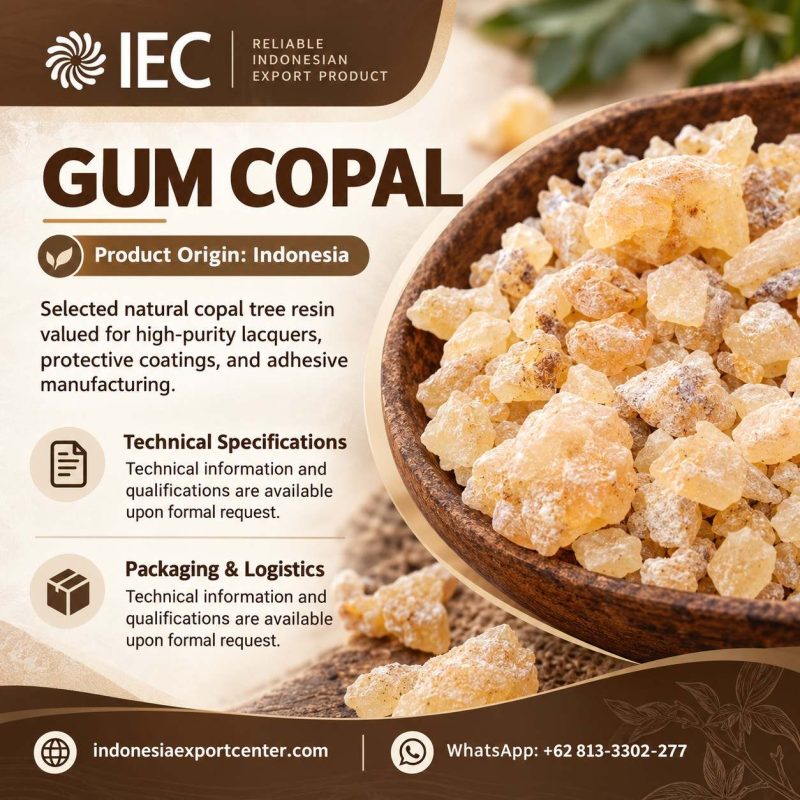
The IEC product brochure identifies Indonesia as the origin of the Gum Copal product and describes potential applications in protective coatings, lacquers, and adhesives.
What Are Protective Coatings?
Protective coatings are formulated to provide a functional film on a substrate.
Depending on the application, they may be designed to address:
- Moisture exposure.
- Surface wear.
- Chemical contact.
- Environmental exposure.
- Appearance retention.
- Adhesion.
- Surface protection.
Different coating applications require different performance criteria.
A decorative indoor coating should not be evaluated using exactly the same acceptance criteria as a coating intended for severe industrial exposure.
The Potential Role of Gum Copal
Gum Copal may be investigated as a resin component or modifier in suitable formulations.
Potential evaluation areas include:
- Film-forming behavior.
- Compatibility with other ingredients.
- Surface appearance.
- Gloss.
- Hardness.
- Adhesion.
- Processing requirements.
These are testing objectives, not guaranteed properties.
Selecting the Correct Resin Grade
The buyer should establish:
- Resin identity.
- Grade.
- Colour.
- Physical form.
- Foreign matter.
- Moisture.
- Solubility characteristics.
- Thermal behavior.
- Batch consistency.
A natural resin should not be qualified only on the basis of its commercial name.
Coating Application Requirements
Substrate Compatibility
A coating may be applied to wood, metal, masonry, or another substrate.
The actual substrate affects adhesion and durability requirements.
Environmental Exposure
Indoor and outdoor applications may require different performance tests.
Chemical Exposure
The formulation should be tested against relevant substances where chemical resistance is required.
Mechanical Performance
Scratch resistance, hardness, and flexibility may be relevant.
Appearance
Colour, clarity, and gloss may be important.
Processing
The resin must be compatible with the intended production equipment and formulation procedure.
Technical Qualification Matrix
| Evaluation Area | Test Objective |
|---|---|
| Resin Identity | Confirm material |
| Grade Consistency | Compare samples |
| Formulation Compatibility | Assess mixing and stability |
| Application Behavior | Evaluate coating application |
| Adhesion | Test intended substrate |
| Hardness | Evaluate film |
| Flexibility | Evaluate as required |
| Water Resistance | Test if relevant |
| Chemical Resistance | Test intended exposure |
| Weathering | Evaluate if relevant |
| Appearance | Measure required properties |
| Storage Stability | Evaluate formulation |
The appropriate test standards should be selected by the coating manufacturer.
Laboratory Qualification Workflow
Stage 1 – Supplier Documentation
Review the available resin information.
Stage 2 – Sample Qualification
Inspect the resin and conduct relevant raw material tests.
Stage 3 – Formulation Screening
Evaluate compatibility under controlled conditions.
Stage 4 – Coating Application
Prepare coated specimens using the intended substrate.
Stage 5 – Performance Testing
Conduct tests aligned with the intended application.
Stage 6 – Stability Assessment
Review relevant formulation stability.
Stage 7 – Pilot Production
Evaluate manufacturing feasibility.
Stage 8 – Commercial Approval
Approve only after the required acceptance criteria are satisfied.
Avoiding Unsupported Performance Claims
Buyers should not assume that Gum Copal automatically provides:
- Corrosion resistance.
- UV resistance.
- Waterproofing.
- High-temperature resistance.
- Chemical resistance.
- A particular coating lifespan.
These properties depend on the complete formulation, substrate, application conditions, and test results.
Supplier Documentation
Buyers may request:
- Product description.
- Available specification.
- Sample identification.
- Test results.
- Grade information.
- Packaging.
- Origin information.
- Safety documentation, where available.
IEC’s brochure does not provide numerical technical specifications.
Commercial Procurement Considerations
After technical qualification, the buyer should confirm:
- Available grade.
- Quantity.
- Packaging.
- Shipment schedule.
- Quality acceptance criteria.
- Inspection requirements.
- Price.
- Payment.
- Delivery terms.
Supplier Verification Checklist
- Verify legal company identity.
- Confirm product source.
- Review available documentation.
- Evaluate samples.
- Confirm commercial grade.
- Check quantity availability.
- Confirm packaging.
- Verify export arrangements.
- Agree on inspection.
- Independently verify payment details.
Protective Coating Gum Copal RFQ
Subject: Gum Copal for Protective Coating Manufacturing – Indonesia
Company: [Name]
Country: [Country]
Product: Natural Gum Copal
Coating Application: [Details]
Substrate: [Details]
Required Resin Grade: [Details]
Technical Requirements: [Details]
Testing Requirements: [Details]
Sample Quantity: [KG]
Commercial Quantity: [KG / MT]
Destination Port: [Port]
Preferred Incoterm: [Term]
Please provide potential supplier information and available technical documentation for material qualification.
Frequently Asked Questions
Can Gum Copal be used in protective coatings?
It may be evaluated for selected coating formulations. Suitability must be demonstrated.
Does Gum Copal guarantee corrosion resistance?
No.
Can it be used for outdoor coatings?
Only where the complete formulation meets the required outdoor performance criteria.
Is every copal grade suitable for protective coatings?
No.
Can manufacturers request samples?
Yes, subject to availability.
Does IEC guarantee a particular coating performance?
No. IEC facilitates sourcing inquiries and does not certify formulation performance.
Request Gum Copal for Protective Coatings
Looking for Indonesian natural copal resin for protective coating research, formulation development, or commercial manufacturing?
Share your application, grade, test requirements, and quantity with IEC.
REQUEST GUM COPAL FOR PROTECTIVE COATINGS
IEC | INDONESIA EXPORT CENTER
Website: https://indonesiaexportcenter.com/
WhatsApp: +62 813-3302-277
Related Resources
Gum Copal for Varnish Manufacturing
Gum Copal for Industrial Lacquer
