

IEC | INDONESIA EXPORT CENTER
Your Global Sourcing Partner
Request and Review Gum Copal Quality Documentation
A Certificate of Analysis (COA) is an important document in industrial raw material procurement.
For Gum Copal importers, manufacturers, and quality control teams, a COA may provide analytical information relevant to the identity, grade, and quality of a particular resin lot.
However, a COA is only useful when the reported sample, analytical methods, and results can be appropriately linked to the material being purchased.
Indonesia Export Center (IEC) facilitates sourcing inquiries involving potential Indonesian Gum Copal suppliers.
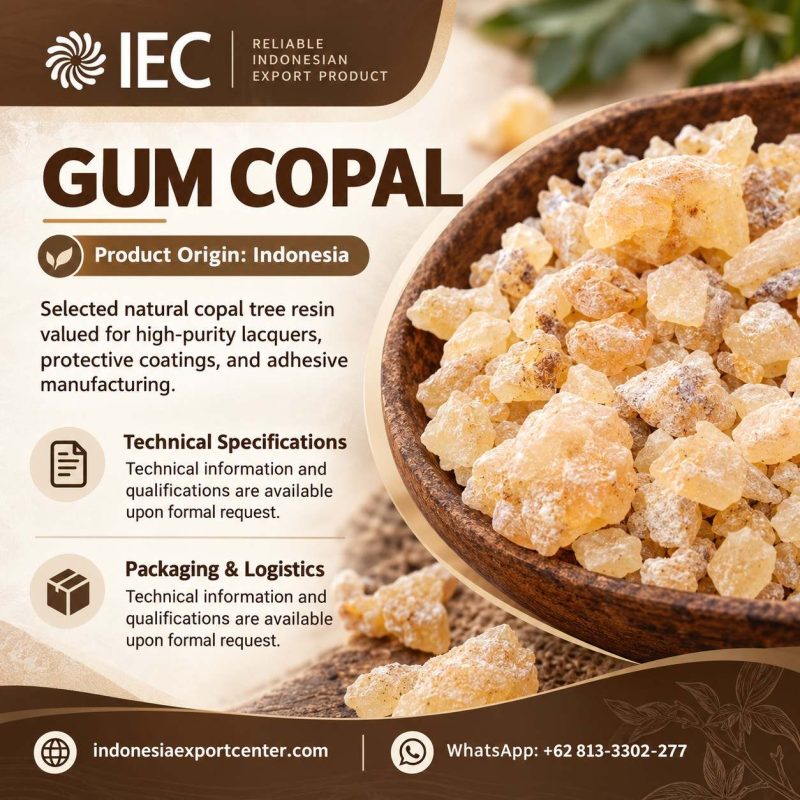
The IEC product brochure states that technical information and qualifications are available upon formal request.
IEC does not guarantee that a COA is available for every supplier, grade, or shipment.
What Is a Certificate of Analysis?
A Certificate of Analysis is a document reporting analytical findings for an identified material or sample.
Depending on the product, it may contain:
- Product name.
- Supplier or manufacturer.
- Grade.
- Batch or lot number.
- Sample identification.
- Test parameters.
- Test methods.
- Analytical results.
- Specification limits.
- Test date.
- Laboratory information.
The actual content varies.
Why Gum Copal Buyers Request a COA
Natural resins may exhibit variation in their physical and chemical characteristics.
A COA can help buyers:
- Review analytical evidence.
- Compare material against purchasing specifications.
- Evaluate batch consistency.
- Support incoming quality control.
- Investigate discrepancies.
- Document supplier qualification.
A COA does not replace appropriate supplier due diligence or shipment inspection.
Gum Copal Parameters That May Be Requested
Depending on the intended application, buyers may consider:
| Parameter | Purpose |
|---|---|
| Product Identity | Confirm material description |
| Appearance | Visual quality |
| Colour | Grade or formulation relevance |
| Moisture | Water-content evaluation |
| Foreign Matter | Cleanliness |
| Particle Size | Handling and processing |
| Softening Behavior | Thermal characterization |
| Acid Value | Titratable acidity |
| Solubility | Application-specific compatibility |
| Additional Tests | Buyer-defined requirements |
Not every parameter will be relevant or available.
COA vs TDS vs Inspection Report
Certificate of Analysis
Reports analytical results for an identified sample or lot.
Technical Data Sheet
Describes product characteristics and available technical information.
Inspection Report
Documents observations or tests performed within an agreed inspection scope.
Safety Data Sheet
Communicates safety-related information under the applicable framework.
These documents have different purposes.
Step 1 – Confirm Document Authenticity
Review the issuing organization, report details, and available verification information.
Where appropriate, contact the issuing laboratory independently.
Step 2 – Match the COA to the Product
Check:
- Product name.
- Grade.
- Supplier.
- Sample identification.
- Lot number.
- Shipment information.
A COA for a different grade or lot may not support acceptance of the proposed shipment.
Step 3 – Review Analytical Methods
Ask which procedures were used.
Methods should be appropriate for the resin and the purchasing specification.
Step 4 – Compare Results with Contractual Requirements
A reported result should be compared against an agreed limit.
The buyer should not invent a specification after receiving the material.
Step 5 – Verify Sampling
Establish who collected the sample and how it was obtained.
Sampling can significantly affect the usefulness of analytical results.
Step 6 – Review Laboratory Information
Relevant considerations may include:
- Laboratory identity.
- Competence for the requested tests.
- Applicable accreditation scope, if claimed.
- Test date.
- Report authentication.
- Measurement uncertainty where relevant.
An accreditation claim should be verified rather than assumed.
Step 7 – Decide Whether Independent Testing Is Necessary
Independent testing may be useful when:
- The order is commercially significant.
- The application is technically demanding.
- The supplier is new.
- Previous results are inconsistent.
- Contractual acceptance requires independent analysis.
The parties should agree on sampling and testing arrangements.
COA Verification Checklist
| Check | Required Action |
|---|---|
| Issuer | Verify |
| Product Name | Match |
| Grade | Match |
| Lot Number | Match |
| Sample Identification | Review |
| Test Parameters | Check relevance |
| Methods | Confirm |
| Units | Verify |
| Results | Compare with limits |
| Test Date | Review |
| Laboratory | Confirm |
| Authenticity | Verify where necessary |
| Shipment Relationship | Establish |
Common COA Problems
Missing Lot Identification
The buyer may be unable to connect the results to a shipment.
Missing Test Methods
Analytical comparisons may be unreliable.
Unclear Units
A numerical result without units may be misleading.
Unverified Laboratory Identity
The buyer may not know whether the report is authentic.
Different Product Grade
The tested sample may not match the purchased material.
Outdated or Unrepresentative Results
An older result may not establish the condition of a current lot.
How to Handle a COA Discrepancy
If a result differs from the agreed specification:
- Preserve the document.
- Identify the affected lot.
- Review sampling records.
- Check analytical methods.
- Notify the relevant party.
- Arrange agreed retesting if appropriate.
- Follow the contract’s acceptance and claims procedures.
Gum Copal COA Request Template
Subject: Gum Copal Certificate of Analysis Request – Indonesia
Company: [Name]
Country: [Country]
Product: Natural Gum Copal
Application: [Details]
Required Grade: [Details]
Requested Parameters: [List]
Required Test Methods: [Details]
Sample Quantity: [KG]
Commercial Quantity: [KG / MT]
Destination: [Port, Country]
Please provide available product specifications, representative COA or laboratory reports, sample identification, and relevant supplier information.
Frequently Asked Questions
Does every Gum Copal supplier provide a COA?
Availability must be confirmed.
Can a COA prove the resin is suitable for varnish?
Not by itself. Formulation testing may also be necessary.
Is a TDS the same as a COA?
No.
Should a COA identify the lot?
Lot identification is important for traceability.
Can buyers request independent testing?
Yes, subject to agreement.
Does IEC certify Gum Copal quality?
No. IEC facilitates sourcing inquiries and does not automatically act as an independent certifying laboratory.
Request Gum Copal COA and Technical Documents
Need laboratory information before purchasing Indonesian Gum Copal?
Contact IEC with your required grade, test parameters, documentation needs, and purchase quantity.
REQUEST GUM COPAL COA INFORMATION
IEC | INDONESIA EXPORT CENTER
Website: https://indonesiaexportcenter.com/
WhatsApp: +62 813-3302-277
Related Resources
Gum Copal Technical Specifications Guide
Gum Copal TDS and SDS Request Guide
